iWell Guard

The Chakana: the Stepped Andean Cross

The Chakana is the stepped Andean cross, a sign from the cultural sphere of the Andes. The stepped cross has ancient roots in Andean art, yet its current, fully elaborated interpretation is to a large extent a more recent development. In the Andes the Chakana is closely tied to the Inca and their cosmological order.

Protective symbolAndesStepped cross
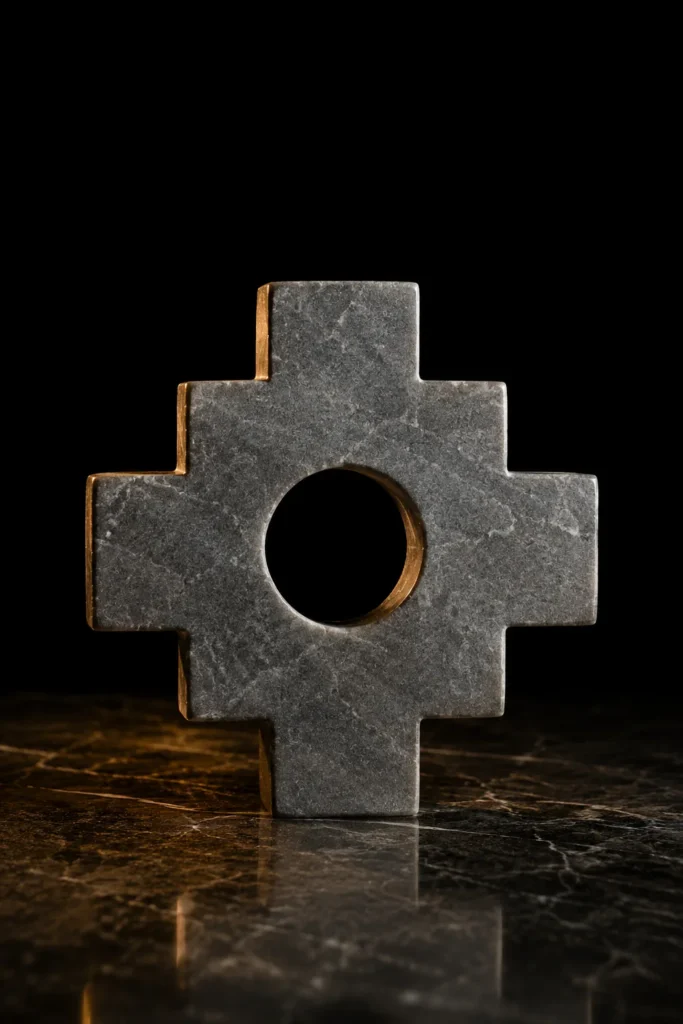
Chakana - protective symbol, museum-style illustration

Classification

The Chakana is a sign from the cultural sphere of the Andes. It is often referred to as the Andean cross or as the Inca cross. Its form is a stepped, multiply angled cross.

The stepped cross is an ancient motif of Andean art. It appears in the architecture, textiles, and ceramics of Andean cultures across a long period of time. In this respect, the Chakana has genuine ancient roots.

At the same time, the Chakana today is associated with a detailed, multilayered interpretation. This interpretation links the sign to the Andean worldview, to the three worlds, and to the four directions.

In research, the Chakana is a case that demands careful distinction. The stepped cross as a pictorial motif is old. The systematic interpretation now associated with the name Chakana is, by contrast, to a large extent a modern elaboration.

An honest account keeps both sides separate. It honors the ancient stepped cross of Andean art while also stating clearly that the elaborated Chakana interpretation belongs substantially to the twentieth century.

This makes the Chakana an instructive example. It shows how an ancient pictorial motif can be given rich meaning in the present, and how important it is to distinguish the old motif from the new interpretation.

The Stepped Cross Form

The Chakana has a distinctive form. It is a cross whose arms do not end straight but are divided into steps. Each arm ends in a staircase-like gradation.

The overall result is a multiply angled, geometrically strict figure. The Chakana is built symmetrically, as all four arms are shaped identically. At its center the sign frequently bears an opening or a circle.

The stepped motif is the defining characteristic of the Chakana. It is a form that was widespread in Andean art. The staircase or step is a fundamental motif of the Andean formal vocabulary.

The strict, clear geometry of the Chakana makes it easily recognizable. It lends itself well to execution in stone, textile, and metal. This formal clarity has contributed to its popularity today.

The stepped form invites interpretation. Steps can be understood as ascent and descent, as a connection between different levels. The current interpretation of the Chakana builds on such considerations.

For all the clarity of the form, it must be kept in mind that form alone does not fix a specific meaning. What the stepped cross meant to the people of the ancient Andean world cannot be read from its shape alone.

The Stepped Cross in Ancient Andean Art

The stepped motif has a long history in Andean art. It can be traced across many centuries and across various cultures of the Andean region.

The stepped motif is particularly well known from the culture of Tiwanaku, a major center in the highlands at Lake Titicaca. In the stone art of Tiwanaku the stepped motif appears in many forms.

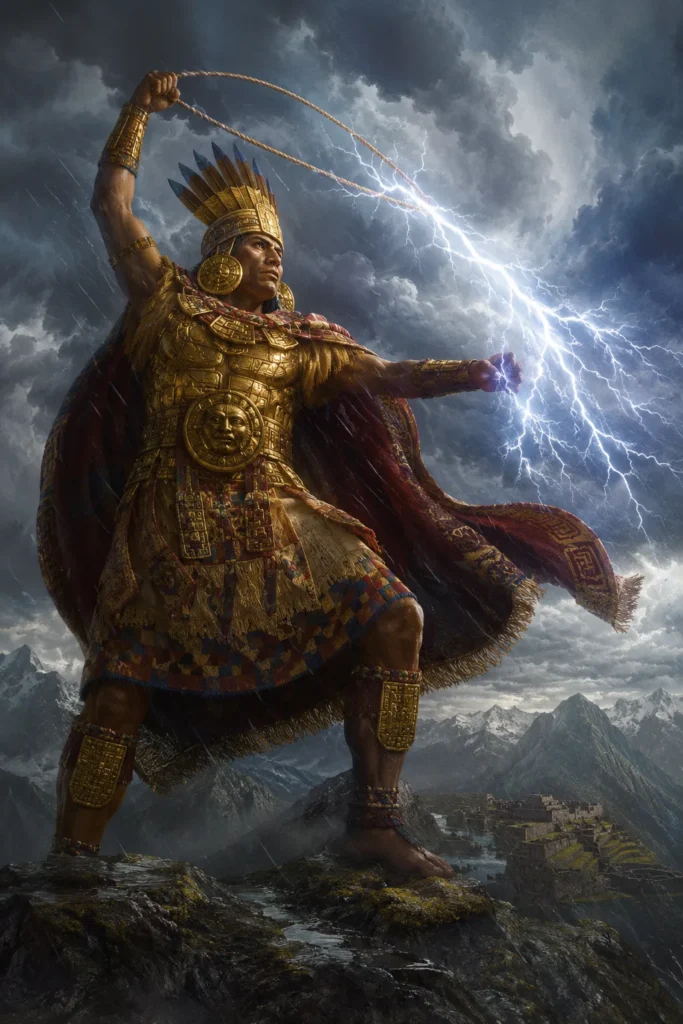
The step also plays a role in Inca architecture. The famous stone walls and terraced structures of the Inca display the stepped motif. It belongs to the basic stock of the Andean formal language.

In the textiles of the Andean cultures, which rank among the most accomplished in the world, the stepped motif is likewise widespread. The weavers of the Andean region used geometric patterns, among them the stepped motif.

The stepped cross is thus well attested as a pictorial motif in ancient Andean art. It is not a modern invention but a genuine element of the Andean formal vocabulary.

What exactly these ancient stepped crosses meant to the people of that time is, however, not equally well established. The Andean cultures did not have writing in the conventional sense, and so texts that would explain the motif are absent.

The Three Worlds

The current interpretation of the Chakana connects the sign to the Andean worldview. An important component of this worldview is the concept of three worlds or three realms of existence.

These three realms are named in the Quechua language. There is the upper world, associated with the sky. There is the middle world, in which human beings live. And there is the lower world, associated with the interior of the earth.

This tripartite division of the cosmos is indeed attested in Andean thought. The idea of an upper, a middle, and a lower world belongs to the transmitted worldview of the Andean cultures.

In the modern interpretation of the Chakana, the steps of the cross are linked to these three worlds. The stepped cross then appears as an image of the tripartite cosmos and of the connection between its levels.

This connection between the stepped cross and the three-worlds concept is coherent and internally consistent. The steps can readily be read as ascent and descent between the worlds.

This association, however, is an interpretation. That the ancient Andean cultures themselves understood the stepped cross in precisely this way is not attested by early sources but is inferred.

The Four Directions and the Southern Cross

Alongside the three worlds, the current interpretation also links the Chakana to the four cardinal directions. The cross with its four equal arms can easily be read as a sign of the four directions.

This interpretation fits a fundamental feature of the Inca empire. The Inca realm was divided into four great parts, and its name expressed this fourfold division. The number four held an important place in Andean thought.

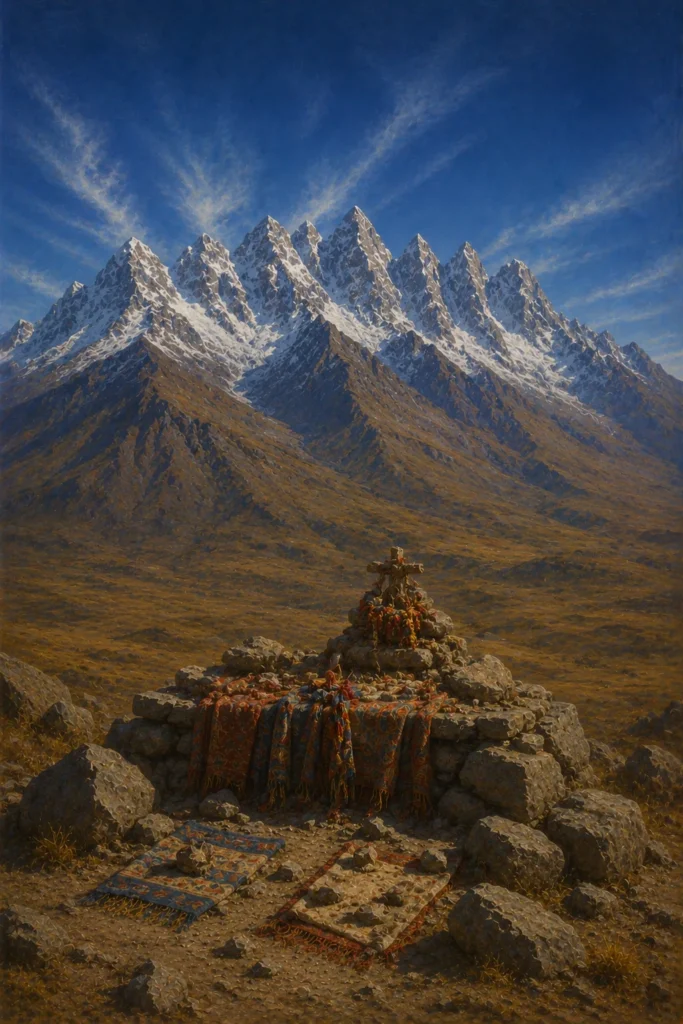
A further line of interpretation connects the Chakana to a constellation, the Southern Cross. This constellation is clearly visible in the sky of the Southern Hemisphere and held significance for the Andean cultures.

The name Chakana is associated with a Quechua word relating to crossing, connecting, and bridging. In this interpretation the Chakana is a sign of connection, a bridge between realms.

These interpretations, the four directions, the constellation, and the idea of the bridge, together form a rich image. The Chakana then appears as a sign encompassing the cosmos, its directions, and its levels.

Here too, however, the necessary caution applies. These interpretations are well reasoned and internally consistent, yet they are to a large extent modern elaborations. How much of this reaches back to ancient Andean knowledge is difficult to determine in detail.

The Name and Its Meaning

The name Chakana comes from Quechua, the language that was widespread in the Inca empire and is still spoken in the Andean region today. The name is linked to a word stem denoting crossing and connecting.

From this linguistic connection arises the interpretation of the Chakana as a bridge or as a connecting sign. The Chakana would then be that which joins realms together, for instance the three worlds of the Andean cosmos.

This interpretation is accessible and fits well with the stepped form, which can be read as ascent and descent. It is an important component of the Chakana’s meaning today.

It is not established, however, that the ancient stepped cross of Andean art already bore this name or was understood in exactly this way as a bridge. The name and the interpretation may have been linked only at a later point.

This uncertainty is characteristic of the Chakana. Form, name, and interpretation can today be combined into a coherent picture, yet whether this picture was equally coherent in antiquity remains open.

An honest account names this openness. It presents the interpretation but marks it as interpretation rather than as established ancient knowledge.

The Question of Age

For the Chakana, the question of age is particularly important. In the current picture, the Chakana is often regarded as an ancient symbol fully elaborated by the Inca or their predecessors. This view calls for careful examination.

It is correct that the stepped cross motif in Andean art is old and well attested. The step and the stepped cross belong to the genuine ancient formal vocabulary of the Andean cultures.

The elaborated interpretation of the Chakana, however, which connects the sign to the three worlds, the four directions, the constellation, and the idea of the bridge, is to a large extent an achievement of the twentieth century.

Researchers and authors of more recent times took up the ancient stepped motif and gave it a systematic, self-contained meaning. They drew on the transmitted Andean worldview, on observations, and on their own reflections.

The Chakana of today is thus the result of a combined effort. A genuine ancient pictorial motif was joined to a modern, carefully considered interpretation. Both belong to the Chakana as it is understood today.

This observation does not diminish the Chakana. It simply places it in its proper context. The Chakana is a sign with ancient roots and a modern interpretation, and an accurate account names both sides clearly.

Protection and Order

As a protective sign the Chakana belongs to those signs that work through the depiction of an order. It does not ward off through a frightening image and does not intercept a gaze. Rather, it presents an image of the ordered world.

In the current interpretation the Chakana is an image of the cosmos. It shows the three worlds, the four directions, and the connection between the levels. It thereby represents a comprehensive order of existence.

A sign that depicts a comprehensive order can convey stability and a sense of security. Someone who contemplates or wears the Chakana sees an image of a world in which everything has its place and in which the levels are connected with one another.

In this sense the Chakana operates as a protective sign. Its protection lies not in warding off a single danger but in presenting a meaningful, ordered world.

This places the Chakana among those signs that function similarly to a worldview symbol. It gives the wearer an orientation and situates them within a larger, ordered context.

This mode of operation belongs to the current, elaborated Chakana. It rests on the modern interpretation of the sign. With this qualification, the Chakana can meaningfully be placed within the context of protective signs.

Reception Today

The Chakana is today widespread throughout the Andean region. In Peru, Bolivia, and neighboring countries it appears on jewelry, on textiles, in design, and as a sign of cultural identity.

For many people in the Andean region the Chakana is a sign of connection with their own heritage and with the legacy of the Andean cultures. It stands for the Andean worldview and for a root that reaches back before the era of colonization.

Beyond the Andean region the Chakana has become known through interest in Andean cultures and in spiritual currents. It is worn as jewelry and used as a motif.

With this spread, the Chakana is often interpreted with great certainty, as though its detailed meaning were ancient, established knowledge. A factual account counters this with the open state of the sources.

The Chakana thus remains a doubly interesting sign. It is based on a genuine ancient motif of Andean art, the stepped cross. And at the same time it is an example of how in the present an ancient motif is given a rich interpretation.

A complete account honors both sides. It presents the Chakana as a sign that combines ancient Andean roots with a modern, carefully considered interpretation, and it keeps the distinction between the two clearly in view.

Selected Literature

  • Mary Strong: Art, Nature, and Religion in the Central Andes (2012)
  • Gary Urton: At the Crossroads of the Earth and the Sky. An Andean Cosmology (1981)
  • Catherine Allen: The Hold Life Has. Coca and Cultural Identity in an Andean Community (1988)
  • Henrique Urbano: Studies on Andean Mythology and Worldview
  • Tom Zuidema: The Ceque System of Cuzco (1964)

Related key terms: Chakana Andean cross Inca stepped cross three worlds Quechua Tiwanaku Andes.

iWell Guard and Protective Traditions

iWell Guard stands in the cultural-historical line of wearable protective objects, to which the Chakana also belongs. A modern companion for people who live with protective symbols: made in Germany, 41 layers of genuine gold, platinum, and silver, with a 30-day right of return.

Individual experiences may vary. Not a medical device. No healing claims.