Skiron, ash wind of winter's onset
By Ralf Ittermann · last reviewed on
Skiron is a god of the Greek tradition.
The dry north-west wind that heralds winter. Skiron was known among the Greeks as the wind that signals the onset of winter. Skiron is described as an ash wind tied to winter’s onset, which situates the figure among the seasonal wind personifications treated on this site.
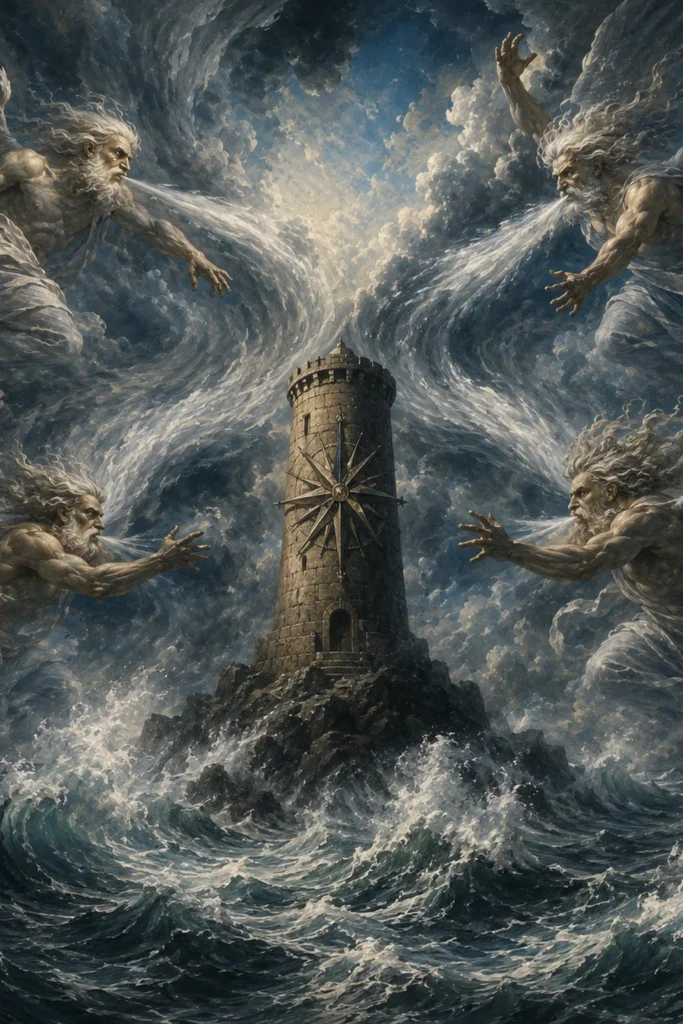
Skiron, also Skeiron, called Caurus or Corus in Roman tradition, is the Greek god of the dry north-west wind, also called Argestes in the wind rose. On the Tower of the Winds in Athens, he tips an inverted bronze vessel from which glowing ash pours.
He heralds winter and withers vegetation. He is only thinly attested: Skiron is generally regarded as a Megarian local variant of Argestes, without a myth of his own and without his own rite.
Type: god of the dry, cold north-west wind
Origin: Greek cultural sphere, Megarian local variant of Argestes
Texts: Aristotle (Meteorologica), Vitruvius, Seneca
Period: Aristotle to the Imperial era
Appearance: bearded man with an inverted brazier

Context within the wind rose
Period of the Texts
The attestations range from Aristotle to the Imperial era; Vitruvius and Seneca contribute the Latin name forms.
Area of Diffusion
The Greek cultural sphere, with Athens and Megara: the name Skiron is the Megarian term for the north-west wind.
Sources
Thin: Skiron is mostly a local variant of Argestes; he becomes most tangible on the Tower of the Winds and in ancient wind lore.
Name and variants
Greek: The etymology is uncertain. Suggestions include a link to the Attic festival of Skira, to skiros, meaning dark, or to the Skironian Rocks near Megara. In Roman tradition the wind is called Caurus or Corus.
Appearance
Appearance
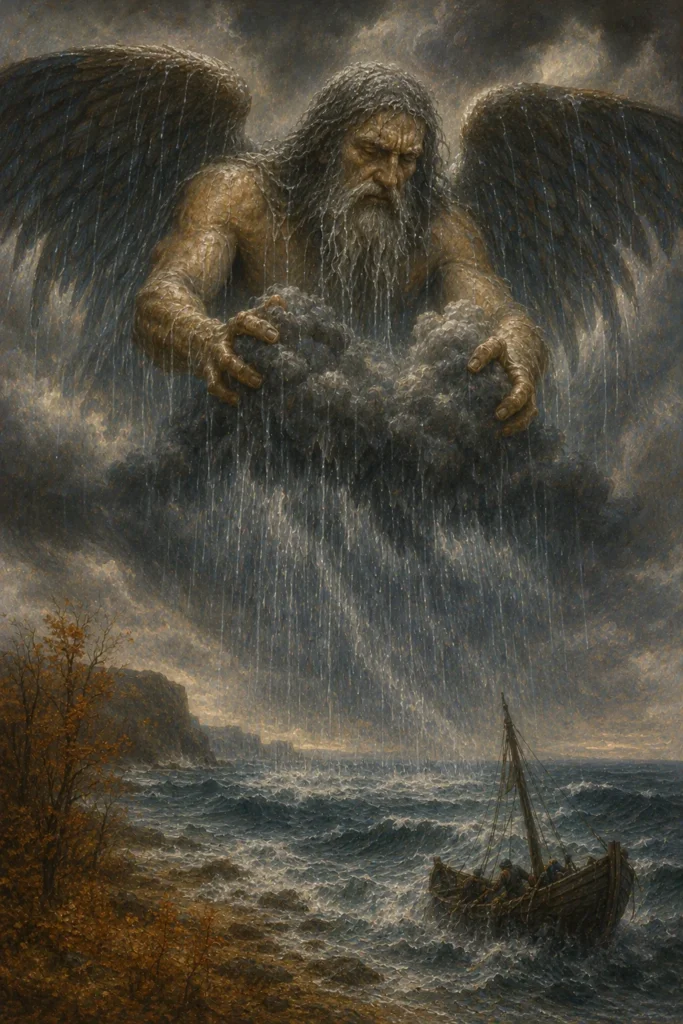
On the Tower of the Winds, Skiron is a bearded, unkempt man tipping an inverted bronze vessel or brazier, from which glowing ash pours. The image stands for desiccation and the onset of winter.
Effect
Skiron is a dry, cold north-west wind. He heralds winter and withers vegetation; for farmers he was thus a harbinger of the barren season.
Profile: Skiron
The key aspects of the north-west wind at a glance.
The Megarian name form of the north-west wind Argestes in the ancient wind rose; thinly attested, with no myth of his own.
The turn towards the cold season: Skiron dries out the land, withers vegetation and heralds winter.
Bearded, unkempt man tipping an inverted bronze brazier from which glowing ash pours; depicted this way on the Tower of the Winds.
Dry, cold wind from the north-west, the counterpart to the moist Lips; a harbinger of winter in ancient wind lore.
No cult of his own is attested; Skiron belongs to the collective offerings for the Anemoi and has no ritual of his own.
Identical with Argestes and Olympias, called Caurus and Corus in Roman tradition; related through the wind rose to Maestro and Mistral.
Argestes, Olympias, Skiron: three names for one wind
Aristotle names the northwest wind Argestes and lists Olympias and Skiron, the Megarian designation, as local variants. On the Tower of the Winds in Athens, the wind stands under the name Skiron on the northwest side; the Roman name is Caurus or Corus.
The origin of the name is uncertain: discussed are a connection to the Attic festival of Skira, to skiros, dark, or to the Skironian Rocks near Megara. In the wind rose, Skiron forms the dry counterpart to the moist Lips in the southwest; his cold neighbour to the north is Boreas.
Afterlife in Europe's wind rose
Through the Tower of the Winds, Vitruvius and Seneca, Skiron carried on into the European wind rose, into the circle of Maestro and Mistral. He is a fixed part of ancient wind lore.
In terms of religious studies, Skiron is thinly attested as a wind god and is mostly a local variant of Argestes. Important clarification: the robber Sk(e)iron of Megara, whom Theseus killed, is a separate legendary figure and not the wind god; there is only a geographical overlap at the Skironian Rocks, no mythological identity. His cardinal direction is northwest.
Cult evidence: only the collective offerings
No separate cult for Skiron is documented. Like the other directional winds, he belongs to the collective offerings to the Anemoi; he has no ritual of his own. This fits his overall profile: Skiron is mostly a local variant of Argestes, a name within the wind rose, not a god with an established cult community.
Caurus, Maestro, Mistral: the kinship
Skiron is identical with Argestes and Olympias, the northwest wind, and corresponds to the Roman Caurus and Corus. Within the Greek wind rose he is the dry counterpart to the moist Lips; his cold relatives are Boreas in the north and Kaikias in the northeast. Through Vitruvius and Seneca, his line extends to the modern wind names Maestro and Mistral.
Frequently asked questions about Skiron
Which wind is Skiron?
The northwest wind, also called Argestes in the wind rose, Roman Caurus or Corus, dry and cold.
What does he carry on the Tower of the Winds?
An overturned bronze vessel from which glowing ashes pour, a sign of desiccation.
Is Skiron the robber whom Theseus killed?
No. That is a separate legendary figure; there is only a name overlap at the Skironian Rocks.
Further links
Further reading:
- Greece – all beings of Greek mythology
- Boreas, Lips, Kaikias – the neighbours in the wind rose
- Amulet, Protective candle, Salt – traditional protective means
- Protection Compass – protective means at a glance
Literature (selection)
Further standard works in the bibliography.
As the Greek northwest wind, in the technical language of the winds the Argestes, Skiron remains a quiet figure of ancient wind lore: not a hero of his own myths, but the bearded man with the ash basin who announces winter.