Greys, demon of the modern tradition
By Ralf Ittermann · last reviewed on
The “Greys” are, within modern esoteric and UFO narratives, humanoid extraterrestrial beings depicted as abductors or alien visitors. From a religious-studies perspective, they represent contemporary myths that articulate technological anxiety, surveillance paranoia, and secular hopes for salvation (alien contact as a bearer of redemption). This entry treats the Greys as a demon figure of New Age Lore, embodying technological anxiety and secular hopes for salvation.

Greys
Greys are typically described as short, humanoid-reptiloid in appearance, with large black eyes, grey skin, and technological capabilities. They are portrayed as abductors of humans (the alien abduction narrative, from the 1950s onward) who conduct medical experiments or communicate telepathically.
Key myths include: the Roswell Incident (1947), Betty and Barney Hill (1961), and the X-Files in popular culture. Functionally, they represent threat and promise simultaneously: the powerlessness of the individual in the face of an overwhelming force, yet also contact with god-like intelligences.
Origins of the Grey Tradition
The Grey tradition emerged remarkably late from a history-of-religions perspective. The earliest accounts featuring the characteristic description of small, slender humanoid beings with large black eyes appear in the late 1950s and 1960s within American UFO subculture.
The case of Betty and Barney Hill (abduction report 1961, elaborated under hypnosis in 1964, brought to a wide audience by John Fuller in The Interrupted Journey, 1966) is regarded as the prototypical account of a Grey encounter.
Whitley Strieber’s Communion (1987) established the cover image of the typical Grey face, which has been iconographically fixed ever since.
Quick Overview: Greys
The Grey narrative emerged from the post-war UFO movement (1945, 1960s), primarily in North America. Key sources include: US government UFO documents (partially declassified since 2023), UFO documentaries (J. Allen Hynek), and science fiction (X-Files, Whitley Strieber’s Communion).
Current research: Thomas Bullard (popular abduction narrative analysis), David J. Hufford (The Terror that Comes in the Night), and ufologists (Jürgen Krüger, Andreas Schöpf in the German-speaking world). The doctrine is globalized but remains centered on Western UFO culture.
Classification
Period of the Sources
The continuity of the tradition across these long spans of time is remarkable and reflects a deep, stable cultural rootedness. Even in modern times, the memory, and sometimes active veneration, remains alive, sometimes transformed, but still recognizable in its essential features.
Academic Treatment
John E. Mack, psychiatrist at Harvard Medical School, published in 1994 with Abduction. Human Encounters with Aliens a systematic clinical examination of abduction accounts in a reputable publishing environment. Mack reported consistent phenomenological descriptions across a few dozen cases that could not be explained by conventional psychiatric diagnosis.
His approach was methodologically agnostic: he argued neither for an ontologically realist nor for a reductionist explanation. His position was academically contested and led to a review committee at Harvard’s faculty, which nonetheless merely confirmed his academic freedom in 1995.
Geographic Distribution
For many followers of abduction narratives, the Greys are at the centre of an interpretive pattern that traces one’s own unexplained experiences, sleep disturbances or memory gaps back to the intervention of extraterrestrial visitors. The wide and similar spread of this image across countries is explained by internationally distributed books, films and television series, not by trade or migration. Through these channels the idea, at first mainly North American, reached other countries, where it met existing stories about unidentified flying objects and merged with them.
Source Situation
Primary sources include Whitley Strieber’s Communion (1987), the hypnosis sessions of Betty and Barney Hill (1960s, documented in John Fuller’s Interrupted Journey), US government reports and FOIA releases (Pentagon UFO reports, through 2024). Period: 1945 to the present. Language sphere: English, later global. Geographic focus: USA (primary), later Germany, Scandinavia. Researchers: Thomas Bullard (abduction phenomena), David J. Hufford (The Terror That Comes in the Night, 1982), James Houran (alien contact narratives and cultural stress). The legitimacy of the sources is contested, falling between UFO researchers, academic skepticism, and parapsychological studies.
Phenomenological Readings in Religious Studies
Religious-studies research in recent years has begun to read the Grey tradition as a modern religious phenomenon. Diana Walsh Pasulka argues in American Cosmic. UFOs, Religion, Technology (Oxford University Press, 2019) that UFO and Grey accounts belong structurally to religious experience and should not be interpreted primarily as psychopathology or mass suggestion.
Jeffrey Kripal has, in Mutants and Mystics (2011) and Authors of the Impossible (2010), drawn the arc to the ghost and visionary tradition and worked out the phenomenological constants between medieval angel encounters, modern UFO experiences, and shamanic trance journeys.
Name
The Greys are depicted across various sources and artistic traditions with certain recurring iconographic elements that remain relatively constant over decades and across different geographic areas. These elements are not purely decorative or chosen at random; they are deeply symbolically coded and carry great significance.
They convey the being’s core functions, sources of power, domains of authority, and cosmic role.
The entire system works like a sacred text or a coded image, allowing initiates or culturally informed observers to grasp and correctly understand the essential deeper meaning. Colors, sacred objects or weapons, physical attributes, specific accessories: all are significant and traditionally transmitted.
Description
Engagement with the Greys is not carried by trained clergy but by authors of popular nonfiction, by hypnotherapists working with alleged abductees, and by members of private research circles. From their reports, interviews, and publications, a recurring narrative pattern gradually emerged, with fixed components such as nighttime abduction, medical procedures, and subsequent memory loss. These components were not handed down over generations; they took shape within a few decades through the participants referencing one another.
Functions were varied: some were preventive (warding off potential misfortune), some were healing (alleviating illness or suffering), and some were transformative (accompanying transitions between stages of life).
iWell Guard Protection and the Grey Tradition
In the Protection Mantra, the Grey tradition is explicitly addressed under Layer 4 (warding off implants). The Mantra clause names implants of extraterrestrial life forms as one of the five implant classes warded off by the protective field. Implants already in place are, according to the clause, to be dissolved and transformed via Gaia.
This construction is historically modern in religious-studies terms and follows the theosophical light-worker tradition of the 1980s and 1990s, in which Grey accounts were interpreted as a form of energetic threat.
A detailed treatment of the implant class is provided in the section /implantate/; the functional overview of the entire Mantra system is available at /affirmationen/.
Profile: Greys
The profile of the Greys examines their popular iconography, their role in abduction narratives, their geographic and temporal origins, the social groups who believe in Grey accounts, their typical visual representation, and cultural parallels to demonic or otherworldly entities.
The Greys emerged temporally in the context of the Roswell legend (July 1947, New Mexico, USA) and early UFO sightings (Kenneth Arnold 1947, Washington State). Geographic origin: North America, particularly the USA (Nevada, California, New Mexico, sites of military UFO research).
Cultural origin: a syncretic blend of science fiction, Cold War alien phobia, conspiracy theories, and modern esoteric narratives. First press references: 1950s UFO literature (George Adamski). Iconographic standardization: 1970s and 1980s (Strieber, science-fiction television).
Grey abduction accounts were initially directed at rural and marginally urban communities (farm families, night-shift workers, travelers on isolated roads). Later, the target audience broadened: New Age seekers, conspiracy theorists, anti-establishment cultures.
Triggers included: nocturnal fear experiences (sleep paralysis, hypnagogic hallucinations), interpretive framing of sensory experience, and cultural amplification through media (X-Files, films). Social context: Cold War anxiety, technological ambivalence, deep-psychological trauma (violation, powerlessness), but also hope for extraterrestrial salvation.
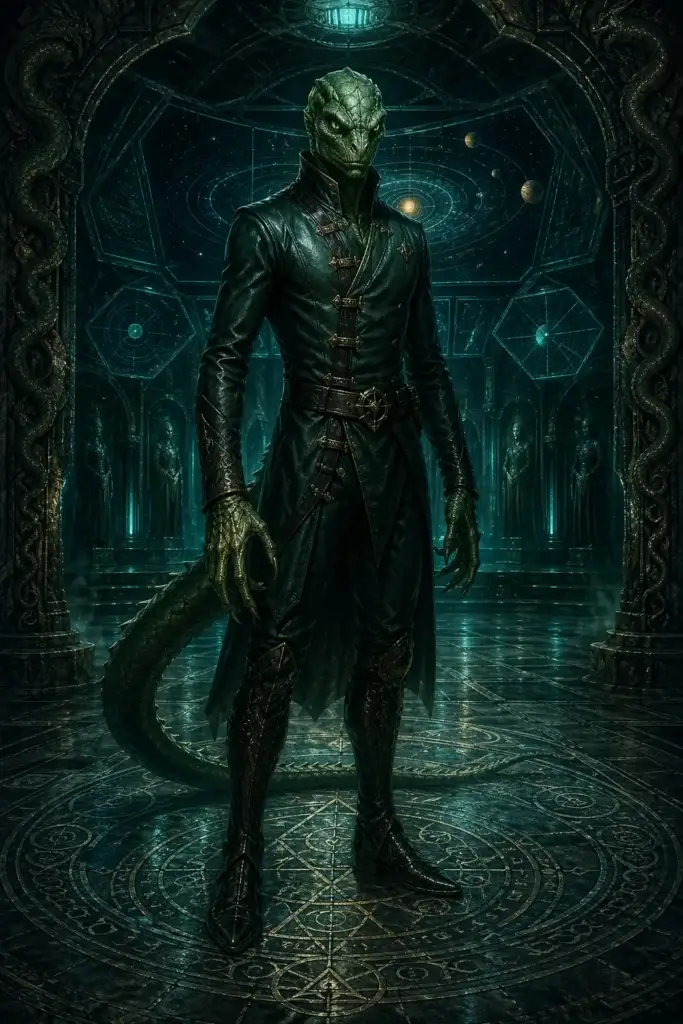
Greys are standardly depicted as 1 to 1.2 m tall, humanoid with reptiloid-style large black almond-shaped eyes, grey skin, a pointed chin, thin lips, slender arms, and three to four fingers. Clothing: often metallic and tight-fitting, or absent entirely.
Attributes: technological devices, emitters, aura or light-body effect. In popular iconography (Steven Spielberg, Hollywood) they appear alien yet elegant; in abduction accounts, they tend to be disturbing. Color: grey, sometimes silver or greenish. Gaze: frontal and fixed (cold, non-emotional).
Domain of Influence: The so-called Greys or Grey aliens are a central figure in modern UFO mythology and in “abduction narratives.” Unlike classical religious beings, they do not derive from a tradition thousands of years old.
Instead, they took shape only after the Second World War, primarily from Betty and Barney Hill’s 1961 account and its literary dissemination by John G. Fuller (The Interrupted Journey, 1966).
Whitley Strieber’s Communion (1987) established the iconic appearance: small humanoid beings, pale grey skin, oversized black almond-shaped eyes, a narrow head, and weak limbs.
From a religious-studies perspective (Bullard, Lewis, Partridge), they are to be understood as secondary mythogenesis in the technological age, comparable to the functional transformation of classical spirits (elves, demons) within a secularized and scientifically shaped symbolic world.
Protective practices against Grey abduction (according to New Age folklore and abduction literature) include: bedroom protection rituals (crystals, symbols, prayer), mental defense visualization, invocation of guardian angels or the higher self, and light-body sealing.
Some abductees report successful mental resistance or invocation of God. Long-term approaches include: psychological integration of trauma through hypnotherapy or spiritual counseling. No documented magical binding formulae; protection is primarily psychological and spiritual in nature.
Comparable figures include traditional demons that abduct humans (Lilith, incubi, succubi in European demonology); extraterrestrial gods in modern variants of the ancient astronaut hypothesis (Erich von Däniken); scientists or doctors appearing in dreams as symbols of violation (trauma projection); and Jinns or Yatu in Islamic and Hindu supernatural traditions.
All share the following features: unwanted intrusion, technological superiority, emotional distance, and ambivalent intent.
Greys: Parallels in Other Cultures
The Grey as a type of encounter within UFO contact discourse belongs to contemporary para-mythology. Functionally related beings include the Nordic Hulder, the Irish Sídhe as otherworld beings, and, in a broader sense, shamanic spirit-being encounters worldwide.
Unlike classical mythologies, the Greys lack their own cultic context; they are purely an experiential category of modernity.
Jewish Tradition: Jewish supernatural tradition knows demons and Shedim that abduct or torment humans at night, particularly during sleep and in sexual contexts. The Lilith myth (nocturnal visitant) shows a similar dynamic of coercion without choice.
There is, however, no alien dimension; the forces are rather local or cosmically demonic in character. The descriptions in the Midrash and Kabbalah are anthropomorphically distinct from science-fiction Greys.
Greco-Roman World: Greek daimones and incubi, Roman Lamiae, describe nocturnal beings of intrusion. Nymphs and Naiads tend to be willingly seductive rather than coercive. Goetic demons (in later Christian-occult traditions) display power relations similar to those of the Greys: superhuman beings, mysterious, capable of pact-making. No technological dimension is present.
Mesopotamia: Mesopotamian Lilu demons and nocturnal Edimmu (spirits) share a similar intrusive character, but no otherworldly technology. There is no direct parallel to the Greys; the dynamic is closer to demonic intrusion than to alien encounter.
India and Asia: Buddhist and Hindu supernatural tradition knows Rakshasas (demons), Pretas (hungry ghosts), and Asuras (powerful beings) that can abduct or torment humans. Tibetan Buddhism describes Pretas and Yudu deities active at night. There is no science-fiction dimension, but there is a structural similarity: superhuman beings, alternative dimensions, potential for intrusion.
Origins of the Grey Image
The idea of the Greys, namely short extraterrestrials with a large head, large black eyes, and grey skin, is a product of the second half of the twentieth century. Early descriptions of alleged extraterrestrials during the UFO wave from 1947 onward were still very inconsistent. Only gradually did a uniform type establish itself.
An important turning point is the case of Betty and Barney Hill, who in 1961 reported an alleged abduction. The account produced under hypnosis, and the depictions based on it, shaped the appearance of the beings significantly.
The type then reached wide circulation through the book Communion (1987) by Whitley Strieber, whose cover image made the figure familiar to a mass audience.
Media-studies research has shown that film and television, such as Close Encounters of the Third Kind (1977), and reporting on alleged abductions mutually reinforced each other. The image of the Greys is thus a well-documented example of a culturally generated and media-consolidated motif.
Distribution and Cultural Reception
Since the 1980s, the Greys have become the world’s most widely recognized depiction of extraterrestrial life. They appear in films, series, advertising, comics, and as a merchandising motif. This pervasive presence in popular culture has meant that the image is recognizable even where no belief in real extraterrestrials exists.
Within ufology and the abduction community, extensive narratives have formed around the Greys, including accounts of medical examinations, hybridization programs, and agreements with governments. These motifs partly connect with conspiracy narratives, among them the complex surrounding the Reptiloiden, though the two concepts have different origins and should not be equated.
Religious studies and sociology describe belief in the Greys in part as an element of new, technologically shaped frameworks of meaning. Some researchers have pointed to structural similarities between abduction accounts and older narratives of encounters with supernatural beings, such as fairies or demons, without thereby asserting any equivalence in content.
Research Classification and Critique
There is no scientifically recognized evidence for the existence of the Greys as real beings. Abduction accounts rest predominantly on memories that were frequently organized only retrospectively, in some cases under hypnosis. Psychological research has noted that hypnosis does not make memories more reliable and can encourage so-called false memories.
Several explanatory approaches have been discussed, including sleep paralysis with accompanying perceptions, the effect of cultural templates on the interpretation of ambiguous experiences, and social dynamics within self-help and research groups. None of these approaches requires the existence of real extraterrestrials, and none denies the affected individuals the reality of their subjective experience.
iWell Guard classifies the Greys as a modern phenomenon of ufology and popular culture, not as a traditionally transmitted mythological figure. The presentation serves to inform about origin, distribution, and research discussion. Those wishing to explore related contemporary concepts will find further connections in the article on Reptiloiden.
Sources and Literature
The Grey is not an established deity of ancient pantheons, but a modern borrowed motif, reconstructed and reinterpreted in contemporary movements from older imagery of threshold beings.