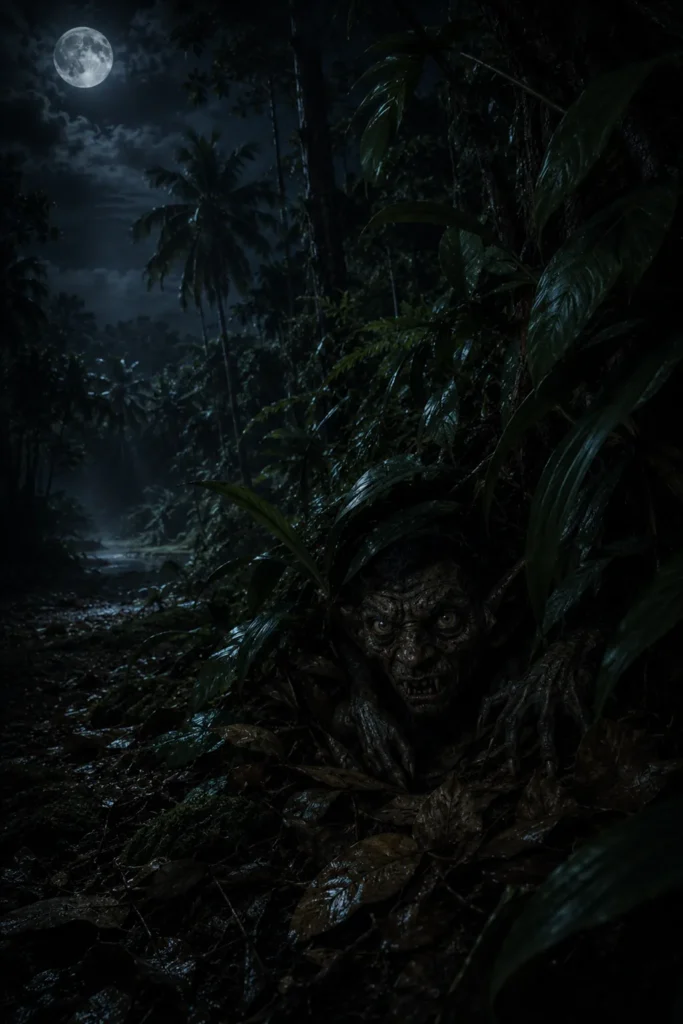
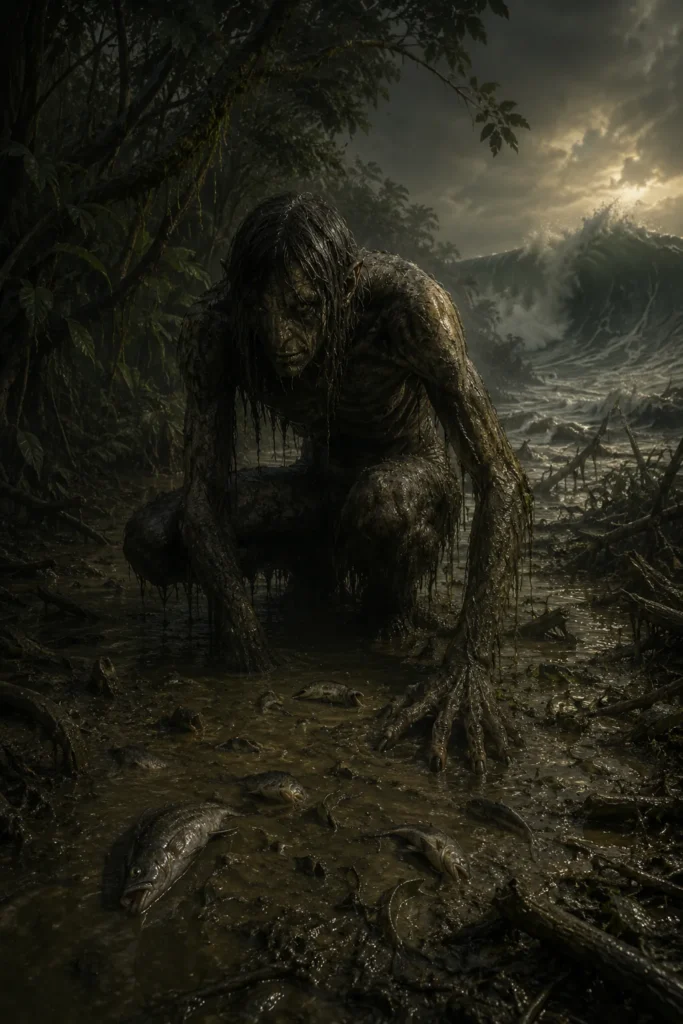
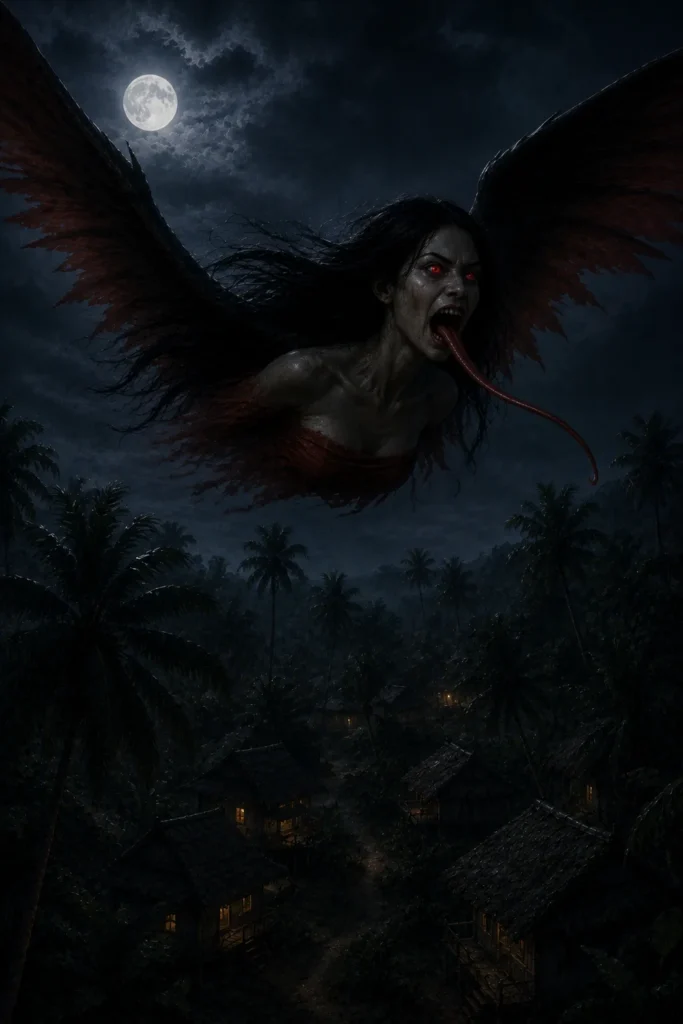
Aswang, the collective term for five nocturnal figures
By Ralf Ittermann · last reviewed on
Aswang is a demon of Philippine tradition.
Not a single being, but five types of nocturnal terror.
Aswang is the collective term for the shapeshifting blood-suckers, corpse-eaters and witch-beings of Philippine folklore. By day an unremarkable neighbour, often a woman, the Aswang becomes a shapeshifter by night, one who devours corpses and threatens the unborn and the sick.
In 1971, the folklorist Maximo Ramos classified the Aswang Complex into five types: vampire, viscera-sucker, were-dog, evil-eye witch, and ghoul. The belief is especially rooted in Capiz Province on the island of Panay.
Type: Collective term for five types of shapeshifting blood-suckers, corpse-eaters and witch-beings
Origin: pre-colonial Philippine belief, overlaid with Catholic influence, scientifically systematised in 1971 by Maximo Ramos
Texts: Ramos, The Aswang Syncretism in Philippine Folklore (1969) and The Creatures of Philippine Lower Mythology (1971)
Period: pre-colonial to the present, a living everyday folklore
Appearance: an unremarkable human by day, one of five shapeshifter types by night
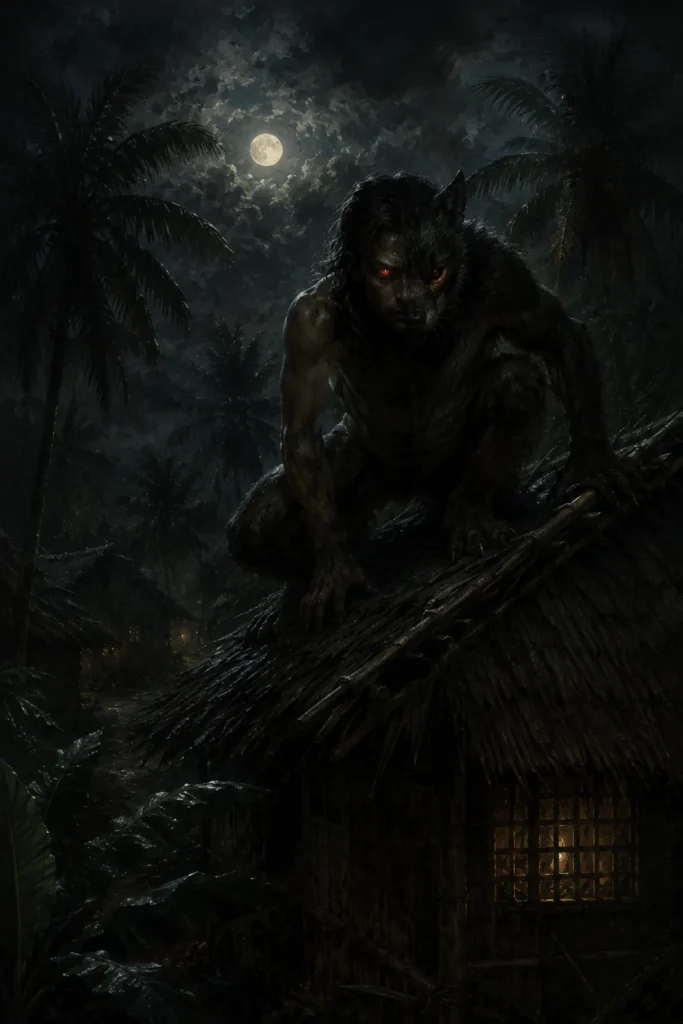
Historical Classification
Period of the Texts
Of pre-colonial origin and still alive today: in 1971, Maximo Ramos scientifically systematised the belief in the Aswang Complex.
Area of Diffusion
A nationwide collective term, especially widespread in southern Luzon, parts of Mindanao and the Visayas; Capiz Province on the island of Panay is considered a stronghold.
Sources
Good: the basis is Maximo Ramos’ systematisation from 1971, supplemented by contemporary reviews such as that of Frank Lynch.
Name and variants
Philippine: The origin of the name Aswang is disputed; roots relating to dog or beast, as well as to a deity, are discussed. Spanish missionaries reinterpreted the indigenous nocturnal figures as witches and devil’s work.
Appearance
Appearance
The Aswang is shapeshifting: as dog, pig, bird or human. By day it is fully human and integrated into the neighbourhood, which makes it especially threatening on a social level. It symbolises fear of hidden evil within the community, of illness, social deviance and the breakdown of shared values.
Effect
Depending on type, the Aswang devours corpses at night as a ghoul, sucks blood as a vampire, or takes the unborn from the womb. Ramos interpreted the figure as a cultural means of expressing moral boundaries.
Profile: Aswang
The key aspects of the Aswang Complex at a glance.
Combines pre-colonial Philippine folk belief with Spanish-Catholic demonisation; scientifically systematised in 1971 by Maximo Ramos.
People travelling by night, corpses, the unborn, the sick and children, depending on the type within the Aswang Complex.
An unremarkable human by day, often a woman; by night one of five shapeshifter types, including dog, pig or bird.
Blood-sucking, corpse-eating and the abduction of the unborn, expressed differently depending on the type within the Complex.
Salt in the corners of the house, garlic at doors and windows, and the dried stingray tail Buntot Pagi as an amulet.
The Manananggal as its viscera-sucker type, while the Multo is by contrast a harmless spirit of the dead without the predatory traits of the Aswang.
The Aswang Complex according to Maximo Ramos
Aswang is an umbrella term whose origin is disputed; roots relating to dog or beast, as well as to a deity, are discussed. Spanish missionaries reinterpreted the indigenous nocturnal figures as witches and devil’s work, shaping the Catholic overlay that still resonates today.
The folklorist Maximo Ramos systematised the Aswang Complex in 1971 into five types: the blood-sucking vampire, the self-segmenting viscera-sucker, the man-eating were-dog, the vengeful or evil-eye witch, and the carrion-eating ghoul. Only this systematisation brought the many regional nocturnal figures of the Philippines together into a shared Complex.
Superstar of Philippine horror cinema
The Aswang is the superstar of Philippine horror cinema, featuring among others in the 1992 film Aswang, and is a fixture of comics, Halloween and modern popular culture.
In religious studies, the Aswang is not a single being but a complex of five types. It combines pre-colonial belief with Catholic overlay and serves as a cultural means of expressing fear of hidden evil and the community’s moral boundaries.
Salt, garlic and the stingray tail
Well documented are salt, scattered into every corner of the house, and garlic carried in a pocket or hung as a wreath at doors and windows. Also used are ginger and the dried stingray tail Buntot Pagi, regarded as an amulet and whip, along with a rosary, a silver blade and incense of garlic and the makabuhay plant.
Vampire, ghoul and werewolf in one complex
In its blood-drinking type, the Aswang corresponds to the vampire, and in its carrion-eating type to the Arabian ghoul; as a shapeshifter it is related to the werewolf motif. Within the Philippine spirit world of this collection, it is joined by the headless Pugot and the spirit child Tiyanak, both independent figures alongside the actual Aswang Complex.
Frequently asked questions about the Aswang
Is the Aswang a single being?
No, it is a collective term and complex made up of five types according to Maximo Ramos: vampire, viscera sucker, weredog, witch and ghoul.
How can one recognise an Aswang?
Traditionally by the mirrored reflection in its eyes, or by the fact that during the day it appears to be an ordinary neighbour.
Where is the belief strongest?
In the province of Capiz on the island of Panay.
Further links
Further reading:
- Manananggal – the self-segmenting viscera sucker type of the Aswang Complex
- Tiyanak, Pugot – further Philippine nocturnal figures alongside the Aswang
- Multo – the harmless Philippine spirit of the dead, for comparison
- Salt, Garlic, Amulet – traditional protective means
- Protection Compass – protective means at a glance
Literature (selection)
Further standard works in the bibliography.
As a Philippine shapeshifter, the Aswang is not a single monster but the collective name for the entire Aswang Complex: five types of nocturnal horror who live among people by day as inconspicuous neighbours.