Habergeiß is a demon of the alpine tradition.
A three-legged billy goat whose bleating heralds misfortune.
The Habergeiß, in some places also spelled Habergeiss, is a three-legged, goat-like frightening figure of the Eastern Alps, travelling through the winter nights chiefly as a companion of the Perchten and Krampuses. Its bleating is considered a bad omen, its sight a warning of coming misfortune.
It has been documented in folklore since the 19th century, presumably older in oral tradition, with a focus on Carinthia, Salzburg and Styria.
Type: Three-legged, goat-like figure of misfortune in the Perchten processions
Origin: Eastern Alps, documented in folklore since the 19th century, presumably older in oral tradition
Texts: 19th-century legend collections (Vernaleken 1858), Handwörterbuch des deutschen Aberglaubens, historical-linguistic studies
Period: Perchten processions and Rauhnächte in winter, occasionally Fastnacht and maypole customs
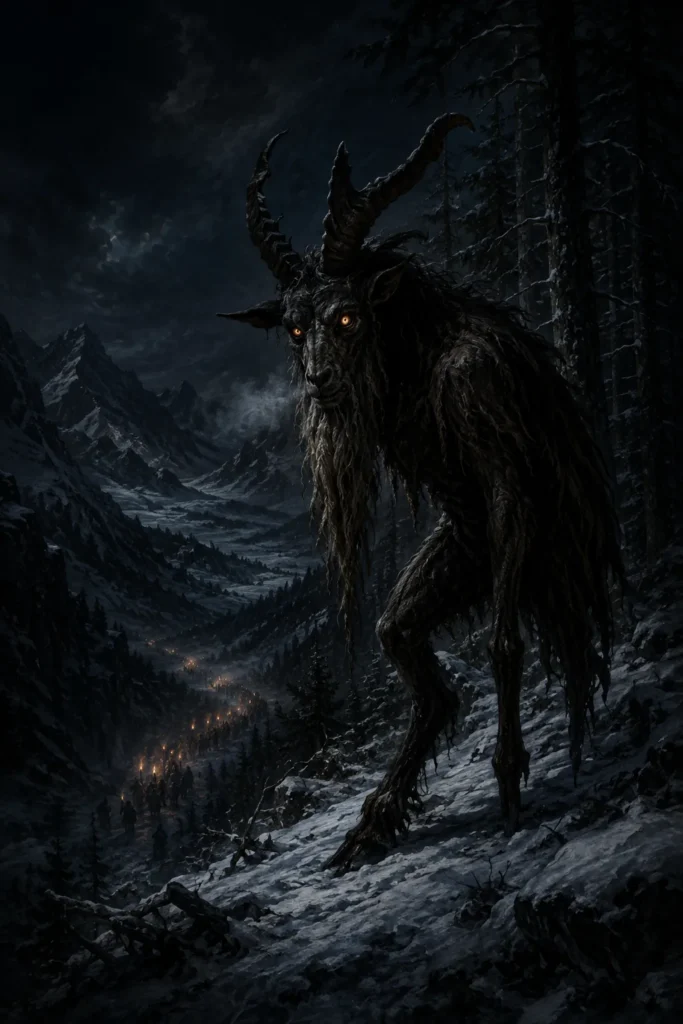
Appearance: three-legged billy goat with glowing eyes and a long beard, more rarely a deformed bird
Documented in folklore since the 19th century, for instance in Theodor Vernaleken’s Alpensagen of 1858; presumably older in oral tradition, though the exact age cannot be reliably reconstructed from the late written records.
Carinthia, Salzburg and Styria form the core area, with isolated parallels in Swabia and Franconia.
19th-century legend collections, the Handwörterbuch des deutschen Aberglaubens, and historical-linguistic studies of the name form the basis of the sources.
Linguistically: The name Habergeiß is a tautological formation from two words for billy goat: Haber derives, via Old Icelandic and Celtic hafr, from the word for goat, not, as is often assumed in folk etymology, from Hafer (oats), while Geiß likewise denotes the goat.
Appearance
The most widespread notion is that of a three-legged billy goat with glowing eyes, a long, often shaggy beard, and one or more missing or extra limbs. In the Perchten processions, performers sometimes wear costumes over two metres tall with clattering jaws and the carrying basket known as the Zistl.
Effect
The irregularity of its form, above all the third leg, marks it as a being outside the natural order and thus as a bearer of misfortune; its bleating in the darkness was widely regarded as an audible sign of coming disaster.
The key aspects of the three-legged frightening figure at a glance.
A regular companion of the Perchten and Krampuses in the winter procession customs of the Eastern Alps, in some regions blended with older bird demons.
Farmers, livestock and unruly children: its appearance or call at night was regarded as a bad omen, especially for the stable and the harvest.
A three-legged billy goat with glowing eyes and a long beard, more rarely a deformed bird; Perchten procession costumes can be over two metres tall.
An omen of misfortune and companion figure of the Perchten processions; according to tradition, it sucks the blood from farmers and livestock.
Burning juniper or incense, loud bell-ringing in the stable, bolted stable doors and iron on the thresholds.
The Orcadian Nuckelavee as a distant parallel of a deformed, misfortune-bringing animal being.
The name Habergeiß is a tautological formation from two words for a male goat: Haber does not derive, as folk etymology often assumes, from Hafer (oats), but rather, via Old Icelandic and Celtic hafr, from the word for billy goat, while Geiß likewise denotes the goat. The doubling points to a very old naming pattern whose exact age cannot be reliably reconstructed from the written records, which only begin in the 19th century.
The legend collections of that period, such as Theodor Vernaleken’s Alpensagen from 1858, already record the Habergeiß as a fixed part of the winter customs in Carinthia, Salzburg and Styria, with isolated parallels in Swabia and Franconia. In some regions it appears not as a goat but as a misshapen bird, which points to a blending with older bird demons. Some interpreters suspect that behind the Habergeiß lies an originally independent fertility or harvest being that only became a pure figure of dread through the Christian reinterpretation of winter customs, a thesis that cannot, however, be conclusively supported from the available sources.
The Habergeiß remains to this day a fixed part of many Perchten and Krampus runs in Carinthia, Salzburg and Styria, where it is represented by specially made, often elaborately crafted costumes. Outside the Alpine region it remained relatively unknown, whereas within the Perchten runs it has held its place as an independent, clearly recognisable minor figure alongside Krampus and the Perchten.
From a religious-studies perspective, the Habergeiß can be understood as a condensation of agrarian fears in animal form: the malformation of its body marks it as a liminal being between livestock and demon, while its association with the Perchten season places it within the broader context of winter expulsion rituals. Whether the name originally denoted an independent fertility being that only later became a pure figure of dread cannot be reliably reconstructed from the comparatively late sources.
According to tradition, the general protective measures of the Rauhnacht period were regarded as effective against the Habergeiß: fumigating stable and living room with juniper or frankincense to protect livestock and provisions from roaming winter spirits, as well as the loud ringing of bells, which was said to lend protective power to the livestock in the stable. Firmly bolting the stable doors during the critical nights and fitting iron to thresholds also belonged to the traditional repertoire. Where the Habergeiß was interpreted as an omen, people were additionally advised to keep their own farm especially tidy during the Rauhnächte, so as not to invite further misfortune.
A distant parallel is offered by the Orcadian Nuckelavee, a skinless being fused with a horse, to which plague and crop failure were likewise attributed. Both figures share the motif of the unnaturally deformed animal body as a bearer of agrarian threat, even though the Nuckelavee comes from an entirely different, North Atlantic legend tradition and is not tied to winter procession customs. Within the Perchten runs, it stands alongside Krampus, Frau Perchta and the Barbegazi as another Alpine winter figure of dread.
Why does the Habergeiß have three legs?
Scholars read the malformation as a sign that the figure stands outside the natural order and therefore announces misfortune. There is no uniform, source-supported explanation for exactly three legs.
Is the Habergeiß the same as the Krampus?
No, it is an independent companion figure of the Perchten runs, appearing alongside Krampus and the Perchten but possessing its own form and symbolism. All three figures, however, share the same winter procession season.
Recommended internal links:
Further standard works in the bibliography.
As a companion figure of the Habergeiss Perchten run, she moves through the village alongside Krampus and the Perchten; the name Three-Legged Goat Alps aptly describes this figure of misfortune, whose bleating still carries warning and superstition alike today.
Against its influence, cross-cultural tradition names these protective means:
Recommended protective means
The simplest protective means in this collection: 41 layers of fine gold 999, platinum, silver and silicon, manufactured in Ruhla, Thuringia. It requires no activation, is bound to no person, and is effective within a radius of around 50 meters, even without being worn.
Related Beings

Metsaema, the Estonian forest mother, is regarded as guardian of game and forest. Origin, traditi...

Jubokko, the Japanese vampire tree. Origin as a modern figure, its emergence on battlefields and ...

The Nasnas, the lengthwise-halved desert demon of Arabia. Origin, the double meaning and its clas...

Vishnu, preserver of the Hindu Trimurti. Ten avataras (Krishna, Rama and others), the chakra, the...

Seongju, the supreme Korean household god in the ridge beam. Origin, the Seongju-gut ritual, and ...

Rolling Calf, Jamaica's vengeful spirit in calf form. Origin, the glowing eyes and the chain, and...