Tatzelwurm, the mountain serpent between legend and sighting
By Ralf Ittermann · last reviewed on
The Tatzelwurm is demon of alpine legend.
Cat head, serpent body, poisonous breath: the alpine cryptid.
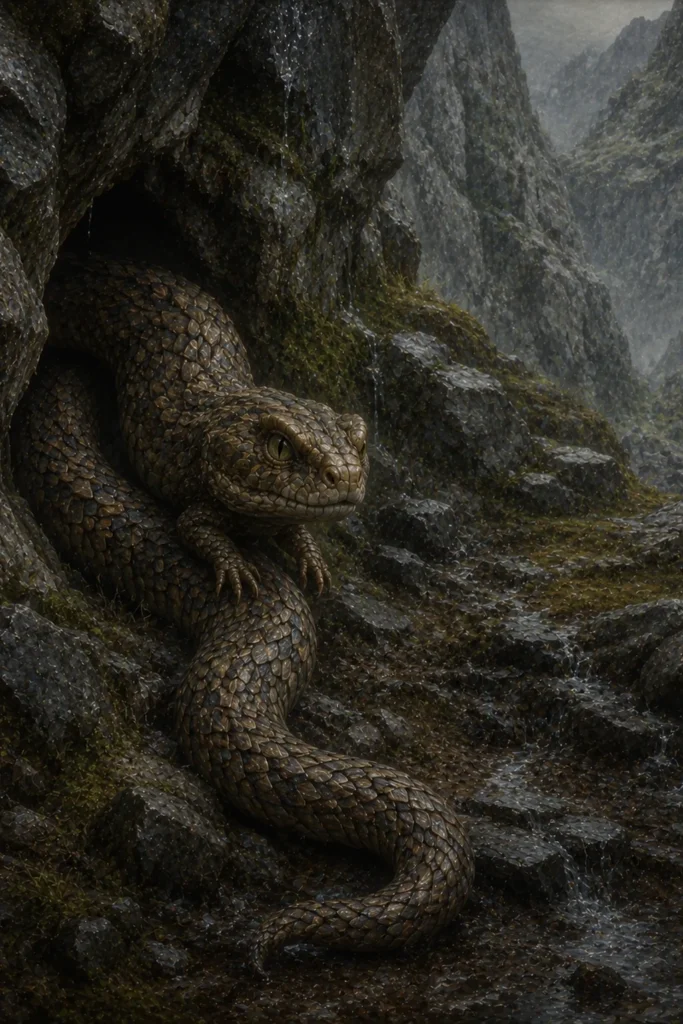
The Tatzelwurm, also known as Stollenwurm or Springwurm, is an alpine dragon and lizard being: a stocky mountain snake with a cat’s head and two clawed front legs. It lives in rock tunnels near water, is considered shy yet aggressive, and is the subject of both legends and alleged sightings.
The tradition ranges from Scheuchzer’s Itinera of 1723 through eyewitness accounts by Samuel Studer in 1814 to Alpenburg and Dalla Torre; around eighty eyewitness accounts have been recorded. Serious zoological consensus, however, does not require a real animal.
Type: Alpine dragon and lizard being, figure of legend and cryptid
Origin: alpine folklore tradition since 1723
Texts: Scheuchzer, Studer, Alpenburg, Dalla Torre
Period: legendary tradition since 1723, sightings in the 19th and 20th centuries
Appearance: stocky, scaly mountain snake with cat’s head and clawed front legs
Sources and History of Sightings
Period of the Texts
The legendary tradition begins in 1723 with Scheuchzer’s Itinera; alleged sightings increase during the 19th and 20th centuries.
Area of Diffusion
Switzerland, Austria, Bavaria and South Tyrol; in the French Alps the being is known as Arassas.
Sources
Good: collections of legends and cryptozoological literature, from Scheuchzer and Studer to Magin and Heuvelmans.
Name and variants
Origin of the name: The name combines ‘Tatze’, meaning paw or claw, and ‘Wurm’, Germanic for snake or dragon, thus a half-dragon with a serpent’s body and two clawed front legs. Stollenwurm means the worm of the mountain tunnels, Bergstutz the mountain stump, Springwurm refers to its leaping, and Arassas is the French Alpine name.
Appearance and Behaviour
Appearance
The Tatzelwurm is reptile-like and stocky, scaly, and around 50 to 200 centimetres long, with a cat-like head. It has two short clawed front legs with no hind legs, resembling a lindworm, or four short legs.
Effect
It lives in rock tunnels near water and appears in sultry weather; it is considered shy yet aggressive, leaps at its target, and has a poisonous breath or bite. According to myth, its gaze turns sand to glass, it hatches from a black rooster’s egg like the basilisk, and it sucks milk from cows.
Profile: Tatzelwurm
The key aspects of the cat-headed mountain snake at a glance.
An alpine folk belief between dragon legend and cryptozoology, documented in writing since Scheuchzer’s Itinera of 1723.
Alpine folk belief: herders, shepherds and hikers report encounters at rock tunnels, in sultry weather, and near water.
Stocky, scaly, 50 to 200 centimetres long, cat-like head, two short clawed front legs with no hind legs or four short legs.
Shy yet aggressive: it leaps at its target, has a poisonous breath or bite; according to myth its gaze turns sand to glass, and it sucks milk from cows.
Weakly documented; the clearest old motif is the white rooster kept with the cows. Protective practice supplements this with magical signs, salt, incense, prayers, protective stones, verbal charms and protective herbs.
Dragon, lindworm and Haselwurm; the Swedish Lindorm with a cat’s head is a direct parallel. Cryptozoologically it is grouped with Nessie and the Yeti.
From Scheuchzer to Dalla Torre: Three Centuries of Accounts
The name combines ‘Tatze’, meaning paw or claw, and ‘Wurm’, Germanic for snake or dragon: a half-dragon with a serpent’s body and two clawed front legs. Alongside this stand the regional names Stollenwurm, the worm of the mountain tunnels, Bergstutz, the mountain stump, Springwurm after its leaping, and Arassas in the French Alps.
Historical sources include Scheuchzer’s Itinera of 1723, Samuel Studer’s eyewitness accounts of 1814, Alpenburg’s Mythen und Sagen Tirols of 1857, and Dalla Torre’s Drachensage im Alpengebiet of 1887. This allows the Tatzelwurm to be traced across three centuries: first as a figure of alpine dragon legend, later increasingly as a supposedly sighted animal.
From Copperplate Engraving to Photo Scandal
Scheuchzer’s copperplate engravings shaped the image of the Tatzelwurm. The Balkin photo affair of 1934 is now unanimously regarded as a fake, a doctored ceramic figure. The Tatzelwurm is the mascot of the Aare Gorge; around eighty eyewitness accounts have been recorded.
From a religious-studies perspective, the Tatzelwurm is a prime example of the separation between legend and cryptozoology: the poisonous breath, the basilisk-like birth and the sand-to-glass motif are purely mythical, while modern interpretations from the 1930s onwards sought to explain it as a real animal, for instance as an otter or giant salamander. Serious zoological consensus does not require a real animal. The Balkin photo is a fake.
The White Rooster and Other Motifs
A distinct defence against the Tatzelwurm is weakly documented; a canon of amulets is lacking. The only clear motif is the white rooster kept with the cows against milk-sucking snakes. In hero legends, plain force of arms helps, but this is a narrative motif, not a real form of protection. The Tatzelwurm is therefore not a being with a traditional system of protection, but one that legend simply seeks to avoid.
Protective practice supplements the tradition with tried means: magical protective symbols, salt and incense, prayers, protective stones, verbal charms, and protective herbs carried in a pouch.
Lindworm, Basilisk and the Swedish Lindorm
The Tatzelwurm stands alongside the dragon, lindworm and Haselwurm; the Swedish Lindorm with a cat’s head is a direct parallel, and the motif of birth from a black rooster’s egg links it to the basilisk. Cryptozoologically it is grouped with Nessie and the Yeti; the Olgoi-Khorkhoi of the Gobi also belongs to this series of unexplained crawling beings. In the alpine landscape of legend, the Fänggen share with it the field of the threatening.
Frequently Asked Questions About the Tatzelwurm
What does the Tatzelwurm look like?
As a stocky, scaly mountain snake with a cat’s head and two short clawed front legs.
Is the Balkin photo real?
No. It is unanimously regarded as a fake, a doctored ceramic figure.
Does the Tatzelwurm really exist?
Serious zoological consensus does not require a real animal; it is a being of legend and cryptid.
Further links
Further reading:
- Yeti – the best-known mountain cryptid
- Olgoi-Khorkhoi – the enigmatic worm of the Gobi
- Iron, salt, amulet – traditional protective means
- Protection Compass – an overview of protective means
Literature (selection)
Further standard works in the bibliography.
As both an alpine dragon being and a cat-headed mountain snake, the Tatzelwurm lives in two worlds: in the old dragon legend of the Alps and in the sighting reports of cryptozoology, without zoology ever having needed it.