The Fänggen are spirits of Alpine legend.
Gigantic forest women, child devouring and yet helpful.
The Fänggen, also called Fängge or Fanggen, are the wild mountain folk of the Alps: wild forest women and giantesses, alongside moss-grown forest giants as their male counterparts. They are ambivalent, though predominantly dangerous, considered man-eating with a preference for children, and they steal children and women in childbed or leave changelings in their place.
At the same time they can help: in some places they give their daughters as strong maidservants to farms. The Fänggen are attested in Tyrol, Vorarlberg, Liechtenstein and the Bavarian Alps, collected in the 19th century by Zingerle, Alpenburg and Vonbun.
Type: Wild, ambivalent mountain folk, a local variant of the wild folk
Origin: Alpine legendary tradition, collected in the 19th century
Texts: Zingerle, Alpenburg, Vonbun
Period: 19th century (collections), older narrative material
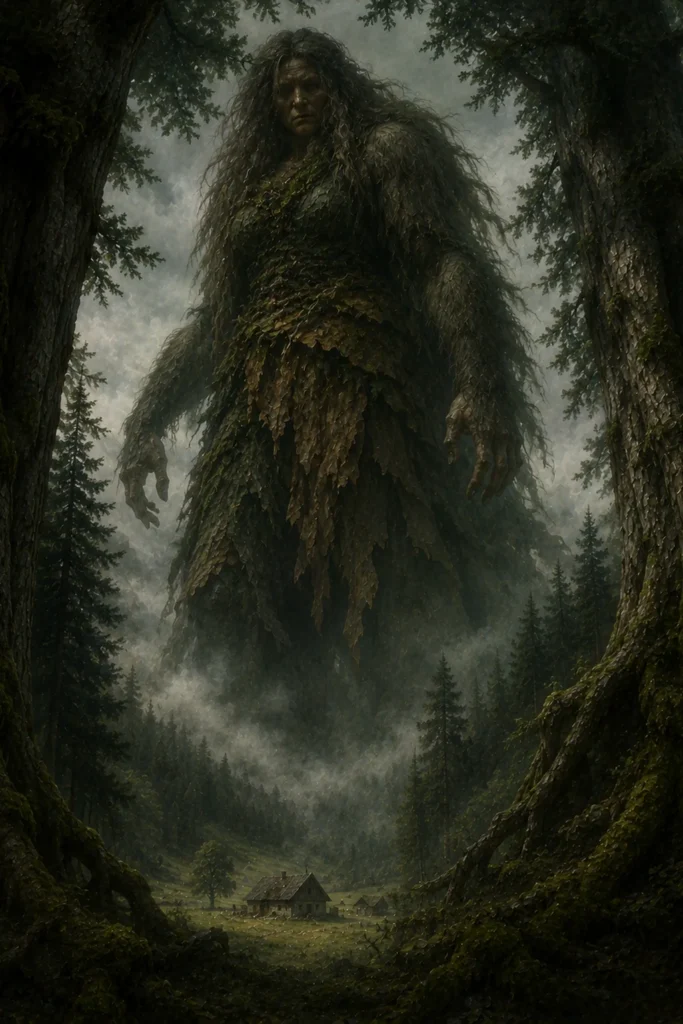
Appearance: gigantic, hairy forest women and moss-grown forest giants
The narrative material belongs to the Alpine legendary tradition and was collected in the 19th century, chiefly by Zingerle, Alpenburg and Vonbun.
Tyrol, South Tyrol, Vorarlberg, Liechtenstein and the Bavarian Alps; the Fänggen are a local variant of the wild folk.
Good: the collections by Zingerle, Alpenburg and Vonbun offer a broad, regionally spread body of legend.
Etymology: disputed and unsettled. Grimm speculated about Funke (‘spark’) or fangen (‘to catch’), explicitly as speculation; most likely attested is a kinship with Fank or Fankerl, meaning devil or fiend. The popular derivation from fauna or Faun is unattested and speculative.
Appearance
The female Fangga is gigantic, as tall as a tree, strong, covered all over in hair, with black hair shot through with beard lichen and a mouth stretching from ear to ear, dressed in bark and fur; the male Fanggen are moss-grown forest giants. Depending on the region, they appear giant-sized or dwarf-sized. They are bound to trees and die with the tree.
Effect
The Fänggen are predominantly dangerous, man-eating with a preference for children, and they steal children and women in childbed or leave changelings in their place. At the same time they can help, and in some places give their daughters as strong maidservants to farms.
The most important aspects of the wild mountain folk at a glance.
A local variant of the wild folk in the Alpine region, attested in Tyrol, Vorarlberg, Liechtenstein and the Bavarian Alps.
Farms, children and women in childbed: the Fänggen steal children and women in childbed, leave changelings, and in some places serve as strong maidservants.
Gigantic forest women covered all over in hair, dressed in bark and fur, with a mouth stretching from ear to ear; the males are moss-grown forest giants.
Forest and farm: bound to trees, dying with the tree; dangerous as child-devourers, helpful as strong maidservants.
Christian means: the cross, which cannot be crossed over, church bells, guardian angels and baptism, along with the Polyphemus trick using the name Selfmade.
The wild folk and the Wild Man, the Moosweiblein and the Saligen; furthermore the Basque Basajaun with the Basandere, and Pan and Faun.
The etymology of the name is disputed and unsettled. Grimm speculated about Funke (‘spark’) or fangen (‘to catch’), explicitly as speculation; most likely attested is a kinship with Fank or Fankerl, meaning devil or fiend. The popular derivation from fauna or Faun, by contrast, is unattested and speculative.
In content, the Fänggen are a local variant of the wild folk: attested in Tyrol, Vorarlberg, Liechtenstein and the Bavarian Alps, collected by Zingerle, Alpenburg and Vonbun. Their most striking motif is the bond with trees: the Fänggen are bound to trees and die with the tree, a trait that inscribes them deeply into forest nature and distinguishes them from mere giants.
The Fänggen are a firm fixture of Tyrolean and Vorarlberg legend research and comparative mythology.
In religious studies, the Fänggen are ambivalent but predominantly a real threat, man-eating and gigantic, and considerably more dangerous than the Saligen. Important clarifications: they are not to be confused with the benevolent Saligen. They are not consistently giantesses; depending on the region they appear giant-sized or dwarf-sized. The fauna or Faun etymology is unattested. And the caraway-bread motif is not confirmed for the Fänggen; it is attested for the Moosweiblein and only transferred by analogy.
Christian means are attested: the cross, which the Fänggen cannot cross over, church bells, the guardian angel and baptism. Then there is the Polyphemus trick: whoever introduces themselves with the name Selfmade and jams the Fangga’s hand escapes, because no one takes her complaint seriously. The caraway-bread motif, by contrast, is attested for the Moosweiblein, not certain for the Fänggen, and only transferred by analogy.
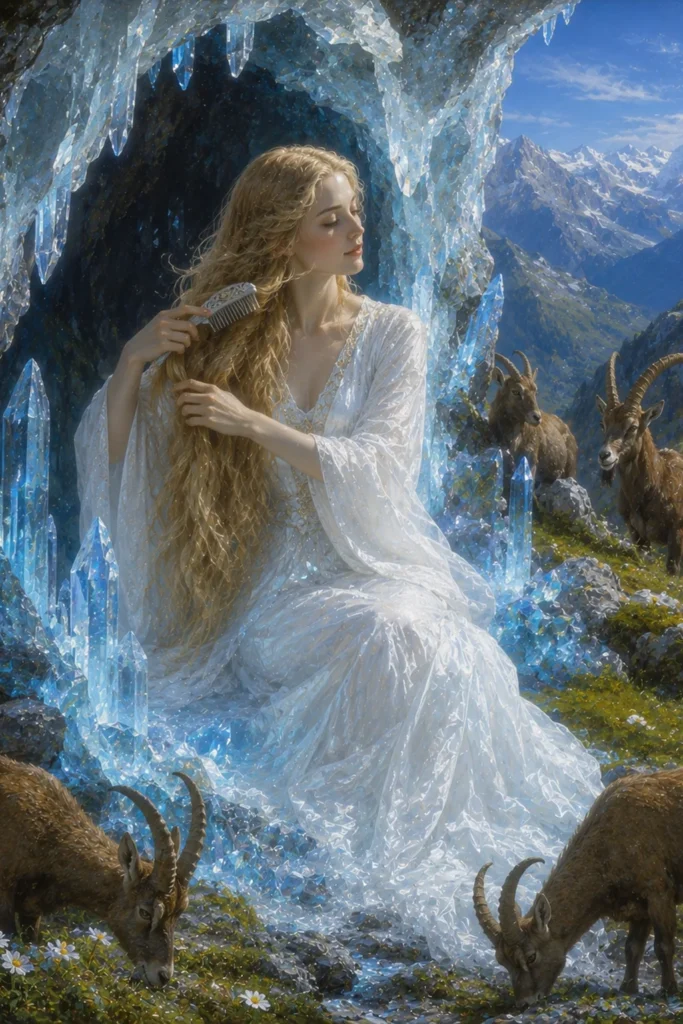
The Fänggen stand alongside the wild people and the Wild Man, the Moss Maidens and the Salige, with whom they share the chamois motif; yet they are clearly distinct from the benevolent Salige. Related figures include the Basque Basajaun and Basandere, as well as Pan and Faun. In the Alpine region, the small Nörgel and the Dellermännle also belong to the same legendary landscape, albeit at its opposite end.
What are the Fänggen?
The wild, ambivalent mountain folk of the Alps, wild forest women and giantesses.
Are they dangerous?
Mostly yes: they are regarded as man-eating, especially towards children, but they can also help.
Are they the same as the Salige?
No. Both form a continuum from benevolent to wild, but they are not identical.
Recommended internal links:
Further standard works in the bibliography.
Whether as the wild mountain folk of the forests or as wild maidens of the Alps who serve farmsteads as strong maidservants: the Fänggen unite both faces of the wilderness, and the dangerous one prevails.
Against its influence, cross-cultural tradition names these protective means:
Compare in the Protection Compass →Recommended protective means
The simplest protective means in this collection: 41 layers of fine gold 999, platinum, silver and silicon, manufactured in Ruhla, Thuringia. It requires no activation, is bound to no person, and is effective within a radius of around 50 meters, even without being worn.
Related Beings

Cheonyeo-gwishin: spirit of an unmarried woman in Korean folk religion, with iconography and prot...

Upyr, the Slavic revenant and progenitor of the modern vampire figure. Burial rituals, protective...

The dreamcatcher comes from the Ojibwe and was meant to keep bad dreams away over the cradle. Ori...

Apaosha, the Zoroastrian demon of drought. Origin, the rain battle against Tishtrya, and the clas...

The Naiads, freshwater nymphs of Greek mythology. Origin, nympholepsy, spring cult at the nymphae...

Shezmu, Egyptian demon of slaughter and wine. Butcher, oil presser and wine maker: Book of the De...