iWell Guard

Venedigermandl, the ore prospector from abroad

The Venedigermandl is a spirit of the Alpine tradition.

The mysterious ore-seeking dwarf of the Alpine streams.

Table of Contents

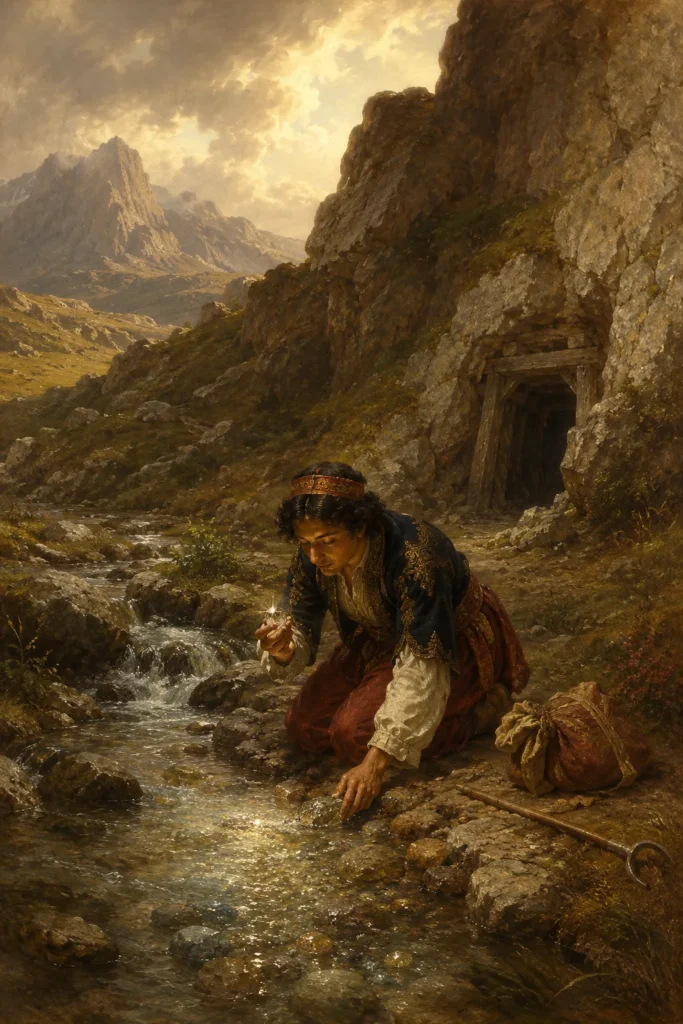
Venedigermandl - spirits from alpine tradition, historical illustration
Venedigermandl

The Venedigermandl is the legendary embodiment of the Venediger or Walen, foreign mineral prospectors who travelled through the Alps and the German highlands from the late Middle Ages to the early 19th century. Real, foreign-speaking ore seekers became, in oral tradition, a small, mysterious little man with magical abilities.

The legends revolve around dowsing rods, secret finding places and the narrow line between reward and curse for the local population. The figure is widespread above all in the Eastern Alps, as well as in the Ore Mountains, the Black Forest and the Fichtelgebirge.

Overview: Venedigermandl

Type: legendary gold and ore-seeking dwarf
Origin: Eastern Alps (Tyrol, Salzburg Pinzgau, Virgen Valley, Carinthia) as well as the Ore Mountains, the Black Forest and the Fichtelgebirge
Texts: Zingerle, Sagen aus Tirol; Lienert, Schweizer Sagen (1915); Panzer, Bayerische Sagen und Bräuche
Period: historical core since the late Middle Ages, earliest records 1365; legend formation mainly 17th to 19th century
Appearance: small, dark-haired male figure, foreignly dressed, thought of in his homeland as a distinguished gentleman

Historical Classification

Period of the Texts

The historical core reaches back to the late Middle Ages, with the earliest records of Venediger prospectors dating to 1365; the actual formation of legends set in mainly between the 17th and 19th centuries.

Area of Diffusion

The Eastern Alps, in particular Tyrol, the Salzburg Pinzgau, the Virgen Valley and Carinthia, as well as the Ore Mountains, the Black Forest and the Fichtelgebirge.

Sources

Doubly grounded: the real economic history of the mineral seekers is documented, and there are also numerous regional legend texts from the 19th century.

Name and variants

German: The name Walen derives from Welsche, meaning foreigners, while Venediger refers to Venice as, at the time, a world-famous centre of gold and glass craftsmanship. Both terms refer to the same occupational group of foreign-speaking mineral seekers, regardless of the region from which they actually came.

Appearance and behaviour

Appearance

The Venedigermandl appears as a small, dark-haired male figure with a foreign look, whose clothing marks him out as an incomer. In his true homeland, some legends say, this same little man turns out to be a distinguished gentleman who lives in a marble palace. Some versions place a divining rod in his hand, with which he detects hidden veins of ore.

Effect

According to legend, the Venedigermandl returns every summer to the same alpine valleys to gather gold, ore or glittering stones from streams and rock crevices. Towards helpful shepherds he shows himself generous and promises a reward, such as a sack of silver. But if a given promise is broken or hospitality disregarded, the tale turns dark: springs dry up, find spots vanish, and a curse falls upon the ungrateful.

Profile: Venedigermandl

The key aspects of the ore-seeking little man at a glance.

Cultural Context

Mythologisation of a real occupational group: foreign-speaking mineral prospectors who travelled through the Alps from the 14th to the early 19th century.

Responsible for

Hidden deposits of ore, gold and precious stones by streams and rock crevices, which he detects using a divining rod and local knowledge.

Depiction

A small, dark-haired male figure in foreign dress, though in his homeland imagined instead as a distinguished gentleman in a marble palace.

Function

Rewards honesty and hospitality with gold or silver, punishes broken promises with a curse and drying springs.

Conduct

Keep promises given, do not touch the find spots and tools of the Venedigers, and show hospitality towards strangers.

Distinctions

Clearly distinct from the Kasermandl: the Venedigermandl is a wandering ore prospector, not a penitent spirit bound to a hut.

From real occupational group to legendary figure

Behind the Venedigermandl stands a real occupational group: the so-called Walen or Venediger, mineral prospectors from Italy, France and occasionally Spain, whose activity in the German-speaking mining regions is first mentioned as early as 1365 and can be traced up to the early 19th century. They were mainly searching for cobalt ores for blue zaffer glass, manganese-bearing pyrolusite for decolourising Venetian mirror glass, as well as precious stones and refractory clays for crucibles, concentrated in the Erzgebirge around Schneeberg, in the Black Forest and in the Fichtelgebirge, with offshoots into the Eastern Alps.

The foreign language and secretive working methods of these prospectors seemed mysterious to the local population; in the 17th and 18th centuries, memories of them condensed into legends of small, magically skilled men who carried divining rods and could make themselves invisible and fly. This myth was reinforced by forged ‘Walenbücher’ bearing alchemical signs and supposed find spots. In Tyrol, Ignaz Vinzenz Zingerle collected numerous Venedigermandl legends, for instance from the Virgental and the Brixental, while in Switzerland Meinrad Lienert recorded a Glarus version in 1915.

Afterlife in field names and legend portals

Numerous field names such as Venedigerloch or Venedigerstein have survived in the landscape, still pointing today to the old ore-prospecting activity. Regional tourism and legend portals keep the stories alive, and Meinrad Lienert’s literary version of 1915 shaped the Swiss reception of the figure lastingly.

From the perspective of religious studies, the Venedigermandl is an example of the mythologisation of a real occupational group: foreign-speaking mineral prospectors, on account of their secretive working methods and their access to hidden wealth, were brought close to older ideas of mountain spirits and mountain gnomes and endowed with their magical qualities. Important for classification: the name refers, in a representative sense, to Venice as the best-known centre of glass and jewellery making, not to the claim that all prospectors actually came from Venice. At the same time, the tales of reward and curse negotiate a moral economy of hospitality and of keeping one’s word towards strangers.

The kept word as the best protection

Central to the tradition is the kept word: whoever made a promise to the Venedigermandl was well advised to keep it, since according to legend, breaking one’s word brought curses and drying springs. Equally handed down is the advice not to touch or destroy the find spots and tools of the Venedigers, and to meet strangers who identified themselves as ore prospectors with hospitality rather than suspicion. No further protective charm against the Venedigermandl itself is recorded, since in most versions it is not a hostile being but a reciprocal one.

Mountain beings with knowledge of ore in comparison

As a mountain being who knows of hidden minerals and encounters people at ore deposits, the Venedigermandl is closely related to the Cornish Knocker, who likewise dwells underground, watches over ore veins and reacts in a similarly reciprocal way to respect and disrespect. A further parallel is offered by the Scandinavian trolls, who in some legends also guard mountains and their treasures and punish people for greed or broken promises. From the Kasermandl, the other alpine Mandl figure, the Venedigermandl differs fundamentally: it is not a penitent household spirit but a wandering, foreign seeker whose activity is tied to real mining history.

Frequently asked questions about the Venedigermandl

Who were the Venediger really?

They were real mineral prospectors, mostly from Italy and France, who from the 14th to the early 19th century searched the Alps and the German uplands for cobalt ore, pyrolusite and precious stones for glass and jewellery making.

Why are they called Venedigermandl if not all of them came from Venice?

Venice was at the time Europe’s best-known centre of gold and glasmaking craft, and stood in a representative sense for the origin of the foreign, often Romance-speaking prospectors, regardless of which region they actually came from.

What happens if someone breaks a promise to the Venedigermandl?

The legends tell of harsh consequences: springs dry up, find spots disappear and a curse befalls the ungrateful. Kept promises, by contrast, are rewarded with gold or silver.

Further links

Recommended internal links:

Literature (selection)

A selection of key sources and studies:
  • Zingerle, Ignaz Vinzenz: Sagen aus Tirol. 2nd edition, Innsbruck 1891.
  • Vernaleken, Theodor: Alpensagen. Vienna 1858.
  • Lienert, Meinrad: Schweizer Sagen und Heldengeschichten. Stuttgart 1915.
  • Panzer, Friedrich: Bayerische Sagen und Bräuche. 2 volumes, Munich 1848-1855.

Further standard works in the bibliography.

Whether told as the Venedigermandl legend or as an account of the real ‘Venedig treasure seekers of the Alps’: the same foreign occupational group of mineral prospectors stands at the origin, spoken of in terms of honesty and hospitality just as much as of curse and broken promises.

Classification & Protection

IILEVEL
The Protection Compass assigns this being to influence level II, Noticeable influence.

Against its influence, cross-cultural tradition names these protective means:

Compare in the Protection Compass →

Recommended protective means

iWell Guard

The simplest protective means in this collection: 41 layers of fine gold 999, platinum, silver and silicon, manufactured in Ruhla, Thuringia. It requires no activation, is bound to no person, and is effective within a radius of around 50 meters, even without being worn.

All protective means at a glance →