Pazuzu, demon of the Mesopotamian tradition
By Ralf Ittermann · last reviewed on
Pazuzu, wind and plague demon of Mesopotamia, who at the same time acts as a protection against Lamashtu, who endangers children. The paradoxical profile of an evil being that protects against worse makes him one of the best-known figures of the Ancient Near East.
Pazuzu is a demon of the Mesopotamian tradition and a protective figure against Lamashtu.
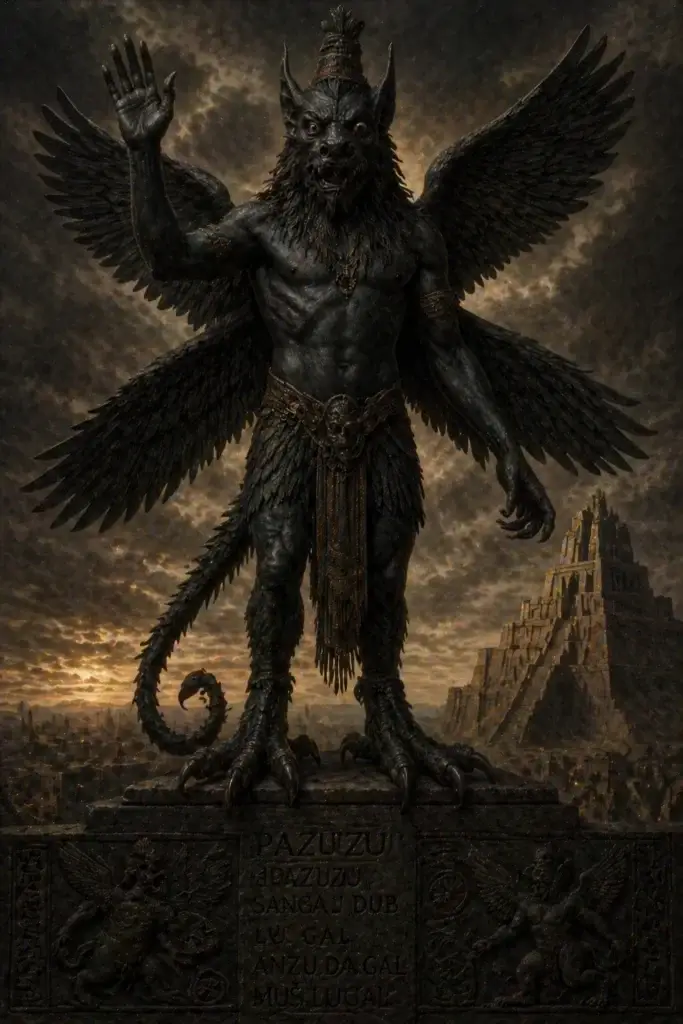
Pazuzu
Pazuzu is an Assyro-Babylonian demon whose name is documented in the Akkadian tradition primarily in the 1st millennium BCE. He is considered king of the wind demons (lilû) and son of Hanbi (Hanpi).
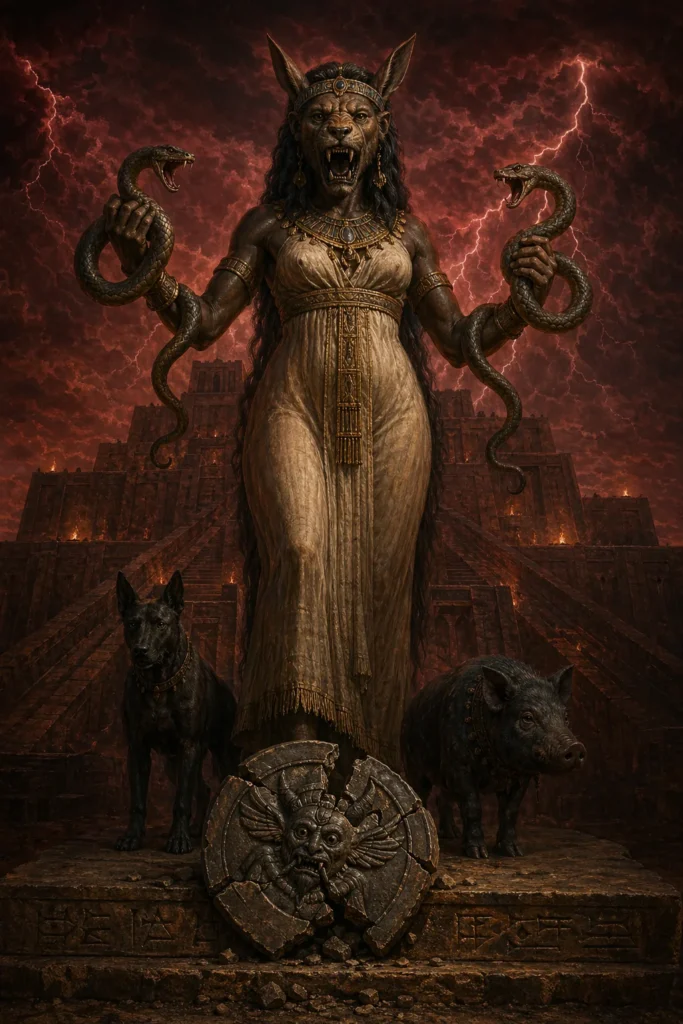
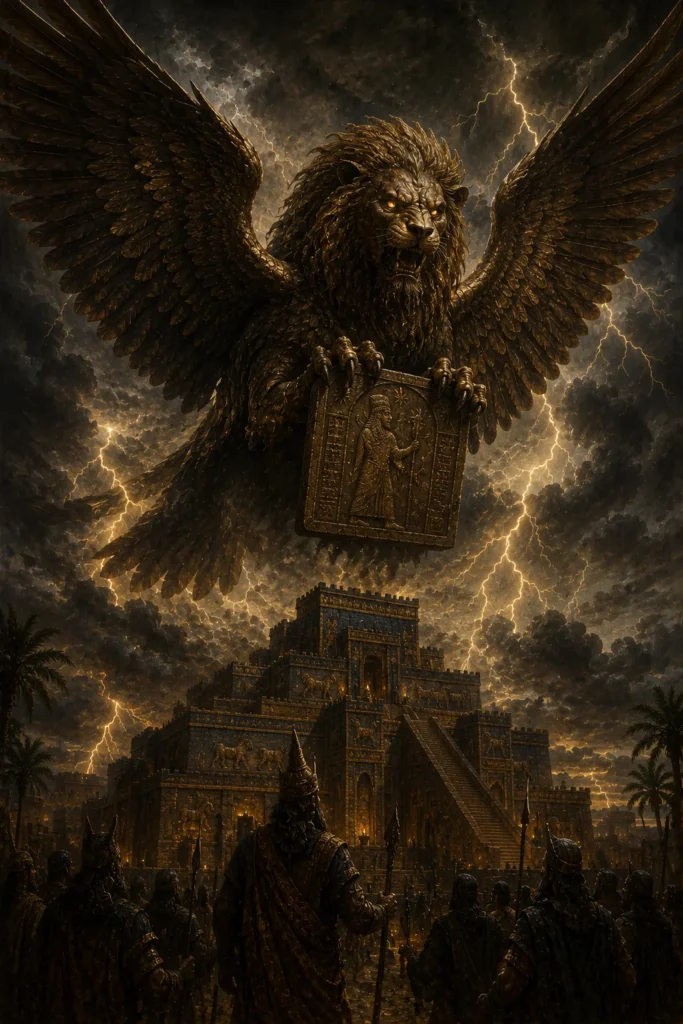
His characteristic iconographic appearance, with a dog’s or lion’s head, a human upper body, bird talons, a scorpion tail and two or four wings, appears on numerous bronze figures, stone plaques and amulets that are today housed in Western museums.
Quick overview: Pazuzu
Type: wind and plague demon, at the same time protective demon
Origin: Assyro-Babylonian, focus in the 1st millennium BCE
Function: ambivalent, brings illness (west wind) and protects against Lamashtu
Invocation: amulets with Pazuzu’s head, especially for pregnant women and infants
Central sources: Akkadian Lamashtu Series, archaeological finds
Classification
The Pazuzu cult is documented in its mature form since the early 1st millennium BCE, with its centre in the Neo-Assyrian and Neo-Babylonian empires (8th to 6th centuries BCE).
Precursors of individual motifs, such as protection against female disease demons, reach further back. In late antiquity the Pazuzu cult proper disappears; individual motifs continue, however, in the Jewish Lilith tradition and on Coptic amulets.
Mesopotamia (Assyria, Babylonia) as the core area; Pazuzu heads and statuettes are found from northern Syria (Tell Halaf, Tell Sheikh Hamad) through the Jordan Valley to Phoenicia and Cyprus.
Individual finds are also attested in Iran and the Levant. The finds reach well beyond the narrower Land between the Rivers and demonstrate the transregional impact of the protective motif.
Central are the Akkadian incantation texts against Lamashtu, in which Pazuzu is invoked as an effective counterpart (Lamashtu Series).
In addition there are more than 100 surviving bronze statuettes and heads as well as stone amulets, many of them in the Louvre, the British Museum, the Vorderasiatisches Museum in Berlin and the Iraqi National Museum in Baghdad.
Research rests substantially on F. A. M. Wiggermann, Walter Farber and R. Borger; the most important recent monograph is Heeßel 2002 (Brill).
Designation and spellings
Akkadian: Pazuzu (with the determinative DINGIR for gods and demons). More rarely Pa-zu-zu (phonetic spelling in school texts). A Sumerian precursor cannot be clearly identified.
Son of Hanbi (Hanpi), brother of the Seven (sebettu, seven disease spirits). Direct Greek and Roman reflexes are not transmitted; the functional parallels are passed on through the Lamashtu line.
Description
Appearance
Dog’s head (frequent) or lion’s head, with bared teeth and protruding tongue. Human upper body. Bird talons instead of feet. Scorpion tail. Two or four wings. One hand is raised in an apotropaic gesture, the other points downward. The statuettes are often 8 to 15 cm tall and carry incantation formulas on the back.
Behaviour
Pazuzu rides on the hot west wind, which in Mesopotamia brings plague and fever. He is himself understood as a dangerous cause of illness. At the same time, however, he appears in incantations as an honourable opponent against the female demon Lamashtu, whom he drives back into the underworld.
Sphere of action
Classically: diseases of the respiratory tract, fever, infant death, complications during childbirth. At the same time, however, protection against precisely these threats, provided he is bound by means of an amulet. The logic is apotropaic: only the stronger one can protect against the strong, a basic motif of Ancient Near Eastern protective magic.
Profile: Pazuzu
The most important aspects of Pazuzu at a glance. A detailed treatment follows in the next sections.
Pazuzu is the son of Hanbi (Hanpi), a wind demon who remains shadowy in the sources, and brother of the Seven (sebettu, seven disease spirits). His position in the family of gods is ambiguous: he belongs to the lower demons, but holds royal rank among the wind demons.
Effect on all people, but especially on pregnant women, infants and women in childbed, who at the same time become his most important protégés when his amulet is used.
The standard iconographic execution (dog’s head, scorpion tail, four wings) remains constant over almost 500 years. Variation occurs in the number of wings and the position of the hands. The range of materials extends from bronze through lapis lazuli to rock crystal.
On the physiological level: illness, fever, shortness of breath. On the existential level: the awareness of the vulnerability of human life before invisible powers, and the possibility of meeting it through ritual.
Paradoxical: Pazuzu himself becomes the means of defence. Pregnant women and women in childbed wear his head as a pendant or hang statuettes above the infant’s bed. The apparatus of Lamashtu incantations combines the invocation of Pazuzu with fumigation, protective circles and incantation formulas.
Practical use
Rituals of invocation
Incantation tablets were recited at night, statuettes placed in house niches or at the child’s bed. In cases of complications during pregnancy, Pazuzu heads were worn as chest pendants. Fumigation offerings of juniper and cedar wood accompanied the invocation. The Lamashtu incantation series has a fixed liturgical frame with preparation, invocation and closing formulas.
Pazuzu: parallels in other cultures
Egypt
Bes is a comparable ambivalent protective deity for pregnant women and infants. A similar profile: a dwarfish, ugly figure whose very ugliness frightens off evils. Taweret, the hippopotamus-shaped protective goddess of pregnant women, shares the same sphere of action.
Greece
Lamia and Empusa as child-killing female demons correspond functionally to Lamashtu, without, however, having a direct Pazuzu counterpart. Greek protective practice prefers apotropaic objects such as phallic Hermes pillars or Medusa heads.
Jewish tradition
Lilith functionally takes over the role of Lamashtu in Jewish rabbinic and Kabbalistic writings (threat to women in childbed and infants). Protective amulets bearing the name Lilith or the archangels Sanvi, Sansanvi and Semangelaf appear from the Middle Ages onward.
Modern reception
William Peter Blatty’s novel The Exorcist (1971) and the film adaptation of the same name (1973) turned Pazuzu into a figure of popular culture in the 20th century.
The novel takes up the topos of the plague demon and transfers it into a modern context of possession, which is only loosely connected with the historical function of Pazuzu.
Iconography and image carriers
Hardly any Mesopotamian demon is as clearly tangible in imagery as Pazuzu. The depiction follows a remarkably stable canon over centuries: a gaunt, upright composite-being body with a dog’s or lion-like face, protruding eyes, bared teeth, a scaled trunk, bird talons on the feet, a scorpion tail and two pairs of outspread wings.
This stability of the visual formula is noteworthy in the history of religion because it secured the recognisability of the protective sign.
Pazuzu has survived above all on small-format bronze and stone amulets, on plaques, and as an isolated, often pierced head worn on the body or fastened to furniture. Many pieces bear a standardised inscription on the back, in which the demon introduces himself: son of Hanbu, king of the evil wind spirits.
The bronze heads from the first pre-Christian millennium are among the most frequently found apotropaic objects of Mesopotamia and document a broad use that was not restricted to elites.
Function within the Lamashtu complex
In the sources Pazuzu rarely acts alone. His fixed point of reference is Lamashtu, the female demon who preys on pregnant women and newborns.
This opposition explains Pazuzu’s paradoxical position: he is himself a dangerous wind and fever demon, but is for precisely that reason deployed against the still more dangerous Lamashtu. The principle is one of warding off evil by means of a controlled, lesser evil.
On the so-called Lamashtu amulets, Pazuzu frequently appears at the upper edge or behind the scene in which Lamashtu is being driven back into the underworld. His head often projects over the edge of the image, as though he were looking in from outside.
Assyriology interprets this as a ritual logic: the demon drives out his own kind. Heinrich Zimmern, and later Frans Wiggermann, described this mode of operation as the core of the Mesopotamian apotropaion, which relies not on purity but on counter-power.
State of the sources and history of research
The scholarly study of Pazuzu rests on a comparatively dense body of material. Foundational is the monograph by Nils Heeßel, which brings together the entire known corpus of Pazuzu objects and the associated incantation texts and arranges them typologically.
Complementary are the works of Frans Wiggermann on Mesopotamian protective spirits and the older collection of incantation literature by Erich Ebeling.
Methodologically Pazuzu is a fortunate case, because pictorial and textual sources support each other: the recurring inscription on the objects can be linked with the ritual texts of the royal libraries.
The question of the precise time of origin of the figure remains open; the oldest secure attestations date to the early first pre-Christian millennium, and an older background is suspected but not documented.
Further internal links
Further reading:
- Mesopotamia (superordinate culture page)
- Lilû and Lilītu (related wind demons)
- Bes (Egyptian parallel)
- Apotropaic symbols (thematically close)
Literature (selection)
A selection of important works on Pazuzu and Mesopotamian demonology:
- Heeßel, Nils P.: Pazuzu, Archäologische und philologische Studien zu einem altorientalischen Dämon, Brill 2002.
- Wiggermann, F.A.M.: Mesopotamian Protective Spirits, The Ritual Texts, Styx 1992.
- Farber, Walter: Lamaštu, An Edition of the Canonical Series of Lamaštu Incantations and Rituals, Eisenbrauns 2014.
- Black, Jeremy & Green, Anthony: Gods, Demons and Symbols of Ancient Mesopotamia, An Illustrated Dictionary, British Museum Press 1992.
- Borger, Rykle: Beiträge zum Inschriftenwerk Assurbanipals, Harrassowitz 1996.
Further standard works in the literature index.
The protective practice described here is a religious-studies classification of historical traditions. iWell Guard connects to this cultural-historical line of wearable protective objects and represents a contemporary form of it. More about the iWell Guard →
Frequently asked questions about Pazuzu
Who was Pazuzu?
Pazuzu was a Mesopotamian wind and storm demon, originally feared, but paradoxically used as a protective demon against the far more dangerous Lamashtu. Pazuzu was considered king of the evil winds, bringer of drought and famine, but in his anti-Lamashtu function he became the most popular apotropaic figure of the Ancient Near East.
What was the Pazuzu amulet used for?
Pazuzu amulets of bronze or stone were widely worn in the 1st millennium BCE, especially at birthing houses and at the beds of women in childbed. They were intended to keep away Lamashtu, who was held responsible for infant death and puerperal fever. The famous statue in the Louvre shows Pazuzu in profile with a raised scorpion tail.