Tarhunna, Hittite Weather God and Imperial Lord
By Ralf Ittermann · last reviewed on
Tarhunna, usually written in cuneiform texts as D U or Tarḫunna, is the supreme weather god of the Hittite empire in the second millennium before the common era.
As god of thunderstorm and storm he rules the sky above Anatolia, protects the Great King in battle, and stands at the center of numerous state treaties that seal their oaths in his name.
Profile: Tarhunna
Tarhunna: the most important aspects at a glance. The following fields summarise origin, function, appearance, veneration, symbols and parallels.
Tarhunna is the supreme weather god of the Hittite empire in the second millennium BC. He is attested from the 17th and 16th centuries BC until the fall of the empire around 1180 BC. He appears in local variants, for example as the weather god of Nerik, Aleppo, Ziplanda or Ḫattuša.
As god of thunderstorms and storms, Tarhunna governs the sky over Anatolia and protects the Great King in battle. His sphere of action ranges from thunderstorm and rain through protection of the king to the treaty oath and the fertility of the fields. In state treaties he is the supreme oath god.
Tarhunna appears as a bearded man in a short, belted kilt with a pointed, horned cap, holding a three-pronged lightning fork in one hand and a battle axe in the other. On the rock reliefs of Yazılıkaya he leads the male procession of gods as its head.
His most important sanctuary lay in Nerik, a second main site in Aleppo. The spring festival purulli was his annual main festival, with a festival procession, ritual repetition of the dragon fight and bull sacrifices. In the imperial temple of Ḫattuša, offerings were made daily.
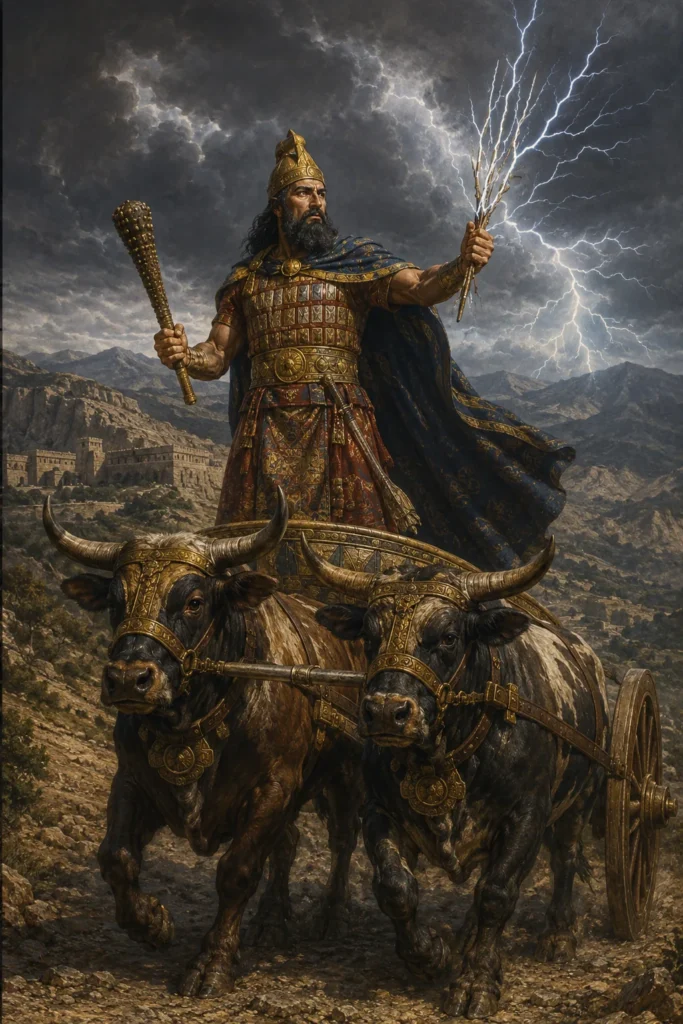
His symbols are the axe and the three-pronged lightning bolt, which appear on seals and amulets as protective images. The bull is his sacred animal and is sacrificed in the cult. His chariot is drawn by the bulls Šeri (“Day”) and Ḫurri (“Night”).
Tarhunna belongs to the type of the Indo-European weather god and is related to Teshub, Hadad and Indra. There are parallels to Zeus and Donar, and in the dragon fight to Indra’s victory over Vrtra and Thor’s fight against the Midgard Serpent. Particular to him is his role in treaty law as guarantor of oaths.
Classification and Short Profile
Tarhunna belongs to the innermost circle of the Hittite state pantheon and appears in texts from the archives of Ḫattuša (today Boğazkale) as the supreme male imperial god.
In his Geschichte der hethitischen Religion (1994), Volkert Haas showed that Tarhunna is continuously attested from the Old Hittite period of the 17th and 16th centuries BCE and remained the central weather deity until the fall of the empire around 1180 BCE.
His sphere of activity is broad: thunderstorm, rain, the violence of battle, royal protection, the treaty oath, and the fertility of the fields.
Within the Hittite tradition he holds a position similar to that of Teshub in the Hurrian pantheon, with whom he was increasingly identified in the imperial cult of the Great Kings.
In The Kingdom of the Hittites (2005), Trevor Bryce calls this merging one of the most important developments in the religious history of the late Bronze Age of Anatolia.
Tarhunna appears in local variants, for example as the weather god of Nerik, of Aleppo, of Ziplanda, or of Ḫattuša, and each maintained its own cult sites, festival calendars, and priestly hierarchies.
In religious-studies terms, Tarhunna belongs to the widespread type of the Indo-European weather god who rules from the peak of a high mountain or from a seat in the clouds.
Parallels are found in Indra, Zeus, and the Germanic Donar; Tarhunna, however, differs from these through the strong contractual and legal component that marks him as the guarantor of oaths.
Hittite theology wove the weather god together with kingship to a unique degree: the Great King is the ‘son’ or ‘beloved servant’ of Tarhunna, and his legitimacy depends on divine favor.
Name and Etymology
The name Tarhunna derives from the Indo-European root *terh₂- ‘to cross, to overcome, to be strong’. In How to Kill a Dragon (1995), Calvert Watkins showed in detail that the root yielded in Hittite the verb tarḫ- ‘to be victorious, to subdue’. Tarhunna is therefore literally the ‘victor’ or ‘subduer’, a speaking name that programmatically anticipates his principal mythological battle against the serpent Illuyanka.
The formation of the name with the element -na is productive in Anatolian and forms divine names from verbal stems.
In the cuneiform texts the name is almost always written with the Sumerian logogram DU (read: Iškur/Adad) or DIM, followed by Hittite phonetic complements such as -aš, -un, -ni. A rare phonetic spelling Tar-ḫu-na-aš is found in Old Hittite festival rituals.
In Luwian the form Tarḫunt appears, in Palaic Tarḫunna. The variation of the form is an important trace in the history of the language and is discussed in detail in the works of H. Craig Melchert (Anatolian Historical Phonology, 1994).
Hieroglyphic Luwian inscriptions of the late and post-Hittite period in Karkamiš, Maraş, and Tabal show a standing god with axe and bundle of lightning; the logogram DEUS.TONITRUS designates him directly as ‘thunder god’. In Akkadian god-list material he is identified with Adad, who in turn corresponds to the West Semitic Hadad; this chain of identification shows the consistent perception of Tarhunna as ‘the weather god’ par excellence in the ancient Near Eastern context.
Description and Iconography
In imagery Tarhunna appears as a bearded man in a short, belted kilt, a pointed cap with horns on his head, in one hand a three-pronged lightning fork, in the other a battle axe.
This iconography is recorded in canonical form on the rock reliefs of Yazılıkaya, the great pictorial sanctuary near Ḫattuša. In Die Hethiter (1976), Kurt Bittel described Tarhunna in the main chamber A of the sanctuary as the leader of the male procession of gods.
Characteristic is his mount, or rather his team: Tarhunna drives a chariot drawn by two bulls named Šeri (‘Day’) and Ḫurri (‘Night’). This bull-team iconography is a direct indication of Hurrian influence; it closely links Tarhunna with Teshub.
The bull itself is his sacred animal and is sacrificed in his cult; in numerous reliefs a bull stands beside the weather god or carries him on its back.
The bronze figurine of a striding Tarhunna from Tarsus shows the god with raised axe and is one of the best-known individual objects of Hittite minor art.
In addition, rock reliefs are known in which Tarhunna assumes royal protection: at Yazılıkaya the god Šarruma embraces the Great King Tudḫaliya IV and thus places him under divine protection.
The pictorial formula of the divine embrace is referred to in scholarship as the ‘tutelary gesture’ and is a hallmark of royal legitimation. In Karkamiš, Aleppo, and other Late Hittite sites the Tarhunna iconography remains present into the 8th century BCE, frequently in connection with the winged sun-disk symbol of kingship.
Mythological Narratives
The most important Tarhunna narrative is the myth of the dragon battle against Illuyanka, an enormous serpent. The text survives in two versions from the Old Hittite purulli spring festival (CTH 321) and was edited by Gary Beckman in Hittite Myths (1998).
In the first version Tarhunna is defeated by Illuyanka and loses his heart and his eyes; only the cunning of the goddess Inara and the mortal Ḫupašiya leads to the destruction of the dragon.
Inara holds a feast, invites Illuyanka, lets him become drunk and full, then Ḫupašiya binds the serpent with a rope, and Tarhunna is able to kill it.
In the second version Tarhunna fathers a son with a mortal woman, who, against expectation, becomes Illuyanka’s son-in-law and brings back to his father the stolen organs. The son then demands that his father kill him, because he cannot maintain loyalty to both sides. Tarhunna fulfills this tragic request and regains his power.
The motif of the weather god’s dragon battle is, in the history of religion, one of the oldest Indo-European narrative patterns. Watkins showed that the formula ‘the hero slew the dragon’ (Indo-European *gwhen- h₃egwhim) is preserved in almost all Indo-European languages.
With Tarhunna it becomes a seasonal myth: the victory over the dragon marks the change from the dead winter season to the fruitful spring.
Further narratives in which Tarhunna appears are the Telipinu myth, in which Tarhunna searches for his vanished son, as well as the Ullikummi cycle, in which as Teshub he fights against the stone giant. In all three narratives Tarhunna does not appear as infallible; he is vulnerable, can lose, and needs allies and cleverness.
Cult and Veneration
Tarhunna’s cult was spread across the entire Hittite imperial territory. His most important sanctuary lay in Nerik, a North Anatolian city that was for a time lost to the hostile Kaska people and whose recovery became a religio-political imperative.
The weather god of Nerik was an independent local hypostasis and the addressee of numerous prayers of the Great King Muršili II (for example CTH 376).
A second principal place of veneration was Aleppo (Ḫalab), already since Old Syrian times the seat of an important weather god; after his integration into the Hittite pantheon, his local temple was rebuilt in Ḫattuša.
The purulli spring festival was the annual main festival of Tarhunna. Volkert Haas reconstructed its course: festival procession, ritual repetition of the dragon battle, sacrifice of bulls, hosting of the gods with bread, beer, and wine.
In the imperial temple of Ḫattuša sacrifices were offered daily; the Hittites kept extensive temple inventories in which cult implements, garments, and statuettes are recorded. These inventories have been edited, among others, by Carter and Hazenbos.
In the law of state treaties Tarhunna is the supreme oath god.
Treaties between Hittite kings and vassal rulers regularly begin with a long list of gods, at the head of which stands ‘the weather god of heaven’. If a party violates the oath, Tarhunna is to ‘smash it like a clay jar’, as attested in the treaties with Aziru of Amurru or with Šattiwaza of Mittani.
The priestly organization of his cult comprised several classes: SANGA priests for daily service, LÚAZU conjurers for special rituals, and SAL ŠU.GI priestesses (‘Old Women’) for apotropaic and healing rituals.
Practice of Protection and the Apotropaic
In Hittite everyday life Tarhunna was frequently invoked to ward off weather damage, droughts, and hostile incursions. Numerous prayers (Hittite arkuwar) to the weather god of Ḫatti survive, for example the plague prayers of Muršili II (CTH 378), in which the king asks for the ending of a great epidemic.
In religious-studies terms these texts are significant because they contain a differentiated theological argumentation: the king reasons with the god, points to his own acts of atonement, and admonishes the gods not to abandon their servants entirely.
Apotropaic rites frequently used the symbols of Tarhunna: the axe and the three-pronged lightning. On seals and amulets the striding weather god with raised weapon appears as a protective image.
At building sacrifices, bronze figurines bearing the Tarhunna iconography were deposited in the foundations of temples and palaces; the Ḫattuša area has yielded a larger number of such statuettes.
In Materia Magica et Medica Hethitica (2003), Volkert Haas showed that thunder tools (stone axes, presumably Neolithic finds interpreted as thunderbolts) were kept in houses to ensure protection from lightning.
From a religious-studies perspective, the close connection between imperial rule and the promise of protection is of interest: Tarhunna guarantees protection primarily not to the individual, but to the king and through him to the people, against chaos and enemies.
The individual invocation for protection is documented more rarely in the Hittite material than in Mesopotamia or Ugarit, but is certainly present in the texts of the ‘Old Women’ (ḪAR.ḪAR). The iWell Guard regards Tarhunna as a figure of historical and religious history, not as a present-day addressee of protection.
Parallels in Other Cultures
Tarhunna belongs to the great type of the Indo-European weather god and is closely related to the Hurrian Teshub, the West Semitic Hadad, and Indra.
With the dragon-battle motif, parallels can be drawn to Indra’s victory over Vritra in the Rigveda, Zeus’ battle against Typhon, and Thor’s battle against the Midgard serpent. In Die Wettergottgestalten Mesopotamiens und Nordsyriens (2001), Daniel Schwemer presented a comprehensive comparative study of this tradition; the work remains the standard reference to this day.
In the Phoenician pantheon the god Baal-Hadad corresponds very closely, in function and dragon-battle myth, to the Tarhunna profile. Here too the weather god fights against the chaotic water, here Yam, structurally corresponding to Tarhunna’s antagonist Illuyanka.
These parallels are no coincidence, but the result of intensive cultural exchange in the Late Bronze Age between Anatolia, North Syria, and the Levant.
In terms of the history of religion, the spread of the dragon-battle motif rests on an Indo-European heritage as well as on Northwest Semitic storm-god traditions; the Hittite variant is a particularly well-documented mixed form.
The Luwian and Palaic material also records independent weather-god traditions that are in part identified with, in part distinguished from, Tarhunna.
In From Hittite to Homer (2016), Mary Bachvarova traced in detail the transmission of these Anatolian weather-god myths into the Greek narrative material, referring in particular to the Typhon myth, which shows structural borrowings from the Anatolian-Syrian region.
Present-Day Reception and Research
Modern Hittitological research begins with the decipherment of Hittite cuneiform by Bedřich Hrozný in 1915. Since then the texts on Tarhunna have appeared in numerous editions, above all in the series Keilschrifttexte aus Boghazköy (KBo) and Keilschrifturkunden aus Boghazköy (KUB).
Volkert Haas, Trevor Bryce, Daniel Schwemer, and Gary Beckman are among the most important authorities of the 20th and early 21st centuries. In Hittite Prayers (SBL 2002), Itamar Singer translated and commented on the most important prayers to Tarhunna.
In popular reception Tarhunna is less well known than his Indo-European relatives Thor or Zeus. In the Turkish cultural sphere he has been experiencing a modest return since the late 2020s through the marketing of Yazılıkaya and Boğazkale as a UNESCO World Heritage Site.
A spiritual revival in the neo-pagan sense, by contrast with Germanic mythology, is hardly to be observed.
In religious-studies terms, Tarhunna is today present above all as an object of study in comparative mythology and ancient Near Eastern religious history.
Current research focuses on the investigation of local hypostases (weather god of Nerik, Aleppo, Ziplanda), on the relationship between Tarhunna and Teshub, and on the Hieroglyphic Luwian tradition of the Late Hittite Iron Age. The iWell Guard records Tarhunna within this historical and philological framework.
Literature and Sources
The following works are the most important standard references for Tarhunna and the Hittite weather-god pantheon and are also cited in the further lexicon work.
Tarhunna in the Hittite State Treaties
A particularly informative group of sources for Tarhunna are the Hittite state treaties. When a Hittite Great King concluded a treaty with a vassal or a foreign ruler, it was authenticated by a long list of gods of both sides, who were invoked as witnesses and as guarantors of the treaty.
In these god lists the weather god regularly stands in first or foremost place.
The treaties often name a whole series of weather gods of various places: the weather god of heaven, the weather god of Hatti, the weather god of Nerik, the weather god of Zippalanda, and many further local manifestations.
This enumeration shows that Tarhunna was not conceived as a single, centrally organized figure, but as a god who possessed his own, locally anchored presence at every significant cult site.
The curse formulas at the end of the treaties are especially striking. Whoever breaks the treaty is to be destroyed by the weather god and the other gods, together with his land, his descendants, and his property. The weather god appears here as the guardian of the oath and of the interstate order.
The famous treaty between Hattusili III and Ramses II of Egypt, of which both a Hittite and an Egyptian version survive, expressly invokes the weather god on the Hittite side. These treaties are thus a first-rank source for the towering role that Tarhunna played in the political and legal order of the Hittite empire.
The Weather God of Nerik and the Problem of Local Manifestations
Among the many local weather gods of the Hittite empire, the weather god of Nerik holds a special importance. Nerik was an old cult city in the north of the Hittite core territory, which was for a time occupied by the Kaska, a hostile mountain people.
The loss and the later recovery of Nerik occupied the Hittite kings over generations, and the cult of the weather god there was closely interwoven with this history.
Hattusili III reports in his autobiographical text, the so-called Apology, in detail of his connection to Nerik and to its weather god. He presents himself as the one who restored the city and its cult.
The weather god of Nerik was thus not only a religious but also a highly political quantity, by whose veneration the legitimacy of a ruler was measured.
Here a fundamental problem in dealing with Tarhunna becomes apparent. The Hittite texts carefully distinguish between the various local weather gods, yet at the same time treat them as manifestations of the same divine sphere of activity.
Whether an ancient Hittite understood the weather god of Nerik and the weather god of Zippalanda as two gods or as two aspects of one god cannot be answered unambiguously from the sources.
Scholarship speaks of local manifestations and emphasizes that the modern question of the identity of the deity is in part foreign to the ancient texts. The evidence from Nerik is so important precisely because it is particularly well documented and shows how closely local cult, imperial history, and royal ideology were connected.
Tarhunt in Luwian and Post-Hittite Anatolia
The Hittite Tarhunna had a closely related counterpart among the Luwians, a people of Anatolia who likewise spoke an Indo-European language and whose weather god was called Tarhunt. Unlike Hittite, which disappeared after the fall of the Hittite great empire around 1180 before our era, Luwian lived on, and with it the cult of Tarhunt.
In the so-called Late Hittite or Neo-Hittite minor kingdoms that existed after the collapse of the great empire in southeastern Anatolia and North Syria, Tarhunt is a central deity.
He appears in Luwian hieroglyphic inscriptions and on numerous reliefs, for example from Karkemish, Malatya, and other principalities. These inscriptions, composed in the Luwian hieroglyphic script, were deciphered in the course of the 20th century, with works by Emmanuel Laroche, John David Hawkins, and others being fundamental.
In the reliefs of this period Tarhunt frequently appears on a bull or a bull-drawn chariot, with axe and bundle of lightning. This iconography stands in the tradition of the old Anatolian weather god but also shows influences from the Syrian region.
Linguistically the name Tarhunt is connected with the Hittite verb for to be victorious or to be mighty, so that the divine name means roughly the Victorious or the Mighty.
Through Luwian and through Anatolian personal names the designation of the weather god can even be traced into the Greco-Roman period of Asia Minor. Tarhunna and Tarhunt are thus an example of how a deity could survive by centuries the fall of the empire that had borne its main cult.
Literature (Selection)
- Volkert Haas: Geschichte der hethitischen Religion (Leiden 1994)
- Trevor Bryce: The Kingdom of the Hittites (Oxford 2005)
- Daniel Schwemer: Die Wettergottgestalten Mesopotamiens und Nordsyriens (Wiesbaden 2001)
- Harry A. Hoffner: Hittite Myths (SBL 1998)
- Calvert Watkins: How to Kill a Dragon (Oxford 1995)
- Jared Miller: Royal Hittite Instructions (SBL 2013)
As weather god and imperial lord, Tarhunna guaranteed in Hittite royal ideology rain, victory, and fidelity to treaties, as state treaties and rock reliefs in Hattuša attest.
Related key terms: Tarhunna Hittites weather god Illuyanka purulli Nerik Ḫattuša chariot god.
iWell Guard and Traditions of Protection
iWell Guard ties in with the cultural-historical tradition of portable protective objects, in the tradition of Hittite and many other cultures worldwide. 41 layers, solid gold, platinum, silver, manufactured in Germany. 30-day right of return.
Personal experiences may vary. Not a medical device. No promise of healing.