Horagalles, Thunder God of the Sami
By Ralf Ittermann · last reviewed on
Horagalles (also Hora Galles, Tiermes or Aijeke) is, in Sami belief, the god of thunder and storm and counts as one of the most powerful deities of the pre-Christian religion of the Sami peoples in the north of Scandinavia, Finland and the Russian Kola Peninsula.
His worship is documented through early modern missionary sources, whose evidential value has to be assessed with source criticism.

Profile: Horagalles
Horagalles: the most important aspects at a glance. The following fields summarise origin, function, appearance, veneration, symbols and parallels.
Horagalles is the god of thunder and storm in the pre-Christian belief of the Sámi in the north of Scandinavia, Finland and on the Russian Kola Peninsula. His name is explained from the Old Norse “Þórr karl” (“old Thor”). The tradition comes from missionary sources of the 17th and 18th centuries, which presented Sámi religion in a distorted way.
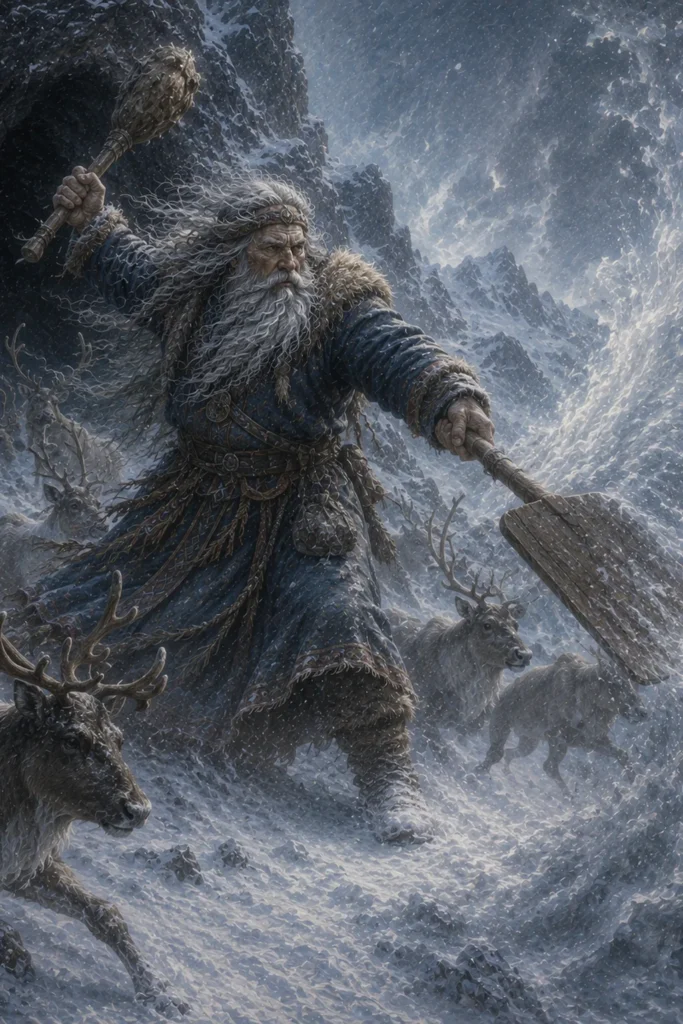
Horagalles controls lightning and thunder and exercises power over the weather. He protects people from evil spirits, especially from the Stallo (giants), and drives away the trolls and giants with hammer or battle-axe.
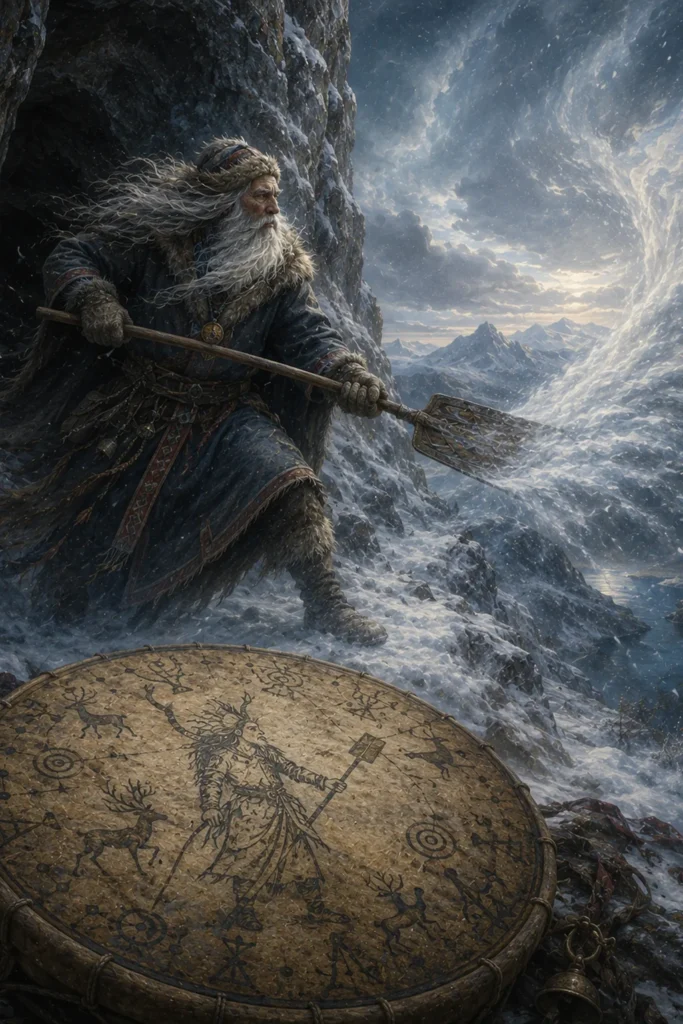
On many Sámi drums a central figure with a hammer or hatchet is depicted, who is regarded as Horagalles, sometimes directly beneath the sun symbol (Beaivi). Typical is a human-shaped figure with a raised weapon. There is no standardized iconography, and the interpretation of the figures is not always clear.
Horagalles received animal sacrifices, above all reindeer, at places of worship (sieidi), mostly conspicuous rock formations, large stones or special trees. During thunderstorms special offerings were made to appease him, and black oxen were dedicated to the thunder god in early summer.
Symbols are the hammer, the hatchet and the battle-axe, and on drums also two hammers or hammer and staff. To this is added the closeness to the sun symbol Beaivi. Birch-bark twigs in lightning shape were hung at sacred places, and the sieidi stones received fat and blood.
Horagalles is regarded as typologically related to the North Germanic Thor. Parallels are found in the Finnish tradition (Ukko) and among the Nenets in western Siberia (Num), which points to a wide-ranging North Eurasian thunder-god complex. Missionaries equated him with the Devil; equation with Saint Olaf was also widespread.
Source situation and critical assessment
The most important written sources on Sami religion date from the 17th and 18th centuries. Olaus Magnus, in his “Historia de gentibus septentrionalibus” (1555), gives the first comprehensive account of Sami religious practices, though in a strongly ethnographic and distanced form.
The central source is Johannes Schefferus’s “Lapponia” (1673), in which Horagalles is described by name and by function. In the 18th and 19th centuries, Knud Leem, Lars Levi Læstadius and Johan Nordlander added more detailed observations.
Caution is required when interpreting these sources. Håkan Rydving, in his studies, above all in “The End of Drum-Time” (1993), has shown that the missionary records depicted Sami religion through a Christian lens and systematically distorted it. Terms such as “god”, “idol” or “devil” were applied without reflecting on Sami concepts.
Juha Pentikäinen, in “Sami Mythology” (1999), pointed to the methodological difficulty that Sami religion in its pre-Christian form can today only be reconstructed indirectly. Louise Bäckman and Anna-Leena Siikala have edited and critically annotated the evidence systematically.
Name and etymology
The name Horagalles is explained as a Sami borrowing from the Old Norse “Þórr karl” (“old Thor”, “Thor-man”), which indicates a clear connection to the North Germanic thunder god Thor.
This etymology has been the standard assumption since the 19th century and was confirmed by linguists such as Lars Levi Læstadius and later by Konrad Nielsen and Pekka Sammallahti. In some Sami dialects the form Hora-Galles or Hora-Gallis is also attested, in Northern Sami Horagálles.
In addition, scholarship uses further names for what is probably the same deity: Tiermes, Atjek, Aijeke or Pajan-Olmai. This variety of names reflects, on the one hand, regional dialect differences and, on the other, the fact that Sami religion did not have one uniform, dogmatically fixed form but varied strongly from place to place.
Håkan Rydving has pointed out that the missionary records often carried out an artificial homogenization that did not correspond to the actual religious diversity.
Function as thunder god
Horagalles is first and foremost a thunder god who controls lightning and thunder and thereby exercises power over the weather. He is regarded as a protector of people against evil spirits, especially against the Stallo (giants) and other hostile beings from Sami spirit belief.
His hammer or his battle axe is his most important weapon, with which he drives away the evil ones and fights against the trolls and giants. This function and armament explains the clear typological kinship with the North Germanic Thor.
Anna-Leena Siikala, in comparative works on Finno-Ugric and Sami mythology, has shown that the thunder god conception among the Sami was influenced by contacts with the Scandinavian neighbours, but built on older, independent ideas.
Parallels are also found in the Finnish tradition (Ukko) and in the West Siberian tradition (Num among the Nenets), which point to a wide-ranging North Eurasian thunder god complex.
Drum symbolism
The most important source for the iconography of the Sami gods are the Sami drums (“goavddis” or “gievrie”), which were collected by missionaries in the 17th and 18th centuries and preserved in museums.
On many of these drums a central figure is depicted, usually armed with a hammer or axe, which is identified as Horagalles. Sometimes his figure is placed directly beneath the sun symbol (Beaivi), which underscores his high position in the Sami pantheon.
The meaning of these drum figures is, however, not unambiguous in all cases, because the drums were used by the respective “noaidi” (Sami shamans) for ritual purposes and were designed with personal symbols.
Ernst Manker and Phebe Fjellström, in their studies of Sami drum art, have worked out the diversity of the depictions. There is no standardized iconography for Horagalles, but certain basic features (hammer, axe, anthropomorphic figure with raised weapon) appear repeatedly.
Worship and rites
The missionary sources report little in detail about the concrete worship practice. Horagalles evidently received sacrifices in the form of animals (above all reindeer), which were offered at special cult sites (“sieidi”).
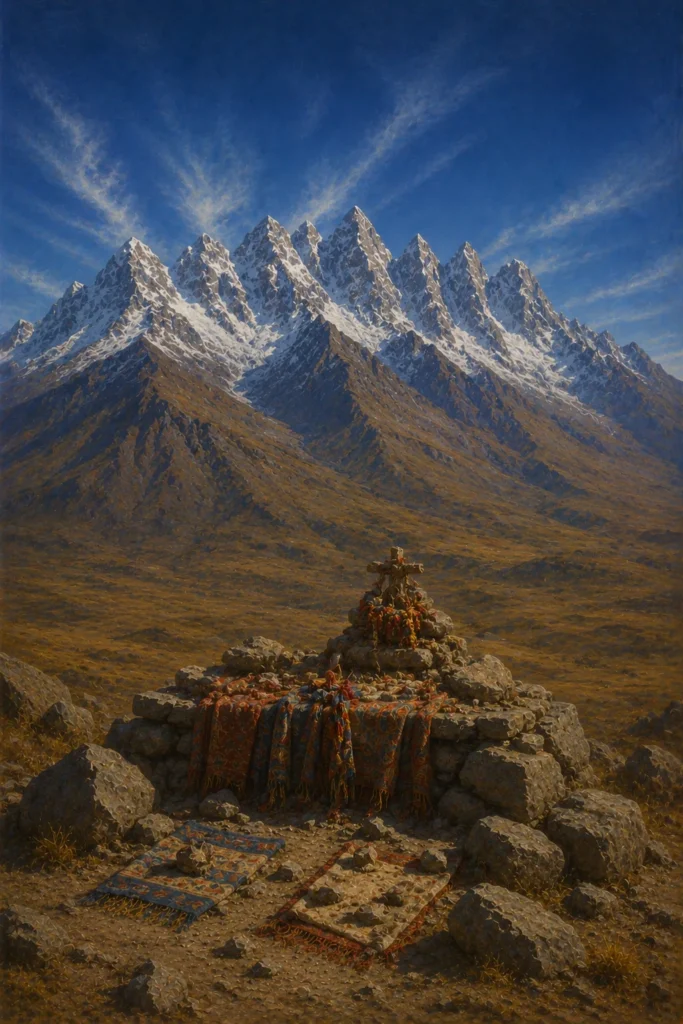
These cult sites were mostly striking rock formations, large stones or special trees that were regarded as the seat of the gods. During thunderstorms, special sacrifices were offered to appease Horagalles or to ask for his help.
Shamanic practice was at the centre of Sami religion. The noaidi could make contact with the gods, including Horagalles, with the help of his drum and through ritualized trance journeys.
This practice is often presented in the missionary sources as “devil’s sorcery” and was systematically persecuted in the 17th and 18th centuries. Håkan Rydving, in “The End of Drum-Time”, has documented how the Sami drums were burned or confiscated during this period, which led to a massive loss of religious cultural goods.
Christianization and suppression
The Christianization of the Sami began in the 11th and 12th centuries with first missionary attempts, intensified massively in the 16th and 17th centuries, and ended in the 18th and early 19th centuries with the extensive displacement of the pre-Christian religion from public life.
Håkan Rydving has traced the stages of this process in detail. The Swedish, Norwegian, Finnish and Russian state and church authorities used punishments, drum confiscations and forced baptisms to suppress the traditional belief.
During this phase of suppression, Horagalles was often identified with the Christian devil or with “Satan”. This identification was part of the missionary strategy of branding the old religion as demonic.
The identification of Horagalles with Saint Olaf was also widespread, the Norwegian royal saint who, like Horagalles, was regarded as a fighter of trolls and giants and could thus function as an iconographic bridge between the old and the new religion.
State of research
The modern study of Sami religion began in the second half of the 19th century and became markedly more differentiated in the 20th and 21st centuries. Important contributions come from Håkan Rydving, Juha Pentikäinen, Louise Bäckman, Anna-Leena Siikala, Ernst Manker and Phebe Fjellström.
Together they have developed a differentiated picture of Sami religion that takes into account the diversity of regional traditions, the distortions caused by missionary sources and the difficulties of reconstruction.
A central matter of dispute concerns the degree of influence from Scandinavian religion. While older research saw Horagalles as a purely Sami counterpart to Thor, more recent works emphasize the independent Sami tradition and see the Scandinavian influence as a layer over an older Sami thunder god conception.
This position is held above all by Anna-Leena Siikala, who points to Finno-Ugric parallels.
Key missionary sources of the 17th and 18th centuries
The most important stage of the Horagalles tradition in terms of source criticism lies in the 17th and 18th centuries, when Swedish and Danish-Norwegian missionaries and officials first made systematic records of Sami religion.
Johannes Schefferus published his “Lapponia” in Frankfurt in 1673, a regional account written on behalf of the Swedish Lord High Chancellor Magnus Gabriel De la Gardie, which in a separate chapter, “De Lapponum Diis”, presents the world of the gods and lists Horagalles (in the form “Thoragalles”) as the highest of the thunder gods named among the “Stoorjunkare”.
Schefferus relied on reports by Swedish pastors such as Olaus Petri Niurenius, Samuel Rheen, Olaus Graan and Johannes Tornaeus, whose manuscripts he partly quoted directly. The “Lapponia” was quickly translated into several European languages (English 1674, German 1675, French 1678) and shaped the ethnographic perception of Sami religion in Europe for a century.
In the Norwegian-Danish region, the manuscripts of the missionary Thomas von Westen (1682 to 1727) arose in parallel; he led a systematic missionary effort in the northern Norwegian Sami areas as the “Apostle of the Lapps”.
His pupils Isaac Olsen, Hans Skanke (with the “Epitomes Historiae Missionis Lapponicae Pars Prima”, completed in 1728), Jens Kildal and Johan Randulf gathered an extensive corpus of handwritten reports, which are referred to as the “Nærøy manuscript” (Randulf) and the “Kildal manuscript”.
These sources were not fully edited until the 20th century, by Reidar Th. Christiansen and Karl Bernhard Wiklund.
They provide the densest descriptions of the concrete sacrificial practice: black oxen were consecrated to the thunder god in early summer, birch bark twigs in lightning shape were hung at holy places, and the “sieidi” stones received offerings of fat and blood.
Drum painting in comparative research
The central iconographic source for Horagalles are the depictions associated with him on the “goavddis” drums, the shaman drums of the Sami “noaidi” specialists. Ernst Manker, in the two monumental volumes “Die lappische Zaubertrommel. Eine ethnologische Monographie” (Stockholm 1938 and 1950), documented and iconographically catalogued around seventy surviving drums in all.
On about a third of these drums a central figure with two hammers (or hammer and staff) is recognizable, which is identified with Horagalles in the source inscriptions of the drums and in the comments of the confiscating clergy.
A particularly dense depiction is found on the “Bindal drum” (Stockholm, Nordiska Museet) and on the “Sør-Fron drum” (Oslo, Norsk Folkemuseum).
Håkan Rydving, in “The End of Drum-Time. Religious Change Among the Lule Saami, 1670s to 1740s” (Uppsala 1993), has shown that the drum paintings are not to be read as a static pantheon, but as regionally varying, biographically shaped diagrams of the individual “noaidi”, whose pictorial world shifted strongly in the early modern encounters with Christianity.
Juha Pentikäinen (“Shamanism and Northern Ecology”, Berlin 1996) and Anna Westman (anthology “Sápmi.
Becoming a Nation”, Stockholm 2007) have corroborated this thesis with reference to more recent drum examples and contextual reports from Inari and Pite Lappmark.
Reception today
In the 20th and 21st centuries, Sami identity, including religious elements, has become the subject of a broad cultural revitalization. The Sami languages are being promoted, traditional drum art is being practised again, and the old gods are at least being addressed again as cultural heritage.
There has been no official religious revival of the Horagalles cult, but in contemporary Sami art and literature he appears as a symbol of cultural autonomy.
In the Finnish, Norwegian and Swedish majority culture, Horagalles is less well known than Thor and Odin, but has gained visibility in recent decades through the growing interest in Sami culture.
Museums such as the Siida Museum in Inari, the Nordnorsk Vitenskapsmuseum in Tromsø and the Ájtte Museum in Jokkmokk present Sami religion and its gods to a wider public. This cultural visibility is part of a broader postcolonial reckoning with the historical oppression of the Sami tradition.