Bieggegaellies, the Wind Elder of the magic drum
By Ralf Ittermann · last reviewed on
Bieggegaellies is a god of the Sami tradition.
The Wind Elder, a second name for the lord of wind and storm.
Bieggegaellies, also Biegkegaellies or Bieggagállis, is the Sami Wind Elder: a name variant of the same wind god known as Bieggolmai, the Wind Man. The epithet Wind Elder, rather than Wind Man, denotes the same deity who rules over wind and storm.
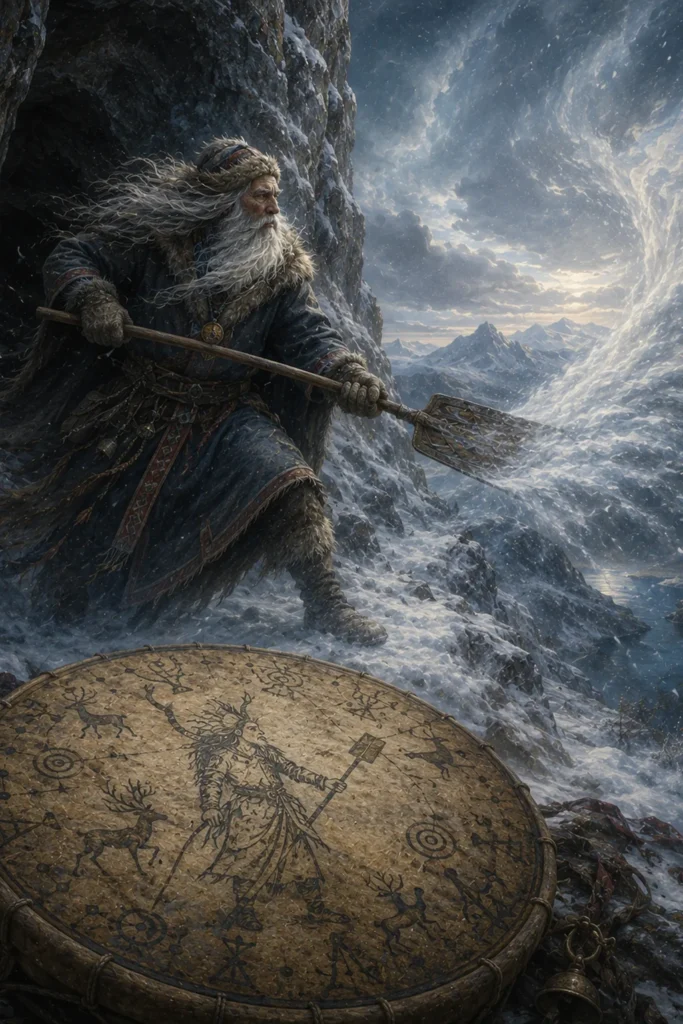
The name is above all tangible on the Sami magic drums, where the wind deity appears in the form Biegga-galles as one of the central figures, and in missionary and ethnographic sources from the 17th to 19th centuries.
Type: wind god, name variant of the Wind Man Bieggolmai
Origin: Sápmi, the Sami region
Texts: Randulf (Nærøy manuscript, 1723), Læstadius, magic drums
Period: missionary and ethnographic accounts from the 17th to 19th centuries
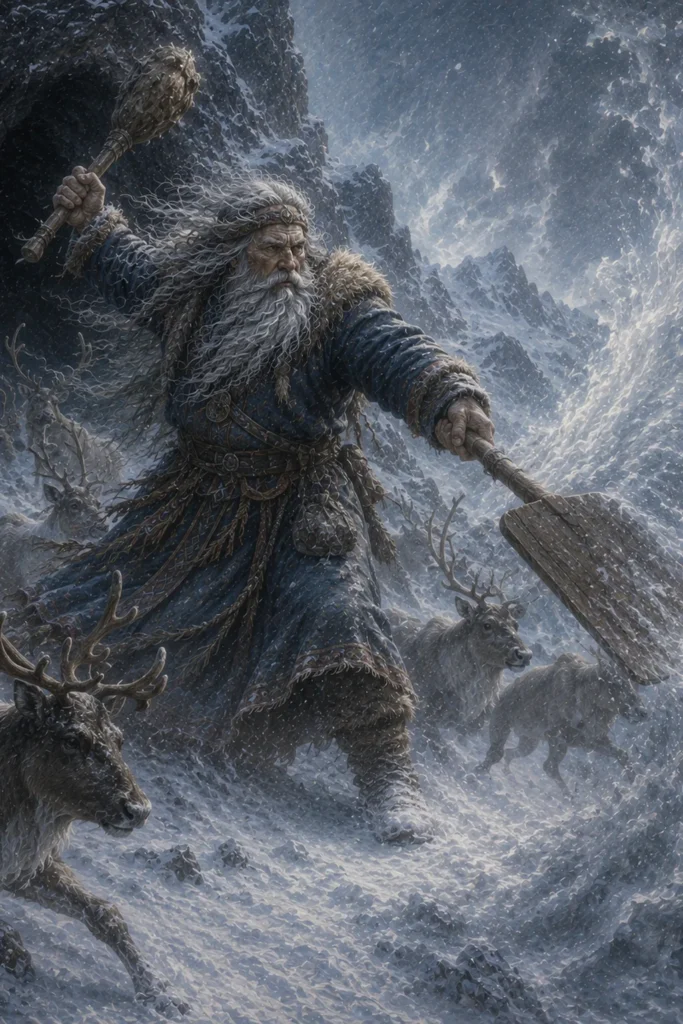
Appearance: with two shovels, or a shovel and a club
Textual history
Period of the Texts
The deity is attested in missionary and ethnographic sources from the 17th to 19th centuries, above all in Johan Randulf (Nærøy manuscript of 1723) and Lars Levi Læstadius.
Area of Diffusion
Sápmi, the Sami region: the Wind Elder belonged to the belief world of reindeer herders, hunters and coastal dwellers of northern Scandinavia.
Sources
Good by Sami standards: missionary and ethnographic accounts, as well as the form Biegga-galles on Sami magic drums.
Name and variants
Sami: biegga means wind, gállis means elder or old man, hence Wind Elder; the form -olmmái gives Wind Man. It is the same being as Bieggolmai under a different epithet; the spelling variants Biegkegaellies and Bieggagállis arise from dialects and the inconsistent transcription by non-Sami missionaries.
Appearance
Appearance
Bieggegaellies is depicted with two tools, a shovel and a club, with which he shovels the wind back into its caves and drives it out again.
Effect
Like Bieggolmai, Bieggegaellies controls wind and storm; the effect and significance for hunting, reindeer herding and seafaring are the same, since it is the same being.
Profile: Bieggegaellies
The key aspects of the Wind Elder at a glance.
An epithet of the central Sami wind deity; on the drums, alongside Horagalles and Veralden Olmai, one of the main figures.
Reindeer herders, hunters and coastal dwellers: the same audience as with the Wind Man, since wind determined the outcome of hunting, herding and seafaring.
An old man with a shovel and club; on the magic drums the deity appears in the form Biegga-galles.
Wind and storm: the Wind Elder shovels the winds back into their caves and drives them out again.
Offerings of antlers and horns, as well as of animals, small boats and wooden shovels, are attested, corresponding to the cult of Bieggolmai.
Not a separate deity, but a name variant of Bieggolmai; typologically the wind-keeper Aiolos is closely related.
One god, many names: the tradition of the Wind Elder
Sami biegga means wind, gállis means elder or old man; Bieggegaellies is thus the Wind Elder, while the form ending in -olmmái denotes the Wind Man. It is the same being as Bieggolmai under a different epithet. The deity is attested in missionary and ethnographic sources from the 17th to 19th centuries, above all by Johan Randulf in the Nærøy manuscript of 1723 and by Lars Levi Læstadius.
The name is especially tangible on the Sami magic drums: there the wind deity appears in the form Biegga-galles as one of the central figures, alongside Horagalles and Veralden Olmai. The multitude of spellings is not a sign of several gods, but a result of dialects and the inconsistent transcription by non-Sami observers.
Afterlife and Classification
As a name form of the Sami wind deity, Bieggegaellies is present chiefly in drum research and the reception of Sami culture.
In terms of religious studies: Bieggegaellies is not a separate deity distinct from Bieggolmai, but a name variant, the epithet Wind Elder rather than Wind Man. The multitude of spellings arises from dialects and the inconsistent transcription by non-Sami missionaries; we see the deity largely through the lens of Christian observers.
Offerings to the Wind Elder
The forms of worship correspond to those of Bieggolmai: offerings of antlers and horns, as well as of animals, small boats and wooden shovels are attested, along with the trinity with Horagalles and Veralden Olmai on the drums. Whoever invoked the Wind Elder under this epithet was addressing the same lord of wind and storm on whom hunting, reindeer herding and seafaring depended.
The Wind Elder alongside the drum gods
Bieggegaellies is typologically close to the Greek Aiolos, who keeps the winds in a vessel. Within the Sami pantheon he is, alongside Horagalles and Veralden Olmai, one of the central drum figures. The actual main page of the deity is Bieggolmai, the Wind Man: the same being, a different epithet.
Frequently asked questions about Bieggegaellies
What does Bieggegaellies mean?
Wind Elder, from biegga, wind, and gállis, old man; it is a name variant of the Wind Man.
Is Bieggegaellies a separate deity?
No. It is the same deity as Bieggolmai, only under the epithet Wind Elder.
Where does the name appear?
Among other places, as Biegga-galles on Sami magic drums, where the wind deity is one of the central figures.
Further links
Further reading:
- Sami – all beings of the Sami tradition
- Bieggolmai – the Wind Man, the main name of the same deity
- Aiolos – the Greek keeper of the winds
- Amulet, protective candle, salt – traditional protective means
- Protection Compass – protective means at a glance
Literature (selection)
Further standard works in the bibliography.
As the Sami Wind Elder, Bieggegaellies is the second name of a single lord of storms, and as the wind god of the magic drum he remains visible where the Sami belief world is most densely recorded: on the skin of the drum.