Spider Grandmother (Hopi Kokyangwuti, Navajo Na’ashje’ii Asdzaa, known by their own names in other Pueblo languages) is the creator grandmother and wisdom teacher of the southwestern Pueblo peoples. She is one of the central female creator figures in the religious history of the Americas.
Spider Grandmother is the highest female creator figure of the Pueblo-speaking peoples of the southwestern United States: the Hopi, Zuni, Navajo (technically Athabaskan but culturally integrated into the Pueblo system), Tewa, Tiwa, Towa, and the Keresan peoples (Acoma, Laguna, Santa Ana).
In each of these traditions she is present under her own name, yet the structural position as a spider-shaped grandmother creator is the unifying element.
From a religious studies perspective, she belongs to the class of female high-being creators found in numerous religions worldwide.
Structurally comparable figures include the Andean Pachamama in her cosmogonic function, the Mesoamerican Coatlicue, the ancient Greek Gaia, the ancient Indian Aditi, and the West African Asase Ya. Spider Grandmother differs from these parallels through her specific spider component and her role as teacher.
Within Pueblo religion, Spider Grandmother often acts as an intermediary between the higher creative principles and human beings.
Among the Hopi she accompanies the first humans during their emergence ascent through the four previous worlds into the current fifth world; among the Navajo she is the teacher of the first weavers, transmitting the art of weaving and with it the cosmic order to humanity.
The Pueblo designations vary by language. In Hopi she is called Kokyangwuti, which literally means Spider Woman (kokyang = spider, wuti = woman). In Navajo she is called Na’ashje’ii Asdzaa, likewise meaning Spider Woman. In Zuni she is called Awitelin Tsita, meaning Earth Mother, emphasizing the specific earth component.
In the Keresan Pueblos (Acoma, Laguna, Cochiti, Zia, Santo Domingo, San Felipe, Santa Ana) she is called Tsitsi’ittini or Tse-che-nako, translated as Thinking Woman or Spirit-First-Woman. Here the teacher component comes especially to the fore: Tse-che-nako is the first Thinking One, who brings the world into existence through her thinking.
The standard English translation Spider Grandmother has been common in American Anglo-Saxon literature on Indigenous peoples since the late 19th century. It emphasizes the grandmother form of address, which in most Pueblo traditions is genuinely part of ritual language (shiwóyeé in Navajo, so’wuti in Hopi).
The grandmother form of address corresponds structurally to the Lakota grandmother address Unci (see Tunkasila) and reflects the gender-bipolar kinship theology of North American Indigenous traditions.
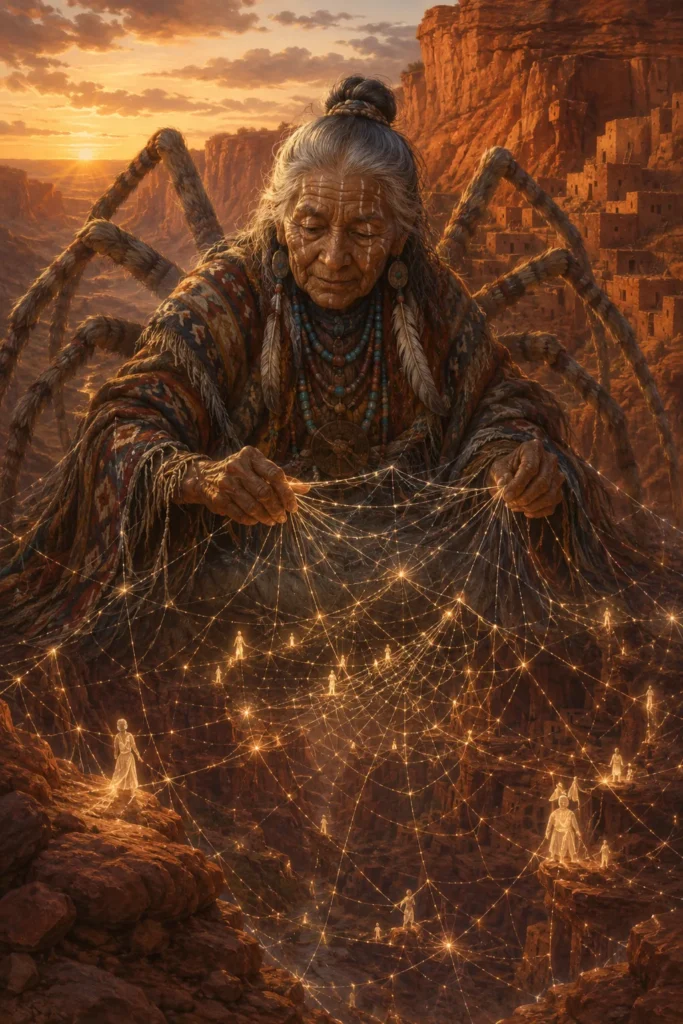
Spider Grandmother is described in Pueblo narratives in several forms. Her primary form is that of a small black spider living in an earth cave or beneath a rock.
She can, however, transform at any moment into a dignified old woman with white hair and a wrinkled face, appearing in a traditional Pueblo dress and speaking staff in hand.
In Hopi iconography she is often depicted with a small spider figure on her shoulder, visualizing her dual form.
On surviving Pueblo ceramics from the 11th to 14th centuries (Mimbres, Anasazi) spider motifs appear that are archaeologically often interpreted as Spider Grandmother manifestations. This attribution is speculative, however, since we lack the emic designation of these archaeological cultures.
On modern Pueblo weavings and pottery, particularly in the Navajo woven-rug tradition, the Spider Grandmother motif is a central element.
The woven rugs often contain a Spider Hole, a small intentional weaving flaw at the center of the rug that honors Spider Woman, because a perfect work would call her teacher status into question. This practice has been described in detail by Navajo anthropologist Wesley Thomas and Navajo weaver Roxanne Swentzell.
The mythological tradition surrounding Spider Grandmother is one of the richest in Indigenous American religion. A central narrative class is the Emergence myth of the Hopi: the people first lived in the underworld, which became increasingly filled with evil and strife.
Spider Grandmother helps the people climb upward through a reed into the next world. This ascent repeats through four worlds until the people arrive in the current fifth world. In each of these worlds Spider Grandmother is the accompanying figure, the teacher, who protects the people from losing their purpose.
A second narrative class is the Hero Twins cycle of the Navajo. Spider Grandmother encounters the young heroes Monster Slayer and Born-for-Water as they search for their father Tsohanoai (the sun).
She teaches them the magical songs and gives them the protective amulets with whose help they later defeat the monsters of the world. This Hero Twins myth is one of the best-known narratives of North American Indigenous religion and was described extensively by John Bierhorst (The Mythology of North America, 1985).
A third narrative class is the founding story of the weaving art. Spider Grandmother teaches the first Pueblo women to spin and weave and thereby gives them the power to structure the world through their weavings.
The cosmological significance of weaving in the Pueblo tradition, the cloth as a model of cosmic order, the weaving act as symbolic act of creation, has been systematically described by Roxanne Swentzell, Patricia Anne Davis, and Navajo weaving researcher Kate Peck Kent (Navajo Weaving, 1985).
A fourth important narrative class is the cosmogonic spider-web creation in the Acoma tradition. Here Spider Grandmother’s first act is the spinning of a cosmic web from nothing, forming the structure of the world.
On the nodes of this web she places the first beings: the stars, the sun, the moon, the mountains, and finally human beings.
The entire universe is accordingly one great spider web in which all beings are connected to one another by the fine threads of Spider Grandmother.
This cosmological idea, the universe as a web, has attracted attention in comparative religious studies because it is structurally similar to the Hindu Maya concept, even though no historical connection exists.

The ritual veneration of Spider Grandmother is ubiquitous in Pueblo tradition, though not in a centrally institutionalized form.
She is invoked at the start of every kiva session (kiva: underground ceremonial chamber of the Pueblo peoples), honored in every weaving activity through the placement of the Spider Hole weaving flaw, and invoked as companion and protector in the great Pueblo feasts (Kachina dances, see Kachina; Yei-bi-chai dances of the Navajo).
Among the Hopi there is a particularly significant ritual application in the Spider Sand Painting tradition. In this ritual an elaborate mandala of colored sand powders is drawn on the earth floor, with its center representing Spider Grandmother.
The sand painting serves as a ritual healing tool; the patient sits in the center while the healers symbolically transfer the illness from them onto the sand painting and then destroy the image to remove the illness from the world for good.
The sand painting tradition is particularly highly developed among the Navajo (called iikaah) and belongs to the most intensively documented ritual phenomena of Indigenous American religion.
Sand paintings are religious-ritual tools, not visual art; they are created during the day, used in the evening, and destroyed at the end of the ceremony. The reproduction of sand painting motifs in non-ritual works (murals, prints) is regarded critically in the Navajo tradition as cultural appropriation.
Spider Grandmother is one of the most important protective figures in the Pueblo tradition. Her apotropaic veneration focuses on four areas: protection of children and pregnant women, protection of the domestic sphere, protection against illness, and protection during travel.
Concrete protective practices include keeping a small spider representation, such as a carved spider made of turquoise or a drawn spider on a piece of leather, at the house entrance or above the sleeping area, collecting spider webs from mountain crevices, and weaving small protective cloths with an incorporated Spider Hole.
The Navajo also know the practice of the spider-bite prayer: anyone bitten by a spider should understand the event as a message from Spider Grandmother and offer a prayer of thanks rather than killing the spider.
A particularly notable protective practice is the Naming Ceremony at the birth of a child.
Among the Hopi and Tewa the newborn is brought on the 20th day of life in an elaborate ceremony to its first encounter with sunlight; at this point Spider Grandmother is invoked to serve as the child’s companion on its path through life.
This Naming Ceremony was systematically described by Frank Cushing and Elsie Clews Parsons in their classic Pueblo ethnographies.
A further specific protective practice is the Spider-Web Crib tradition. Among the Navajo the cradleboard of a newborn is fitted with a stylized spider web of thin cords hanging above the child’s sleeping area. This protective construction is intended to catch the child’s bad dreams and prevent them from entering the child’s consciousness.
From this Navajo protective cradle tradition the later commercialized dreamcatcher tradition derives, now widespread far beyond Indigenous peoples. Navajo researcher Helen Hardin traced the unbroken line from the traditional Spider-Web Crib to the modern dreamcatcher industry in her works on Navajo art.
The spider-woman configuration is philosophically unusual within religious studies. Most female creator figures in world religions are anthropomorphic (Gaia, Aditi, Asase Ya, Pachamama), while Spider Grandmother retains her zoomorphic primary form. The closest parallel is the African-Caribbean Anansi tradition (a male spider), which is structurally similar but of the opposite sex.
A more distant parallel appears in the Greek mythological Arachne tradition, in which a mortal weaver challenges the goddess Athena through her art and is ultimately transformed into a spider.
This narrative separates the human weaver from the divine spider (Athena herself remains anthropomorphic), whereas in the Pueblo tradition spider being and cosmological teacher converge in a single figure.
Within North American Indigenous traditions, Spider Grandmother shows close parallels to the Changing Woman of the Navajo (with whom she is functionally closely related but iconographically distinct) and to the White Buffalo Calf Woman of the Lakota (with whom she shares the founding-teacher position but conveys different cultural content).
The Anasazi predecessor culture of the modern Pueblo peoples (ca. 200 BCE to 1300 CE) left numerous rock drawings and petroglyphs in their spectacular cliff dwellings (Mesa Verde, Chaco Canyon, Bandelier) that prominently feature the spider motif.
This more than thousand-year continuity between archaeological spider symbols and living Pueblo religion makes Spider Grandmother one of the longest-documented religious figures in American religious history. The archaeological spider motifs from Chaco Canyon, whose precise ritual function remains disputed, are read in modern Pueblo theology as direct predecessors of today’s Spider Grandmother tradition.
Spider Grandmother remains undiminished in modern Pueblo practice. The Pueblo peoples of the southwestern US states of New Mexico and Arizona (in particular the Hopi on the Hopi Mesas, the Acoma Pueblo, the Zuni Pueblo) continue to practice their traditional religions in a form only partially disrupted by centuries of Spanish and American colonization.
Spider Grandmother is present in almost every kiva ritual.
In academic research, Frank Cushing, Elsie Clews Parsons, Alfonso Ortiz, Pueblo theologian Joseph Suina, and Navajo weaving researcher Kate Peck Kent have systematically described the Spider Grandmother tradition. Joseph Suina described the conflict between Pueblo religion and American compulsory schooling in vivid terms in And Then I Went to School (1985).
From a religious studies perspective, Spider Grandmother is an important example of a genuinely American Indigenous theology that cannot be forced into the typological categories of comparative religious studies.
Her dual form as spider and grandmother, her cosmogonic function, and her pedagogical teaching role constitute a specific theological construction that deserves its own attention in pan-American religious history. The iWell Guard approach to the Pueblo tradition describes these findings in terms of religious history, without claims of efficacy or spiritual recommendations.
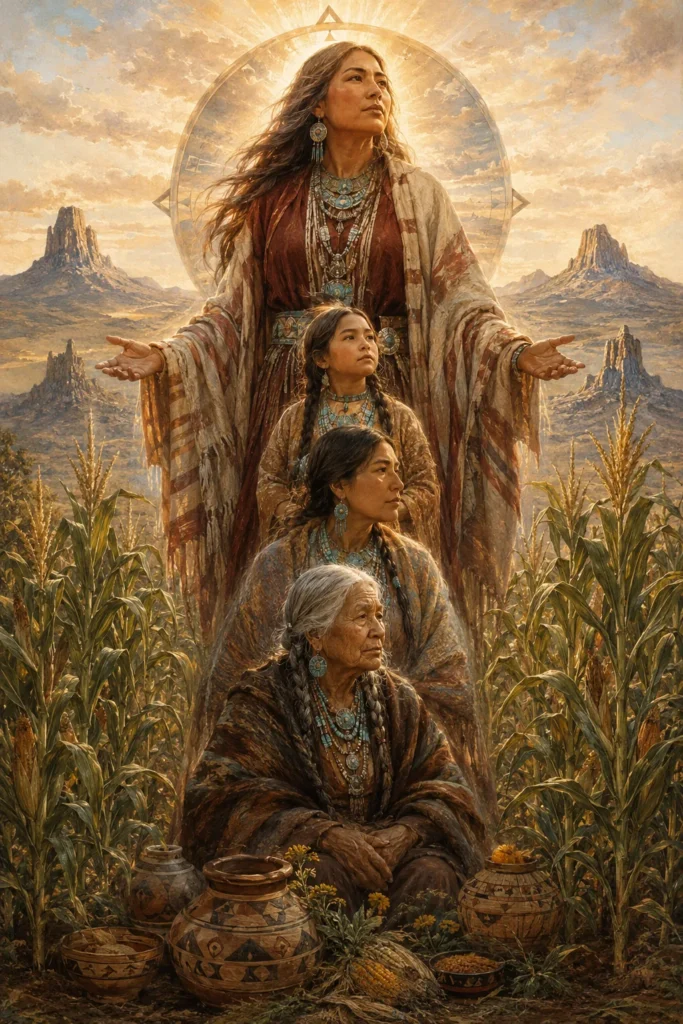
An important more recent strand of research addresses the question of gender relations in Pueblo religion. The Pueblo peoples are characterized, in stark contrast to the Spanish Catholic missionary culture imposed on them in the 16th and 17th centuries, by a remarkable religious and social gender equality.
Pueblo women own the houses, the fields, and the ritual implements; many areas of ritual practice are exclusively female.
Spider Grandmother as the highest female creator is the theological foundation of this socio-religious standing of women.
Pueblo women writers such as Leslie Marmon Silko (Ceremony, 1977) and Paula Gunn Allen (The Sacred Hoop, 1986) have systematically worked out this matrilineal and ritually matri-centric Pueblo religion against the Christian missionary patriarchal tradition.
The following selection lists key works on Pueblo religion and southwestern Indigenous research.
In the Hopi creation and migration tradition, the figure known in English-language scholarship as Spider Grandmother plays a central role. She bears the Hopi name Kookyangwso’wuuti.
In the so-called Emergence narrative, the people ascend from earlier worlds into the present world, and Spider Woman is one of the beings who makes this ascent possible and accompanies it. She is also regarded as having participated in the creation of living beings.
This material was recorded, among others, by H. R. Voth, a Mennonite missionary who assembled extensive collections at Oraibi around 1900, and by the ethnographer Mischa Titiev in the 1930s. Both sources are problematic.
Voth collected material partly against the will of the Hopi and published ceremonial content that by Hopi understanding was not intended for the public. Titiev worked during a period of internal conflict in Oraibi. The Hopi tribal government has subsequently spoken out repeatedly against the further dissemination of these records.
In the narrative itself, Spider Woman appears as a helper who gives advice, warns, and intervenes in difficult situations without assuming the leading role of the human actors. Characteristic is her combination of great age, wisdom, and an unassuming, almost inconspicuous appearance.
Research emphasizes that she should not be understood as a ruler figure but as an authority that transmits knowledge.
A scholarly account must at the same time point out that many details of the Hopi tradition are regarded by the community itself as protected, and that the published versions show only a portion whose circumstances of creation deserve critical assessment.
Among the Dine a related but independent figure appears, rendered in scholarship as Spider Woman and bearing the Dine name Naʼashjéʼii Asdzáá. She is closely linked to the Hero Twins, whom she helps in the great narrative cycles.
In several versions she warns the Twins of the dangers on the way to their father, the sun, and gives them means of protection.
A particular strand of Dine tradition connects Spider Woman with weaving. According to a widespread narrative, she taught the Dine to weave, while another figure, Spider Man, built the loom.
This connection is more than an etiological note, because weaving holds a high social and economic value in Dine culture that extends to the present day. Weavers sometimes refer explicitly to this tradition.
The ethnographic documentation derives, among other sources, from the work of Washington Matthews in the late 19th century and from records connected with the great healing ceremonies. Matthews was a military physician and one of the early careful observers of Dine ceremonies, yet his texts too are shaped by the conditions of the reservation period.
Research notes that the linkage of Spider Woman, the Hero Twins, and weaving is not uniform across the sources but was shaped differently depending on the narrator and ceremonial complex. Spider Woman is thus not a closed myth but a junction point where several strands of Dine tradition converge, including creation, hero narrative, and craft.
Related key terms: Spider Grandmother Kokyangwuti Tse-che-nako Hopi Navajo Pueblo Kiva Sand Painting.
iWell Guard draws on the cultural-historical tradition of wearable protective objects, in the tradition of Native American and many other cultures worldwide. 41 levels, real gold, platinum, silver, crafted in Germany. 30-day return policy.
Individual experiences may vary. Not a medical device. No healing claims.