Avalokiteshvara, god of the Buddhist tradition
By Ralf Ittermann · last reviewed on
Avalokiteshvara is a god of the Buddhist tradition.
The Bodhisattva of compassion, embodied a thousandfold for the salvation of all beings. Avalokiteshvara is arguably the best known Bodhisattva of Mahayana Buddhism, so popular that he is almost regarded as a god. His name means “the one who hears the sounds of the world”.
With a thousand arms, each of which holds an eye, Avalokiteshvara stands ready to help every being. In China he became the goddess Guanyin, in Japan Kannon, and everywhere he hears the cries of those who suffer. A gentle, generous power, no thunderbolt like Vajrapani, but the very heart of enlightenment.
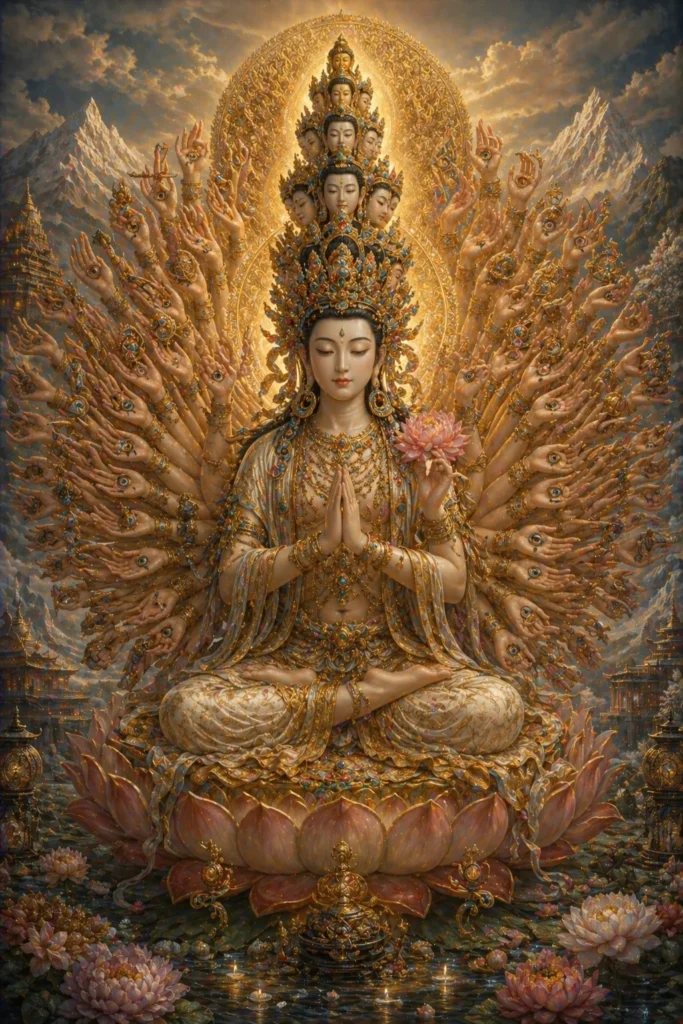
At a glance: Avalokiteshvara
Type: principal Mahayana Buddhist bodhisattva, Bodhisattva of compassion
Pantheon: Mahayana and Vajrayana Buddhism (all schools)
Function: embodiment of boundless compassion (karuṇā)
Principal attributes: lotus, vase with nectar, mantra OM MAṇI PADME HŪṂ
Principal cult sites: Potala Palace (Lhasa), Putuoshan (China), Tibet, Bhutan
East Asian identifications: Guanyin (China), Kannon (Japan), Quan Am (Vietnam)
Context
Period of the texts
Avalokiteshvara is attested from the 1st to 2nd century AD in the early Mahâyâna sutras. The main flourishing of the iconographic tradition is the Gupta period of India (4th to 6th century).
With the spread of Mahâyâna to China (3rd century onward) the identification shifted toward the female Guanyin. In Tibet central since the 7th century, the Dalai Lama is regarded as his incarnation. Today one of the most widely venerated Buddhist bodhisattvas in the world.
Area of diffusion
Principal cult sites: Potala Palace in Lhasa (the principal Tibetan cult site), Putuoshan (one of the four sacred mountains of Chinese Buddhism, consecrated to Avalokiteshvara/Guanyin), the Sera and Drepung monasteries (Tibet). In modern China and Vietnam thousands of Guanyin temples. In Japan one of the most important bodhisattvas (the 33-Kannon pilgrimage routes).
State of the sources
Central sources: the Lotus Sutra (chapter 25, the famous Avalokitesvara chapter), the Kâraṇḍavyûha Sutra (the main source for the OM MAṇI mantra), the Sukhâvati-vyûha Sutra, the Tibetan Mani Kabum.
Secondary literature: Studholme, The Origins of Om Manipadme Hum; Yu, Kuan-yin: The Chinese Transformation of Avalokitesvara; Lopez, Religions of Tibet in Practice.
Name and variants
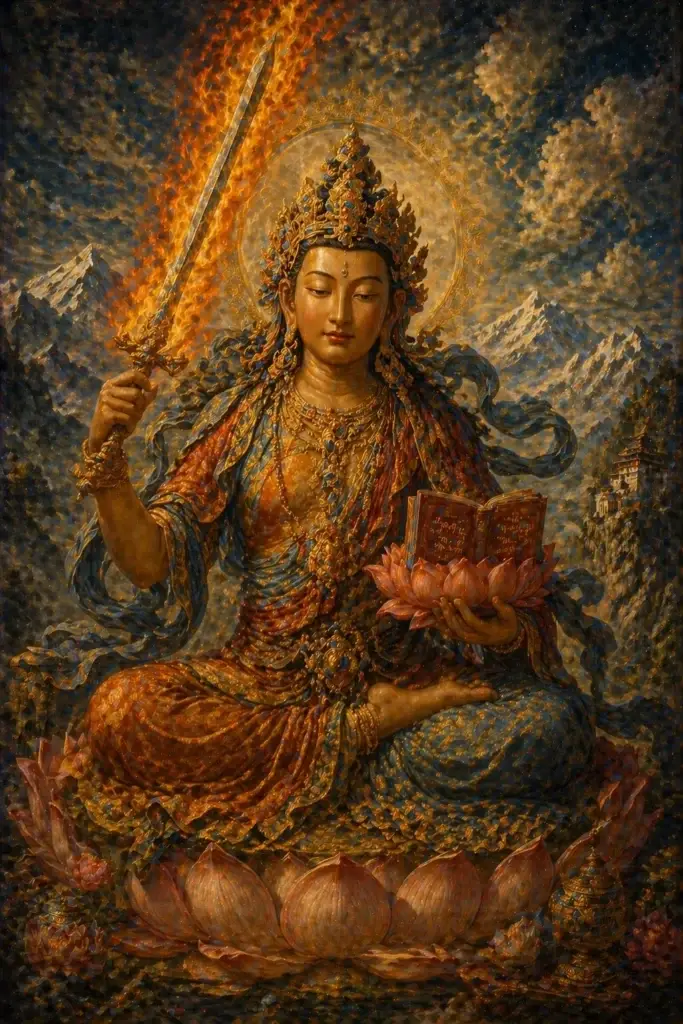
Avalokiteshvara is usually depicted with one or eleven heads, but his best known form has a thousand arms, each with an eye in its center. His body is white, pink or golden. The uppermost hand often holds a lotus.
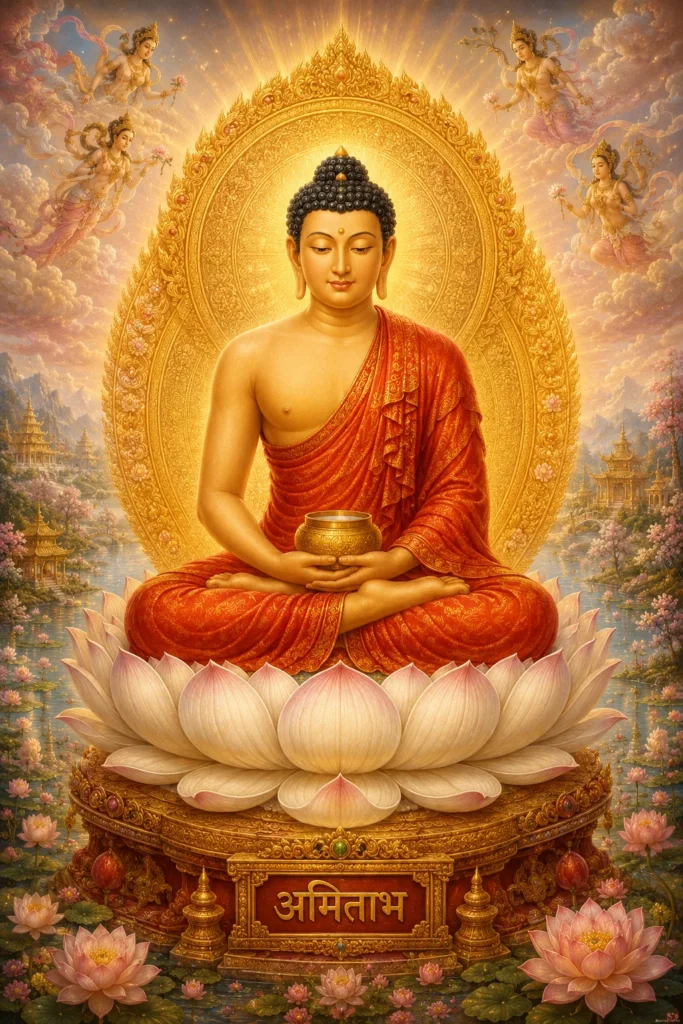
He wears a crown with the Buddha Amitabha on the forehead, his spiritual master. In different cultures his form varies: the Chinese Guanyin is female and gentle; the Tibetan form (Chenrezig) is male and can be fearsome; the Japanese Kannon is androgynous.
Characteristics
Avalokiteshvara hears the sounds of the world, every cry of suffering, every plea for help. He manifests a thousandfold in order to save: as a mother, as a warrior, as a physician, as a priest.
In Himalayan Buddhism the Chenrezig meditation is central; one visualizes oneself as the thousand-armed Avalokiteshvara. The mantra Om Mani Padme Hum (“Oh jewel in the lotus”) is recited daily to cultivate compassion. Prayers to Avalokiteshvara fill every temple and prayer hall.
Appearance and symbolism
Avalokiteshvara is depicted with eleven heads or a thousand arms (in Tibetan Buddhism), where each head and arm embodies an aspect of compassion. The white or pink skin color symbolizes purity. He carries a lotus and a water vessel. His mount in the sea aspect is the dragon.
Profile: Avalokiteshvara
The most important aspects of Avalokiteshvara at a glance. The following fields summarize origin, function, appearance, veneration, symbols and parallels.
Avalokiteshvara arises in the early Mahâyâna tradition as the personification of the boundless compassion of the Buddha. In some sutras he appears as the emanated son of the Buddha Amitâbha (the Sukhâvati school).
In Tibet the Dalai Lama is regarded as a re-incarnation of Avalokiteshvara. In China the identification shifts from the Tang period onward toward the female Guanyin, one of the most significant gender transformations in the history of religion.
Embodiment of infinite compassion (mahâ-karuṇâ). Whoever is in distress and calls upon Avalokiteshvara receives deliverance. In the Lotus Sutra 33 manifestations are enumerated; Avalokiteshvara appears in the form the seeker of help requires.
Protector of seafarers (Guanyin as sea goddess), of mothers, of the dying. Mantra: OM MAṇI PADME HŪṂ (“Om, jewel in the lotus, hum”).
Various manifestations:
Indian: young man with lotus and vase, one hand in a gesture of protection (abhaya-mudrâ).
Tibetan (Chenrezig): four-armed, the main pair in the folded Mani gesture, the outer pair with lotus and mala chain. The thousand-armed form (Sahasrabhuja-avalokitešvara) with eleven heads.
Chinese (Guanyin): female figure in flowing white robes, frequently with a vase and willow branch. In the sea aspect riding on a dragon.
Sphere of influence: Avalokiteshvara is invoked in distress of every kind, illness, shipwreck, imprisonment. The mantra recitation of OM MAṇI PADME HŪṂ is the most spoken Buddhist mantra in the world.
Tibetan Mani stones (stones bearing the mantra) line pilgrimage routes. In China Guanyin is venerated almost universally at the Chinese household altar, even by non-Buddhists as a bringer of good fortune.
Lotus (the principal attribute), vase with nectar (Amrita), mala prayer chain, the mantra OM MAṇI PADME HŪṂ, white robe (Guanyin), deer (Tibet), a thousand eyes (in a thousand hands, the Sahasrabhuja form), eleven heads (the Sahasrabhuja form), dragon (Guanyin as sea goddess), bamboo flute.
Guanyin (China, female form), Kannon (Japan), Quan Am (Vietnam), Gwaneum (Korea), Chenrezig (Tibetan). Functionally: Mary (Christianity, Mater Misericordiae, compassionate mother), Tara (Buddhism, female deity of compassion, often described as a tear of Avalokiteshvara), Lakshmi and Sarasvati (Hinduism, aspects of loving protection).
Protective practice
Rituals of veneration
Avalokiteshvara is one of the most venerated bodhisattvas, with daily meditation before statues or altars. Chapter 25 of the Lotus Sutra is devoted to this Bodhisattva. A popular practice: reciting Om Mani Padme Hum 108 or 1000 times with a mala.
In Japan (Kannon) and China (Guanyin) national pilgrimage sites such as the Saigoku and Bandō routes and Mount Putuo are centers of veneration. Tibetan goenpa rituals: visualizing Avalokiteshvara in the highest chakra.
Invocations and appeals
The universal mantra “Om Mani Padme Hum” (“The jewel in the lotus”) is the core mantra of compassion. The dharani text of the Avalokiteshvara Sutra is used in chanting rituals.
Tibetan: “Om Mani Padme Hum Hrih” with visualization of the four-armed Avalokiteshvara. Sanskrit tradition: the Saddharma-Pundarika Sutra
Amulets and protective symbols
Kannon statues in Japanese household shrines and temples are the most common Avalokiteshvara amulet. Tibetan malas and Om Mani plaques of stone or brass. Prayer flags with mantra inscriptions for the Himalayan region.
Archaeological evidence: Avalokiteshvara reliefs at Bamiyan, the Ellora caves (India, 7th to 8th century), the Borobudur relief (Indonesia, 8th century). Japanese ofuda (talisman papers) from Koyasan.
Avalokiteshvara, parallels in other cultures
Avalokiteshvara resembles the Mother of God (Mary) in Christianity; both are mother figures of compassion. With Isis of Egypt he shares the function of rescuing those who suffer.
In Western esoteric tradition Avalokiteshvara is often read as an archetype of divine compassion. The thousand arms symbolize universal readiness to help, an ideal image for modern spiritual seekers.
The Bodhisattva of compassion: theological classification
Avalokiteshvara is not a Buddha but a bodhisattva, a being who strives for Buddhahood yet postpones the final entry into nirvana in order to assist all suffering beings. In the Mahayana tradition he embodies karuna, great compassion, just as the bodhisattva Manjushri embodies wisdom.
The Sanskrit name is interpreted in various ways. One widespread explanation understands it as “the lord who looks down” or “the one who perceives the sounds of the world”, that is, the bodhisattva who hears the cries of beings for help.
It is precisely this interpretation that is reflected in the East Asian name, to which a separate section is devoted.
A central text is the Lotus Sutra, whose twenty-fifth chapter is devoted entirely to Avalokiteshvara.
It describes how the bodhisattva saves everyone who calls upon his name, whether in fire, water, before robbers or other dangers, and how he shows himself in whatever form is needed to instruct a being. This chapter is fundamental to the veneration of the bodhisattva.
In Buddhist cosmology Avalokiteshvara is associated with the celestial Buddha Amitabha, in whose Pure Land Sukhavati he acts as a helping companion. In depictions he therefore often bears a small image of Amitabha in his crown. This association closely links the bodhisattva of compassion with the widespread piety of the Pure Land.
Guanyin: the change of gender in East Asia
One of the most remarkable developments in the history of religion is the transformation of Avalokiteshvara on his way to East Asia. In India and Tibet the bodhisattva is understood and depicted as male.
In China, by contrast, Guanyin developed from him, whose name means “she who perceives the sounds of the world” and who, from roughly the 10th to 12th century onward, has been predominantly depicted and venerated as female. In Japan the figure is called Kannon, in Korea Gwaneum, in Vietnam Quan Am.
Scholarship discusses the reasons for this change without settling on a single explanation. One factor was probably that the Lotus Sutra expressly attributes to the bodhisattva the ability to assume any form, including female ones.
In addition there were native Chinese conceptions of motherly, helping deities and legends, such as that of Princess Miaoshan, which is told as an embodiment of Guanyin.
Guanyin thus became the most venerated figure of East Asian Buddhism. She is regarded as a helper in every distress, as protectress of seafarers, as a giver of children. In this last function there is the widespread depiction as Songzi Guanyin, “Guanyin who grants children”.
From the standpoint of religious studies the case is an instructive example of inculturation. A figure travels across linguistic and cultural boundaries and takes on traits of the receiving culture without losing its core function, compassion.
Soberly considered, the male and the female figure are, in terms of the history of religion, the same being, even though they look very different.
A thousand arms and eleven heads: the iconography
Avalokiteshvara is depicted in numerous forms, each carrying its own meanings. The simplest shows a standing or seated bodhisattva with two arms, often with a lotus blossom in the hand, which is why he is also called Padmapani, “the lotus bearer”.
Better known is the many-armed form, above all the figure with a thousand arms, Sahasrabhuja. In each palm there is an eye. The symbolism is clear: the thousand arms reach everywhere in order to help, the eyes in the hands see every distress.
To this belongs often the form with eleven heads, Ekadashamukha. A widespread legend explains both: when Avalokiteshvara recognized the immeasurable extent of suffering, his head burst apart from pain; Amitabha assembled the pieces into many heads and gave him manifold arms so that he could help more effectively.
In the Tibetan tradition the bodhisattva is called Chenrezig. Associated with him is the most famous Buddhist mantra of all, Om mani padme hum, which in Tibet is carved into stones, turned in prayer wheels and recited countless times. The Dalai Lamas are regarded in the Tibetan tradition as emanations of Chenrezig.
The material culture is correspondingly rich: statues of bronze, stone and wood, wall paintings, scroll paintings, prayer flags. The various forms are not arbitrary variants but a precise visual vocabulary, in which each number of arms, heads and attributes makes a particular statement about the helping activity of the bodhisattva.
Further links
Research literature
Further standard works in the literature index.
Frequently asked questions about Avalokiteshvara
Who is Avalokiteshvara in Buddhism?
Avalokiteshvara (Sanskrit, roughly “the lord who looks down”) is the bodhisattva of infinite compassion and one of the central bodhisattvas of Mahayana Buddhism. A bodhisattva is a being who could attain Buddhahood but voluntarily remains in the cycle of rebirths in order to help all suffering beings.
Avalokiteshvara hears the cries of the world for help and appears in countless forms. In Tibet he is called Chenrezig and is regarded as the patron of the country; the Dalai Lama is considered his human embodiment.
Why is Avalokiteshvara depicted as female in East Asia, as Guanyin?
In India and Tibet Avalokiteshvara is depicted as male. With the spread of Buddhism to China the bodhisattva merged with native conceptions of female deities and changed, from about the 10th century onward, into the female Guanyin (Japanese Kannon, Korean Gwaneum).
Guanyin became the most popular deity of East Asia, especially as protectress of mothers, seafarers and children. The mantra Om mani padme hum is dedicated to Avalokiteshvara and is among the most frequently recited formulas of all Buddhism.