Tunupa, wandering god and volcano by the salt lake
By Ralf Ittermann · last reviewed on
Tunupa is a god of Aymara tradition.
An ancient wandering and fire deity whose name is borne by a volcano.
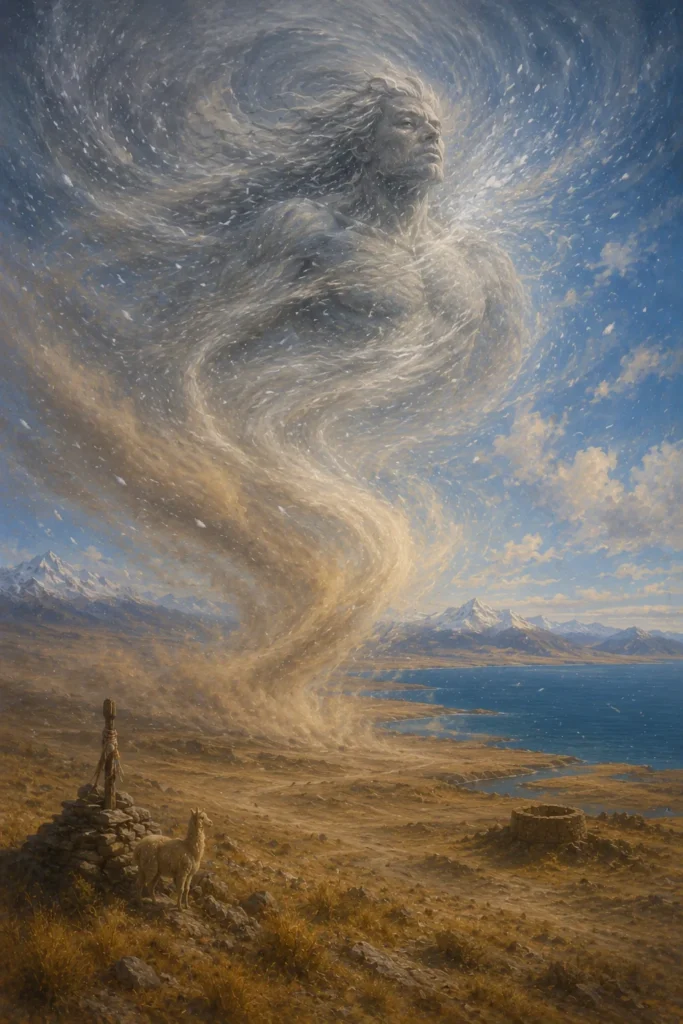
Tunupa is a pre-Inca Aymara deity of the Titicaca region, connected with fire, lightning and volcanism, and at the same time the name of a volcano at the Salar de Uyuni. Mountain and deity must be strictly distinguished: the deity is older and pan-lacustrine, while the volcano stands at about 5321 metres.
The myth tells of an old, bearded, light-skinned wanderer with a staff who travels from north to south, works wonders, preaches and provokes anger, until he is bound to a raft and thrown into the lake, whereupon the Río Desaguadero opens up. Bertonio writes in 1612 that to say Tunupa is to say God.
Type: Wandering, fire and volcano deity of the Aymara
Origin: Titicaca and Collao region, pre-Inca
Texts: colonial chronicles from 1603, Bertonio 1612, Ramos Gavilán 1621
Period: older myth, recorded during the colonial era
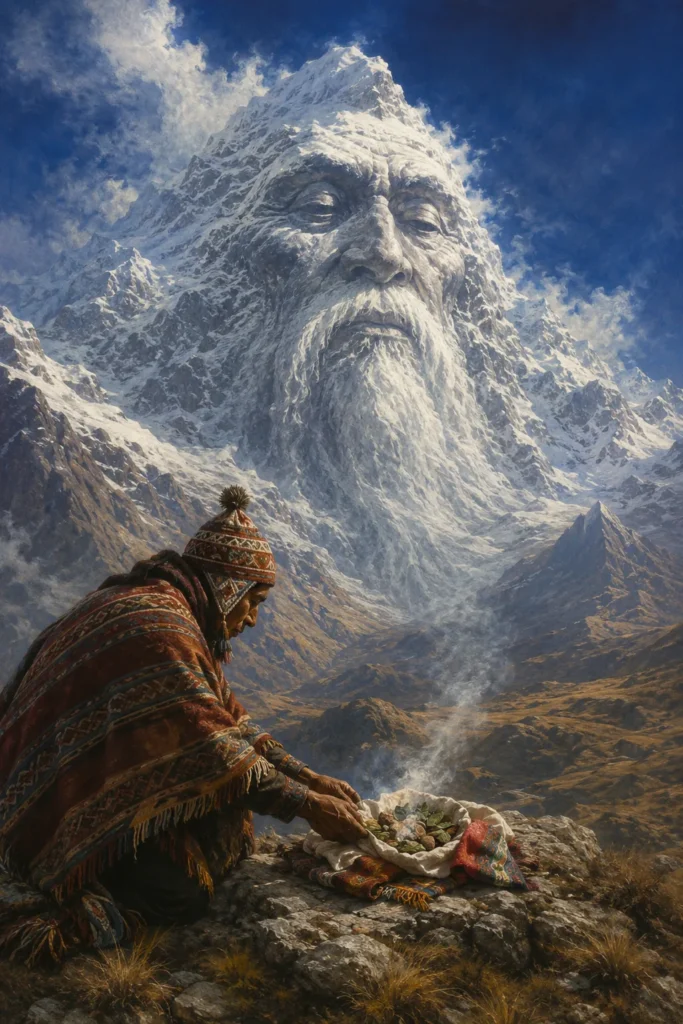
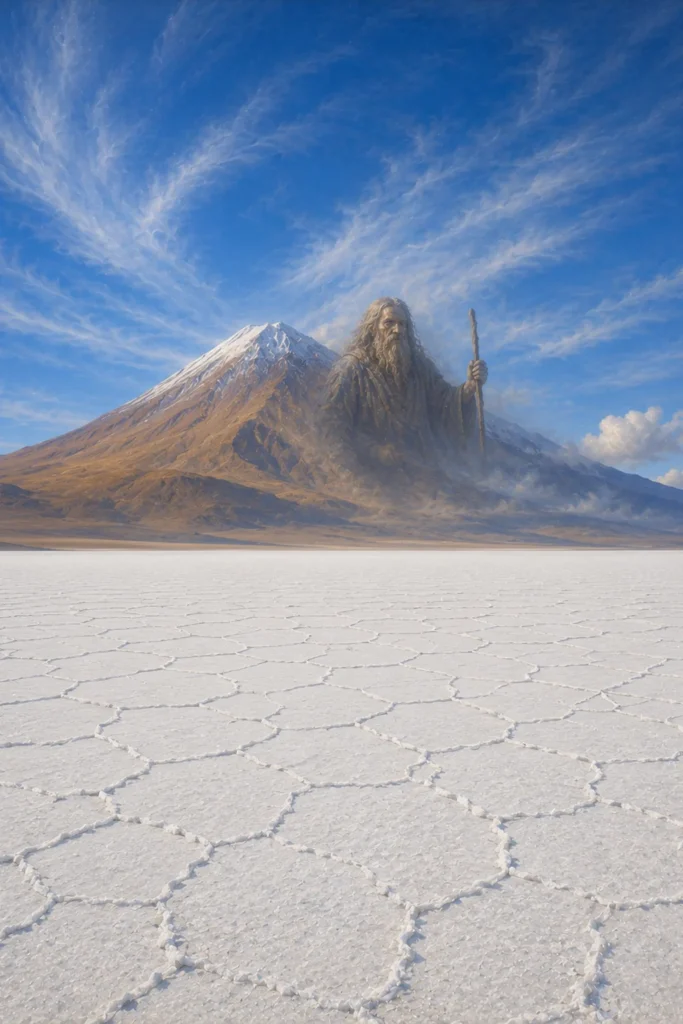
Appearance: old, bearded, light-skinned wanderer with a staff; also a volcano
Textual history
Period of the Texts
The name first appears explicitly in the sources from 1603 onwards; older name variants are Taguapaca and Tuapaca. The myth itself is considered considerably older.
Area of Diffusion
The Titicaca and Collao region, as well as the Salar de Uyuni in Bolivia, at the northern edge of which stands the Volcán Tunupa.
Sources
Well documented for the deity: colonial chronicles from 1603, Bertonio and Ramos Gavilán; mountain and deity must always be kept distinct.
Name and variants
Aymara: The etymology is uncertain; the popular interpretation is Thunder or Lightning, while Ramos Gavilán glosses it as great sage and lord. Older name variants are Taguapaca and Tuapaca. Bertonio writes in 1612 that to say Tunupa is to say God.
Form of the wanderer
Appearance
The deity appears as an old, bearded, light-skinned wanderer with a staff. The Volcán Tunupa, in turn, is an extinct volcano at the northern edge of the Salar de Uyuni with a cave containing mummies; it is treated today as a sacred achachila.
Effect
Tunupa is connected with fire, lightning and volcanism and has a culture-founding effect. In the salar legend, partly authentic and partly reshaped for tourism, the mountains around the salt lake form personified giants, and Tunupa’s milk or tears form the salt flat.
Profile: Tunupa
The key aspects of the ancient Andean deity at a glance.
Pre-Inca Aymara deity of the Titicaca region, recorded in colonial writing from 1603 and reinterpreted early on in Christian terms.
The Andean peoples of the Collao: Tunupa wanders through their land, works wonders, preaches and provokes anger.
Old, bearded, light-skinned wanderer with a staff; alongside him, the extinct volcano with the mummy cave at the northern edge of the salt lake.
Fire, lightning and volcanism, along with culture-founding action on the journey from north to south.
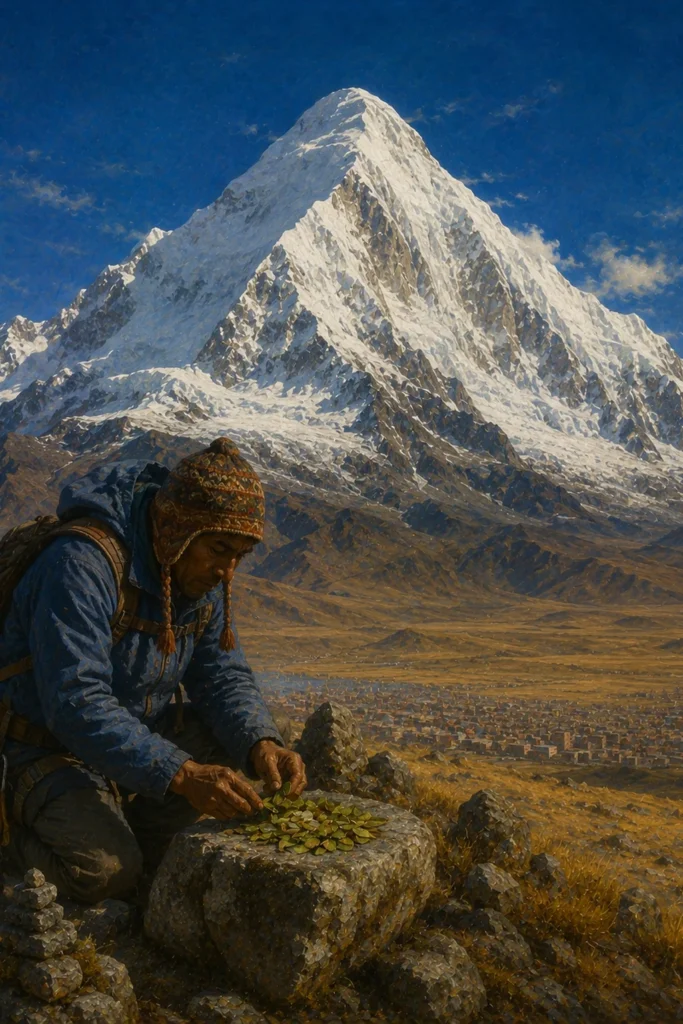
The independent cult has practically died out or been overlaid by Christianity; today, despacho offerings are made at the volcano as at other mountains.
The abundance god Ekeko of the Alasita festival; one hypothesis regards Tunupa as an older deity beneath the Inca Viracocha.
The wanderer on the raft: the myth
The name first appears explicitly in the sources from 1603 onwards, with older name variants being Taguapaca and Tuapaca; Bertonio writes in 1612 that to say Tunupa is to say God. The popular interpretation of the name is Thunder or Lightning, while Ramos Gavilán glosses it as great sage and lord.
The myth tells of an old, bearded, light-skinned wanderer with a staff who travels from north to south, works wonders, preaches and provokes anger. He is bound to a raft and thrown into the lake, whereupon the Río Desaguadero opens up. As early as 1621, the chronicler Ramos Gavilán reinterpreted the wanderer as an apostle, an early example of Christian reshaping.
Tourism legend and classification
The volcano Tunupa and the milk legend are strongly present through Uyuni tourism, which threatens to overshadow the complex old Andean figure; scientifically, Tunupa is above all documented through Andean studies.
From a religious studies perspective, Tunupa shows an old, multi-layered Andean deity overlaid by touristic legend. Five clarifications: the mountain, about 5321 metres, and the deity must be distinguished. The height is not 6542 metres, that is Sajama. The milk and tears legend is not a colonially documented ancient myth but predominantly a modern tourism narrative. The colonially documented figure of Tunupa is male. And Tunupa equals Viracocha is a hypothesis.
From cult to despacho at the volcano
The independent Tunupa cult has practically died out or been overlaid by Christianity; the chronicler Ramos Gavilán reinterpreted Tunupa as an apostle in 1621. Today, despacho offerings are made at the volcano as at other mountains. The nursing milk and tears legend is a local narrative tradition with a genuine core, but in the tourism version it is heavily simplified and not documented in colonial sources.
Ekeko, Viracocha and the Gateway of the Sun
Tunupa is connected with the god of abundance Ekeko, who lives on today in the Alasita festival. A widespread hypothesis regards Tunupa as the older Aymara deity who was overlaid by the Inca Viracocha; the Staff God figure on the Gateway of the Sun at Tiwanaku is interpreted by some as Tunupa, though this is disputed. As a mountain, the Volcán Tunupa ranks among the Achachila figures, alongside peaks such as Sajama.
Frequently asked questions about Tunupa
Who or what is Tunupa?
An old Aymara deity of travel, fire and volcanoes, and at the same time the name of a volcano at the Salar de Uyuni.
How high is the volcano?
About 5321 metres; the frequently cited 6542 metres belongs to Sajama.
Is the milk legend about the salt lake true?
It has a local core, but in the tourism version it is heavily simplified and not colonially documented.
Further links
Further reading:
- Achachila – the ancestral mountain spirit type of the Aymara
- Viracocha – the Inca deity of the overlay hypothesis
- Sajama – the often confused highest mountain of Bolivia
- Smoke cleansing, Amulet – traditional protective means
- Protection Compass – an overview of protective means
Literature (selection)
Further standard works in the bibliography.
As an Andean travel god and as a volcano at the Salar de Uyuni, Tunupa leads a double afterlife: on one side the old, multi-layered deity of the chronicles, on the other the mountain, whose milk legend is told to every Uyuni traveller today.