Illimani is god of Aymara tradition.
The protective mountain of La Paz, lord of rain, climate and harvest.
At about 6438 metres, Illimani is the highest mountain of the Cordillera Real and the most important Achachila or apu of La Paz. As the protective mountain of the city, he watches over the balance between the dry Altiplano and the humid Yungas and is lord of rain, climate and harvest.
Unlike many Andean peaks, his cult is well documented ethnographically, notably by Gabriel Martínez: Illimani-specific waxtʼa offerings are attested, especially at the Andean New Year around the winter solstice on 21 June.
Type: Most important Achachila and protective mountain of La Paz
Origin: Aymara region of the Cordillera Real, Bolivia
Texts: colonial records, ethnography by Gabriel Martínez
Period: colonial to present
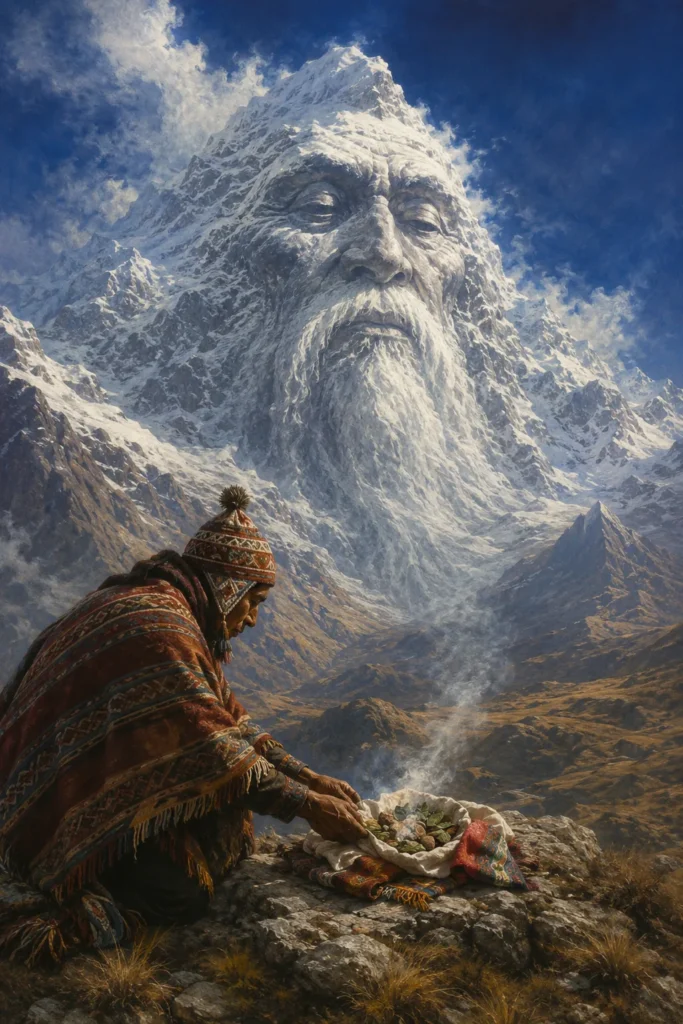
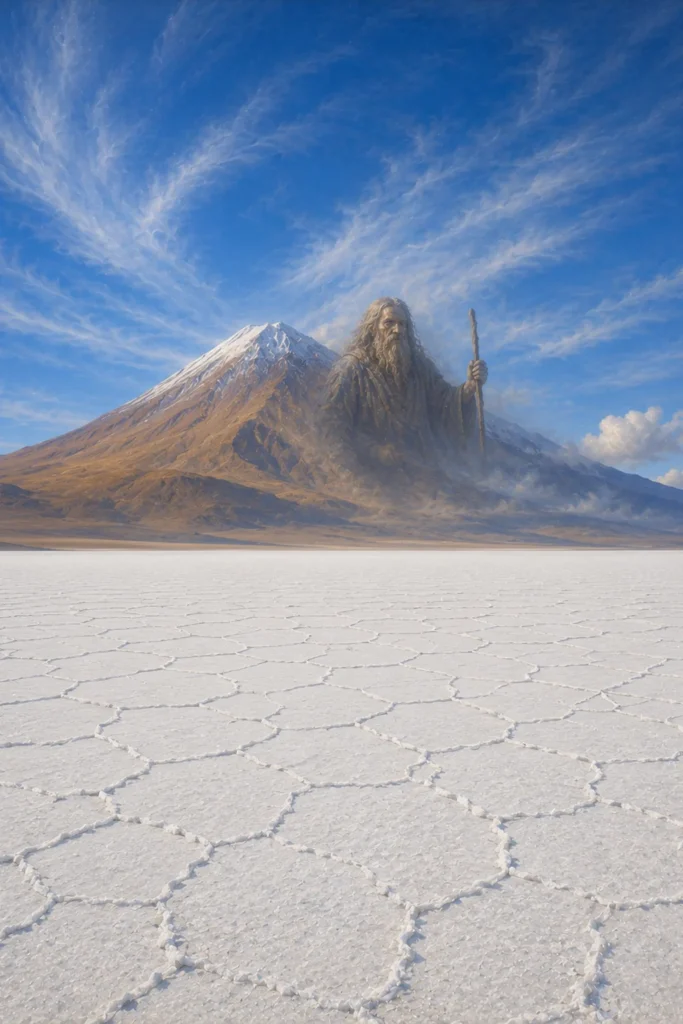
Appearance: multi-peaked snow mountain, conceived as an old man
Documented from colonial times to today; the cult is ethnographically recorded, notably by Gabriel Martínez, and thus more than mere folklore.
The Cordillera Real and the city of La Paz in Bolivia; the mountain dominates the basin and the high plateau.
Good: There is Illimani-specific ethnography, along with the general research on the Achachila cult of the Altiplano.
Aymara: The etymology is uncertain. A common interpretation is place of light or radiance, alternatively a combination of illa, abundance, and mamani, falcon or guardian; no interpretation is established.
Appearance
Illimani has several snow-covered peaks and is the symbol of permanence, protection and identity of the city; he appears on the coat of arms of the Department of La Paz and in art and dances such as the Diablada. As an Achachila, he is conceived as an old man.
Effect
Illimani is the guardian of the balance between the dry Altiplano and the humid Yungas and lord of rain, climate and harvest.
The key aspects of the city mountain at a glance.
Most important Achachila of the Aymara city of La Paz, named in invocations alongside Illampu and Sajama.
The city of La Paz and its farmers: rain, climate and harvest, plus the balance between the Altiplano and the Yungas.
Multi-peaked snow mountain, personified as an old man; present on the departmental coat of arms, in art and in dances such as the Diablada.
Protective mountain and lord of climate: he maintains the balance between the dry high plateau and the humid valleys and secures the harvest.
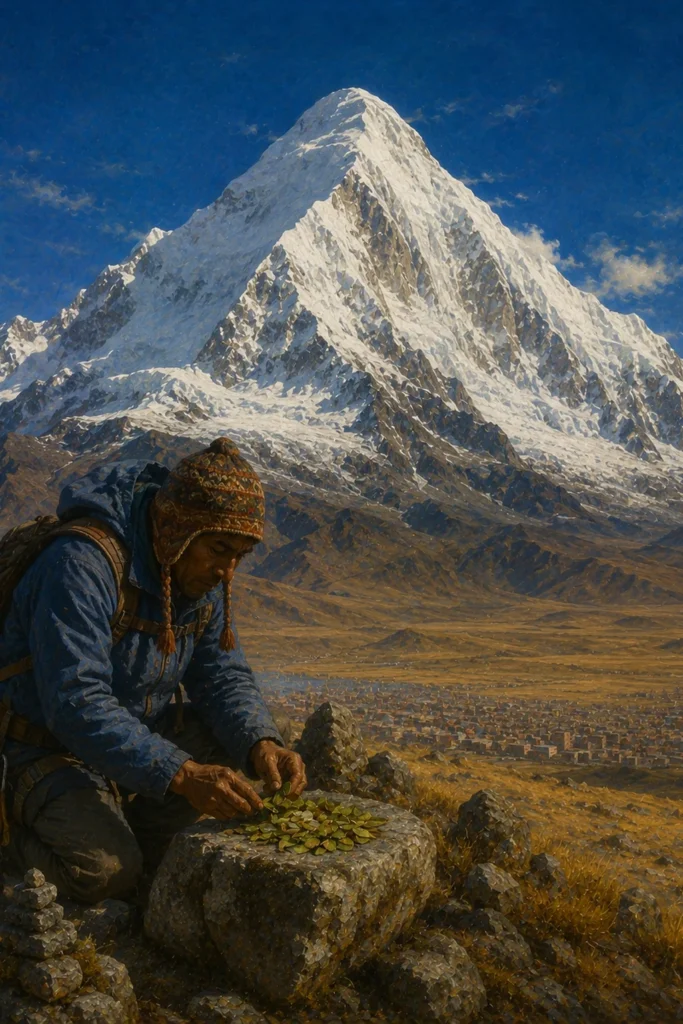
Waxtʼa offerings made specifically for the Achachila, especially at the Andean New Year on 21 June, for instance in Pinaya, along with the Challa drink libation.
The Achachilas Illampu and Sajama as great neighbours; the Quechua counterpart of this type is the Apu.
The etymology of the name is uncertain; a common interpretation is place of light or radiance, an alternative links illa, abundance, with mamani, falcon or guardian, though no interpretation is confirmed. What is certain, however, is the religious standing: Illimani is the most important Achachila of the Aymara city of La Paz.
Notable is the quality of the evidence: the cult is ethnographically documented, among others by Gabriel Martínez, and is thus not mere folklore or travel prose. This makes Illimani one of the best-researched mountain cults of the Altiplano.
Illimani is deeply anchored in La Paz, in the cityscape, on the departmental coat of arms and in popular culture. Also well known is the 1985 crash of an aircraft on its slopes, the highest-altitude accident of its kind in commercial aviation.
From a religious-studies perspective, Illimani is a prime example of the living, widely established Achachila cult of an Andean city. Three clarifications: Illimani is not a volcano but a folded mountain of granodiorite. The interpretation golden eagle is only one possible, unconfirmed etymology. And no confirmed Inca-period Capacocha summit find has been made at Illimani.
Illimani-specific evidence includes Waxtʼa offerings made specifically for the Achachila, especially at the Andean New Year around the winter solstice on 21 June, for instance in Pinaya. The components include coca leaves, llama fat, a llama foetus, coloured wool, sugar figures and nuts; the bundle is doused with alcohol and burned, together with the Challa drink libation. In the invocations, Illimani is named alongside Illampu and Sajama.
What is Illimani for La Paz?
The most important Achachila and protective mountain of the city, its landmark and guardian over climate and harvest.
Is Illimani a volcano?
No. It is a folded mountain of granodiorite, not a volcano.
When are offerings made to it?
Chiefly at the Andean New Year around the winter solstice on 21 June, with Waxtʼa offerings.
Recommended internal links:
Further standard works in the bibliography.
As the mountain god of La Paz and Achachila of the city, Illimani is one of the rare figures whose cult continues to live on in the middle of a modern metropolis: visible from the coat of arms to the offering fires of the Andean New Year.
Against its influence, cross-cultural tradition names these protective means:
Compare in the Protection Compass →Recommended protective means
The simplest protective means in this collection: 41 layers of fine gold 999, platinum, silver and silicon, manufactured in Ruhla, Thuringia. It requires no activation, is bound to no person, and is effective within a radius of around 50 meters, even without being worn.
Related Beings

Venus is the Roman goddess of love and beauty and ancestress of the gens Iulia. A religious-studi...

Hamadryads: Greek tree nymphs whose lives are bound to their tree. With the myth of Erysichthon a...

Shinatobe and Shinatsuhiko, the wind deity of Shinto. Origin, the Ise wind cult and the religious...

The Himmelsbrief was a worn protective letter with blessing formulas against danger. Origin, cust...

Wutou-gui, the headless spirit of a beheaded person in China. Origin from execution punishments, ...

Isis, Egyptian goddess of magic and resurrection. Throne crown, falcon wings, Heka magic. Mytholo...