Shanxiao, the salt thief by the mountain fire
By Ralf Ittermann · last reviewed on
The Shanxiao is a demon of Chinese tradition.
The one-legged mountain goblin that steals salt and roasts crabs. The entry casts the Shanxiao as a one-legged thief who steals salt and roasts crabs by the mountain fire.
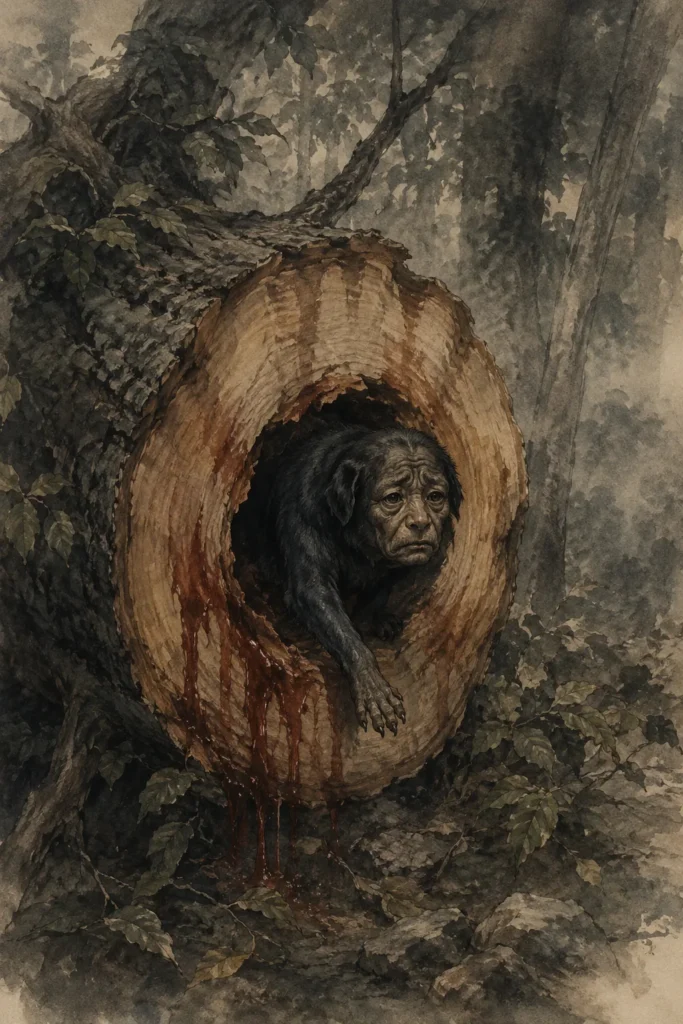
The Shanxiao is a one-legged mountain-forest demon of China that dwells in the mountains and forests. At the campfire it roasts frogs and crabs, steals salt from woodcutters and harasses travellers; whoever offends it comes down with fever.
At the same time it is a textbook case of Daoist spirit control: whoever knows and calls out its name deprives it of power. It is widely documented in the Shenyijing, the Baopuzi and the Youyang zazu, and summarised in the Bencao Gangmu.
Type: One-legged mountain-forest demon, mountain essence
Origin: China, classical textual tradition
Texts: Shenyijing, Baopuzi, Youyang zazu, summarised in the Bencao Gangmu
Period: classical to present
Appearance: small, ape-like and human-like, one-legged, naked, some with a backward-turned foot

Historical Background
Period of the Texts
Widely documented in classical literature: in the Shenyijing, in Ge Hong’s Baopuzi and in the Youyang zazu, summarised in Li Shizhen’s Bencao Gangmu.
Area of Diffusion
Southern China; the older sources place these beings in the deep mountains of the west.
Sources
Good: the classical texts themselves, along with scholarly interpretations, which see in the Shanxiao partly mythologised memories of mountain peoples.
Name and variants
Chinese: Shānxiāo, literally mountain goblin. Numerous variant and dialect names are documented, including tree guest. The Baopuzi names among the mountain essences the Qi, shaped like a small boy who hops backwards on one foot.
Appearance and behaviour
Appearance
The Shanxiao is small, ape-like and child-like, one-legged, with a partly backward-turned foot, naked and shaggy. It lives in trees and mountains, fears loud bangs such as bursting bamboo, but loves music. It is more a goblin than a wholly malicious being.
Effect
The Shanxiao harasses and robs people, especially of salt, and roasts crabs and frogs over the fire. If offended, it causes fever and misfortune such as illness or house fires. It is changeable and takes on other shapes.
Profile: Shanxiao
The key aspects of the mountain goblin at a glance.
Both mountain essence and demon, a textbook case of nature-spirit ambivalence and of Daoist spirit control through knowledge of names.
Travellers, woodcutters and anyone spending the night in the mountains: their campfire and their salt attract the Shanxiao.
A small, ape-like and child-like goblin on one leg, naked and shaggy, partly with a backward-turned foot.
Harassment and theft, especially of salt; if offended, fever and misfortune such as illness or house fires.
The naming ban from the Baopuzi and bang rituals: bamboo in the fire, whose bursting drives the Shanxiao away.
Mountain essences between the Shenyijing and the Baopuzi
The Shenyijing describes naked beings, over a foot tall, in the deep mountains of the west, who roast frogs and crabs over the fire, are not shy of people and steal salt. Ge Hong’s Baopuzi names the mountain essences, including the Qi, shaped like a small boy who hops backwards on one foot; if one knows and calls out its name, it cannot cause harm.
Numerous variant and dialect names, such as tree guest, show how widespread the figure was. The Bencao Gangmu later summarised the tradition; Li Shizhen also reports that in some places people worshipped the Shanxiao as a spirit in order to seek peace.
Interpretations and classification
Scholars interpret the Shanxiao partly as a mythologised memory of non-Chinese mountain peoples as well as mountain and spirits of the dead; the figure also appears in modern popular culture.
In terms of religious studies, the Shanxiao is a mountain essence and at the same time classed among the demons. It embodies the ambivalence of the nature spirit between goblin and threat, and the Daoist notion that knowledge of names grants power over spirits.
Naming ban and bursting bamboo
Well attested is the name-ban from the Baopuzi: knowing and calling out the Shanxiao’s name strips it of its power. Alongside this stand fire and noise rites, such as throwing bamboo into the fire, whose bursting drives it away, for the goblin fears loud bangs. Li Shizhen also reports that in some places people venerated it as a spirit to ask for peace: warding off and appeasing stood side by side.
One-legged forest spirits compared
The Shanxiao belongs to the one-legged forest spirits, alongside the Colombian Patasola and the Brazilian Curupira with its backward-turned feet; it corresponds to the European goblin and the Japanese Sansei. Within China, it should be distinguished from the Penghou: both are regarded as essences, yet the Penghou rests passively in the wood of the camphor tree, while the Shanxiao actively roams around people’s campfires.
Frequently asked questions about the Shanxiao
How many legs does the Shanxiao have?
Only one, sometimes with a backward-turned foot.
How does one protect oneself?
By knowing and calling out its name, and by using loud bangs such as bamboo bursting in fire.
Is it an animal or a spirit?
Both at once: a mountain essence that is also classed among spirits and demons.
Further links
Literature (selection)
Further standard works in the bibliography.
As a one-legged mountain-forest demon and mountain goblin of China, the Shanxiao represents the living wilderness beyond the villages: troublesome, moody, yet manageable for anyone who knows its name.