Penghou, the dog in the wood of the camphor tree
By Ralf Ittermann · last reviewed on
The Penghou is a demon of the Chinese tradition.
The black, tailless dog in the wood of ancient camphor trees.
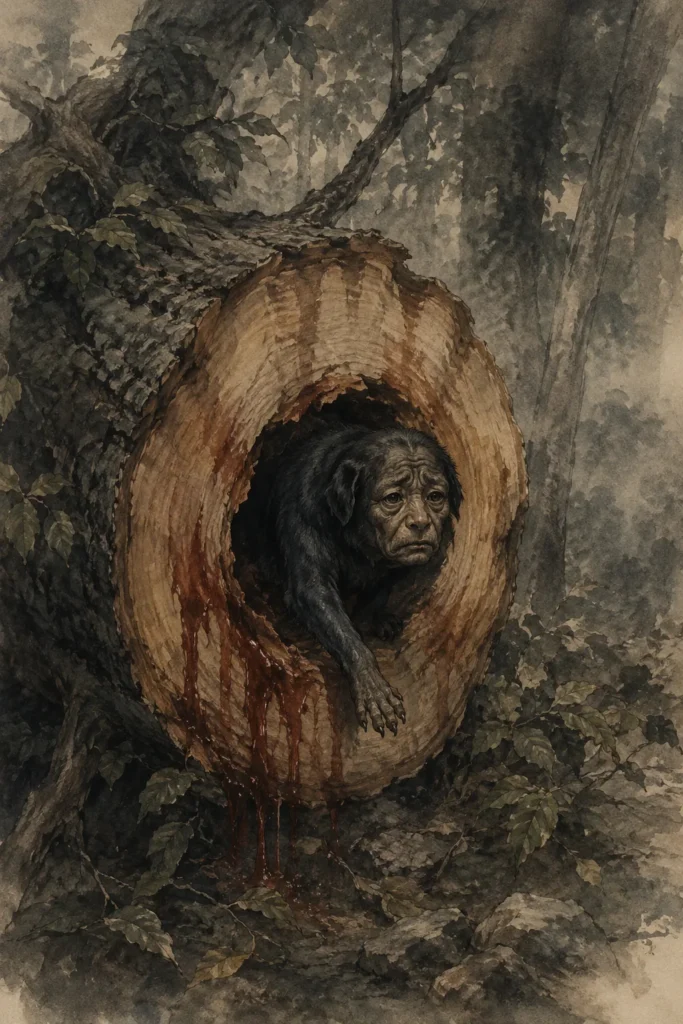
The Penghou is a Chinese tree spirit that dwells in the wood of ancient camphor trees and, when the tree is felled, emerges as a black, tailless dog with a human-like face. It embodies the vital essence of the old tree and is more curious than threatening.
It is attested in the classical texts: in the Baize tu, in Gan Bao’s Soushen Ji, and later in the Bencao Gangmu. Its case exemplifies the Daoist belief that the essence of a thousand-year-old tree can become a spirit, and that knowledge of its name can bind such beings.
Type: Tree spirit, essence of ancient camphor trees
Origin: China, classical textual tradition
Texts: Baize tu, Soushen Ji, later Bencao Gangmu
Period: classically attested, received in Japan as Hoko
Appearance: black, tailless dog with a human-like face
Source context
Period of the Texts
Classically attested in the Baize tu and in the Soushen Ji, later in the Bencao Gangmu, which lists the Penghou among the apes.
Area of Diffusion
China; via Japan the Penghou was received as Hoko and thus found its way into the Japanese world of yokai.
Sources
Good sources: the classical texts themselves, from the Baize tu through Gan Bao’s Soushen Ji to Li Shizhen’s Bencao Gangmu.
Name and variants
Chinese: Pénghóu, literally something like Drum-Beat Marquis. The Baize tu states that a being named Penghou, formed from the essence of the wood, looks like a black dog without a tail.
Description
Appearance
The Penghou is a small, black, tailless dog with a human-like face. It embodies the vital essence of the wood of ancient camphor trees, for the essence of a thousand-year-old tree can become a spirit.
Effect
The Penghou manifests when the tree is felled; in the traditional account it is harmless and passive, and is even caught and eaten. It is not an aggressive attacker but a tree essence released by the felling of wood.
Profile: Penghou
The key aspects of the camphor-tree essence at a glance.
A model example of the Chinese tree cult: the essence of ancient trees can become a spirit, catalogued in the Baize tu.
Woodcutters felling old trees: the spirit hidden within the trunk comes to light when the wood is cut.
Small black, tailless dog with a human-like face, hidden in the wood of old camphor trees.
Passive tree essence without active threat; in the Soushen Ji, the released Penghou is caught and eaten.
The Daoist binding by name: whoever knows the spirit’s name and calls it out binds it; the Baize tu served as a catalogue for this purpose.
From the Baize tu to the Bencao Gangmu
The Penghou is documented in the Baize tu, which states that a being formed from the essence of wood called Penghou looks like a black dog without a tail. In the Soushen Ji by Gan Bao, during the era of the Wu kingdom a man fells a large camphor tree; the wood bleeds, and inside is a dog-like creature with a human face, which is identified as Penghou.
Li Shizhen’s Bencao Gangmu later lists it among the apes. Thus the Penghou runs through the classical textual world from spirit catalogue to anecdote collection to natural encyclopaedia, remaining throughout what it is at its core: the released essence of an ancient tree.
Reception and classification
The Penghou is a classic example of the Chinese tree cult and was widely received in Japan through Toriyama Sekien. Its nature-spirit ambivalence is low; it is regarded more as a curious tree essence than as a threat.
In terms of religious studies, the Penghou embodies the Chinese notion that ancient trees harbour an essence that can become a spirit. It is a textbook example of the tree cult and, through the naming ban, is linked to the Daoist technique of spirit control.
The naming ban of the Baize tu
Well documented is the overarching Daoist motif from the Baize tu and the Baopuzi: whoever knows and calls out the name of a spirit binds it. The Baize tu served as a catalogue for identifying such beings and thereby controlling them; for the Penghou, the Soushen Ji states that recognition is the decisive act of control. Whoever knows that the dog in the wood is called Penghou has already prevailed over it.
Tree essences and their relatives
The Penghou corresponds to the Japanese Kodama, the tree spirit as which it was directly received in Japan, as well as to the West African Iroko Man; in general it belongs to the tree-bound essence spirits such as the Greek Dryad. It must be clearly distinguished from the Shanxiao: the Penghou is a passive essence within the wood, released only by the felling of the tree, whereas the Shanxiao is an active, one-legged goblin of the mountains that harasses and robs people.
Frequently asked questions about the Penghou
Where does the Penghou live?
In the wood of ancient trees, especially camphor trees.
What does it look like?
Like a black dog without a tail, with a human-like face.
Is it dangerous?
Hardly, according to the traditional accounts; it is released when the tree is felled and is more curious than threatening.
Further links
Further reading:
- China – all beings of Chinese tradition
- Shanxiao – the active mountain goblin, for comparison
- Kodama, Dryad – related tree spirits
- Amulet, Smoke cleansing, Salt – traditional protective means
- Protection Compass – overview of protective means
Literature (selection)
Further standard works in the bibliography.
As a Chinese tree spirit and camphor-tree demon, the Penghou is one of the quietest figures in the spirit catalogues: not a threat, but the visible life force of an ancient tree made manifest.