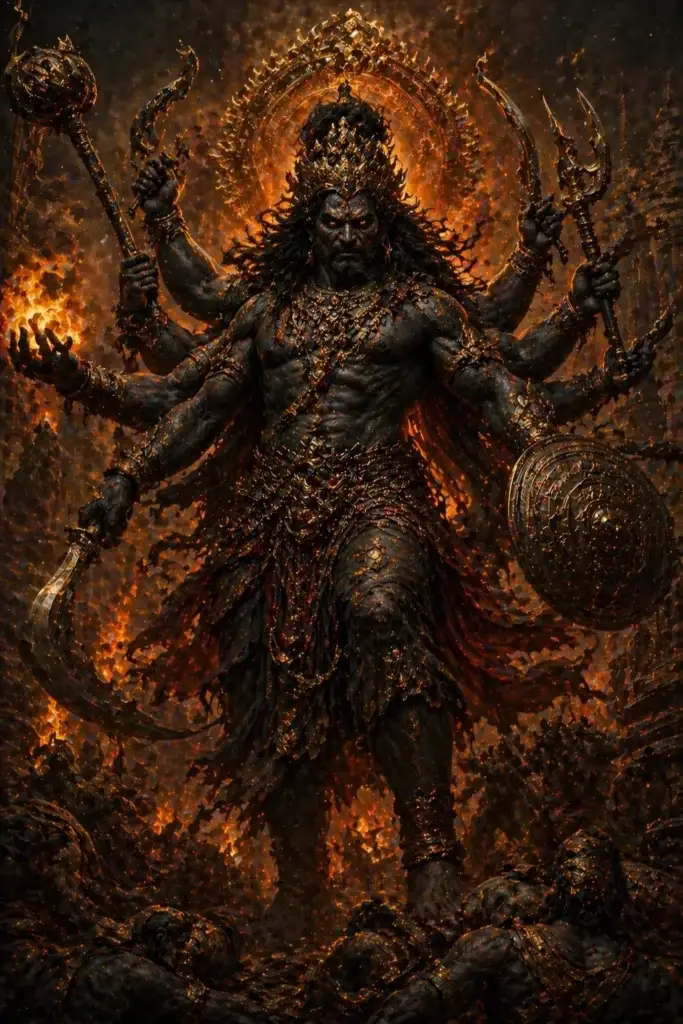
Yama, god of the Hindu tradition
By Ralf Ittermann · last reviewed on
Yama is a god of the Hindu tradition.
The first mortal, the god of death and judge of souls. Yama is one of the oldest Indian deities, not evil but inevitable like death itself. As the first human to die, he became the ruler of the afterlife, the Yamadharma, the Dharma of death.
With his staff (Danda) and his faithful buffalo Mahisha, Yama roams the world, gathers the souls of the dying and brings them before judgment. In Hinduism he is not a demon, but a necessary force of the cosmic order.
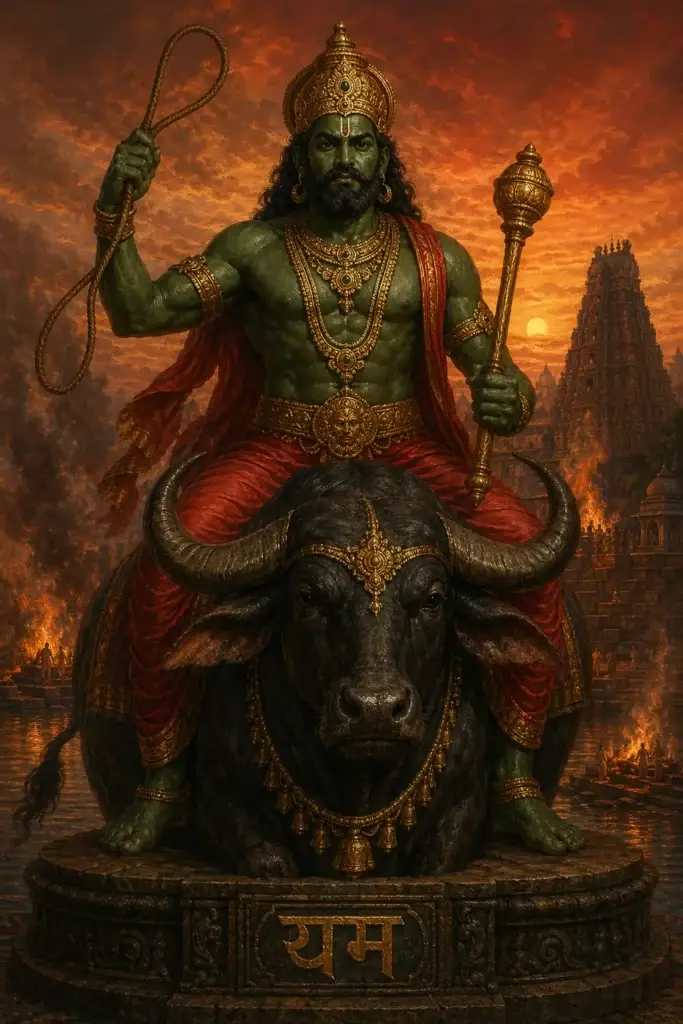
Yama
Type: Hindu-Buddhist principal deity, judge of the dead and ruler of the underworld
Pantheon: Hinduism, Buddhism (Yamaraja), Tibet (Yama-Dharmaraja)
Function: First mortal to experience death; now judge of all the dead, lord of Naraka
Main attributes: Black buffalo as mount, club (Danda), noose (Pasha), book of deeds
Main cult sites: Yama temples in Tamil Nadu, Tibetan monasteries (Cham dance), Japan (Enma-O)
Buddhist identification: Yamaraja (also in Tibet), Enma-O (Japan), Yeomra (Korea)
Classification
Yama is attested in the Rigveda (1200–900 BCE) as the first mortal, the one who first walked the path into the world of the dead and rules there. In the later epic tradition (Mahabharata) he becomes the stern judge of the dead.
Adopted in Buddhism as Yamaraja, with an expanded cosmos of hells. In Tibet since the 8th century CE as Yama-Dharmaraja in the wrathful-deity pantheons. In East Asia as Enma-O / Yeomra / Yanluo, each with local adaptations.
In India, temples to Yama are rare; the judge of the dead is feared, not popular in cultic terms. The most important: the Yamadharma temple in Tamil Nadu, Yama mandirs in Nepal.
In Tibet he is central to the Cham dance performances of the Gelug monasteries (especially Drepung, Ganden, Sera). In Japan he appears as an Enma-O statue in every Buddhist cemetery. In Korea: Yeomra in the shamanistic Mu-sok tradition.
Central sources: Rigveda X 14–18 (Yama as the first dead), Atharvaveda, Mahabharata (Book II, Sabha Parva: the description of Yama-Sabha), Markandeya Purana, Garuda Purana (descriptions of the hells).
Buddhist: Devaduta Sutta, the Tibetan Bardo Thodol. Secondary literature: O’Flaherty, The Origins of Evil in Hindu Mythology; Doniger, Hindu Myths; Lopez, The Tibetan Book of the Dead.
Name
Yama is depicted as a green-skinned or reddish man, often in royal armour. He carries a staff (Danda), his attribute of punishment and order, and often a noose (Pasha) to bind the souls.
His buffalo Mahisha is his most important animal; sometimes he also rides horses or mingles among the living. In later iconographic texts he has a green or grey-black face.
Description
Yama is the uncontested judge. No deception escapes him. When a lifespan ends, Yama comes in person, or his envoy Chitragupta keeps the records, to fetch the soul. The soul is then brought to Yamaloka, where its deeds (Karma) are weighed.
Depending on the Karma, punishment (Naraka) or reward (Swarga) follows before the next rebirth. Rituals for the deceased (Shraddha) are meant to appease Yama and to guide the souls more quickly into the next life.
Profile: Yama
The most important aspects of Yama at a glance. The following fields summarise origin, function, appearance, worship, symbols and parallels.
Yama is the son of the sun deity Vivasvat (Surya) and Saranyu, twin brother of Yami.
In the oldest myth the first human to encounter death, hence the one who first walked the path into the world of the dead and now rules within it. In later traditions married to the wife Dhumorna, he has two hounds (descendants of Sarama) as guardians of the way. His house lies in the south.
The first dead, therefore king of the dead. Dharmaraja (king of duty), the judge who decides according to the karma of each deceased person. Administrator of the 21 hells (Naraka) and of the heavenly rewards.
In Buddhism formally a keeper of the cosmic law (Dharma) with regard to the logic of deed and consequence. In Tibet, as a wrathful deity, also a protector of the school tradition against negative forces.
In the Hindu tradition: a dark-skinned (green-blue-black) figure with colourful ornaments, holding the Danda (club of judgment) and Pasha (noose with which he catches the souls), riding a black buffalo. Red attire.
In Tibet as Yama-Dharmaraja: buffalo head, three eyes, flaming aureole, bone ornaments, a curved crown of hair, holding a skull cup and a sword. Accompanied by his sister Yami and a host of servants.
Sphere of influence: In India, Yama is rarely invoked directly for protection; he is feared as the stern one. In death rites, however, he is central, and the bereaved ask for mild treatment of the deceased.
In the Bardo Thodol (the Tibetan Book of the Dead) he appears to the deceased in the Bardo state as a testing figure. In Japan, Enma-O is a central figure of the popular Buddhist death rites and is found in every cemetery. In the Cham dances of Tibet he appears as a fearsome masked figure.
Black buffalo (mount), Danda (club), Pasha (noose), book of the dead, mirror of karma (Karma-Darpana), skull cup (Tibetan), buffalo head (Tibetan), flaming aureole, third eye. Plants: black asphodel. Sacred direction: south.
Yamaraja (Buddhism), Yama-Dharmaraja (Tibet), Enma-O (Japan), Yeomra (Korea), Yanluo (China, fifth of the ten kings of hell), Hades (Greece, king of the underworld), Pluto (Rome), Anubis/Osiris (Egypt, guide of the dead and judge of the dead), Hel (Germanic, ruler of the underworld), Mictlantecuhtli (Aztec).
The Indo-European root is recognisable in the Yama-Yima-Yumis stem (Vedic Yama, Avestan Yima, Baltic Yumis).
Protective practice
Rituals of worship
Yama is worshipped in Vedic domestic rituals through offerings (Havis): milk, butter, grain at ancestral commemorations (Pinda-Daan). Rigveda 10.14 documents formulas of worship for a dignified death.
In the Hindu funeral ritual, a Yama mantra is recited before the cremation. Modern practice: meditations at the deathbed or at ancestral commemorations in honour of the king of Dharma.
Invocations and appeals
Mantras to overcome the fear of death are found in the Katha Upanishad (Nachiketas’ dialogue with Yama). Tibetan tantric tradition integrates Yamantaka (the conquest of Yama) into invocations of total transcendence.
Amulets and protective symbols
Yama symbols are rare as a wearable amulet; the connection is more conceptual.
Archaeological evidence for the worship of Yama is found in Vedic ritual texts and in inscriptions in Indian temples from the 3rd century BCE, not as object amulets.
Yama, parallels in other cultures
The myth of the first mortal
The oldest layer of the Indian tradition knows Yama not as a punishing judge but as the first human who died. The tenth mandala of the Rigveda contains several hymns that carry this idea.
In Rigveda 10.14 Yama is invoked as the one who first found the way to the afterlife and thereby opened it for all his descendants. There he is regarded as the son of the sun god Vivasvant and thus as related to the human race itself.
A particularly much-discussed hymn is Rigveda 10.10, the dialogue between Yama and his twin sister Yami. Yami urges Yama to unite so that the human race may continue, and Yama rejects her by pointing to the prohibition of incest among siblings and to the watching gods.
Scholarship, for example Stephanie Jamison and Joel Brereton in their 2014 translation of the Rigveda, reads this hymn as a reflection on the limits of permitted kinship relations, not as an aetiology of humanity.
Remarkable is the linguistic closeness to the Old Iranian Yima, who in the Avesta likewise appears as the first king and lord of an underground refuge. Both names go back to an Indo-Iranian root meaning twin.
Comparative Indo-European studies, among others in the works of Bruce Lincoln, have seen in this the remnant of a shared myth of creation and death, in which the first human is at once the first dead and ruler of the ancestors.
The later Yama of the epics and Puranas, who commands hells and a record-keeping of deeds, is a considerable development of this early figure.
Yama's realm and the record-keeping of deeds
In the epic and Puranic literature, Yama changes from lord of the blessed ancestors to administrator of a differentiated afterlife. His abode, Yamaloka or Yamapura, lies according to most texts in the south, which is why the south is regarded in ritual geography as Yama’s cardinal direction.
The Garuda Purana, a central text for the notions of dying and of the soul’s journey, describes the deceased’s journey across the glowing river Vaitarani to Yama’s throne.
At Yama’s side stands Chitragupta, a scribe who records every deed of a human being in a register. This book, often called Agrasandhani, is read out at death, and according to its content Yama decides the further path.
Chitragupta has become in northern India the ancestor of the scribal caste of the Kayasthas, who venerate him as their forefather. Here it becomes apparent how a mythological figure establishes social identity.
The punishments in Yama’s hells, the Naraka, are catalogued in the Garuda Purana and in parts of the Manusmriti and assigned to particular offences. Decisive, however, is that according to classical doctrine these hells are not eternal places.
They are stations in the cycle of rebirth, and after the consequences of bad deeds have been atoned for, the soul’s path continues.
Yama is thus less a god of final damnation than a functionary of the cosmic law. His epithet Dharmaraja, king of Dharma, expresses exactly that: he executes an order, he does not invent it.
Yama in the Bhagavad Gita and the Katha Upanishad
Two classical texts give Yama a role that goes beyond the merely judicial. In the Katha Upanishad, Yama is the teacher.
The young Brahmin Nachiketas is promised to death by his father in anger and waits three days before Yama’s house. As recompense, Yama grants him three wishes. The third is the question of what happens to a human being after death.
Yama first tries to distract Nachiketas with wealth and long life, but the youth persists. Thereupon Yama teaches him the distinction between the pleasant and the salutary and instructs him about the immortal self, the Atman. Here the god of death is paradoxically the mediator of the knowledge that overcomes death.
In the Bhagavad Gita, in the tenth chapter, in which Krishna enumerates his divine manifestations, he says of himself that he is Yama among the subduers or judges.
Thereby Yama is placed in the ranks of the highest representatives of their respective class. The statement underlines that in classical Hinduism Yama is not a demonic but an ordered and legitimate power.
This textual tradition has strongly shaped the religious-studies assessment of Yama. While popular depictions reduce him to terror, Indologists such as Wendy Doniger emphasise that Yama appears in Sanskrit literature equally as an instructor, as a just figure and as a necessary authority.
Death in this view is not the opposite of order but a part of it.
Iconography and distribution beyond India
In the visual arts, Yama is mostly depicted with dark, often green or bluish skin, clothed in red, with a buffalo as a mount beneath him. In his hands he carries a noose, the Pasha, with which he draws the life-soul out of the body, and often a staff or club, the Danda.
These attributes are stable in temple reliefs and in miniature painting since the Middle Ages. As one of the Lokapalas, the guardians of the world directions, Yama regularly appears on temple exterior walls on the southern side.
Through Buddhism, Yama reached Tibet, China, Japan and Southeast Asia and changed in the process.
In the Tibetan tradition he is, as Shinje, lord of the judgment of the dead and at the same time the object of his own instructional story, in which the bodhisattva Manjushri subdues him in the form of Yamantaka, the conqueror of Yama.
In China he became Yanluo, the fifth of the ten kings of hell (see Yanluo), in Japan Enma. This migration shows how an Indian god could become a pan-Asian emblem of the incorruptible judgment of the dead.
In present-day India, Yama lives on above all in funeral rituals, in literature on dying and in the festival Yama Dvitiya or Bhai Dooj, which ties in with the relationship between Yama and his sister Yami.
The sister entertains the brother and asks for a long life for him. Thus a motif returns in folk custom that was already laid out in the oldest Vedic hymn, the dialogue of the twins.
History of research and dispute over interpretation
The scholarly study of Yama begins in the 19th century with the European opening up of the Rigveda. Early Indologists such as Hermann Oldenberg and Abel Bergaigne disputed whether Yama had originally been a deified primordial human or a death deity from the outset.
The debate is closely connected with the question of how the hymns 10.10 and 10.14 are to be dated and read.
In the 20th century, comparative Indo-European studies shifted the focus to the relationship between Yama and the Iranian Yima. Georges Dumezil and, in his succession, other researchers reconstructed from this an Indo-Iranian, possibly Indo-European myth of the first mortal who becomes ruler of the dead.
Bruce Lincoln has argued in Death, War, and Sacrifice that behind Yama and related figures stands a shared creation scheme in which the first killing structures the world.
It remains contested how strongly the Vedic Yama is to be separated from the later Puranic Yama. Some researchers see a continuous development, others emphasise a break between the ancestral king of the early period and the administrator of hells of the classical texts.
The origin of the scribe Chitragupta is also open, since he is absent in the oldest layers and presumably was added later, possibly under the influence of concrete social groups.
The source situation here compels caution: much of what is taken as a fixed image of Yama is the result of centuries-long layering of various textual traditions.
Further links
Literature (selection)
Further standard works in the literature index.
Frequently asked questions about Yama
Who is Yama in Buddhism?
In Buddhism, Yama is the ruler of the hell realm (Naraka) and judge of the deceased. Unlike in the Western understanding, the Buddhist hell is not an eternal place of punishment but a temporally limited place of rebirth: whoever has atoned for their karma there is reborn.
Yama questions every dead person about their deeds in life; Mahayana Buddhism knows a whole court of judges of hell who assist him. Yama’s realms are described with inconceivable detail in Buddhist cosmology (Abhidharma texts).
How does Yama in Buddhism differ from the Hindu Yamaraja?
Both figures share a common origin in the Vedic Yama (Rigveda 10.14), the first mortal who at the same time became lord of the dead. In Hinduism, Yama remained the central judging god who receives every soul.
In Buddhism, Yama became a many-faced figure: in Theravada more as a concept, in Mahayana and especially in Tibetan Buddhism as a personified lord of hell with complex iconography (often with a bull’s head, the Yama aspect Dharmaraja). In Tibet, the wandering demon dancers (Cham festival) are often performers of Yama.