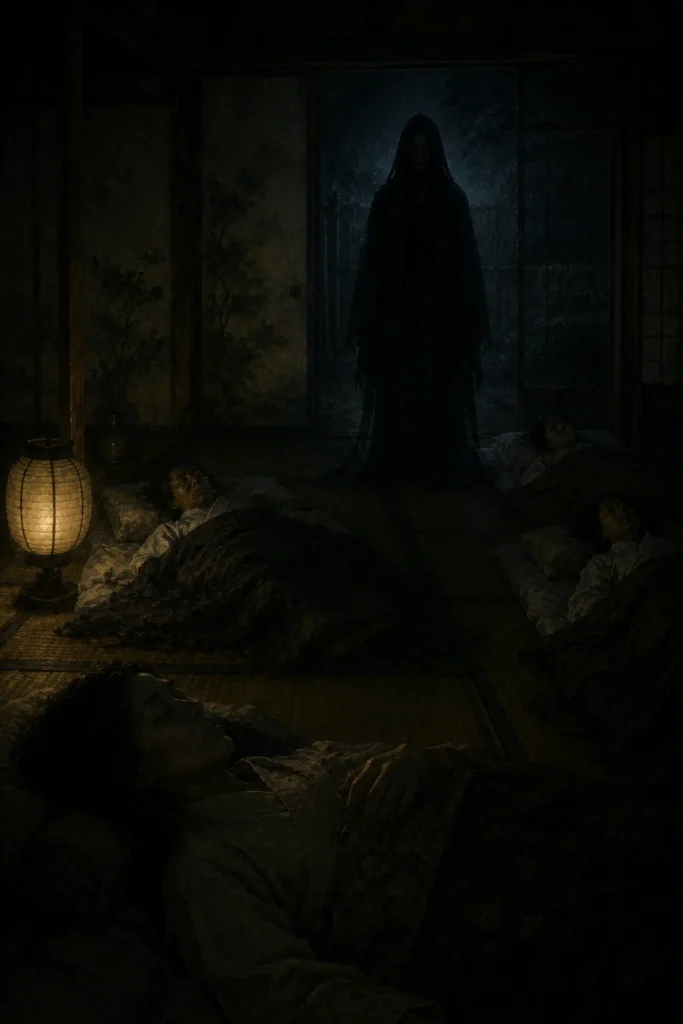
Ubume, the mother with the ever heavier child
By Ralf Ittermann · last reviewed on
Ubume is a spirit of Japanese tradition.
She asks passersby to hold her ever-heavier child. The tradition describes the mother with the ever-heavier child. Ubume is regarded as the spirit of a deceased mother in Japanese tradition.
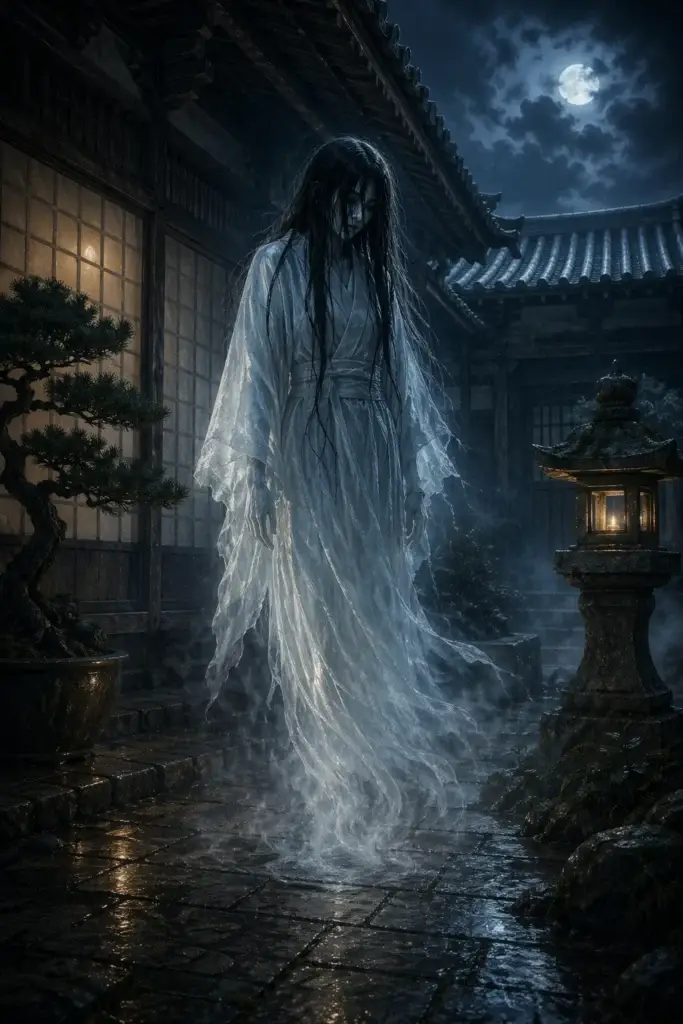
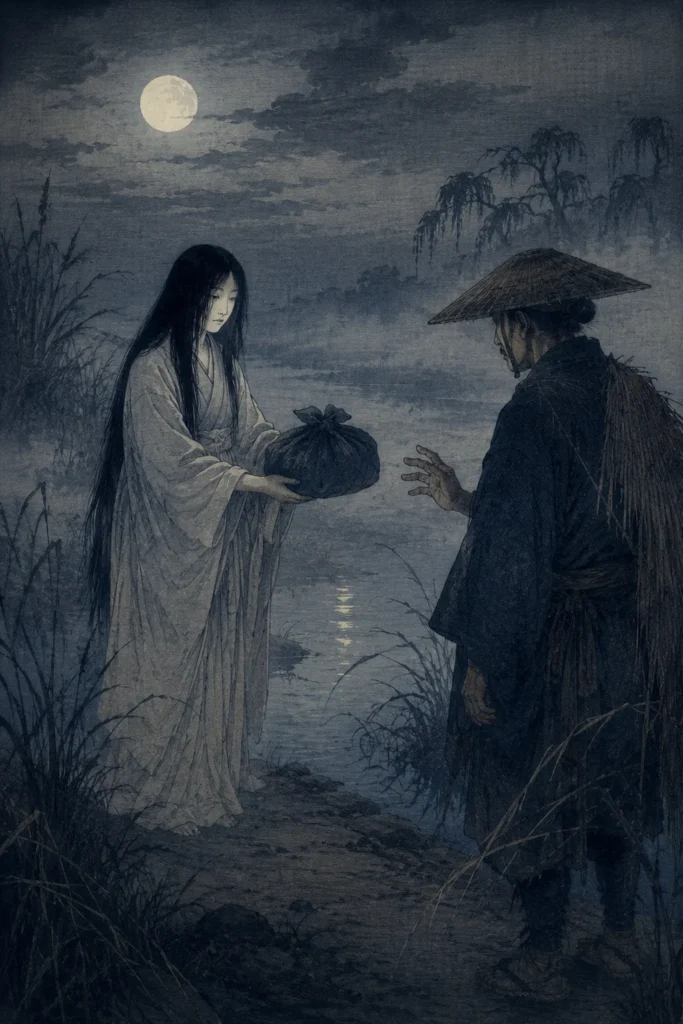
Ubume is the spirit of a woman who died during or shortly after childbirth, literally the one giving birth or the woman in childbed. She appears along roads and riverbanks with an infant in her arms and asks passers-by at night to hold the child for a moment.
What stands in the foreground here is not revenge but grief over a motherhood that death did not allow to be completed.
Type: Spirit of a woman who died in childbirth
Origin: Old Japanese tradition, narratives since the 12th century
Texts: Konjaku Monogatari, Wakan Sansai Zue, Toriyama Sekien’s Gazu Hyakki Yagyo
Period: 12th century to the present, depicted as a yokai in the Edo period
Appearance: Woman with a bloody loincloth and a crying infant in her arms
Textual history
Period of the Texts
Old tradition: narratives are attested since the 12th century; the Ubume was depicted as a yokai in the Edo period.
Area of Diffusion
Widespread throughout Japan, with many regional variants of the narrative.
Sources
Good: the tradition extends from Konjaku Monogatari through Edo-period encyclopaedias to Toriyama Sekien’s pictorial work.
Name and variants
Japanese: ubu or umu means to give birth, me means woman: Ubume is the one giving birth or the woman in childbed. An alternative spelling of the name comes from the Chinese bird-demon tradition.
Appearance and behaviour
Appearance
The Ubume often appears with a bloody loincloth and a crying infant, frequently at riverbanks in reference to the Buddhist Sai no Kawara, the river of the dead for children. She symbolises unfulfilled motherhood and the double tragedy of mother and child.
Effect
She asks passers-by to hold her child for a moment. The bundle grows increasingly heavy, sometimes turning to stone. In some versions, those who stand firm are rewarded with superhuman strength, while those who flee are pursued.
Profile: Ubume
The key aspects of the mourning spirit at a glance.
An old narrative figure of Japanese folk tradition, attested since the 12th-century Konjaku Monogatari and depicted as a yokai in the Edo period.
Individual passers-by at night, on roads and riverbanks, to whom the Ubume holds out her child.
Woman with a bloody loincloth and a crying infant, often at riverbanks near the Buddhist river of the dead for children, Sai no Kawara.
The bundle in her arms grows increasingly heavy, sometimes turning to stone; standing firm is regarded in several versions as bringing blessing.
Buddhist death rites and the mizuko-kuyo for mother and child, along with regional special burial customs for women who died in childbed.
From Konjaku Monogatari to Toriyama's yokai image
The name Ubume combines ubu or umu, to give birth, and me, woman, meaning the one giving birth or the woman in childbed; an alternative spelling comes from the Chinese bird-demon tradition. Related narratives are already found in the 12th-century Konjaku Monogatari.
In the Edo period, works such as the Wakan Sansai Zue took up the subject, and Toriyama Sekien depicted the Ubume in his Gazu Hyakki Yagyo in the late 18th century. He did not invent her, however: the tradition reaches back much further, though his pictorial work contributed decisively to the fixed yokai form.
Afterlife in literature and yokai culture
The Ubume features prominently in Kyogoku Natsuhiko’s 1994 novel Summer of the Ubume and its film adaptation, and is a fixed part of yokai encyclopaedias, manga and horror. She links classical folk tradition with modern popular culture.
From a religious-studies perspective, the Ubume connects the unattended dead with particular anxieties surrounding birth and infant death. She represents cultural concern for women who died ritually impure and without a completed maternal role, and is regarded less as a vengeful spirit than as one of mourning and care.
Death rites for mother and child
Well documented are Buddhist death rites for mother and child, along with, in a broader sense, the mizuko-kuyo, the memorial rite for deceased and unborn children, as well as regionally attested special burial customs for women who died in childbed. Holy water, incense and candlelight are part of the commemoration of mother and child. In several versions of the narrative, standing firm and consciously accepting the child, that is compassion rather than flight, is also regarded as the right and even blessing-bringing response.
Weeping mothers across many cultures
Together with Onryo and Goryo, the Ubume forms a trio of grieving and vengeful spirits, of which she represents the grieving variant: not retribution but unfulfilled motherhood stands at the centre. Outside Japan she corresponds to the Mexican La Llorona, the weeping woman, the European White Lady, the Southeast Asian Pontianak and the Philippine Tiyanak, the ghost child.
Frequently asked questions about the Ubume
Is the Ubume vengeful?
Mostly not: grief stands in the foreground, and she merely asks that her child be held for a moment.
What should you do if she holds out the child?
In many versions you should accept it and stand firm, which brings blessing; fleeing can trigger pursuit.
Did Toriyama Sekien invent the Ubume?
No, the tradition reaches back much further, to the 12th century; however, his depiction proved formative.
Further links
Further reading:
- Japan – all beings of Japanese tradition
- Onryo, Goryo – the revenge variant alongside the grief of the Ubume
- La Llorona – Mexico’s weeping mother
- Holy Water, Smudging, Protective Candle – traditional protective means
- Protection Compass – protective means at a glance
Literature (selection)
Further standard works in the bibliography.
As the spirit of a woman who died in childbirth, the Ubume remains a Japanese mother spirit in the most literal sense: not an avenger, but a mother who, even in death, pleads for her child.