Ogbanje, bound to the iyi-uwa
By Ralf Ittermann · last reviewed on
Ogbanje is a demon of Igbo tradition in Nigeria.
A child who dies in order to return through the same mother.
Ogbanje is a recurring spirit child of the Igbo: an evil spirit that is born, dies young, and is repeatedly reborn through the same mother, tormenting the family with renewed grief. It is bound to a hidden object, the iyi-uwa.
The name ọgbanje literally means children who come and go. The term belongs to Igbo cosmology, Odinani, and is well documented in the Igbo homeland of southeastern Nigeria, both orally and in literature: Chinua Achebe made it known beyond Nigeria in 1958 with his novel Things Fall Apart.
Type: recurring spirit child of Igbo cosmology
Origin: Igbo cosmology Odinani, Igbo homeland in southeastern Nigeria
Texts: central term of oral tradition, fixed in literature by Chinua Achebe
Period: traditional, continuing to the present
Appearance: an apparently normal child who is in fact an evil spirit incarnate

Context of the tradition
Period of the Texts
Traditional, continuing to the present: the Ogbanje is a central term of Igbo cosmology and was also fixed in literature in 1958 through Chinua Achebe’s novel Things Fall Apart.
Area of Diffusion
The Igbo homeland in southeastern Nigeria.
Sources
Good: the Ogbanje is a central term of Igbo cosmology, documented both orally and in literature by Achebe.
Name and variants
Igbo: ọgbanje literally means children who come and go, and describes the recurring passage between this world and the spirit world.
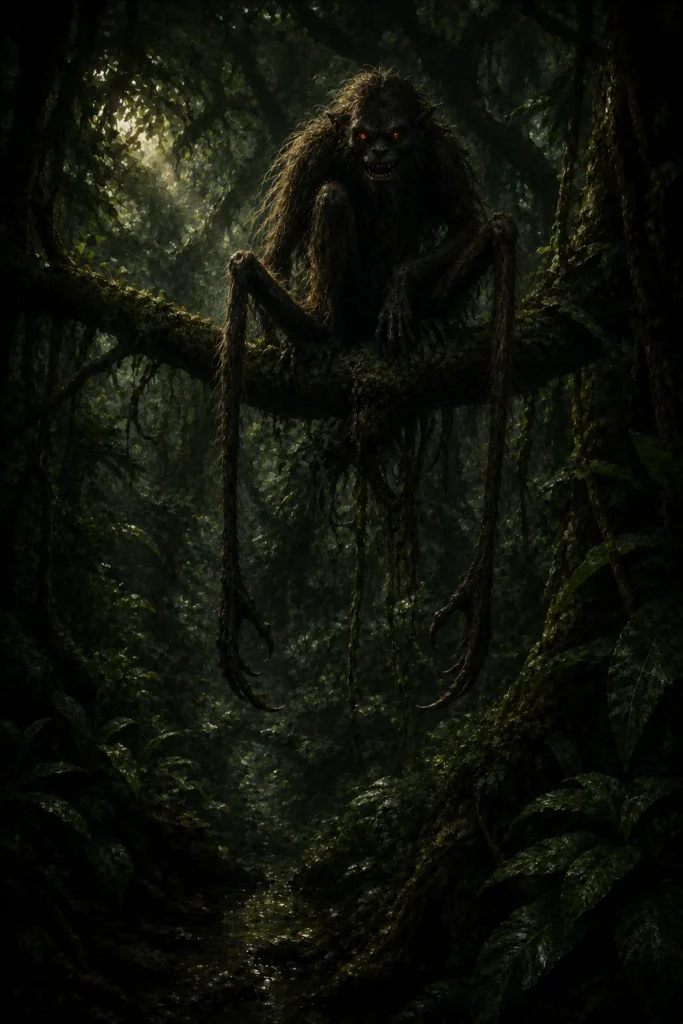
Appearance
Appearance
The Ogbanje stands between worlds and is bound to the iyi-uwa, often a stone, but also a doll, a hair or a piece of clothing of the dead child. The spirit buries it in secret; it allows the Ogbanje to return to the human world and find its way back to the target family.
Effect
The repeated, deliberate death and rebirth wears down the family through ever renewed grief. As long as the iyi-uwa exists, the cycle remains unbroken.
Profile: Ogbanje
The most important aspects of the recurring spirit child at a glance.
A central term of Igbo cosmology Odinani, with its notion of malevolent spirits that deliberately bring misfortune upon a family.
Its own family of origin, especially the mother, who gives birth to the same child again and again.
Apparently a normal child, but actually a spirit bound to the iyi-uwa, standing between this world and the spirit world.
Wears down the family through the repeated, deliberate death and rebirth of the same child.
A Dibia questions the spirit, locates the iyi-uwa and destroys it in order to end the cycle.
Odinani and the children who come and go
The name ọgbanje literally means children who come and go, and describes the ever-recurring passage between this world and the spirit world. The term belongs to Igbo cosmology, Odinani, with its notion of malevolent spirits that deliberately bring misfortune upon a family: the Ogbanje is not the victim of a tragic coincidence but acts of its own will.
An Ogbanje is born, dies young, and is reborn through the same mother, again and again. It is bound to the iyi-uwa, a hidden object, often a stone, but also a doll, a hair or a piece of clothing of the dead child, which the spirit itself secretly buries. The iyi-uwa allows the Ogbanje to return to the human world and find its way back to the same family, so that the cycle of birth and early death remains unbroken as long as it exists.
Achebe and the literary afterlife
In Things Fall Apart of 1958, Chinua Achebe shapes the character Ezinma as an Ogbanje child, including the search for the iyi-uwa. The Ogbanje and Abiku motif runs through modern West African literature.
From a religious-studies perspective, the Ogbanje is a mythological explanation for repeated early childhood death within a family. Some researchers interpret the concept as a premodern explanation of hereditary illnesses such as sickle cell anaemia or sudden infant death, whose familial recurrence was understood as the return of the same spirit.
The Dibia and the destruction of the iyi-uwa
The counter-ritual is well documented: a Dibia, a traditional healer and seer, questions the Ogbanje and forces it through rituals to reveal the location of the iyi-uwa. The iyi-uwa is dug up and destroyed so that the spirit can never haunt the family again. In addition, a worn amulet is considered a protective sign and medicine from the Dibia for the endangered child. In general, mugwort is regarded as a protective herb. Salt is also regarded in folk belief as a protective sign against evil spirits.
Abiku and other recurring children
Frequently asked questions about the Ogbanje
What is the iyi-uwa?
The hidden, buried object, often a stone, a doll, a strand of hair or an item of clothing belonging to the dead child, that binds the Ogbanje to the world and to its family.
How does one stop the cycle?
A Dibia questions the spirit, locates the iyi-uwa and destroys it; afterwards the Ogbanje is said to no longer haunt the family.
Is Ogbanje the same as Abiku?
Practically yes, only among a different people: Ogbanje among the Igbo, Abiku among the Yoruba.
Further links
Literature (selection)
Further standard works in the bibliography.
As an Igbo spirit child, the Ogbanje remains one of the most haunting images of the tradition: a recurring child that torments its own family with the cycle of birth and early death, until the iyi-uwa is found and destroyed.