Abiku is a demon of Yoruba tradition.
Born to die, and yet it always returns home.
Abiku is the recurring spirit child of the Yoruba: a child born to die young, who then returns again and again to the same family. It belongs to a spirit community whose members have agreed among themselves to die early and return home to the spirit world Orun.
The name àbíkú combines àbí, the one born, with ikú, death. According to the ethnographer Timothy Mobolade, the Abiku form their own species of spirit with their own dwelling places: secluded corners, the forest and roadsides, especially beneath large trees such as the iroko and the baobab.
For the mother and the family, the child’s pact with its spirit community means repeated suffering: every birth is met with the suspicion that the same child has returned once more, only to die again.
Type: recurring spirit child in the cycle of birth and early death
Origin: Yoruba belief in a spirit community whose members have agreed to die early
Texts: ethnographically documented by Mobolade in 1973, since then widely received in literature
Period: academically recorded since 1973, still active in literature to this day
Appearance: a child on the threshold between the living and spirits, bearer of supernatural knowledge
Ethnographically documented by Timothy Mobolade in 1973, belief in the Abiku has since been widely received in literature and is still regarded today as a living part of Yoruba culture.
Yorubaland in south-western Nigeria and Benin, where belief in the recurring spirit child remains part of family experience to this day.
Good: Mobolade’s foundational study of 1973 and a broad literary reception in the works of Ben Okri, Wole Soyinka and John Pepper Clark.
Yoruba: The name àbíkú combines àbí, the one born, and ikú, death: born to die. The name thus directly denotes the child’s fate, bound to the cycle of birth and early death.
Appearance
The Abiku is a being on the threshold between the living and spirits, bearing supernatural knowledge. It is regarded as a symbol of the irresolvable contradiction between becoming and passing away, a child bound to its own death from birth onward.
Effect
The pact with the spirit community calls the child back prematurely into the spirit world Orun. For the family, this means the repeated loss of the same child, prompting them to seek ways of breaking the cycle.
The most important aspects of the spirit child at a glance.
Part of the Yoruba spirit world and its concept of reincarnation, embodied by a distinct spirit species within a spirit community.
Mothers and families who suffer the repeated early death of the same child and seek an explanation.
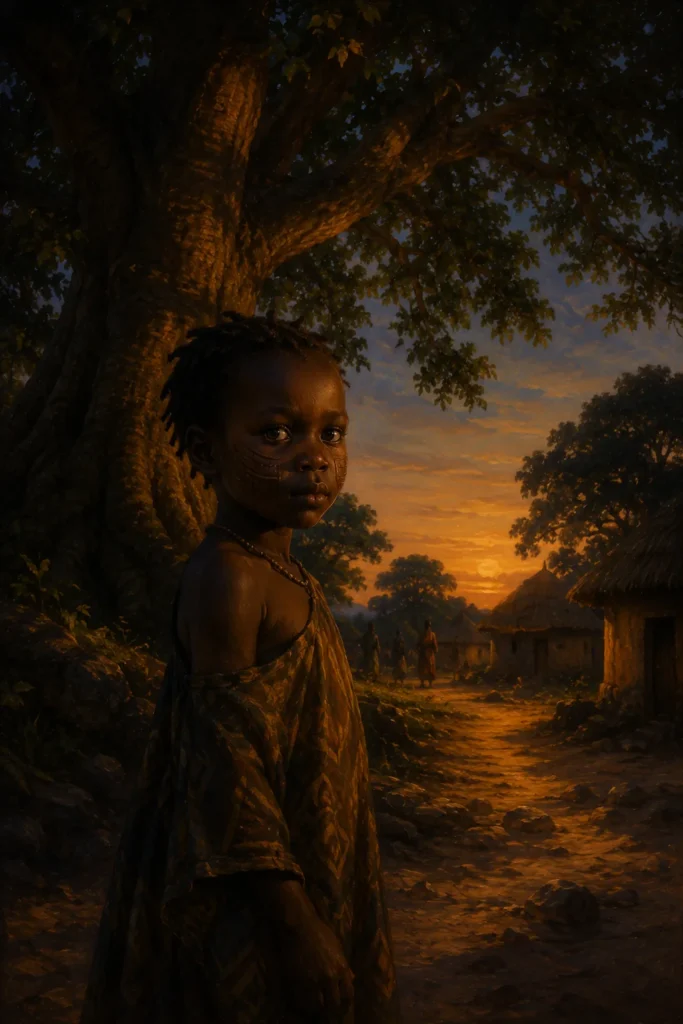
An ordinary child, recognisable only by scarification marks and a pleading protective name such as stay and bury us.
A mythical explanation of repeated infant death: the child belongs to a spirit community that reclaims it early.
Scarification, protective names, amulets and the ceremonies of specialised diviner priests intended to persuade the child to stay.
The name àbíkú combines àbí, the one born, with ikú, death, meaning born to die. According to the ethnographer Timothy Mobolade, the Abiku form their own species of spirit: their members belong to a spirit community that has agreed to die early and return to the spirit world Orun.
The dwelling places of the Abiku are said to be secluded corners, the forest and roadsides, especially beneath large trees such as the iroko and the baobab. From there, the being seeks out the family into which it is born, only to fulfil the pact with its spirit community soon after.
In his 1991 novel The Famished Road, Ben Okri portrays the protagonist Azaro as an Abiku, a spirit child. Wole Soyinka devotes a poem to the Abiku, in which he embodies the cycle of creation and destruction, and John Pepper Clark, too, has dedicated a poem of his own to the figure.
From the perspective of religious studies, the Abiku, like the Ogbanje of the Igbo, is a mythical explanation for repeated early infant death, embedded in the Yoruba concept of reincarnation and in a spirit community to which the child remains bound.
Well attested by sources are scarification, fine cut marks meant to make the child unattractive to its spirit companions, along with protective names, often pleading names meaning stay and bury us. As amulets, anklets and chains serve to spiritually anchor the child, while salt and protective signs are generally believed in folk tradition to ward off spirits. Mugwort stands for the herbs and medicine with which specialised divination priests, in ceremonies, try to persuade the child to stay. Older accounts also mention extreme practices performed on the corpse of a deceased Abiku child; these belong to the historical record of suffering and are noted here at a distance, not as a practice recommended or widespread today.
The direct parallel to the Abiku is the Ogbanje of the Igbo: the same basic pattern of a child who repeatedly dies and returns, only under a different name and among a different people. Further dead-child motifs appear in the Slavic Navki, restless spirits of children who died young, in the Scandinavian Myling and in the Philippine Tiyanak.
What does the name Abiku mean?
Born to die, from the Yoruba words àbí and ikú.
How does the Abiku differ from the Ogbanje?
It is the same phenomenon among two peoples: the Abiku among the Yoruba, the Ogbanje among the Igbo.
How does the family try to break the cycle?
Through scarification, protective names, amulets and the divination rituals of the priests.
Further standard works in the bibliography.
As a Yoruba spirit child, Abiku carries the meaning of its own name: born to die. Cut marks, protective names and the art of the divination priests are the family’s attempt to finally break the cycle.
Against its influence, cross-cultural tradition names these protective means:
Compare in the Protection Compass →Recommended protective means
The simplest protective means in this collection: 41 layers of fine gold 999, platinum, silver and silicon, manufactured in Ruhla, Thuringia. It requires no activation, is bound to no person, and is effective within a radius of around 50 meters, even without being worn.
Related Beings

Aos Sí, the people of the mounds of the Irish tradition, are fairy beings of the Otherworld. Acad...

Almas, the wild mountain man of the folklore of the Caucasus and Altai. Origin, the distinction f...

Yama-no-Kami, the mountain Kami of Shinto and folk belief. Origin, the alternation with Ta-no-kam...

The Adinkra symbols of the Akan from Ghana connect proverbs with pictorial signs. Origins, Gye Ny...

The Ghaddar, the cruel desert demon of Yemen and Egypt. Origin, the thin source basis and its rel...

Shamash, the Mesopotamian sun god and guardian of justice. His role in the Code of Hammurabi, tem...