Sasabonsam, the catcher in the treetops
By Ralf Ittermann · last reviewed on
Sasabonsam is a demon of the Akan tradition of Ghana.
He lurks in treetops and pulls hunters upward by the feet. The entry casts this demon as a catcher lurking among the treetops, seizing hunters by the feet.
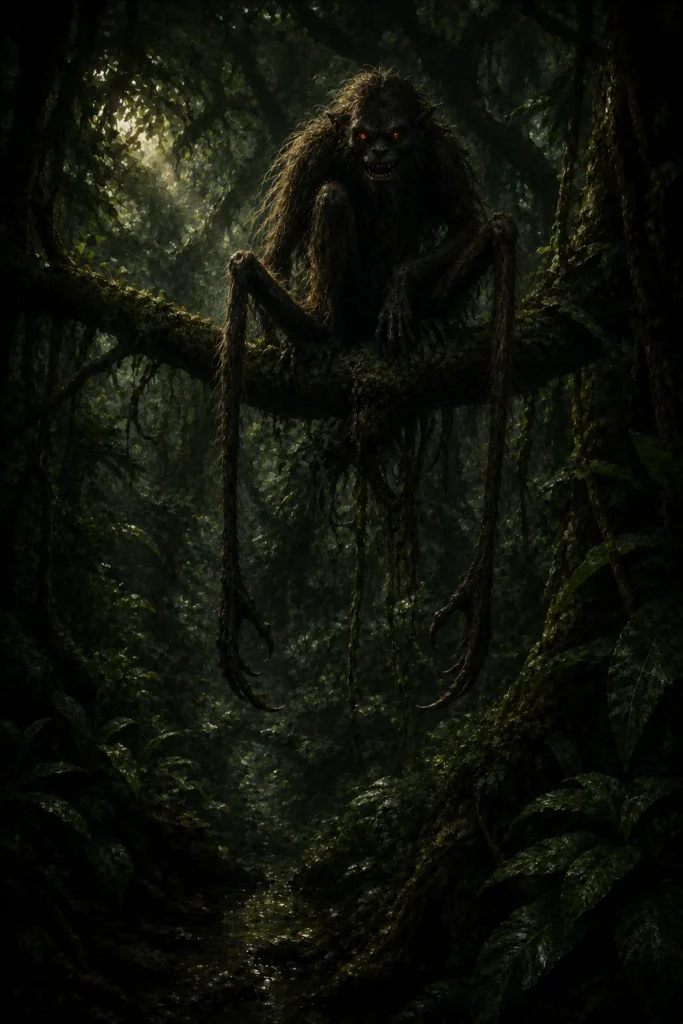
Sasabonsam is the hairy forest fiend of the Akan in Ghana, a man-eater with bloodshot eyes, iron teeth, and hooked feet. He lets his legs hang down from high treetops and pulls up lone-travelling hunters to devour them.
The classic record comes from R. S. Rattray, who documented the figure in Kumasi in the 1920s as part of his account of Ashanti religion. Belief in him is widespread in the deep rainforest of the Akan region in southern Ghana and neighbouring areas, where lone-travelling hunters in particular are considered at risk.
Type: man-eating forest fiend of Akan religion
Origin: traditional Akan religion, rainforest of southern Ghana
Texts: classically documented by Rattray 1927, followed by wide folklore reception
Period: classic to present
Appearance: densely hairy fiend with bloodshot eyes, iron teeth, and hooked feet
Area of origin and sources
Period of the Texts
Classically attested since 1927 through R. S. Rattray’s ethnographic records in Kumasi, followed by wide folklore reception up to the present.
Area of Diffusion
The deep rainforest of the Akan region in southern Ghana and neighbouring areas.
Sources
Solid: the classic ethnographic record by Rattray, along with wide later folklore reception.
Name and variants
Akan: The name belongs to the word field around bonsam, the evil spirit or devil; sasa denotes a restless, vengeful spiritual remnant, such as that of a killed animal or person.
Form and effect
Appearance
The Sasabonsam is a densely hairy forest fiend with bloodshot eyes, long legs, iron teeth, and hooked feet. The feet, pointing in both directions, symbolise deception and unpredictability, while the iron teeth represent devouring.
Effect
He sits in high treetops and uses his hooked feet to pull up those passing by, in order to devour them. He is considered allied with the witch Obayifo, who is regarded partly as his servant and partly as his patron; the question of who holds authority is disputed in the sources. He is also linked with the dwarf-magic beings Mmoatia.
Profile: Sasabonsam
The key aspects of the forest fiend at a glance.
One of the feared wild bush spirits of traditional Akan religion, classically documented by R. S. Rattray in Kumasi.
Hunters and travellers who move alone through the deep forest.
Densely hairy, bloodshot eyes, long legs, iron teeth, and hooked feet pointing in both directions.
Pulls those passing by up from the treetops to devour them; allied with the witch Obayifo.
Avoiding certain trees and deep forest zones as well as observing forest taboos; specific banishing rituals are barely attested.
He is considered allied with the witch Obayifo and the Mmoatia, the dwarf-magic beings of the Akan; among the spirits of the dead in this collection, the also West African Ogbanje stands closest to him.
Between bonsam and sasa: the name of a forest spirit
The name belongs to the Akan word field around bonsam, the evil spirit or devil; sasa denotes a restless, vengeful spiritual remnant, such as that of a killed animal or person. The classic ethnographic record comes from R. S. Rattray, who documented Ashanti religion in Kumasi in the 1920s. The Sasabonsam belongs to the feared wild bush spirits of traditional Akan religion.
The Sasabonsam embodies the danger of the untrodden, wild forest. In some interpretations he is a guardian of nature who punishes breaches of taboo, such as penetrating too deeply into the forest. The feet, pointing in both directions, symbolise deception and unpredictability, while the iron teeth represent devouring.
From bush spirit to symbol of nature conservation
The Sasabonsam is increasingly present in modern fantasy, horror literature, and video game design, and in contemporary African narratives often serves as a symbol of nature conservation and cultural preservation.
In religious studies, the Sasabonsam is a classic wild bush spirit and man-eating demon of traditional Akan religion. His function is to mark the boundary between the cultivated village and the dangerous wilderness, as well as to act as a guardian of taboos.
Avoidance, taboo, and sparsely attested defences
The source material on specific defensive rituals is thin: the Sasabonsam is not a cult object but a threat to be guarded against. Protection consists mainly in avoiding certain trees and deep forest zones and in observing forest taboos; concrete banishing or sacrificial rituals aimed specifically at him are barely attested. In dealing with the forest fiend, cold iron is considered effective, along with a worn amulet for the journey through the deep forest. Protective herbs such as mugwort are also regarded in Akan tradition as effective against bush spirits.
Forest fiend, ogre, and the vampire question
The Sasabonsam is a man-eating forest ogre, structurally comparable to the Arabian ghoul, the desert and road demon that ambushes and devours travellers. Because of its blood-drinking, it is often described in Western literature, together with the witch Obayifo, as an African vampire; in Akan tradition itself, however, it is primarily a man-eating forest spirit, not a vampire in the European sense. Related figures named in tradition include the Caribbean Soucouyant and the North American Stikini, as well as the likewise West African Ogbanje.
Frequently asked questions about the Sasabonsam
Is the Sasabonsam a vampire?
In Western literature it is classified as such because it devours humans and is linked to the blood-sucking Obayifo. In Akan tradition itself, however, it is primarily a man-eating forest spirit.
Where does it dwell?
In the high treetops of the deep rainforest, from where it seizes prey with its hooked feet.
How is it connected to witchcraft?
It is regarded as the master or ally of the witch Obayifo; according to tradition, whoever summons one also calls the other.
Further links
Further reading:
- Ogbanje – the West African spirit child of the Igbo
- Soucouyant, Stikini – related figures in the collection
- Iron, Amulet, Mugwort – traditional protective means
- Protection Compass – protective means at a glance
Literature (selection)
Further standard works in the bibliography.
Known as the Akan forest ogre and Ashanti man-eater, the Sasabonsam remains one of the most striking terror figures of the rainforest: hairy, with iron teeth and hooked feet that reach down from the treetops.