Coyote, trickster, culture hero, and cosmic disruptor of the Native American tradition
By Ralf Ittermann · last reviewed on
Coyote (Navajo Ma’ii, Crow Old Man Coyote, known under distinct names in numerous other languages) is the trickster of the Native American prairie and plateau peoples. He belongs to the most well-known figures in indigenous American mythology and appears in over 100 different indigenous narrative traditions.
Classification in Native American Religion
Coyote is the paradigmatic trickster figure of Native American traditions.
His geographical range covers the Great Plains (with the exception of the Lakota, who know their own trickster Iktomi), the Great Basin (Paiute, Shoshone, Ute), the Southwest (Navajo, Apache, Pueblo), the California Native American region (Wintu, Maidu, Pomo), and the Plateau (Salish, Sahaptin, Nez Perce).
This makes Coyote the most widely distributed trickster figure in North America.
From a religious studies perspective, he belongs to the pan-American trickster class, in which almost every indigenous American language family has its own central trickster figure.
Structurally comparable beings include Iktomi among the Lakota, the Raven among the Northwest Coast peoples, the Hare (Manabozho) among the Anishinabe, and the Arctic Fox among the Inuit. Paul Radin described Coyote in The Trickster (1956) as the paradigmatic trickster of the Native American tradition.
Unlike the spider-shaped Iktomi of the Lakota, Coyote as a real North American wild canid (Canis latrans) is a figure of everyday experience.
The prairie and desert Native Americans observed Coyote’s real behavior over centuries: his cunning, adaptability, surprisingly high intelligence, and the mixture of boldness and caution, and they transferred these real traits onto the mythological Coyote figure. The religious and mythological figure is therefore an extension of ecological observation.
Name and Cultural Diversity
The name Coyote is the Spanish form of the Aztec Nahuatl term coyotl. The Spanish conquistador generation brought the term from Mexico into the North American Southwest in the 16th century, from where it established itself in standard American English.
In the indigenous American languages, Coyote is called, depending on the tradition: Ma’ii among the Navajo, Itca among the Apache, Khwiwi among the Hopi, Sinawavi among the Ute, Sunkmanitu Tanka among the Lakota (though without the trickster connotation, as the Lakota use Iktomi for the trickster function), Mica among the Sahaptin, and Itskuwapesh among the Crow.
This multiplicity of names reflects the regional specificity of each Coyote tradition.
Noteworthy is the almost universally archaic and respectful form of address: Old Man Coyote among many Plains and Plateau peoples, and Grandfather Coyote in some Pueblo traditions. This age-respectful address shows that Coyote, despite his moral ambivalence, is recognized as a dignified and wise (if cunning-wise) being.
The cultural diversity of the Coyote tradition is impressive from a religious ethnology perspective.
Among the Plains peoples (Crow, Pawnee, Arapaho, Cheyenne), Coyote is primarily a cosmogonic companion figure to the creator; among the Plateau peoples (Salish, Nez Perce, Sahaptin), he is the central culture hero who makes the world worth living in for humans; among the California peoples (Wintu, Maidu, Pomo), he is an ambivalent creator-disruptor figure who makes both productive and destructive contributions to the creation of the world.
This regional diversity is an important example of how a pan-American being can be quite differently emphasized without losing its identity.
Description and Iconography
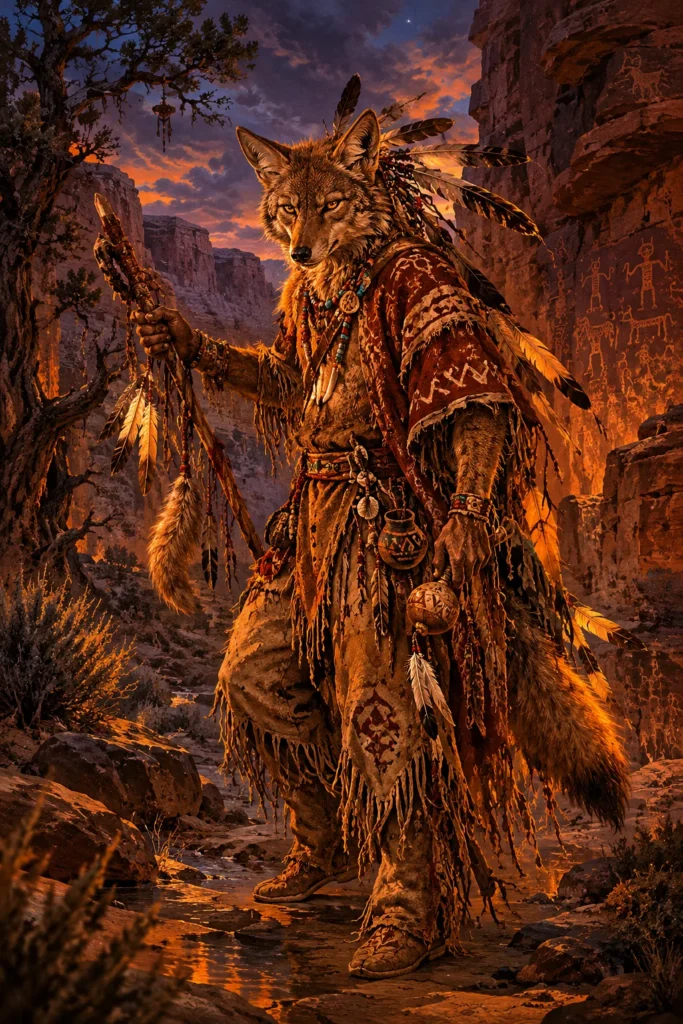
Coyote appears in narratives in several forms. His basic form is the real coyote animal, a grayish-brown wild canid roughly the size of a medium dog, with long ears, a narrow head, and a bushy tail.
However, Coyote can transform at any time into a human man, often appearing as a dignified but treacherous old hunter, a young warrior, or, more rarely, a woman.
In the Navajo sand painting tradition, Coyote regularly appears as an anthropomorphized Coyote figure with a dog’s head and a human body, often accompanied by the Holy Coyote staff and with painted four-directions markings. These sand painting Coyote depictions are strictly ritual in nature and are destroyed at the end of the healing session.
On surviving Pueblo ceramics and on rock petroglyphs of the ancestral Anasazi culture (ca. 200 BCE to 1300 CE), numerous Coyote motifs can be found, both as anthropomorphic canine figures and as realistic Coyote profiles.
The archaeological Coyote iconography has been systematically described by southwestern American archaeologist Polly Schaafsma in Rock Art of New Mexico (1992).
Mythological Narratives
The Coyote narratives form one of the most extensive narrative corpora in Native American mythology. They can be divided into four main classes.
The first class comprises the culture-heroic narratives, in which Coyote brings important cultural practices to humans.
A central narrative describes how Coyote steals fire for humanity: he climbs a sacred mountain where the fire spirits guard the fire, persuades them through trickery to give him a spark, and carries it down to the valley in a piece of wood, where he presents it to the people.
This fire-theft narrative is found in virtually all Coyote traditions and is structurally parallel to the Greek Prometheus mythology.
The second class comprises the trickster narratives, in which Coyote wrongs other beings but usually ends up as the one who is fooled himself.
A particularly well-known narrative describes how Coyote challenges the star spirit: he claims he can run faster than the stars move across the sky, and is then pursued so relentlessly by the stars that he ends up exhausted and torn to pieces.
The individual pieces are reassembled by the life spirit, and Coyote sets off on his next exploit.
The third class comprises the cosmogonic narratives, in which Coyote plays a role in the creation of the world.
In the Crow tradition, Coyote is the companion of the creator Akbatatdia in building the world; he creates the animals, plants, and humans, often in a comically flawed manner that explains the imperfect aspects of the world. This cosmogonic Coyote tradition has been systematically described by John Bierhorst in The Mythology of North America (1985).
A fourth narrative class encompasses the death-and-resurrection stories. In numerous Coyote narratives, Coyote dies during a daring action but reappears alive in the next story without the resurrection itself needing to be made explicit.
This immortality configuration is philosophically interesting from a religious studies perspective and distinguishes Coyote from the usual hero figures of the Western tradition.
Coyote in the Navajo Tradition
A particularly detailed Coyote tradition is found among the Navajo. Here Coyote (Ma’ii) is a central figure in the entire religious theology. He appears in almost every Navajo healing ceremony (chantway), often as an ambivalent figure who can simultaneously be a bringer of illness and a mediator of healing.
The Navajo distinguish between a First Coyote, who co-caused the creation, and the regular Coyotes, which can be encountered in real life.
First Coyote is a dignified figure; regular Coyotes are the everyday manifestations of his tradition. An encounter with a regular coyote in nature is perceived as spiritually significant and can have practical ritual consequences.
A specific Navajo practice concerns the Coyote Crossing meaning: if a coyote crosses the road or path of a traveler, this is a significant sign that must be interpreted.
Depending on the direction of the crossing, the time of day, and the social situation of the traveler, the sign can be interpreted positively (safe journey) or negatively (abandon the planned journey).
The meaning of the Coyote Crossing has been described in research on the Navajo.
Protective Practices and Apotropaic Effects
Coyote is an ambivalent figure in the Native American tradition, capable of both protection and harm. Unlike clearly negative beings (such as the Wendigo), Coyote is not warded off but treated with respectful distance. Protective practice focuses on avoiding unwanted encounters and behaving appropriately during chance meetings.
Concrete protective practices include avoiding the direct pronunciation of Coyote’s name (in many traditions the respectful address Old Man or Grandfather is used instead), burning small amounts of tobacco during a Coyote encounter, and wearing a small Coyote-tooth amulet as an ambivalent protective-trickster connection.
A special practice concerns the Coyote songs. In the Navajo chantway ceremonies, certain songs are invoked that are connected with Coyote and incorporate his ambivalent power into the healing ritual. These songs are strictly protected in a ritual sense and may only be sung by qualified singer-healers (hataalii).
The Navajo singer-healers carry the oral tradition of these songs over decades in the form of chantway bundles, which are artfully assembled ritual objects containing their own songs, sand painting patterns, and stores of medicinal herbs.
A particularly important protective practice region is the Coyote Way healing ceremony of the Navajo. It is invoked when a person has become ill through an inappropriate Coyote encounter (having passed too close to a coyote, or having killed a coyote without ritual purification).
The Coyote Way ceremony encompasses over five nights a complex sequence of sand painting, singing healing, sweat lodge rites, and medicinal herbs.
The Coyote Way is one of the most important and intensively practiced healing paths of the Navajo tradition and has been systematically documented by Karl W. Luckert in Coyoteway (1979).
Parallels in Other Cultures
Coyote is part of the worldwide trickster tradition that Paul Radin and Karl Kerenyi described systematically. Structurally comparable figures include: the West African Anansi (spider), the Germanic Loki, the Greek Hermes (in his trickster dimension), the Japanese Kitsune (fox), the Chinese Sun Wukong (monkey), and the West African Eshu.
Within North America, Coyote shows close kinship with the eastern Native American trickster Hare (Manabozho, Glooscap), the Northwest Coast Raven (Yel), and the southeastern Rabbit trickster.
The geographical distribution of the various trickster beings is connected to ecological habitats: Coyote in the prairies and deserts, the Hare in the eastern forests, and the Raven on the Pacific Northwest Coast.
Carl Jung and Joseph Campbell brought Coyote into the global psycho-religious discourse as an archetypal trickster figure. This archetypal theoretical reading is contested in religious studies, because it flattens the cultural-historical specificity of individual Coyote traditions.
The American literary scholar Karl Kroeber argued in Native American Storytelling (2004) against archetypal theoretical simplification, emphasizing the cultural specificity of the American Coyote tradition.
An additional important parallel is the ancient Turkic and Central Asian wolf-founding tradition, in which the ancient Turkic peoples venerated a mythical female wolf (Asena) as tribal ancestor.
This wolf-founding tradition is structurally comparable to the Coyote-founding narratives: both involve wild canid-like beings as culturally creative ancestors. Whether a historical connection exists across the Bering Strait or whether these represent convergent developments remains contested in religious ethnological discussion.
Contemporary Reception and Research
Coyote remains vibrantly alive in the modern Native American tradition. The Coyote narratives continue to be told in reservation schools, in indigenous language revitalization programs, and in the oral tradition of parents and grandparents. The Navajo tradition in particular has preserved Coyote within its ritual-practical religion.
In academic research, Paul Radin, Karl Kroeber, John Bierhorst, the Navajo theologian Frank Mitchell, and Pueblo researcher Barbara Tedlock have systematically described the Coyote tradition. The important volume of essays on indigenous folklore of the West by Barre Toelken (The Anguish of Snails, 2003) has opened up the specifically theological dimension of the Navajo Coyote tradition.
From a religious studies perspective, Coyote is an important example of the depth of religious observation among indigenous American peoples. The connection between ecological observation of the real coyote animal and mythological personification of the Coyote figure demonstrates a continuous, centuries-long engagement with the living environment.
The iWell Guard reference to the Coyote tradition describes these findings from a history-of-religions perspective, without any claims of efficacy or spiritual recommendations.
An increasingly important line of research concerns the remarkable return of the coyote population to North American cities. Over the past two to three decades, coyotes have expanded their habitat from the prairies and deserts into the suburban and urban areas of the United States and Canada.
Today, thousands of coyotes live in Chicago, Los Angeles, Toronto, and New York, having adapted to the urban environment.
This ecological renaissance has found a mythological resonance in modern indigenous discourse: indigenous authors such as Sherman Alexie and Joseph Bruchac have interpreted the urban coyote in their works as a symbol of indigenous resilience and adaptability in the modern world.
Literature and Sources
The following selection lists central works in Native American trickster research and the Navajo Coyote tradition.
The Theft of Fire in Plateau Narratives
One of the most frequently recorded Coyote episodes is the theft of fire. In versions documented among Salish-, Nez Perce-, and Klamath-speaking groups of the North American Plateau, only distant beings initially possess fire and guard it jealously.
Coyote organizes a chain of animals that pass the fire along in a relay, while he himself steals it first.
The weaker runners at the end of the chain, often a frog or a turtle, save the last spark, even though they are singed in the process. The narrative also explains why fire has since been lodged in wood and can be obtained by rubbing.
This narrative was recorded in several languages by ethnographers such as Franz Boas, Edward Sapir, and Melville Jacobs in the first decades of the 20th century.
Sapir’s work on the Nez Perce and the Wishram tradition shows that the episode was not a fixed text but was newly shaped in each storytelling situation. Narrators inserted place names from their own region, so that the story simultaneously explained the landscape.
Characteristically, Coyote does not appear here as a pure benefactor. He brings fire, but his motivation is often curiosity or a desire for glory, and in some versions his action simultaneously creates a new problem. Research, including the work of Jarold Ramsey and William Bright, emphasizes this dual nature as the core of the figure.
Coyote is culture-bringer and troublemaker in one person, and both sides are inseparably linked. A separation into a good and a bad Coyote figure, as popular retellings tend to make, misses the structure of the tradition. Related trickster functions can also be found in Iktomi of the Lakota.
Coyote in the Narrative Tradition of the Dine
Among the Dine in the Southwest of North America, the Coyote figure bears the name maʼii and occupies an independent position that differs from the Plateau traditions.
In the extensive narrative cycles documented by, among others, Pliny Earle Goddard and later by Karl Luckert and Berard Haile, maʼii is present both in creation narratives and in a large number of shorter stories that are regarded as Coyote narratives in the narrower sense.
A distinctive feature of the Dine tradition is that Coyote stories are bound to seasons. Traditionally they may only be told in winter, when snakes and certain insects are dormant. Telling them outside this time was considered dangerous.
This rule is attested multiple times and shows that the narratives were not mere entertainment but remained embedded in a ritual understanding of correct conduct. Goddard and Haile also recorded that maʼii plays a role in healing ceremonies, particularly in the complex known as Coyoteway, which was performed for certain illnesses.
In the narratives themselves, maʼii is ambivalent. In some versions he brings death into the world by manipulating a trial from primordial times in his favor, thereby establishing the finitude of life. At the same time he appears as inconsistent, greedy, and unreliable. Research warns against equating this figure with tricksters from other regions.
Barre Toelken, who worked with Dine storytellers for decades, emphasized that the stories convey moral and cosmological statements simultaneously and that their meaning only becomes accessible within the specific storytelling context.
Toelken later withdrew part of his publications because Dine partners raised concerns about the dissemination of certain content, a widely discussed case in research ethics.
Colonial Overlay and the Question of Source Criticism
The transmitted image of Coyote has been strongly shaped by the collecting activities of North American anthropology between roughly 1890 and 1940. The school around Franz Boas placed great emphasis on verbatim recording in the indigenous languages; nevertheless, the texts are subject to several distortions.
Narrators were often questioned under time pressure, some stories were deliberately not told because they were considered not intended for outsiders, and the selection of what was published rested with the ethnographers.
A recurring problem is the bundling of very different traditions under a single label. Coyote narratives were recorded in dozens of mutually independent speech communities from the Plateau across the Great Basin to the Southwest. Early comparative studies tended to construct a unified trickster figure from this material.
More recent research, such as that of Gerald Vizenor, has shown that this unification tells us more about the theoretical constructs of anthropology than about the indigenous traditions themselves.
Added to this is the influence of Christian missions, which in many communities interrupted the transmission of narratives across generations. Where records from the time before this break are lacking, the older material can only be reconstructed indirectly.
In recent decades, indigenous authors and language programs have begun reading the old collections from their own perspective and returning the material to the respective speech communities.
This work treats Coyote less as an object of study than as a living part of their own literature. For religious studies analysis, this means that any statement about Coyote should name the specific source and group, rather than speaking of a pan-indigenous figure.
Literature (Selected)
- Paul Radin: The Trickster (1956)
- John Bierhorst: The Mythology of North America (1985)
- Barre Toelken: The Anguish of Snails (2003)
- Karl Kroeber: Native American Storytelling (2004)
- Maureen Trudelle Schwarz: Molded in the Image of Changing Woman (1997)
- Polly Schaafsma: Rock Art of New Mexico (1992)
In the traditions of many Native American peoples, Coyote is not only a trickster and culture hero but also a cosmic actor: he intervenes in the arrangement of stars, day and night, death, and the seasons.
In this cosmic dimension he disrupts existing orders, corrects them at the same time, and often establishes, precisely through his misconduct, the rules that are meant to govern humans, animals, and spirits.
In the narrative traditions of North America, Coyote is simultaneously trickster, culture hero, and cosmic disruptor; he steals fire, arranges rivers and stars, and subverts every overly rigid order with cunning exploits.
Related key terms: Coyote Ma’ii Trickster Navajo Apache Old Man Coyote Hataalii Chantway.
iWell Guard and Protective Traditions
iWell Guard draws on the cultural-historical tradition of wearable protective objects, in the tradition of Native American and many other cultures worldwide. 41 layers, real gold, platinum, silver, manufactured in Germany. 30-day right of return.
Personal experiences may vary. Not a medical device. No healing promises.