Mama Cocha, sea goddess and water mother of the Andean coastal culture
By Ralf Ittermann · last reviewed on
Mama Cocha (Quechua Mama Qucha, Mother Lake, Sea Mother) is the sea and waters goddess of the Andes. For the coastal fishing communities of pre-Hispanic Peru and for salt gatherers, she was the central religious point of reference, comparable in significance to Pachamama for highland farmers.
Profile: Mama Cocha
Mama Cocha: the most important aspects at a glance. The following fields summarise origin, function, appearance, veneration, symbols and parallels.
Mama Cocha (Quechua Mama Qucha, Mother Lake, Mother Sea) is the goddess of the sea and of waters in the Andes. For the fishing communities of the coast and the salt gatherers of pre-Hispanic Peru she was the central religious reference figure. Among the Aymara she is called Quta Mama. According to Charles Stanish, the veneration of Lake Titicaca reaches far back beyond the Inca period.
Mama Cocha embodies the numinosity of all waters, from the Pacific through highland lakes and mountain streams to spring water, and the entire water cycle. She is sea and freshwater goddess at once, in agriculture also goddess of irrigation, and she receives the dead.
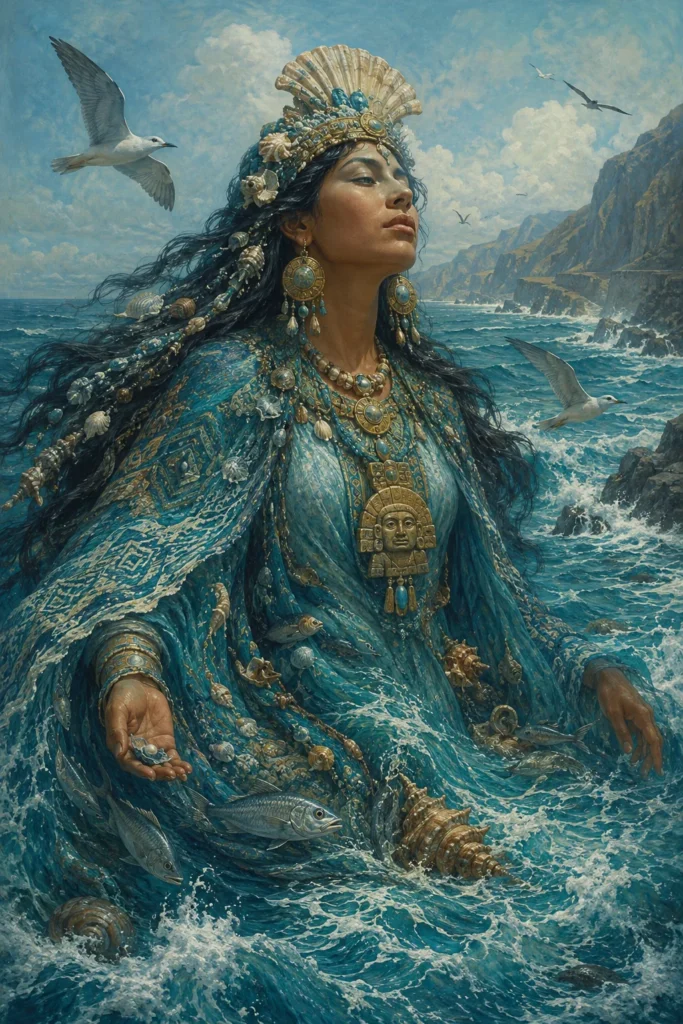
The sources describe Mama Cocha as a goddess not strictly human in form. On Inca keros she occasionally appears as a woman with curls reminiscent of waves, or with a water pot in her hand. In colonial painting she is fused with the Mary of the sailors (Maria Stella Maris).
The cult was strongest on the Peruvian Pacific coast. Fishermen south of Lima offered small wooden figurines, chicha and pieces of Spondylus shells before every outing. In the highlands, Lake Titicaca with the Isla del Sol and the Isla de la Luna were important places. At the festival Yarqa Aspiy the irrigation canals are ritually cleaned and Mama Cocha is asked for water.
Her symbols are water and the red or orange Spondylus shells from Ecuador, which were regarded as her material manifestation. Further signs are shell amulets on ships’ masts and the water pot on keros. She stands in close relationship with the water serpent Yacumama.
Parallels are the Greek Amphitrite, the Roman Salacia, the Germanic Ran, the Slavic Mokosh, the Hindu Ganga and Yemaya. In the Americas the Aztec Chalchiuhtlicue and the Maya goddess Ix Chel resemble her. Within the Andes she forms with Pachamama the pair tierra y agua.
Position in the Andean Pantheon
Mama Cocha is a female deity of the Andean pantheon, alongside Pachamama and the moon goddess Mama Killa. She is the personified numinosity of all bodies of water: the Pacific Ocean, the great highland lakes such as Lake Titicaca, mountain streams, and spring water.
From a religious-studies perspective, she belongs to the broad class of water and sea goddesses who hold a prominent position in nearly all coastal cultures worldwide. Structurally comparable figures include the Greek Amphitrite, the Roman Salacia, the Japanese Toyotama-hime, the Afro-Brazilian Yemaya, and, in a somewhat different configuration, the Polynesian figure of Hina.
Mama Cocha differs from these parallels through her dual function as both sea and freshwater goddess, a distinction that in other traditions is usually distributed between two separate beings.
In the Coricancha of Cusco, the sources (Garcilaso de la Vega, Bernabe Cobo) name chapels for Inti, Mama Killa, Chasca, Illapa, and Kuychi, but no shrine of the Mama Cocha cult.
Inca-era theology connected Mama Cocha closely with the concept of the water cycle: the water of the Pacific rises as cosmic vapour northward, becomes celestial moisture in the region of the Milky Way, falls as rain back onto the Andes, and returns to the sea through mountain streams.
Mama Cocha is the personified numinosity of this entire water cycle, not merely of its maritime endpoint. Gary Urton elaborated this cosmological water theology in At the Crossroads of the Earth and the Sky (1981).
Name and Etymology
The name Mama Qucha is a Quechua formation from mama (mother) and qucha (lake, sea, any standing body of water). Diego Gonzalez Holguin translates qucha in 1608 as laguna o mar, lake or sea. The word thus denotes any larger body of water regardless of salinity.
In Aymara the equivalent is quta or cota; the regional goddess variant is Quta Mama.
Lake Titicaca itself, whose name derives from Aymara (titi-qaqa, rock of the puma), was one of the most important sites of Mama Cocha’s manifestation, above all in its function as the place where sun and moon appear in the Inca myth.
In modern Quechua-language usage, qucha has extended its meaning to any kind of water reservoir, including artificial ponds and irrigation canals. In this way, Mama Cocha in farming-religious practice is not only the goddess of natural bodies of water but also of water-management infrastructure. This extension reflects the central importance of irrigation in Andean agriculture.
Appearance and Iconography
Mama Cocha is described in the sources as a goddess who is not strictly anthropomorphic.
On surviving Inca keros (drinking vessels), Mama Cocha occasionally appears as a female figure with flowing curls reminiscent of waves, or holding a water jar. In colonial Cusquena painting she is regularly merged with the Christian Mary of the Navigators (Maria Stella Maris), particularly in the coastal cities of Lima, Trujillo, and Arequipa.
A particularly significant iconographic trace is found in the Spondylus shell deposits of pre-Hispanic coastal sanctuaries. The red and orange Spondylus shells originate from the warmer waters of Ecuador and had to be transported over long trade routes to the Andean coast.
They were regarded as material manifestations of Mama Cocha and were used in large quantities in temple complexes, in mummy grave goods, and in foundation offering deposits.
Mythological Narratives
Mama Cocha is present in several Inca creation myths. In the most important myth, transmitted by Bernabe Cobo and Pedro Sarmiento de Gamboa, the creator god Viracocha rises from Lake Titicaca and causes the sun and the moon to appear on the Isla del Sol. Lake Titicaca is regarded as the most important place of manifestation of Mama Cocha in the highlands.
A second mythological complex connects Mama Cocha with the dying. In Inca-era theology, the western sea was regarded as the realm of the solar death: the sun descended into the sea in the west each evening and swam nocturnally through the underworld back to its eastern point of rising.
The dead accompany this nocturnal solar swim and are received by Mama Cocha. This eschatological function of the sea mother is also attested in the burial practice of the pre-Hispanic Chimu culture, whose dead were often interred facing west.
A third mythological constellation, transmitted by Maria Rostworowski, describes Mama Cocha as the sister or mother-in-law of Yacumama, the great water serpent. Both being-figures are semantically close and are venerated in some villages within a shared water-cult practice.
The distinction between the zoomorphic Yacumama (water serpent) and the more abstractly maternal Mama Cocha is, however, consistently maintained and should not be dissolved in religio-ethnological analysis.
Cult and Veneration
The most important Mama Cocha cult took place on the Peruvian Pacific coast, particularly among the Chimu, the later Inca-era coastal provinces, and the salt-production regions. The Maranga fishers south of Lima offered the goddess small wooden figurines, chicha, and pieces of Spondylus shell before each voyage.
In the highlands, Lake Titicaca formed the most important site of Mama Cocha’s manifestation. On the Isla del Sol and on the Isla de la Luna stood pre-Inca and Inca-era cult complexes, the remains of which can still be visited today.
The archaeological investigations of Charles Stanish (Ancient Titicaca, 2003) have shown that the veneration of the lake as cosmic mother reaches far back beyond the Inca period.
In the Coricancha temple in Cusco, water libations were performed on the occasion of major festivals, in which water from the Pacific, from Lake Titicaca, and from sacred mountain springs was mixed and poured over the altar stones. Cristobal de Molina describes this complex libation practice, which ritually secured the hydrological unity of the empire.
An important interregional pilgrimage practice existed between the highland Inca temples and the coastal Andean Mama Cocha sanctuaries, particularly at Pachakamak.
Polo de Ondegardo and Cobo report that at major festivals such as the Capac Raymi, special water messengers were sent from the Pacific coast to Cusco, bringing living seawater for the central Mama Cocha libation at the Coricancha altar.
This messenger practice, which used the Inca road network Qhapaq Nan to bridge the roughly 1,000 km between coast and capital in only a few days, shows in an impressive way the ritual integration of maritime and highland water theology in the Inca empire.
Protective Practice and the Apotropaic
Mama Cocha-related protective practice focused primarily on two areas: safety at sea and abundant fish catches. Practising fishers hung small shell amulets on boat masts well into the 20th century, returned the first fish caught back to the sea upon landing, and fumigated their boats with eucalyptus wood before each new season.
In the highlands among irrigation farmers, the most important protective practice was the annual Yarqa-Aspiy festival, in which irrigation canals were ritually cleaned and Mama Cocha was asked for a regular water supply.
Cobo describes this practice for the Inca-era region of Yucay; it has survived to the present day in Cusquena villages near Pisac and Maras.
The day of the yarqa-aspiy falls roughly at the end of July or in August depending on the village, and represents one of the most important collective ritual events of the irrigation communities.
A particular protective practice concerns bathing in sacred springs (puquial). Certain springs are considered especially connected to Mama Cocha and are visited in cases of illness, fever, or ritual impurity.
This bathing practice has survived in Peruvian-Bolivian folk religion to the present day and is described in the ethnographic literature as limpia con agua de manantial.
Among the modern Aymara villages around Lake Titicaca, veneration of Mama Cocha has been preserved in a specific boat-blessing practice. When a new reed boat (balsa de totora) is launched, the family offers small sips of spirits and a little coca to the lake before the boat is used for the first time.
This practice is described by Joseph Bastien and Olivia Harris in their ethnographic works and demonstrates the unbroken veneration of the water mother in the modern Quechua-Aymara peasantry.
Parallels in Other Cultures
Structurally, Mama Cocha has many parallels among the sea and freshwater goddesses of the world’s religions. The Greek Amphitrite, the Roman Salacia, the Old Germanic Ran, the Slavic Mokosh, the Hindu Ganga, the Afro-Brazilian Yemaya, and the Polynesian Hinemoana all belong to the structural group of female water deities.
Mircea Eliade, in Patterns in Comparative Religion (1958), described the water-goddess pattern systematically: water is, in virtually all religions, simultaneously the source of life, a medium of purification, and the realm of the dead.
Mama Cocha embodies this triad paradigmatically: as the place where sun and moon appear, as a bathing and purification medium, and as the receiver of the dead.
Within the Americas, Mama Cocha shows similarities to the Aztec Chalchiuhtlicue (Jade Skirt Goddess) and to the Maya moon and water goddess Ix Chel.
Chalchiuhtlicue is in particular the patroness of births and irrigation, which makes the functional analogy to Mama Cocha’s irrigation connection clear. However, the iconographic tradition of Chalchiuhtlicue is more anthropomorphic and narrative than the restrained, symbolic Mama Cocha tradition.
Within the Andean religious system, Mama Cocha stands in a complementary relationship to Pachamama: where Pachamama embodies the solid earth and agricultural fertility, Mama Cocha is the fluid, moving water numinosity.
Both are described in the ethnographic literature as the complementary pair tierra y agua, which together make agricultural production possible in the first place. Catherine Allen has described this structural complementarity in detail for the villages of the province of Paucartambo.
Contemporary Reception and Research
In the modern Quechua- and Aymara-speaking communities, Mama Cocha has remained alive as a religious-cultic figure above all in irrigation practice. The yarqa-aspiy festivals are still observed in many Cusquena villages today and are systematically described in the ethnographic literature (Inge Bolin: Rituals of Respect, 1998; Karsten Paerregaard: Linking Separate Worlds, 1997).
In the Peruvian coastal region, the Mama Cocha cult has been preserved in syncretic form as the veneration of the Virgen del Carmen and of Stella Maris.
The coastal-Catholic fishers’ processions, in which Madonna statues are carried on boats across the sea, are functional successors to the pre-Hispanic Mama Cocha petitionary rites. The religio-ethnological research, in particular the work of Maria Rostworowski, has thoroughly documented this continuity.
In academic climate research, Mama Cocha has recently been drawn into the discourse on the Andean water crisis. The ongoing glacial retreat in the Andes, which threatens the irrigation systems of highland villages in the long term, is often interpreted in farming-religious discourse as the punishment or grief of Mama Cocha.
Michael J. Sallnow, in Pilgrims of the Andes (1987), described the regional cults around Cusco.
In academic religious studies, Mama Cocha has also recently played a role in the discussion of the genealogy of female deities in the Americas.
The thesis of a continuous female goddess tradition stretching from the Moche culture through Wari and the Inca to colonial Marian syncretisms is advanced by some scholars (Mary Helms, Maria Rostworowski) and critically qualified by others (Tom Zuidema, Pierre Duviols).
The methodological challenge lies in the question of whether iconographic similarities across such long time spans should be read as evidence of religious continuity or whether they represent convergent, independently arising developments.
Literature and Sources
The following selection lists key works of Andean ethnology and archaeological research on the Mama Cocha tradition and on the water goddesses of the central Andes.
Mama Cocha and Fishing on the Pacific Coast
Mama Cocha, the sea mother, was of particular importance for the coastal population of the Andean region, whose livelihood depended on fishing and the use of the extraordinarily fish-rich waters of the Humboldt Current.
Spanish chroniclers who described the Inca highlands paid less attention to the coastal cultures, but individual accounts and above all archaeological evidence confirm that the sea as provider of food received its own veneration.
The Jesuit Jose de Acosta mentions in his Historia natural y moral de las Indias of 1590 that coastal inhabitants addressed the sea as Mamacocha and asked it for fish, much as the highlands asked the earth for crops.
This parallelism between sea and earth, between Mama Cocha and Pachamama, runs throughout the sources and corresponds to a fundamental feature of Andean religion, in which the relationship to the nurturing powers is conceived as reciprocity: gift and counter-gift.
Source-critically it should be noted that the chroniclers often convey coastal religion only from an Inca or missionary perspective and barely differentiate the local characteristics of the numerous coastal cultures, from the Chimu to smaller fishing communities.
Archaeological finds such as votive offerings near the coast and depictions of sea creatures on Moche and Chimu ceramics show, however, that the sea was a religiously charged space long before the Inca.
Mama Cocha is in this sense a collective name for a veneration that is likely to have been configured very differently from region to region.
Literature (Selection)
- Charles Stanish: Ancient Titicaca (2003)
- Maria Rostworowski: Estructuras andinas del poder (1983)
- Inge Bolin: Rituals of Respect (1998)
- Karsten Paerregaard: Linking Separate Worlds (1997)
- Christopher Donnan: Moche Art and Iconography (1976)
- Bernabe Cobo: Historia del Nuevo Mundo (1653)
In the Andean coastal culture, Mama Cocha was venerated as sea goddess and water mother, who placed fishing, salt extraction, and sea voyages under her protection.
Related key terms: Mama Cocha Mama Qucha Titicaca Yarqa Aspiy Puquial Chalchiuhtlicue Stella Maris.
iWell Guard and Protective Traditions
iWell Guard draws on the cultural-historical tradition of wearable protective objects, in the tradition of Andes / Inca and many other cultures worldwide. 41 levels, real gold, platinum, silver, made in Germany. 30-day return policy.
Individual experiences may vary. Not a medical product. No healing promises.