iWell Guard

Mama Killa, moon goddess and sister-consort of the sun god

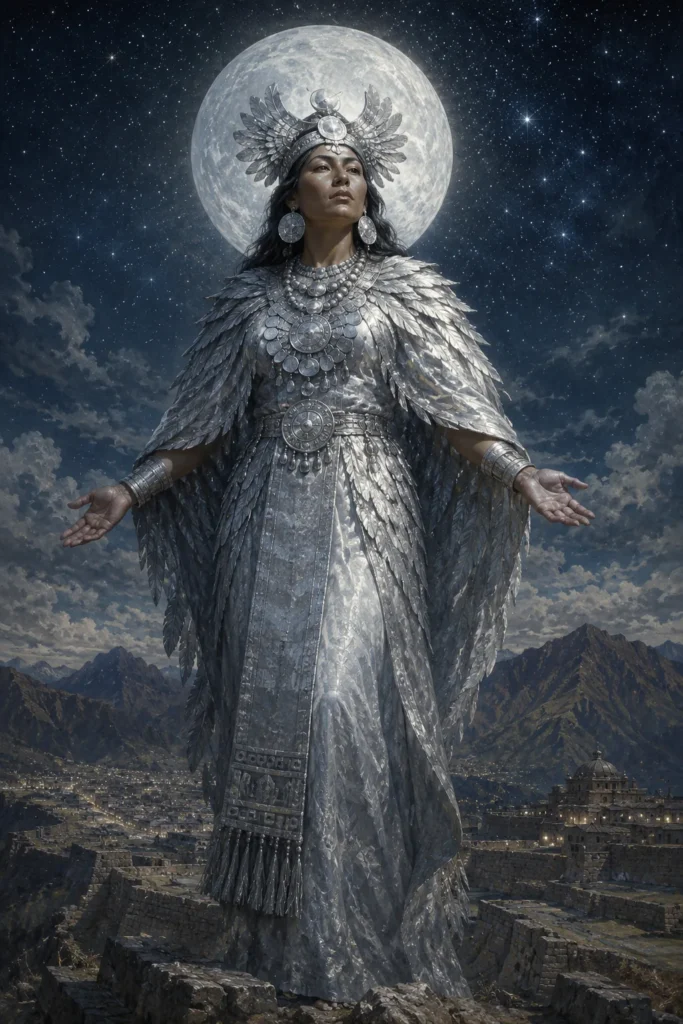
Mama Killa (Quechua Mama Killa) is the moon goddess of the Inca, sister-consort of the sun god Inti and patron of women, calendrical time order and ritual purity. Her temple precinct in the Coricancha of Cusco was lined with silver plates.

GoddessAndes / IncaMoon Goddess

Table of Contents

Mama Killa - gods from the Andes-Inca tradition, historically illustrative

Mama Killa, the Inca moon goddess, is regarded as the sister and consort of Inti and governs the nocturnal sphere.

Position in the Andean Pantheon

Mama Killa ranks among the highest female deities of the Inca state cult.

Garcilaso de la Vega describes her in his Comentarios Reales (1609) as the sister and consort of Inti; her own temple precinct in the Coricancha of Cusco stood directly adjacent to the sun temple, yet was lined with silver plates rather than gold, a consistent iconographic expression of the moon goddess’s subordinate yet autonomous position.

From a religious-studies perspective, she fits the widespread pattern of lunar-solar sibling pairs, ranging from the ancient Egyptian Hathor/Re constellation through the Japanese Tsukuyomi/Amaterasu pairing to the Mesopotamian Ishtar/Shamash relationship.

Within the Andes she forms the female complement to the male solar-theology complex and simultaneously defines the cultic status of the high-ranking Coya, the principal consort of the Inca ruler.

Catherine Allen notes that Mama Killa is far less present in modern Quechua-speaking villages than Pachamama; she functions more as a temporal-calendrical ordering principle that fixed the sowing and harvest seasons, rather than as a personally invoked protective deity.

This distance is explained by the state-imperial character of her veneration in the Inca period, which lost its institutional footing with the collapse of the Inca political structure.

The Inca capital Cusco was divided cosmologically into a hanan (upper) and hurin (lower) Cusco, which according to Tom Zuidema carried complementary male/female, solar/lunar connotations.

Mama Killa was venerated particularly in the quarters of hurin-Cusco, which represented the lower, moister, and more femininely connoted half of the city. This structuring was not merely a formal scheme but determined marriage rules, obligations between quarters and calendrical ritual functions.

Name and Etymology

The name Mama Killa is a straightforward Quechua compound of mama (mother, woman, high female person) and killa (moon, month). As with inti, the word denotes both the physical celestial body and the personified deity, the fusion of the natural and numinous plane that is characteristic of Andean thought.

Diego Gonzalez Holguin gives the meaning of killa in his Vocabulario (1608) as luna o mes. The dual meaning of moon/month is significant: Mama Killa is not only the lunar shape in the sky but also the personification of calendrical monthly time, by which female biology, sowing and harvest were oriented.

In the Aymara region one encounters the equivalent Phaxsi Mama, likewise moon mother. The regional variant Quilla with double l appears in some older Spanish chronicles (Sarmiento, Cobo) and reflects the early orthography of the Spanish missionaries.

Linguistically interesting is the close kinship between killa and killay, the Quechua verb for to wait or to wait for.

Cesar Itier, in his linguistic studies on Inca theology, advanced the hypothesis that killa may originally have marked the waiting phase between sowings, during which the lunar cycles structured the farmer’s patience between seed and harvest.

This hypothesis accounts for the unusual dual function of the moon goddess as the personification of waiting time and as a calendrical ordering principle in a way that is superior to a purely astronomical interpretation.

Description and Iconography

Mama Killa is described in the sources as a silver-gleaming disc with an anthropomorphic face, the female counterpart to the golden Punchao of Inti.

This silver disc stood in the so-called Killakancha, the moon-chamber precinct of the Coricancha. Polo de Ondegardo and Bernabe Cobo report that the moon disc was melted down after the Spanish conquest and has therefore not survived.

In colonial Cusquena painting, Mama Killa frequently appears as a female figure with a silver moon-disc diadem, often accompanied by a stylized starry sky. In some works of the Cusco school she is depicted as a Virgen Maria-Pachamama-Mama Killa syncretism, for example in the angel paintings of the church of San Pedro in Andahuaylillas.

Noteworthy is the astronomical observation of the moon spots in Inca theology: the dark maria of the moon were interpreted as a fox that crept up to Mama Killa out of love and was forever burned into her countenance.

This moon-spot story is recorded by Cristobal de Molina and belongs to the rare surviving Inca myths with an astronomically aetiological character.

The silver disc of Mama Killa in the Killakancha was, according to Garcilaso, approximately the same size as the golden Punchao image of Inti.

Unlike the Punchao, which was carried out of the sanctuary only on feast days, the moon disc was permanently visible, because the lunar theology did not form the centrepiece of the Inca ruler’s political self-representation and therefore did not need to be staged as restrictively.

Along the inner walls of the Killakancha stood in addition the mummified bodies of deceased principal consorts (Mallqui Coya), the female counterpart to the Mallqui ancestor gallery of the Inti temple.

Mythological Narratives

The most important myth surrounding Mama Killa explains lunar eclipses. According to Garcilaso de la Vega, the Inca believed that during a lunar eclipse a cosmic puma or serpent was attacking the moon goddess and threatening to devour her.

To repel this attack, the people of Cusco made a great noise on lunar eclipse nights: they beat on pans, shouted, set dogs barking, shot arrows toward the moon and attempted in this way to drive off the attacking creature. This practice is also depicted in the chronicle of Felipe Guaman Poma de Ayala (1615).

A further narrative links Mama Killa to the aetiology of silver deposits in the Andes.

According to a tradition recorded by the chronicler Antonio Vasquez de Espinosa, Mama Killa wept silver tears that solidified into silver veins in the mountain fissures, a mythical explanation for the Andean wealth of silver that made the Spanish colonization economically attractive in the first place.

In the life-cycle myths of the Inca, Mama Killa is the patron of female maturity. At the first menstruation ritual of a young girl (quikuchikuy), Mama Killa was invoked, as she was at weddings and in the lying-in period.

Cobo reports a fixed ritual text in which the moon goddess was asked for protection of mother and child.

A third mythological narrative links Mama Killa to the founding of the Inca empire. According to an account by Sarmiento de Gamboa, Mama Ocllo, one of the mythical siblings of Manco Capac, derived her name from the ocllo aspect of the moon goddess herself.

The empire’s founding mother is thus a daughter of Inti and simultaneously a manifestation of Mama Killa, a theological construct that secured the legitimacy of the Inca dynasty doubly and legitimized the Coya position through the bloodline of the moon as well as of the sun.

Cult and Veneration

The Mama Killa cult was institutionalized in the Coricancha temple of Cusco. Its personnel consisted exclusively of women, foremost among them the high priestess, who was regularly the sister of the reigning Coya (principal consort of the Inca ruler).

These women, the Acllacuna (see also Inti), wove silver-adorned moon garments, brewed chicha from white maize and conducted the monthly lunar rituals.

The highlight of the cult year was the September festival Coya Raymi (Festival of the Coya/Moon Goddess), which marked the beginning of the sowing cycle.

This festival also included the citua purification ritual, in which the male warriors of the Inca capital ran through the streets bearing torches, drove all known diseases and evil spirits, including the harmful Supay, out of the city and at the end symbolically flushed them away in the four cardinal directions.

The astronomical observation of the lunar phases was the task of specialized priests (kallpa-rikoq), who fixed the lunar calendar on the stone observatories of Cusco (e.g., the Saqsaywaman). Brian Bauer has reconstructed the topography of these lunar observatories in The Sacred Landscape of the Inca (1998).

The monthly sequence of festivals of the Inca imperial year regularly referred to Mama Killa: the lunar calendar determined both the sowing seasons and the internal administrative periods.

Cieza de Leon and Polo de Ondegardo describe that each lunar phase had a specific function in the daily life of the empire: full moon for festivals and sowing, new moon for purification rites and mourning.

This lunar time structure stood in a complex correspondence to the solar time structure of the great sun festivals and produced a two-layered calendar system whose complete reconstruction continues to occupy Andean research to this day.

Protective Practices and the Apotropaic

Mama Killa was invoked in Inca-period practice especially at births, women’s illnesses and night journeys. Cobo reports a custom of placing a silver coin (in Inca times a silver leaf) under the pillow on the night before a long journey, in order to seek the protection of the moon goddess.

Apotropaic against nightmares and nocturnal harmful spirits, in particular against the Supay regarded as nocturnal, were small silver amulets in the form of a crescent disc (tumi) or a stylized female figure. These were placed on children’s foreheads at bedtime or fastened to the bed frame.

In today’s Quechua-speaking villages this practice has largely passed into the Catholic veneration of Mary. The Maria medals worn by many Andean mestizos have functionally replaced the silver amulets of Mama Killa.

Religious-ethnological research, in particular the work of Olivia Harris and Marisol de la Cadena, has described in depth this functional continuity alongside simultaneous theological upheaval.

A very specific protective practice is the use of moon silver against lunar eclipses: on days when a lunar eclipse had been announced, mothers with infants wore silver headbands to prevent the attacking creature, through the weakened Mama Killa, from gaining access to the world of the living.

This practice is described in agreement by Cobo and Albornoz and shows how the astronomical event was interpreted cosmologically and coupled with concrete apotropaic actions.

Parallels in Other Cultures

Mama Killa fits into the worldwide pattern of female moon deities. Structurally comparable are the Greek Artemis-Selene, the Roman Diana-Luna, the Egyptian Isis in her lunar aspect, the Mesopotamian Nanna-Sin relationship and the Hindu Chandra figure (which, however, is conceived as male).

Within the Americas, Mama Killa shows similarities to the Aztec moon goddess Coyolxauhqui, who in the Aztec central myth of the birth of the sun Huitzilopochtli is dismembered by her brother.

The dynamic of aggression between sun and moon is more pronounced in the Aztec myth than in the Inca version, in which the sister-consort relationship is framed more harmoniously.

Noteworthy too is the comparison with the North American Changing Woman of the Navajo, who likewise combines life cycle, female maturity and calendrical time in one figure, albeit without the specifically lunar dimension. Eliade described the moon-woman pattern systematically in his work Patterns in Comparative Religion (1958).

Within the Inca-period comparative perspective, the Aymara variant Phaxsi Mama and the north-Andean variant of the Cara religion near Quito are also significant.

The latter knew a moon goddess Quilla whose temple the Spanish chronicler Padre Velasco describes; indications of a pre-Inca lunar theology in the far north of Tawantinsuyu are therefore present. Frank Salomon described this north-Andean moon cult systematically in Native Lords of Quito (1986) and distinguished it from the Inca state theology.

Contemporary Reception and Research

In the modern Andean region Mama Killa is no longer an independent cult object, but lives on in folklore, festivals and the growing indigenous cultural movement. In the reconstructed Coya Raymi festival (revived since the 1990s in several Cusquenian villages) she is invoked as patron of the feminine and of the sowing season.

In academic research today the focus falls less on institutional lunar theology than on the archaeoastronomical question of the Inca lunar calendar.

Tom Zuidema argued in The Calendar of the Incas (2010, posthumous) that the Inca used a 328-day lunar year corresponding to the 328 huaca shrines of the ceque system. This thesis is contested; Brian Bauer and Gary Urton have partially qualified it.

From a religious-studies perspective, Mama Killa remains an important example of an institutional female deity within a male-dominated high culture.

Her position shows that the Inca empire did not operate with a purely patriarchal theology but developed complementary gendered structures that found expression politically in the Coya-Inca dual regency and theologically in the Inti-Killa sibling-consort pair.

In the contemporary Pachakuti-Mama movement of Bolivia and Peru, Mama Killa also appears as a figure of identification for indigenous feminists. Authors such as Domitila Barrios de Chungara and later Silvia Rivera Cusicanqui have made the rediscovery of female complementarity in the Andean religious system the subject of sociological research.

The Mama Killa figure serves here not as a historical cult-object restoration but as a symbolic reference point for an indigenous gender order of its own, beyond Eurocentric patriarchy critique.

Literature and Sources

The following selection lists key works of Andean ethnology and religious history on Mama Killa, with a focus on archaeoastronomical and women’s history studies.

Mama Killa in the Lunar Calendar and the Interpretation of Lunar Eclipses

Mama Killa, the moon goddess of the Inca, was closely tied to the timekeeping of the empire. While the sun god Inti structured the annual cycle and the major sowing and harvest festivals, the moon governed the shorter cycle by which religious festivals and presumably parts of the agricultural calendar were oriented.

Spanish chroniclers such as Bernabe Cobo report that several festivals in the Cusco festival calendar were calculated by the moon, even though the precise functioning of the Inca calendar remains disputed to this day.

Particularly revealing are the accounts of how lunar eclipses were interpreted. The chroniclers record that the Inca understood a darkening of the moon as an attack by a predator, commonly identified as a puma or a serpent, upon Mama Killa.

To rescue the goddess, the people made noise: they beat on vessels, shouted and made dogs bark, so that the attacking creature might be driven away.

This practice is not specific to the Inca but is attested in many cultures; its documentation for the Andes nonetheless shows that the moon was regarded as a vulnerable being in need of care.

From a source-critical standpoint it should be noted that the chroniclers often described these rites secondhand and with an interest in portraying Andean religion as superstition. Nevertheless the various accounts agree in their broad outlines, which makes the episode credible.

The concern for Mama Killa during the eclipse illustrates her role as guarantor of a reliable course of time, whose temporary disappearance was experienced as a cosmic threat. For the solar side of this divine pair, see the entry on Inti.

The Moon Temple in the Coricancha and the Silver Iconography

In the Coricancha, the central sanctuary of Cusco, Mama Killa had, according to consistent chronicler reports, her own precinct. While the temple section of Inti was fitted with gold, the metal associated with the sun, the sources report that the moon precinct was clad in silver.

Garcilaso de la Vega, himself the son of an Inca mother, describes a silver disc or image of Mama Killa and emphasizes the gender symbolism: gold and sun as male, silver and moon as female.

These accounts must be read with caution. Garcilaso wrote his Comentarios Reales decades after the conquest in Spain, from memory and with the desire to represent the Inca past with dignity.

The Coricancha itself was largely dismantled by the Spanish; on its walls stands today the monastery of Santo Domingo. The silver cladding can therefore no longer be verified archaeologically, but the looting of precious metals by the conquistadors is well attested and makes the account plausible.

In this moon precinct, according to the chroniclers, the mummified bodies of deceased Coyas, the Inca queens, were also preserved and venerated. Mama Killa was thus a cosmic goddess who was at the same time embedded in the ancestor veneration of the female ruling line.

The connection of moon, silver, femininity and the royal line of female ancestors shows that Mama Killa occupied a clearly defined sphere in the Inca religious system, one that stood complementarily opposite to that of the sun god without being subordinate to it in the sense of complete dependence.

Literature (Selection)

  • Garcilaso de la Vega: Comentarios Reales de los Incas (1609)
  • Bernabe Cobo: Historia del Nuevo Mundo (1653)
  • Tom Zuidema: The Calendar of the Incas (2010)
  • Brian Bauer: The Sacred Landscape of the Inca (1998)
  • Felipe Guaman Poma de Ayala: Nueva Coronica y Buen Gobierno (1615)
  • Catherine Allen: The Hold Life Has (2002)
  • Sabine MacCormack: Religion in the Andes (1991)

Related key terms: Mama Killa Quilla Killakancha Coya Raymi Quikuchikuy Citua lunar eclipse.

iWell Guard and Protective Traditions

iWell Guard draws on the cultural-historical tradition of wearable protective objects, in the tradition of Andes / Inca and many other cultures worldwide. 41 layers, solid gold, platinum, silver, crafted in Germany. 30-day return policy.

Personal experiences may vary. Not a medical device. No healing promises.