Nuwa, goddess of the Chinese tradition
By Ralf Ittermann · last reviewed on
Nuwa is a goddess of the Chinese tradition.
Creator goddess, repairer of the heavens, primal mother of humanity. Nuwa is one of the oldest goddesses of Chinese mythology, not a concept but an actively creative force.
With the body of a serpent and the face of a woman, she created humanity from clay or mud, shaping it with her hands or by rope-drawing methods.
She was not alone: her brother and consort Fuxi assisted in the creation, and together they structured the order of the cosmos.
Yet the sky collapsed (a pillar broke, the cosmos tilted), and Nuwa repaired it; she melted colored stones, mended the sky, and saved the world. She is not merely a creator but a cosmic engineer, the goddess who acts when the gods fail. As China’s creator goddess and repairer of the cosmos, Nuwa unites two functions whose relation this page sets out.
Overview: Nuwa
Type: Chinese principal deity, creator goddess and repairer of the world
Pantheon: Daoism, Chinese folk religion, Buddhism (secondary)
Function: creation of humans from clay, repair of the broken sky, patroness of marriage
Principal attributes: serpent lower body, compass or ruler, five-colored stones, female upper-body form
Principal cult sites: Nuwa temple in Shexian (Hebei), Nuwa homestead in Henan, various shrines
Consort/brother: Fuxi
Context
Period of the texts
Nuwa (Chin. Nuwa) is one of the oldest Chinese creator deities. The first literary attestations appear in the Shanhaijing (Classic of Mountains and Seas, 4th to 1st century BCE) and in the Huainanzi (2nd century BCE).
The main flowering of her mythology falls in the Han dynasty (frequently depicted with Fuxi in Han reliefs). She remains present in folk cult to this day, especially in Hebei and Henan. In modern mainland China she is partly celebrated nationally as a “First Mother” symbol.
Area of distribution
Principal cult sites: Nuwa temple in Shexian (Hebei, one of the most important creator-deity temples in China), Nuwa homestead in Henan (mythical site of her activity), shrines in Sichuan and Shaanxi. She is present in some Daoism temples in Taiwanese folk belief. Internationally she appears in Chinese diaspora temples less often than other principal deities.
State of the sources
Central sources: Shanhaijing, Huainanzi, Liezi, Fengsu Tongyi (Han period). Allusions in Tang and Song poetry. Secondary literature: Birrell, Chinese Mythology. An Introduction; Yang/An, Handbook of Chinese Mythology; Werner, Myths and Legends of China; Lewis, The Flood Myths of Early China.
Designation and spellings
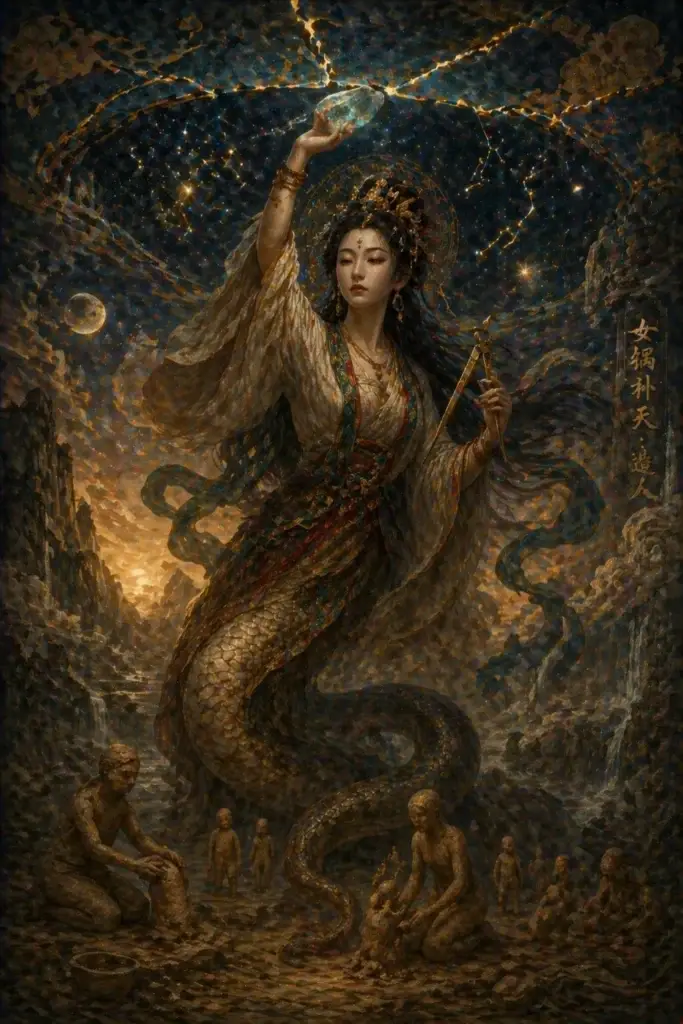
Nuwa is depicted as a hybrid: the upper body of a beautiful woman, the lower body of a long serpent, often green or silver.
She has long hair, sometimes a diadem or crown. In her hands she holds a compass-square (the cosmic measuring tool), or she is surrounded by hundreds of small human figures (her creations).
The collapse of the sky is shown pictorially as a broken or tilted pillar that Nuwa repairs while melting rainbow-colored stones. Fuxi is often depicted beside her, with a square (the male counterpart to the compasses).
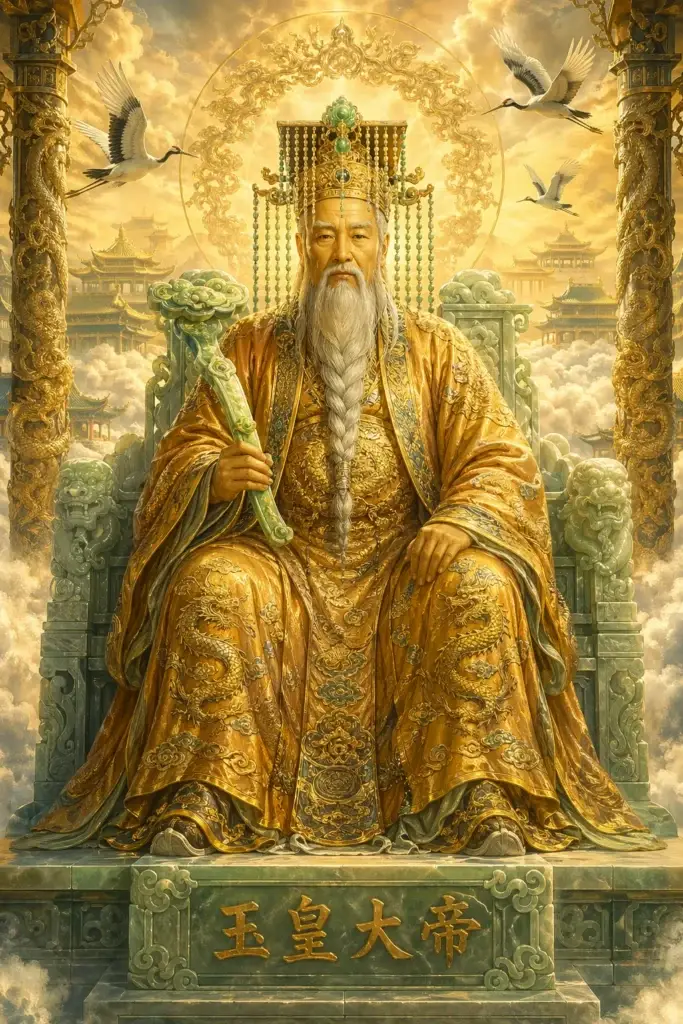
The serpent is not evil but primordial; it symbolizes transformation, shedding, renewal. Artistically, Nuwa is often portrayed as majestic but active, not enthroned like Yuhuang but engaged in work.
Description
Nuwa is less actively venerated in modern times than she was historically. In ancient China there were Nuwa shrines, especially in Shandong and Shaanxi.
Folk belief sees her as a cosmic mother; all human beings are her creations, and she is therefore a source of compassion. In Daoism Nuwa was canonized, but as a secondary power to the Sanqing (the Highest).
Unlike Yuhuang (administrator) or Yanluo (judge), Nuwa is the creator; without her there is no world. Her role is primarily mythological and theological, not ritual.
Modern cult is rare; instead, Nuwa is culturally omnipresent: Chinese literature invokes her, artists draw on her mythology, scholars cite her as a root of creation concepts. She is more an archetype than an active goddess.
Appearance and symbolism
Nuwa is depicted as a woman with a serpent tail, often with a bare upper body and visible breast, which underscores her function as a child-bearing mother.
In some depictions she carries a scepter or a compass. She is often shown with her partner Fuxi, likewise a serpent figure. Her color varies: often red or gold.
Profile: Nuwa
The most important aspects of Nuwa at a glance. The following fields summarize origin, function, appearance, veneration, symbols, and cultural parallels.
In one tradition Nuwa arises from primal chaos itself; in another she is the sister (and later consort) of Fuxi, her male counterpart who created the trigrams of the I Ching. In Han reliefs the pair is often depicted with intertwined serpent lower bodies, a symbol of cosmic union.
Main myths: (1) creation of humans from yellow clay (first artfully shaped, then flung in masses from the mud with a cord, hence the social hierarchy); (2) repair of the broken sky after the battle between Gong Gong and Zhuanxu, by melting five-colored stones and filling the cracks in the heavens; (3) establishment of marriage.
Creator of humans, patroness of women’s initiation and of marriage. Repairer of the world, a unique concept of Chinese creation theology: after creation comes a phase of cosmic fragility that Nuwa heals.
Patroness of birth (in some traditions a birth goddess). In modern China she is increasingly received as a feminist symbol of a female creator tradition.
Characteristic form: female upper-body figure with long black hair, a long courtly robe, holding in her hand a pair of compasses (gui) or a ruler (symbol of the construction of world order). The lower body tapers into a serpent (or dragon).
In Han-period reliefs she is frequently depicted paired with Fuxi, their serpent lower bodies intertwined (the union of Yin and Yang). Sometimes she also holds five-colored stones in her hand (repair material). Skin tone usually light.
Sphere of action: Nuwa was invoked in rural folk belief especially at births and marriages. At the principal cult sites (Shexian, Hebei) there are annual pilgrim festivals.
In modern mainland China she is increasingly received as a “First Mother” within a national-mythological tradition (often in the shadow of the more frequently invoked Mazu, Guanyin, or Yuhuang). In Hong Kong and Taiwan she is rather peripheral.
Serpent lower body, pair of compasses (gui), ruler, five-colored stones (repair material), yellow clay (creation material), cords. Sacred plants: peach (sibling symbolism with Fuxi). Sacred number: 5 (five-colored stones, five elements). Sacred colors: yellow, gold.
Fuxi (China, male counterpart), Tiamat (Mesopotamia, creator and dragon form, a notable parallel), Izanami (Japan, creator goddess), Sarasvati (Hinduism, partial female creation function), Eve (Jewish-Christian, first woman, though not a creator), Pachamama (Inca, earth mother), Gaia (Greece, earth mother, primal creator).
The unique combination of “creator of humans + repairer of the world + serpent lower body” exists only in the Chinese tradition.
Practical defense
Amulets and protective symbols
Nuwa, the creator and repairer goddess, is associated with protection in Chinese folk piety above all through the motif of the five-colored stones with which she mended the collapsed sky.
Colorful pebbles and jade pendants were regarded in later times as signs of cosmic order and were worn as objects of fortune and protection, especially for the protection of pregnant women and newborns, since Nuwa was venerated at the same time as the founder of marriage and the creator of humans.
In Han-period tomb art she frequently appears with Fuxi as an entwined pair of serpents; such double depictions on tomb reliefs and bronze mirrors had an apotropaic function and were meant to preserve the deceased within the order of the beyond.
Cult and veneration
Nuwa was venerated less in organized cults than other Chinese deities, but was anchored in folk customs as a creator. There are Nuwa temples in various regions of China. Her feast day is in part still observed. She represents a continuity that spans Confucianism and Daoism.
Nuwa, parallels in other cultures
Nuwa resembles the Hebrew Eve (mother of humanity), the Greek Pandora (the first woman, created by the gods), and the Indian Aditi (cosmic primal mother). Unlike Eve (passive, sinful), Nuwa is active and capable of healing; she repairs her creation. With Pandora (creations, but also misfortune) she shares ambivalence. With Aditi (cosmic mother) she shares the status of origin.
With the Egyptian Atum or the Indian Brahma (creator) she shares the creator role, but Nuwa is female, which is rare among creator gods. With the Mexican Ometecuhtli (creator duality) she shares the co-creator aspect (with Fuxi).
Unique is the serpent form: it combines primordial wildness with female creative power, not a transcendent goddess but one who acts, with body and soul.
The creation of humans from clay
Among the best-known narratives about Nuwa is the creation of humans. A detailed version is preserved in the Fengsu tongyi, a work by the scholar Ying Shao from the second century of our era.
According to it, after the separation of heaven and earth, when the world was still empty, Nuwa shaped figures from yellow clay. These creatures came to life and populated the earth.
The work proved too laborious, however, to fill the whole world in this way. According to the narrative, Nuwa then dipped a rope or cord into the mud and flung the adhering clay about.
According to this interpretation, the individually and carefully shaped figures became the noble and wealthy people, while those that arose from the spattered lumps of clay became the simple and poor. The narrative thus contains an etiological feature: it explains social inequality as a consequence of the different manner of origin.
This creation story is attested comparatively late in the Chinese tradition. Older texts mention Nuwa without expressly attributing the creation of humans to her. Scholarship therefore debates whether this is an old oral tradition that was only fixed in writing late, or a more recent elaboration.
The clay as creation material connects the narrative with similar motifs in other cultures, without any direct dependence having to be inferred. What is important is that in Chinese mythology Nuwa does not remain a distant creator deity but is portrayed as a figure working with her hands, dealing directly with matter.
The mending of the sky
The second great narrative about Nuwa recounts the repair of the damaged sky. The most detailed version is found in the Huainanzi, a philosophical compendium from the second century BCE.
According to it, the world order fell into catastrophe: the four supporting pillars that bore the sky collapsed, the sky itself tore open, the earth burst, fires raged, and waters flooded the land.
In some versions this destruction is connected with a battle between the deities Gonggong and Zhuanxu, in the course of which Gonggong struck against Mount Buzhou.
Nuwa restored order. She melted stones in five colors and mended the rift in the sky with them. As new supports she used the severed legs of a giant turtle and set them up at the four cardinal directions.
She killed a black dragon to tame the raging waters and piled up the ash of burnt reeds to push back the floods. After this deed the world returned to calm.
This narrative shows Nuwa in a cosmological leading role. She is not only a creator but also a preserver of order who makes the universe functional again after a catastrophe.
The five-colored stones and the four cardinal directions connect the myth with the later doctrine of the five phases of transformation and with the cosmological systematics of the Han period.
Some researchers therefore also read the text as a subsequent placement of an older narrative within the learned worldview of its time. The myth at the same time offers an explanation for why, according to old conceptions, the sky in China appears slightly tilted, because the repair was not perfect.
Nuwa and Fuxi: the sibling pair with serpent bodies
In numerous sources Nuwa appears not alone but at the side of Fuxi, who is often regarded as her brother and in some versions also as her husband. Both are depicted in the pictorial tradition with a human upper body and a serpent or dragon body, their tails entwined with each other.
This depiction is frequently attested from the Han period onward on tomb reliefs, silk paintings, and stone engravings, for example in the famous reliefs of the Wu Liang shrines from the second century of our era.
In these images Nuwa and Fuxi often hold tools in their hands: Nuwa a pair of compasses, Fuxi a set square.
These attributes assign them the role of founders of order who measure circle and square, heaven and earth, and thereby regulate the world. The intertwined bodies have often been interpreted as an image for the connection of Yin and Yang and for procreation.
A separate narrative portrays Nuwa and Fuxi as survivors of a great flood. After all other people have perished, the siblings marry in order to continue humanity, though only after a sign that grants them permission, for instance when two separately lit columns of smoke join together.
This flood-sibling narrative is widespread in China and among numerous peoples of southwest China and is transmitted in many regional variants.
Scholarship sees in it an old, widely diffused narrative material that became firmly connected with the names Nuwa and Fuxi only in the course of transmission. The pair thus stands at the beginning of both the cosmic and the social order.
Source transmission and transformation of the Nuwa figure
What we know about Nuwa stems from a long series of texts of differing age and differing genre. The earliest mentions are found in works of the late Zhou and the Han period. The Shanhai jing, the Book of Mountains and Seas, names Nuwa without providing an elaborated mythic picture.
In his poem Tianwen, the Heavenly Questions, the poet Qu Yuan poses a question about Nuwa that shows her figure already seemed to require explanation at that time. The Huainanzi and the Liezi transmit the mending of the sky, the Fengsu tongyi the creation of humans.
This scattered transmission means that there is no uniform, self-contained Nuwa mythology. The individual narratives were recorded at different times and in different contexts, often by scholars who fitted older oral materials into their respective worldviews.
Scholarship, for example in the works of sinologists such as Anne Birrell or in older studies, has worked out that Nuwa’s role did not remain constant.
In the early transmission she stands in the foreground as an independent, powerful creator figure. In the later, more strongly systematized mythology and in euhemeristic historiography she was increasingly inserted into a series of culture heroes and primal emperors, and in the process often subordinated to Fuxi.
From the creative deity she became in part a legendary ruler of antiquity. This transformation is an example of how the Chinese tradition reinterpreted myth as history. Anyone who wishes to understand Nuwa must therefore keep the different layers of transmission apart and must not take a late systematization for the original picture.
Cult, temples, and folk-religious veneration
Nuwa was not only a literary mythic figure but also an object of actual veneration. In various regions of China, especially in the province of Hebei and in Shanxi, there are temples and cult sites dedicated to her.
A well-known complex is the Wahuang Palace near Shexian in Hebei, a temple complex built into the rock whose beginnings reach back to the early Middle Ages and which remains a place of pilgrimage to the present day.
In the folk-religious context Nuwa was invoked above all as a deity associated with fertility, the desire for children, and marriage. This function follows logically from her role as creator of humans and as founder of marriage.
In some traditions she is expressly regarded as the founder of the marriage order and of the institution of matchmaking. At her cult sites there are correspondingly customs in which women pray for offspring.
Less is known about the precise history of her cult than one might expect. The written sources concentrate on the myth, while the ritual practice on the ground is only sparsely documented and moreover differs greatly by region.
Among the non-Chinese peoples of southwest China, such as the Miao and others, Nuwa moreover lives on in their own narrative traditions connected with the flood-sibling story.
Present-day veneration is in part connected with local tourism and with a revived interest in Nuwa as a cultural figure of identification. In terms of religious studies, Nuwa is thus an example of a figure that stands between learned mythology, living folk cult, and modern symbolic politics.
Further links
Research literature
Further standard works in the literature index.