Izanagi, creator god of Shinto
By Ralf Ittermann · last reviewed on
Izanagi is a creator god of Shinto who, together with Izanami, brought forth the Japanese islands and numerous further deities. Izanagi-no-Mikoto, Izanagi for short, is the male primordial god in Shinto and, together with his sister and consort Izanami, the creator of the Japanese island world.
From their union came the eight main islands of Japan, numerous further islands, and a large part of the Kami pantheon.
After Izanami dies in childbirth, Izanagi follows her into the underworld of Yomi and brings back from this journey a myth that divides Japanese religion into two central poles: the pure and the impure, the light and the dark, life and death.
Profile: Izanagi
Izanagi: the most important aspects at a glance. The following fields summarise origin, function, appearance, veneration, symbols and parallels.
In Shintō, Izanagi is the primordial male god and, together with his sister and consort Izanami, creator of the Japanese islands. The most detailed account is found in the “Kojiki” (712 CE) and the “Nihon Shoki” (720 CE), where he stands at the end of seven generations of gods.
At the command of the heavenly gods, Izanagi and Izanami solidify the floating land, and from their union the islands and a large part of the kami arise. After his return from Yomi he performs the first misogi, the ritual purification with water, and assigns Amaterasu, Tsukuyomi and Susanoo their realms of rule.
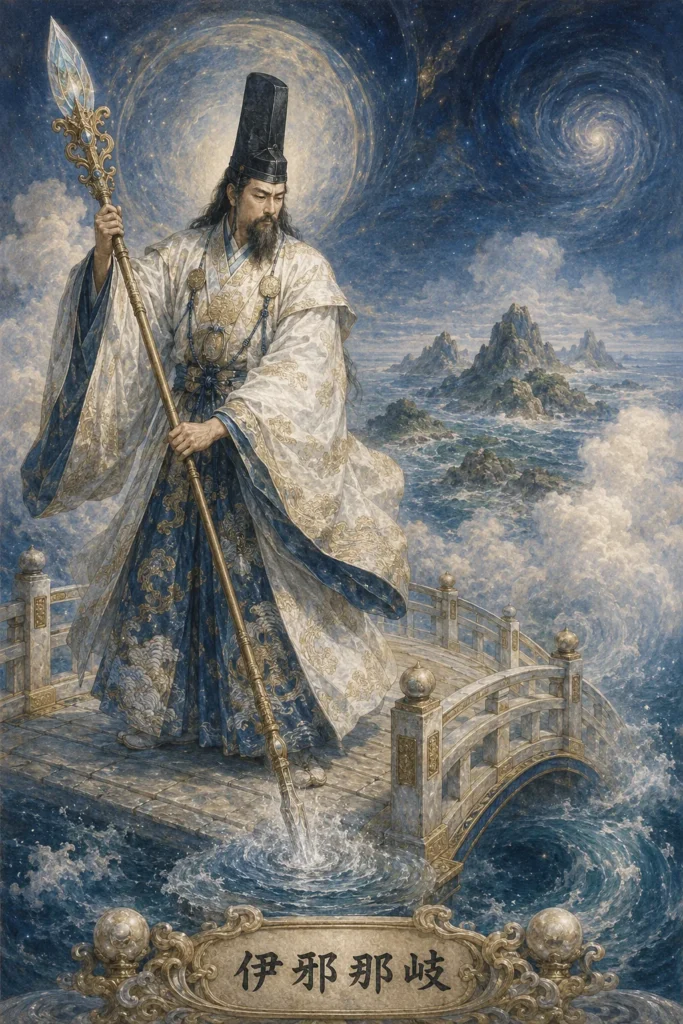
Izanagi usually appears as a bearded man in archaic dress, often standing on the Floating Bridge of Heaven and holding the spear into the sea together with Izanami. In shrine painting he is rarely depicted alone. Only the Meiji period promoted a distinct pictorial program that shows him as the primal father of the nation.
The main shrine is Taga Taisha in Shiga Prefecture, to which several million people make pilgrimages every year, above all for long life and protection for families. Further sites are the Izanagi Jingū on Awaji Island and Eda Jinja in Miyazaki, where a festival with ritual immersions (misogi) takes place every year.
His chief attributes are the spear Ame-no-Nuboko, with which the world is formed from the water, and the sword Totsuka-no-Tsurugi. His symbolic circle includes the peach (momo), the comb and the hair ornament (mizura). In folk belief peaches are still considered to ward off demons.
The descent into the underworld to bring back the beloved resembles the Greek myth of Orpheus and Eurydice. Further points of comparison are the Mesopotamian complex around Inanna and Dumuzi and the Polynesian myth of Hine-nui-te-pō. Structurally, Izanagi corresponds to Brahma, Atum, and to Chaos and Gaia.
Myth and creation
The most detailed account of Izanagi is found in the Kojiki (712 CE) and the Nihon Shoki (720 CE). According to these early imperial chronicles, Izanagi and Izanami stand at the end of a series of seven generations of gods, the Kamiyo nanayo.
The higher heavenly gods commission the sibling pair to consolidate the floating land. Standing on the swaying heavenly bridge Ame-no-ukihashi, they stir the salty primordial flood with the jewelled spear Ame-no-Nuboko. When they pull the spear out, drops of salt water fall down and condense into the first island, Onogoroshima.
On this island they erect the heavenly pillar Ame-no-mihashira and a hall of eight fathoms (Yahiro-dono). They circle the pillar in opposite directions and perform the first wedding rite.
On the first attempt Izanami speaks first, which is regarded as a breach of order; the child Hiruko (leech-child) is born deformed and set adrift in a reed boat. Only on the second attempt, in which Izanagi speaks first, does the birth of the proper islands and the primordial Kami succeed.
From the union arise Awajishima, Shikoku, the Oki islands, Kyushu, Iki, Tsushima, Sado and Honshu, along with numerous Kami of the wind, the mountains, the rivers and the trees.
At the birth of the fire god Kagutsuchi, Izanami burns her genitals and dies. In raging grief, Izanagi kills his own son Kagutsuchi with the sword Ame-no-ohabari; from the blood arise further Kami, including several sword and thunder gods.
The journey to Yomi
Inconsolable, Izanagi follows his consort into the underworld Yomi-no-kuni, the land of the yellow springs. At the dark threshold he asks her to return with him. Izanami answers that she has already eaten of the food of the underworld but wishes to ask the gods of Yomi for permission.
She forbids him to look at her in the meantime. Izanagi breaks the taboo, lights a comb from his hair as a torch, and sees the decaying body of Izanami, covered by maggots and eight thunder gods.
Full of horror, he flees. Izanami sends the hags of Yomi (Yomotsu-shikome), then the eight thunder gods with fifteen hundred warriors after him. Izanagi throws his headdress, and later his comb, behind him; from these objects grow wild vines and bamboo shoots, on which the pursuers are detained.
At the slope threshold Yomotsu-hirasaka he picks three peaches from a tree and hurls them at the pursuers, who thereupon retreat.
These peaches, called Okamuzumi-no-Mikoto in the myth, are still venerated in Japanese folk belief to this day as a demon-averting symbol; the Momo-no-Sekku festival on the third day of the third month traces back to this episode.
At the slope threshold Izanami herself catches up with him. The two exchange a formula of separation: Izanami promises to kill a thousand people each day, and Izanagi replies that he will build fifteen hundred birthing huts each day.
This mythical aetiology explains why more people are born than killed, and at the same time establishes the separation of the world of the living and the world of the dead as fundamental. Izanagi closes the slope with a huge boulder, the Chigaeshi-no-okami.
The ritual purification and the birth of the three noble children
Defiled by contact with death, Izanagi performs the first Misogi, the ritual water purification, at the river mouth of Tachibana-no-Odo on Tsukushi (in present-day Miyazaki). From his discarded clothing, his ornaments, and his immersion in the water, further Kami arise.
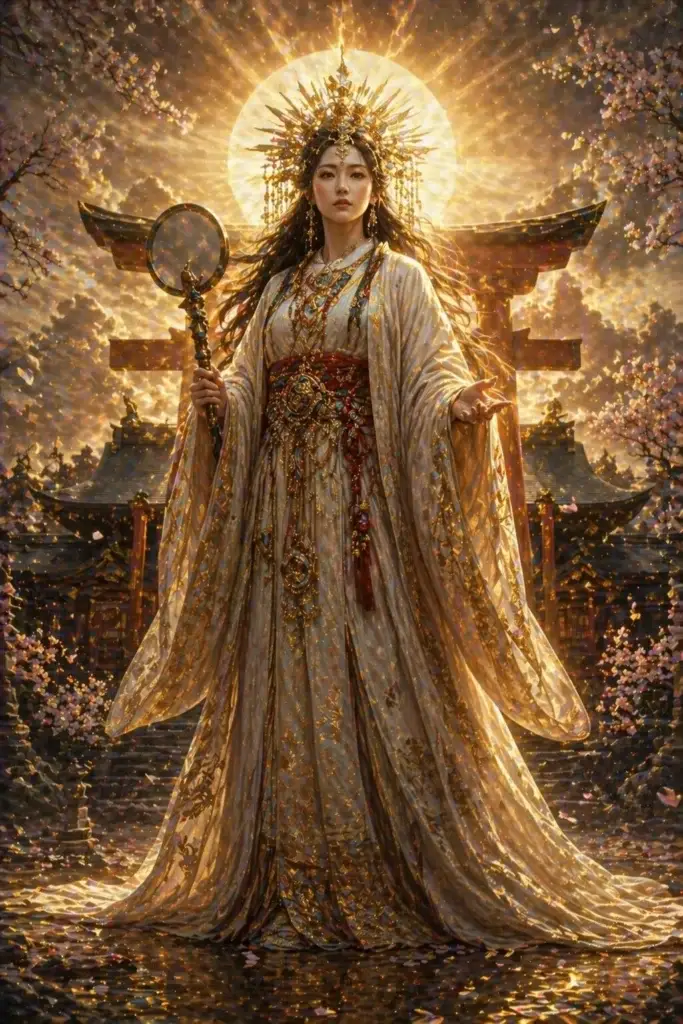
From the washing of his left eye arises Amaterasu-omikami, the sun goddess, whom he commissions to rule the high heavenly field Takamagahara.
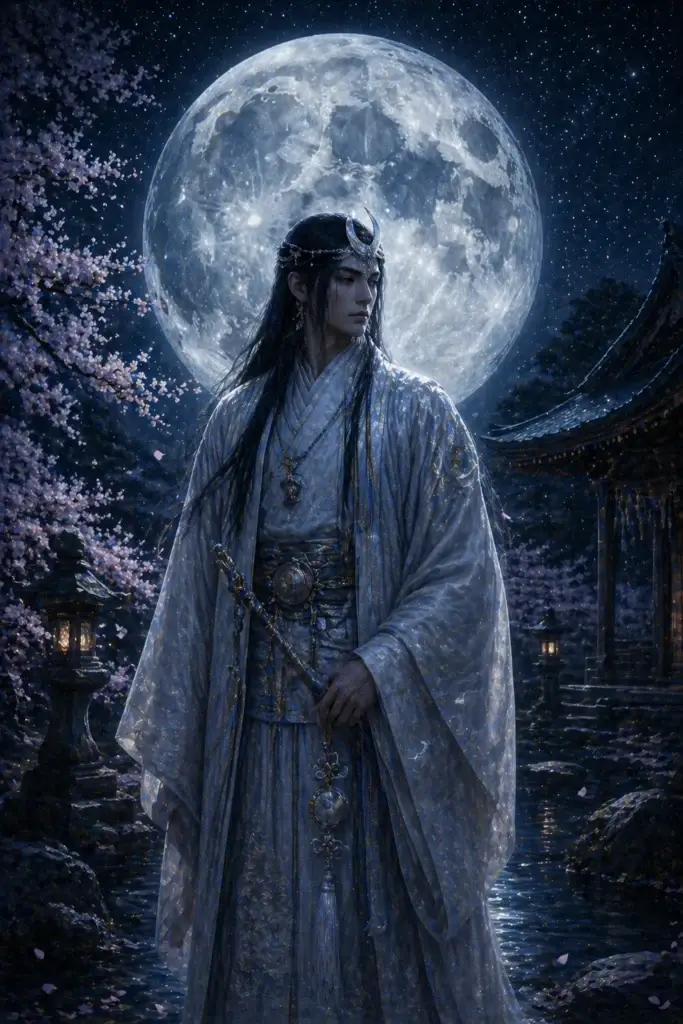
From the washing of the right eye arises Tsukuyomi-no-Mikoto, the moon god, to whom he assigns the night. From the washing of the nose arises Susanoo-no-Mikoto, the storm god, to whom he allots the seas.
These three children, the Mihashira-no-uzunomiko (three noble children), form the core of the imperially official Kami pantheon. Through Amaterasu the genealogy leads to the imperial dynasty, which until 1946 derived itself as an unbroken line from the sun goddess herself.
With the handing over of the world to his children, Izanagi withdraws from the mythical stage. The sources vary in the closing scene: the Kojiki has him enter the shrine of Taga in Omi (present-day Shiga Prefecture), while the Nihon Shoki sends him back to heaven.
Symbols, attributes and iconography
Izanagi is traditionally regarded as the emblem of the male creative and ordering principle. His main attribute is the spear Ame-no-Nuboko, with which the world is formed out of the water, along with the sword Totsuka-no-Tsurugi, with which he kills Kagutsuchi.
The peach (Momo) belongs to his circle of symbols, as do the comb and the headdress (Mizura), which become central in the pursuit scene.
In the visual arts he usually appears as a bearded man in archaic dress, often standing on the heavenly bridge, holding the spear into the sea together with Izanami. Famous are the woodcuts of Kobayashi Eitaku from the late 19th century, as well as the depictions on the shrine panels of Taga-Taisha and Eda-jinja.
Unlike the sun goddess Amaterasu, Izanagi is rarely depicted alone in traditional shrine painting. Only the National Shinto movement of the Meiji period promoted a distinct visual programme that staged him as the primordial father of the nation.
In modern manga and anime his name is a frequently cited motif: in Naruto, Izanagi denotes a costly eye technique that exchanges reality and illusion; in the game Persona, Izanagi is the first Persona spirit of the protagonist.
Veneration and cult sites
Izanagi’s main shrine is Taga-Taisha in Shiga Prefecture, one of the oldest and most important Shinto shrines in Japan. Already in the oldest imperial registers of the Engishiki (10th century) it appears as Kanpei-taisha, that is, an imperial great shrine of the first class.
To this day, several million people make pilgrimage to Taga each year, above all to ask for long life and for the protection of families.
On the island of Awajishima, the mythical first island, stands the Izanagi-jingu in the city of Awaji. The shrine was elevated to a jingu (imperial shrine) in 1954, a distinction granted to only a few shrines.
In southern Kyushu lies Eda-jinja in Miyazaki at the mouth of the Misogi river, the mythical site of purification; there a Misogi festival with ritual immersions is held each year. Further shrines are found in Iwato-jinja (Awajishima) and in numerous small local sanctuaries, which often mark water springs and waterfalls.
The Misogi rite, the ritual immersion in rivers, springs, or beneath waterfalls, traces directly back to Izanagi’s purification and to this day forms a core element of Shinto practice. The sprinkling with water (Harae) at temple and shrine visits is the everyday form of this rite.
Classification in the history of religion
In religious studies, Izanagi is regarded as a textbook example of a mythologem that is both Indo-European and pan-Pacific in distribution: the descent of a god into the underworld to retrieve a lost beloved.
The parallel to the Greek Orpheus-Eurydice myth is evident and was already discussed in the early comparative study of religion (Karl Florenz, The Historical Sources of the Shinto Religion, 1919). Other points of comparison are the Mesopotamian Inanna-Dumuzi complex and the Polynesian Hine-nui-te-po myth.
Joseph Kitagawa (Religion in Japanese History, 1966) and Klaus Antoni (Shinto and the Conception of the Japanese National Essence, 1998) read the Izanagi myth as a religious grounding of the separation of pure and impure, which is constitutive for all of Shinto.
Bernhard Scheid and Inken Prohl emphasise in more recent works that this reading is a modern one: in the oldest layers of the narrative, cosmogonic structural questions dominate rather than categories of purity.
Nelly Naumann (The Indigenous Religion of Japan, 1988) has worked out that the Izanagi-Izanami narrative was probably assembled from several regionally distinct mythical complexes, which in the seventh and eighth centuries were processed by the court chancellery into an imperial genealogy.
Helen Hardacre (Shinto. A History, 2017) has documented the reception history of the myth in the State Shinto of the Meiji and prewar period, in which Izanagi acquired an ideological charge as the primordial father of the nation.
Position in the pantheon and cross-references
Izanagi stands at the beginning of the proper world of the gods. Before him lie the five Separate Heavenly Deities (Kotoamatsukami) and seven generations of Kami, who remain hidden.
After him, with Amaterasu, Tsukuyomi and Susanoo, the historically tangible world of the gods begins, which leads across to the imperial dynasty and thus to the political history of Japan.
In this way Izanagi structurally fulfils the function that in other mythologies is taken by gods such as Brahma (Hinduism), Atum (Egypt) or Chaos and Gaia (Greece): the link between the primordial cosmos and the individualised world of the gods.
Within Shinto he shares this role with Izanami, whose fate ends in the land of Yomi. While Izanagi, through Misogi, embodies the restoration of pure order, Izanami remains present as mistress of the underworld and bringer of death.
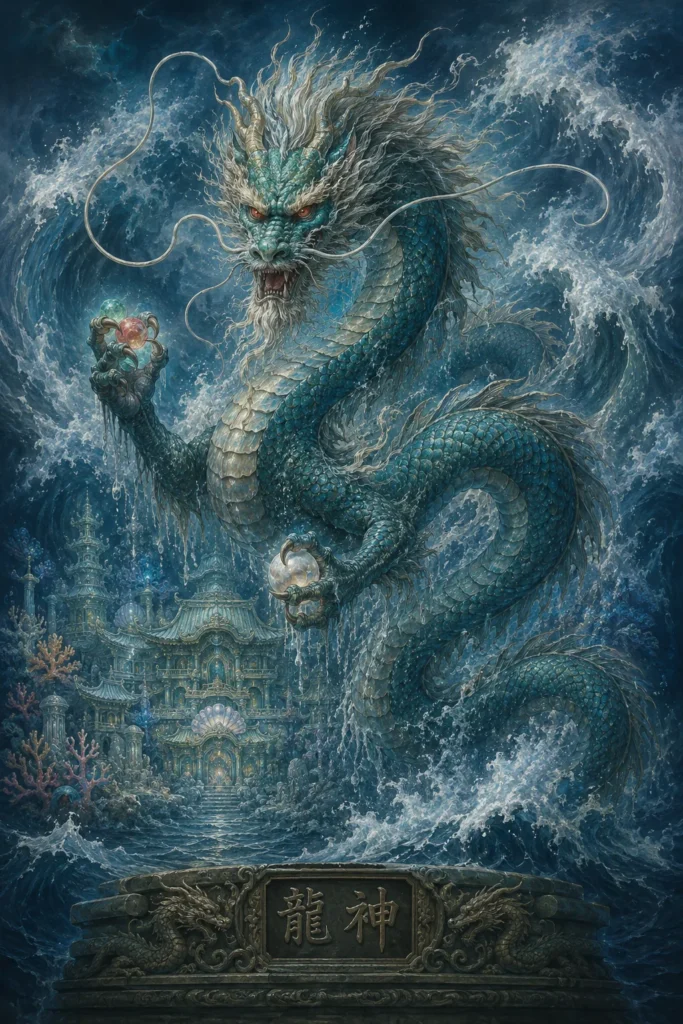
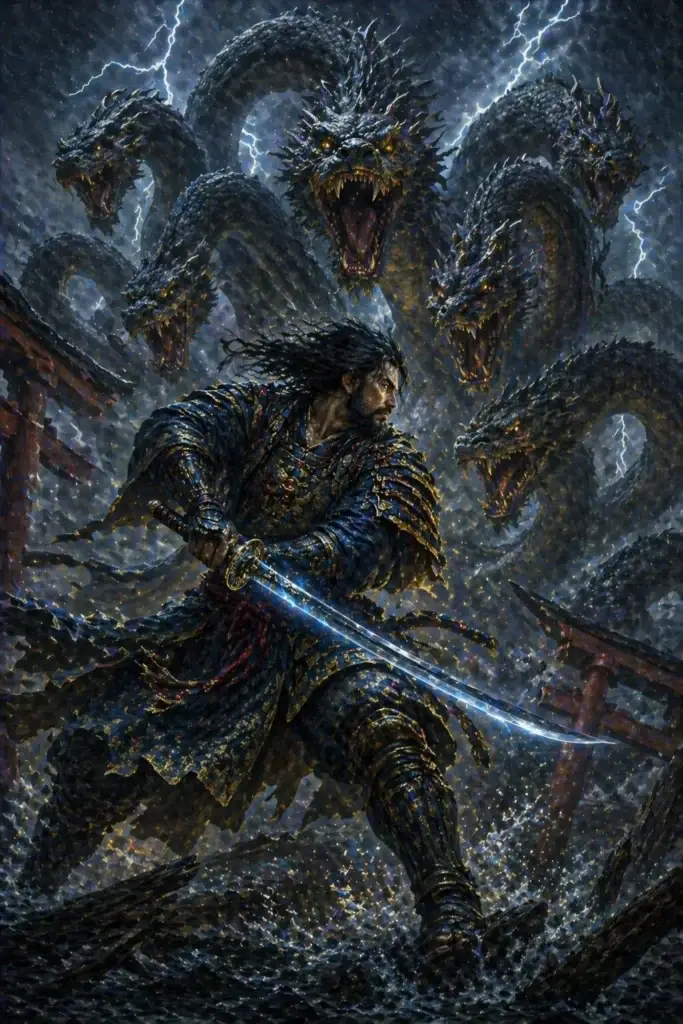
His son Susanoo repeats the conflict with Amaterasu in the next generation and thus forms a narrative bridge from the creation myth to the heroic myth of the Yamato-no-Orochi serpent.
Sources
Kojiki (712 CE), Book I, translation by Klaus Antoni, Berlin 2012. Nihon Shoki (720 CE), Books I and II, translation by W. G. Aston, London 1896, as well as German renderings by Karl Florenz, The Historical Sources of the Shinto Religion, Gottingen 1919. Engishiki (10th century), register of the imperial shrines.
Man’yoshu (8th century), various poems with allusions to the purification myth.
Joseph Kitagawa, Religion in Japanese History, New York 1966. Nelly Naumann, The Indigenous Religion of Japan, 2 volumes, Leiden 1988 and 1994. Klaus Antoni, Shinto and the Conception of the Japanese National Essence, Leiden 1998. Helen Hardacre, Shinto.
A History, Oxford 2017. Bernhard Scheid (ed.), Religion-in-Japan: A Digital Handbook, Vienna, ongoing. Klaus Vollmer, Shinto, in: Religions of the Present, Munich 2002. Inken Prohl, Religious Innovations, Berlin 2006.
Etymology and name forms
The name Izanagi (Izanagi-no-Mikoto, Japanese 伊邪那岐命 in the Kojiki, 伊弉諾尊 in the Nihon Shoki) is connected in modern Japanese religious studies with the Old Japanese verb izanau (to invite, to entice, to recruit).
The element -nagi is read as a male formation in contrast to -nami in Izanami; the two gods thus form an etymologically reflected pair.
Klaus Antoni and Karl Florenz adopted this etymology without regarding it as certain; older proposals that sought to connect izana with the Chinese yin-yang are today considered overstated. The honorific address -no-Mikoto (Illustrious Command) marks Izanagi as a god of the highest rank, comparable to the status of other principal kami.
In the Sino-Japanese script usage of the late Heian period, different combinations of characters appear depending on the tradition. The spellings established in the Engishiki (10th century) became the canonical form for the official shrine prayers (Norito) and remained stable into the modern era.
In philological-religious reading, conclusions about regional layers of transmission can be drawn from the variations in spelling, as Nelly Naumann and Bernhard Scheid have analysed in several specialised studies.
Early evidence and manuscript tradition
The two main sources, the Kojiki (712) and the Nihon Shoki (720), were composed in close temporal proximity in the early eighth century but go back to different editorial conceptions.
The Kojiki, compiled by O no Yasumaro after the orally recited tradition of the court official Hieda no Are, writes the Izanagi narrative as a continuous, narratively self-contained story.
The Nihon Shoki, an official imperial chronicle following Chinese models, offers the same narrative in a main version as well as in several alternative readings (Aru-fumi, one book says). This duplication allows religious studies to identify regional variants and divergent school traditions.
Both texts are composed in Chinese script, with at times considerable Sinitic stylisations. Religious philology distinguishes between the actual mythical layers and the political accents inserted subsequently by the court chancellery, which legitimise the imperial dynasty.
The Izanagi narrative belongs to the layers treated most extensively in both texts, which underscores its central position in the imperial mythology.
In the Engishiki (927) are found the shrine Norito (ritual prayers) for the Misogi rite, which refer directly to Izanagi’s purification.
These texts are the oldest surviving liturgical formularies of Shinto and, together with the great Norito, belong to the classical evidence of early Japanese religious language. Klaus Vollmer and Bernhard Scheid have worked out the liturgical significance of these texts in several contributions.
The Great Purification Rites
From Izanagi’s Misogi myth, two central liturgical complexes have emerged in historical times: the Oharae (Great Purification, twice yearly at the start of summer and winter) and the individual Misogi at waterfalls, rivers, or in the sea.
The Oharae has been demonstrably celebrated at court since the seventh century and transfers the mythical purification of Izanagi into a collective purification of the realm.
In modern Shinto the Oharae continues to be performed in all main shrines on 30 June and 31 December; worshippers pass through the Chinowa, a large reed ring that symbolises the ritual purification.
The individual Misogi beneath waterfalls or in cold water is an ascetic practice that plays a central role in the Shugendo tradition (Yamabushi mountain asceticism). At the sacred waterfalls of Nachi, Kiyotaki and Tarumi-Otaki it is still practised regularly to this day.
Helen Hardacre has documented in Shinto. A History (2017) the spread of Misogi in modern Japanese religiosity and pointed to its increasing adoption by businesspeople, artists and athletes who understand Misogi as a spiritual discipline.
Syncretism with Buddhism
With the arrival of Buddhism in Japan in the sixth century and the increasing synthesis of Kami and Buddha veneration, Izanagi was integrated into the honji-suijaku system, in which Kami were interpreted as Japanese manifestations of Indian Buddhas and bodhisattvas.
Izanagi was frequently identified with the Buddha Dainichi-Nyorai (Mahavairocana), the cosmic sun Buddha of the Shingon school. In the Tendai school he was regarded as the earthly manifestation of the cosmic creative principle. These identifications are systematically elaborated in medieval writings such as the Yotenki (13th century) and the Reikiki (14th century).
With the Meiji Restoration and the enforced separation of Shinto and Buddhism (Shinbutsu-bunri, 1868), Izanagi officially lost these Buddhist connotations. In folk religion, however, syncretistic practices were preserved, especially at the great double sanctuaries where shrine and temple were spatially connected.
In the volume edited by Mark Teeuwen and Fabio Rambelli, Buddhas and Kami in Japan (2003), the mutual interpenetration of both spheres for Izanagi and the other principal kami is presented in detail.
Izanagi in modern religious politics
In the Meiji period (1868 to 1912), Izanagi was ideologically charged within the framework of State Shinto. As the father of the sun goddess and thus grandfather of the mythical imperial dynasty, he was stylised as the primordial father of the nation.
Prewar school textbooks presented him alongside Izanami and Amaterasu as a tribal deity of the Japanese people. The shrine grounds of Awajishima were developed in 1924 into a national pilgrimage site, which made the mythical genealogy accessible touristically and ideologically.
After 1945, this ideological overburdening largely collapsed. In the framework of the American occupation policy, State Shinto was abolished (Shinto Directive of 15 December 1945), and the national genealogy was removed from school instruction.
Izanagi remained as a figure in the history of religion and as the principal god of Taga-Taisha and Awaji-Izanagi-Jingu, without continuing to contribute to imperial ideology.
Klaus Antoni and Helen Hardacre have documented this transformation in several works and characterised Izanagi’s present position as a figure of the history of religion, no longer a political one.
Comparative mythology
Scholarship has located the Izanagi myth within several typological complexes. The most important is the complex of the Orpheus-Eurydice mythologem: the descent of a god or hero into the underworld to retrieve the lost beloved, the breaking of the taboo, and the final separation.
Karl Florenz already drew this parallel in 1919; later studies (Joseph Kitagawa, Yves Bonnefoy, Burkert) have deepened it further and extended it to the Mesopotamian Inanna-Dumuzi narrative, the Polynesian Hine-nui-te-po narrative, and to Native American and circumpolar parallels.
A second complex is that of sibling-incest creation: two primordial divine siblings marry and create the world. This complex is attested in the Egyptian Shu-Tefnut pair, the Chinese Fuxi-Nuwa pair, in Hittite mythology, and in numerous Native American traditions.
The third complex is that of the vegetation-and-death myth: the birth of fire burns the mother, and from the lamentations new gods arise. Here parallels emerge to the Mexican Coatlicue, the Greek Demeter-Kore narrative, and the Indian birth of Skanda.