Lutin, the mane-braider of France's stables
By Ralf Ittermann · last reviewed on
The Lutin is a spirit of French folk tradition.
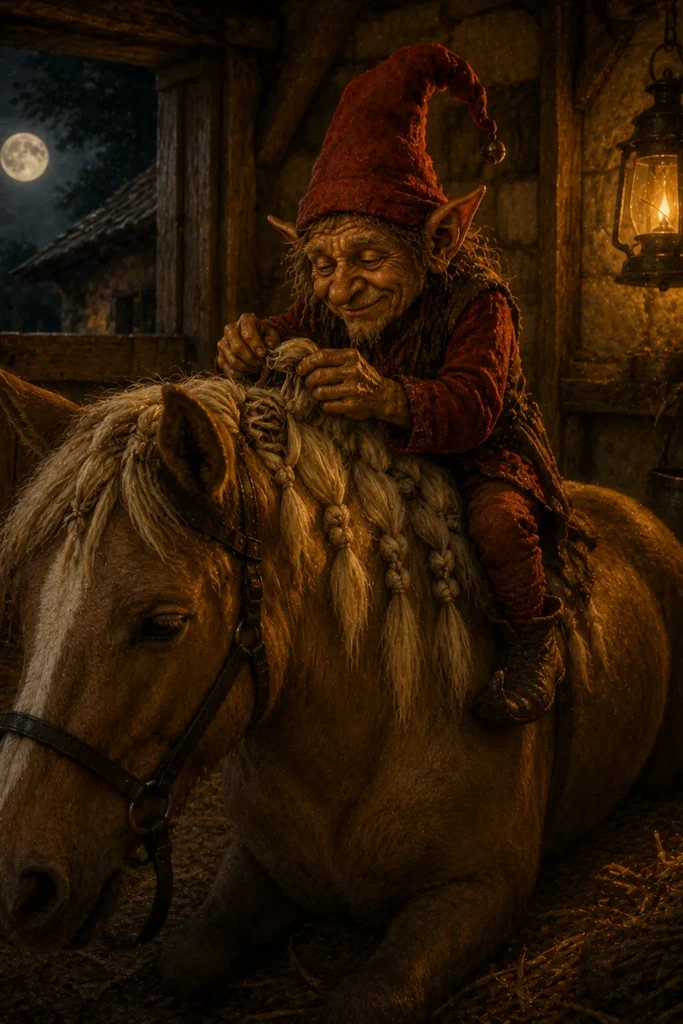
The mischievous goblin who rides the horses at night. Stable hands once blamed a mischievous mane-braider for tangled horse manes found each morning. As the mane-braider of France’s stables, Lutin is placed here among the house and farm spirits whose activity centres on animals.
The Lutin is the French house goblin: a small spirit of the little folk, mostly mischievous but good-natured, as long as one does not offend him. His core motif is the nightly riding and tangling of horses’ manes.
He is attested in literature from the 12th century onwards, in folk belief up to the early 20th century, and also in Québec, where he often appears as a pure white cat. His name traces, by a roundabout path, back to the Roman sea god Neptune.
Type: Mischievous, predominantly good-natured house goblin
Origin: French folklore, attested in literature from the 12th century
Texts: Sébillot, Lecouteux, literary evidence from the Middle Ages onwards
Period: 12th to early 20th century
Appearance: small shapeshifter, often with a red cap
Historical Classification
Period of the Texts
French folklore, attested in literature from the 12th century and as folk belief up to the early 20th century.
Area of Diffusion
France, especially Normandy, as well as Québec, where the Lutin often appears as a pure white cat.
Sources
Well documented: the folklore collections of Sébillot and the studies of Lecouteux, along with literary evidence since the Middle Ages.
Name and variants
French: lutin, going back to Latin Neptunus, the sea god, who in Late Latin was demoted to a pagan demon; via the intermediate forms netun, nuiton and luiton, this became lutin. The terms lutin, gobelin, farfadet and nain overlap strongly by region.
Description
Appearance
The Lutin is a small shapeshifter: invisible, in animal form or as a saddled horse. A red feathered or pointed cap that makes him invisible is a firmly established iconographic attribute, though not attested everywhere regionally.
Effect
He is mostly mischievous but good-natured; good Lutins do household chores. His best-known trait is riding the horses in the stable at night, tangling or braiding their manes; the knots are called fairy knots. Interpretation varies between care for a shining horse and torment of an exhausted animal.
Profile: Lutin
The key aspects of the house sprite at a glance.
Household spirit of the little folk of French folklore; his name is a fallen god’s name, from Neptunus came lutin.
House and stable: good Lutins do household chores, and at night the horses are said to be his favourite pastime.
Small shapeshifter, invisible, in animal form or as a saddled horse; in Québec often a pure white cat, along with the red cap.
Household chores and mischief; in the stable, the nightly riding of horses and the fairy knots in their manes.
A plough stick in the manger, grains on a tilting board, a billy goat in the stable; in Québec he avoids scattered salt.
The German Kobold, the brownie and hobgoblin, the Nisse and Tomte, the Domovoi and the Irish Leprechaun; gobelin and farfadet overlap with him.
From sea god to stable spirit
The name Lutin has a remarkable history: it goes back to the Latin Neptunus, the sea god, who was downgraded to a pagan demon in Late Latin; via the intermediate forms netun, nuiton and luiton the French word emerged. The Lutin is documented in literature from the 12th century onward, as folk belief into the early 20th century, and with the emigrants he reached Québec, where he often appears as a pure white cat.
His core motif belongs to the stable: at night he rides the horses and tangles or braids their manes into fairy knots. The interpretation is ambivalent, between care for a shining horse and torment of an exhausted animal; carelessly cutting a knot brings misfortune.
From Prince Lutin to Christmas elf
In literature, the Lutin appears in d’Aulnoy as Le Prince Lutin and in George Sand, who in her Légendes rustiques attests to the horse-grooming follets. The Lutin de Noël, the Christmas elf, is by contrast a recent, imported secondary meaning from the Anglo-Saxon-Scandinavian elf tradition, not the original household spirit.
From a religious-studies perspective, the Lutin is a household spirit, not a god or a high demon. Three clarifications are important: the French Christmas elf is an import after 2005, not the old household spirit. Lutin, gobelin, farfadet and nain are synonymous and overlapping, not clearly distinct. And the mane knots are not merely damage but are interpreted ambivalently.
Plough stick, grain board and billy goat
The traditional way of dealing with the Lutin relies on cunning rather than a banishing spell: one places a plough stick in the manger, scatters grains on a tilting board to keep him busy with the compulsion to gather them, or puts a billy goat in the stable. In Québec he avoids scattered salt. The fairy knots in the manes are not cut through, as that brings misfortune.
The little folk of the stables in comparison
The Lutin corresponds to the German Kobold, the British Brownie and Hobgoblin, the Scandinavian Nisse and Tomte, the Russian Domovoi and the Irish Leprechaun; on the Iberian Peninsula, the Trasgu is close to him. The terms lutin, gobelin, farfadet and nain overlap strongly by region and are not sharply separated types.
Frequently asked questions about the Lutin
What is a Lutin?
The French house sprite: a small, mischievous but mostly good-natured spirit of the little folk who inhabits house and stable.
Why does he tangle horses’ manes?
He rides the horses at night and braids their manes into fairy knots; the interpretation varies between care and torment.
Is the Lutin a Christmas elf?
The Lutin de Noël is a recent, imported secondary meaning from the Anglo-Saxon-Scandinavian elf tradition, not the original household spirit.
Further links
Literature (selection)
Further standard works in the bibliography.
As the French house sprite and nightly horse spirit, the Lutin unites both sides of the little folk: the helpful hand in the house and the rogue who leaves tangled manes at dawn.