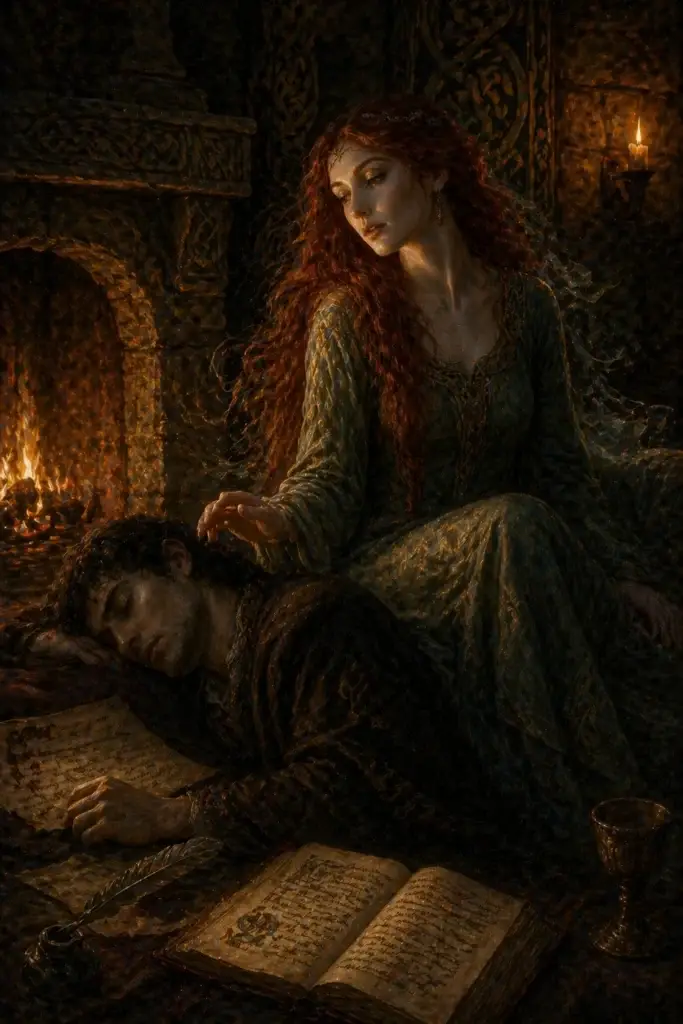
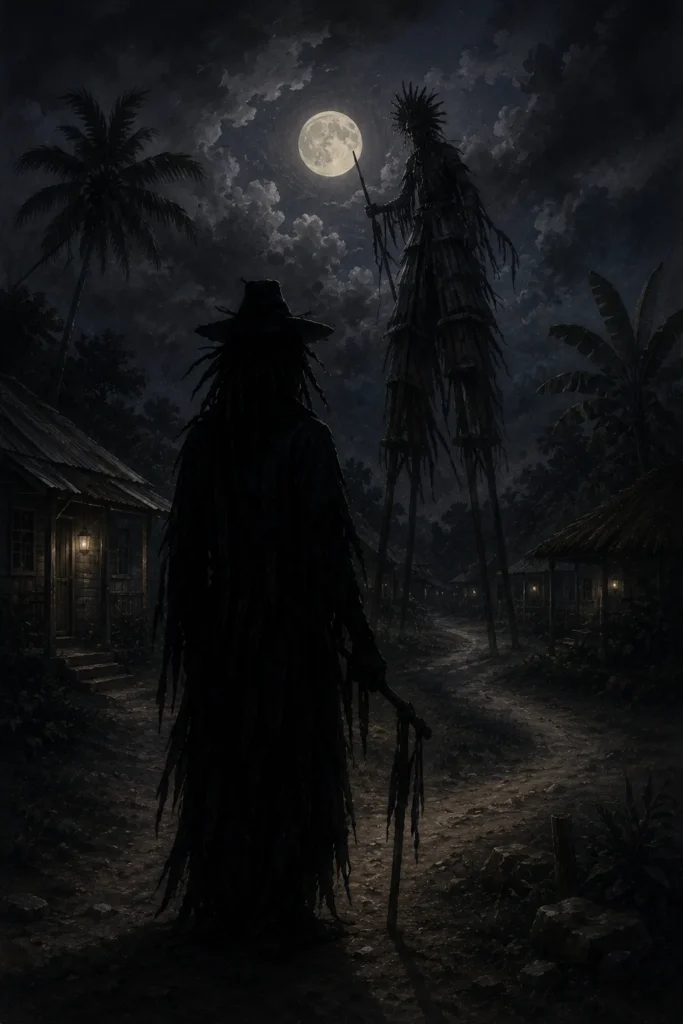
The Trasgu is a spirit of northern Spanish folk tradition.
The mischievous household kobold with the hole in his left hand.
The Trasgu is the household kobold of Asturias and northern Spain, an ambivalent duende familiar with a red pointed cap and a hole in his left hand. He is mischievous and troublesome, but at heart not malicious.
Treated well, he is remarkably tidy and watches over house and animals; treated badly, he breaks crockery and steals. Anyone who wants to get rid of him completely has only one reliable way: an impossible task, on which the otherwise tidy kobold fails in shame.
Type: Ambivalent household spirit of attic, stable and hearth
Origin: Northern Spanish folklore, attested from the 17th century
Texts: Father Feijoo, Cabal, de Llano
Period: 17th century to the present
Appearance: small dark kobold with red cap and hole-ridden left hand
Northern Spanish folklore, already attested in literature in the 17th century by Father Feijoo; around 1900 Cabal documents the Trasgu as a fading ancestral belief.
Its core area is Asturias, along with León, Cantabria and eastern Galicia; in Galician the kobold is called trasno or trasgo.
Well documented: the folklore collections of Constantino Cabal and Aurelio de Llano, along with the early literary attestation by Father Feijoo.
Asturian: trasgu, probably from Latin transgredi, to transgress, fitting for a rule-breaker; Galician trasno or trasgo.
Appearance
The Trasgu is a small duende with dark or brown skin and a red pointed cap, often limping, with a tail and sometimes horns, and always with a hole in his left hand. Horns, limping and devilish traits are Christian overlay, not the oldest part of the tradition.
Effect
As a house spirit of the attic, stable and hearth, he makes noise, hides and moves things about, and startles the livestock, yet at his core he is not malicious. Treated well, he is remarkably tidy and watches over house and animals; treated badly, he breaks crockery and steals. He briefly withdraws when pious invocations are spoken.
The key aspects of the house sprite at a glance.
Ambivalent house spirit of northern Spanish folklore with an old, orally attested core, traceable in literature from the 17th century onwards.
House, attic, stable and hearth: there the Trasgu makes noise and bustles about, acting as a nuisance or a secret helper depending on how he is treated.
A small dark kobold with a red pointed cap, often limping, with a tail and sometimes horns, always with a hole in his left hand.
Treated well, he watches over house and animals and keeps things remarkably tidy; treated badly, he breaks crockery, steals and startles the livestock.
An impossible task: gathering scattered grain that trickles back out through the hole in his hand, carrying a basket full of water, or washing a black kid goat white.
The German Kobold is the closest parallel, along with the Brownie and Boggart, the Leprechaun, the Korrigan, the Follet and Lutin, and within Spain itself the Trasno and the Duende.
The name probably derives from Latin transgredi, to transgress, fitting for a rule-breaker; in Galician he is called trasno or trasgo. The Trasgu is already attested in literature in the 17th century by Father Feijoo, and around 1900 by Cabal as a fading ancestral belief.
His core area is Asturias, along with León, Cantabria and eastern Galicia. What is regarded today as the canonical image owes much to the folklorist collections of the 19th and 20th centuries, which ordered and interpreted the orally transmitted material.
The Trasgu is an icon of Asturian identity, present in illustrations by Álvarez Peña and in the song Trasgu by Víctor Manuel; he also appears in literature by Ana María Matute, Torrente Ballester and Rafael Dieste.
From the perspective of religious studies, the Trasgu is an ambivalent house spirit with an old, orally attested core. Three points of clarification: much of today’s canonical image stems from folklorist collections of the 19th and 20th centuries, whose Celtic-Romance continuity theories are interpretation. The horns are a Christian overlay. And the sharp distinction between the Trasgu and related beings is in part only an analytical ordering imposed later.
Moving house does not help, since the Trasgu comes along. The only reliable way to get rid of him is an impossible task: carrying a basket full of water, washing a black kid goat white, or gathering scattered grain that trickles back out through the hole in his hand. Ashamed, the otherwise tidy Trasgu gives up and leaves. In the Galician variant, one throws him grains to count, at which he loses track.
What is a Trasgu?
The Asturian house kobold, an ambivalent duende with a red cap and a hole in his hand. His core area is Asturias, along with León, Cantabria and eastern Galicia.
How do you get rid of him?
Through an impossible task, such as gathering scattered grain that trickles out through the hole in his hand. Ashamed, the tidy kobold gives up; moving house, on the other hand, does not help.
Is he malicious?
No, he is mischievous and troublesome rather than malicious; treated well, he is even remarkably tidy and watches over house and animals.
Recommended internal links:
Further standard works in the bibliography.
As an Asturian house kobold with a hole in his hand, the Trasgu is the friendliest face of the duende familiar type: a spirit who torments but also protects, and who can only be driven away by an impossible task.
Against its influence, cross-cultural tradition names these protective means:
Compare in the Protection Compass →Recommended protective means
The simplest protective means in this collection: 41 layers of fine gold 999, platinum, silver and silicon, manufactured in Ruhla, Thuringia. It requires no activation, is bound to no person, and is effective within a radius of around 50 meters, even without being worn.
Related Beings

Yuan-gui, the spirit of someone who died wrongfully in China. Origin, the search for justice, and...

The Kelpie: shape-shifting water horse of the Scottish rivers. Origin, legends, the bridle motif ...

The Ben Varrey, mermaid of the Isle of Man. Origin, her benevolent as well as dangerous side, and...

Fuga daemonum: Tradition attributes to St. John's wort the power to drive away demons and night s...

Strigoi, Moroi, Iele and Pricolici: Romanian folk tradition explained from a religious-studies pe...

Tunkasila, the Grandfather Sky of the Lakota, is a form of address for the sacred and a way of re...