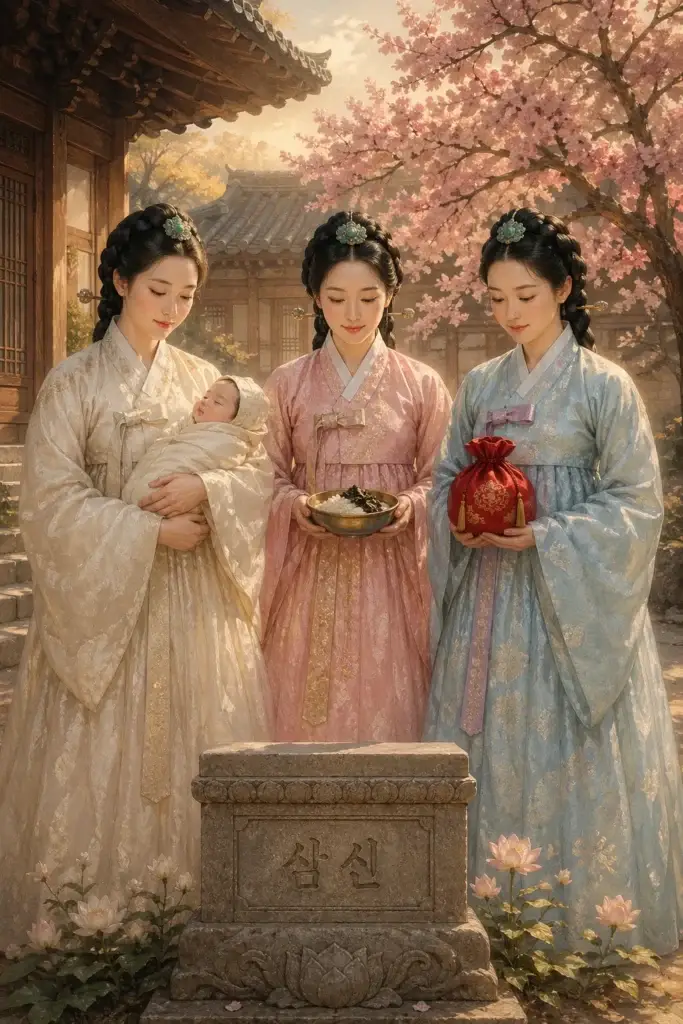
Sansin, Korean mountain god
By Ralf Ittermann · last reviewed on
Sansin is a Korean mountain god whose shrines stand on sacred mountains and who watches over the land, forest and wildlife of his domain. Sansin (Korean 산신, 山神) is the Korean mountain god and is regarded as the most important local protective deity of Korean folk religion.
Unlike the remote heavenly lord Hananim or the transcendent bodhisattvas of Buddhism, Sansin is a place-bound deity who can be invoked in concrete terms, a deity whose sanctuaries are found in the mountains of Korea.
Mountain veneration is among the oldest religious practices of the Korean peninsula and has survived alongside Buddhist, Confucian and shamanic traditions into the present day.

Source situation
Written evidence for the veneration of Sansin reaches back to the Three Kingdoms period (1st to 7th century). The «Samguk Sagi» and the «Samguk Yusa» report on mountain rites at sacred peaks that were regarded as the seat of local deities.
The geographical work «Dongguk Yeoji Seungnam» («Expanded Survey of the Geography of Korea», 1481) also records numerous mountain sanctuaries with their local Sansin.
From the 4th century onward, the Buddhist tradition of Korea integrated mountain veneration into its monastic topography; every larger temple has a small hall for the Sansin, often built behind the main Buddha hall.
James Grayson and Don Baker have summarized the source situation in their surveys of religious history.
In specific studies on Korean shamanic practice, Boudewijn Walraven has shown that Sansin is also invoked in the shamanic rites («gut»), above all in rituals of healing and protection.
Iconography and representation
In the pictorial tradition, Sansin is usually depicted as an old, white-bearded man sitting beneath a pine tree, wearing a traditional Korean robe and holding a fan or staff. At his side he is accompanied by a tiger that serves as a mount or as a messenger.
This pictorial composition has been iconographically standardized since the 17th century. In some regions, above all on Jeju and in parts of Jeolla, Sansin is also depicted as an old woman, which recalls matriarchal mountain cults that are discussed in scholarship.
The tiger is the most important companion animal of Sansin and holds a comprehensive symbolic meaning in Korean folklore studies. It is regarded as the guardian of the mountains, as the agent who carries out Sansin’s punishments and as the protector of the pious.
In some local traditions the tiger itself merges with the mountain god, an effect that reaches into the Korean writing system: the Chinese character for «mountain god» (山神) is occasionally replaced by a «tiger symbol».
Sanctuaries and mountain cults
The most important sanctuaries of Sansin are the «sansin-gak», small shrines erected near mountain monasteries or at special peaks. A shrine complex usually consists of a central main room with an image of Sansin and his tiger, often supplemented by incense stands and offering tables.
In the monastic context the shrines are cared for by the Buddhist monk, in the village context by local elders or shamans.
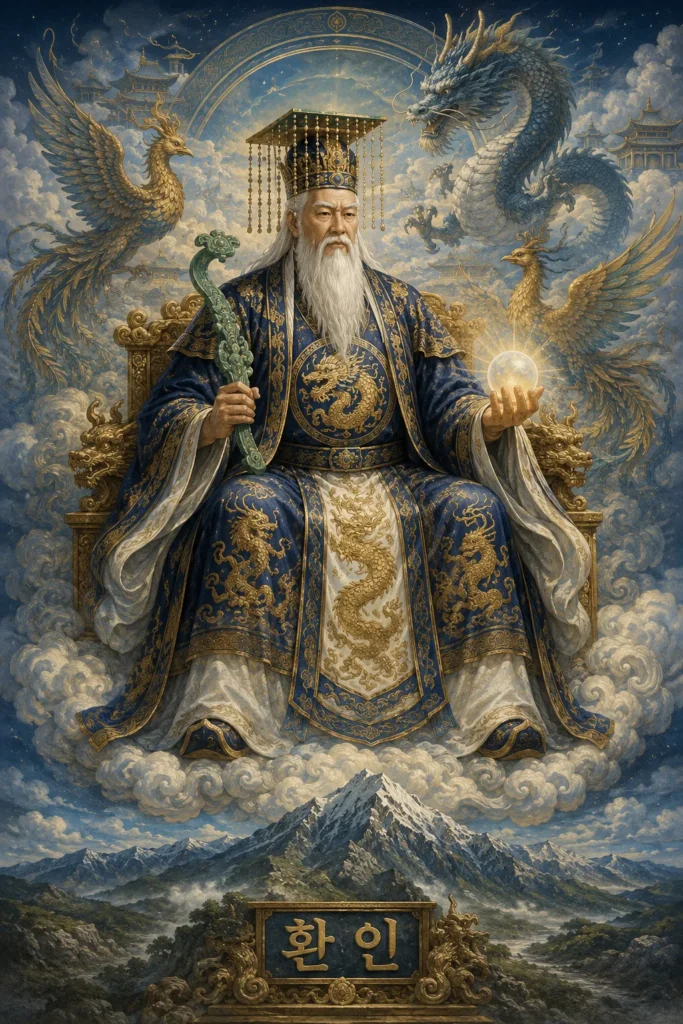
Famous mountain sanctuaries exist on Baekdu (in the north, which is at the same time regarded as the Hwanung-Hwanin mountain), on Jirisan, on Hallasan on Jeju, on Seoraksan and on Bukhan near Seoul.
Each of these sanctuaries has its own local traditions, its own feast days and its own mythical narratives. In his field research, Boudewijn Walraven has documented the diversity of these local cults and shown that mountain veneration, despite its apparent uniformity, has a strongly regional character.
Relationship to Buddhism
The integration of Sansin into the Buddhist monastic topography is a remarkable process. In the 4th and 5th centuries, when Buddhism came to Korea from China, it found the mountains already regarded as sacred.
Instead of combating mountain veneration, the monks integrated it into their monastic complexes and gave the local mountain deities a fixed place in the monastery, though in the rank of a subordinate protective figure. Don Baker has described this practice as a typical example of «hierarchical integration».
In every Korean Buddhist temple there is therefore today a hall called «Sansin-gak», in which the image of the mountain god with his tiger stands.
Before this image, separate incense offerings and prayers are performed, above all by lay people who ask for protection of the family, success in business matters or healing from illness. This practice is today a self-evident part of the Korean temple visit.
Confucian and shamanic appropriation
The Confucian tradition of the Joseon period (1392 to 1910) did not fully displace mountain veneration either. Royal mountain rites were part of the official state cult; the king made offerings at several mountains that were regarded as the protective mountains of the realm.
Bukhansan near Seoul was one of these protective mountains and ranked among the five «great mountains» of the state cult. These official rites differed in their ritualized form from folk-religious practice, but shared the underlying notion of the sacredness of mountains.
In the shamanic context, Sansin is invoked as one of the most important spirits that appear in the «gut» rituals. The shaman, whether female or male, temporarily embodies him and conveys his messages to those present. This mediumistic function is a central aspect of Korean shamanic practice.
In his studies on Songdo and Seoul shamanic practice, Boudewijn Walraven has shown that Sansin occupies a high rank in the shamanic hierarchy without functioning as the sole principal spirit. The shaman, a ritual specialist, is central to this practice.
Sansin and Dangun
A remarkable connection exists between Sansin and Dangun, the mythical progenitor of Korea. According to some versions of the Dangun myth, Dangun withdrew at the end of his life to Mount Asadal and there became the Sansin.
This identification connects the national foundation myth with folk-religious mountain veneration and gives Sansin a quasi-national-religious character. James Grayson has pointed out that this connection was theologically elaborated in the Daejonggyo movement of the 20th century.
In some mountain sanctuaries, especially in the north, Sansin is therefore identified with Dangun or venerated as his heir. This dual identity creates a bridge between the purely local cult and the national myth.
It is an example of the flexibility of Korean religiosity, which is able to combine very different religious layers in a single figure.
State of research and the present
Sansin research is carried out above all by Korean scholars of religion. Internationally, Boudewijn Walraven, James Grayson, Don Baker, Hong-Key Yoon and Antonetta Bruno have presented the most important studies.
From the perspective of cultural geography, Hong-Key Yoon has shown how the mountain sanctuaries shape the spatial perception of the Korean landscape and how mountain veneration is connected with Pungsu (geomancy).
In modern Korean religion, Sansin remains present despite urbanization and modernization. Hikers in the national parks seek out the Sansin-gak and light incense; shamans travel to sacred mountains for special rites; and in the large monasteries the visit to the Sansin hall is a fixed part of the routine of many of the faithful.
The mountain god thus stands for a religious layer that continues to operate under changing principal religions and helps to shape Korean religiosity to this day.
Sansin in folk art
The folk art of Korea has captured Sansin in numerous painted panels, woodcuts and embroideries. In the late Joseon period the pictorial type of the «sansin-do», the mountain-god panel, arose, which depicts Sansin in a strongly stylized form with tiger, pine, pine cones and sometimes a peach fruit.
These painted panels were venerated in the monasteries and were frequently exhibited in folk art museums. Stylistically they combine Buddhist pictorial conventions with folk naivety.
The literary tradition of the Joseon period also drew on Sansin. In numerous folk tales («minhwa») he appears as a tester, helper or as the agent who carries out punishment for human transgressions. These narratives present him as a moral authority with a clear ordering function, which distinguishes him from the rather chaotic mountain demons.
David A. Mason and the ethnographic documentation
The most extensive ethnographic documentation of the Sansin cult has been presented by the American Korea specialist David A. Mason. His work «Spirit of the Mountains: Korea’s San-shin and Traditions of Mountain-Worship» (Seoul 1999) documents more than two hundred Sansin sanctuaries in Korean monasteries and villages and describes the regional variants of the iconography.
Mason shows that the seemingly uniform pictorial tradition consists of three components that are combined differently by region: a patriarchal white-bearded Sansin of the central provinces, a female Sansin on Jeju and in parts of Jeolla, and the Sansin identified with Dangun in the north.
Mason’s survey shows that the Sansin hall of a Korean monastery usually stands east or northeast of the main Buddha hall and, according to Pungsu criteria (Korean geomancy), is placed so as to mirror the «rear mountain» («jinsan») of the monastery.
This architectural convention spatially binds the veneration of the mountain god to the Buddhist monastic order. Hong-Key Yoon has systematically described this geomantic logic in «The Culture of Fengshui in Korea» (2006) and shown how the mountain itself is constituted as a spiritual entity through the Pungsu interpretation.
Jeju Island and the female Sansin tradition
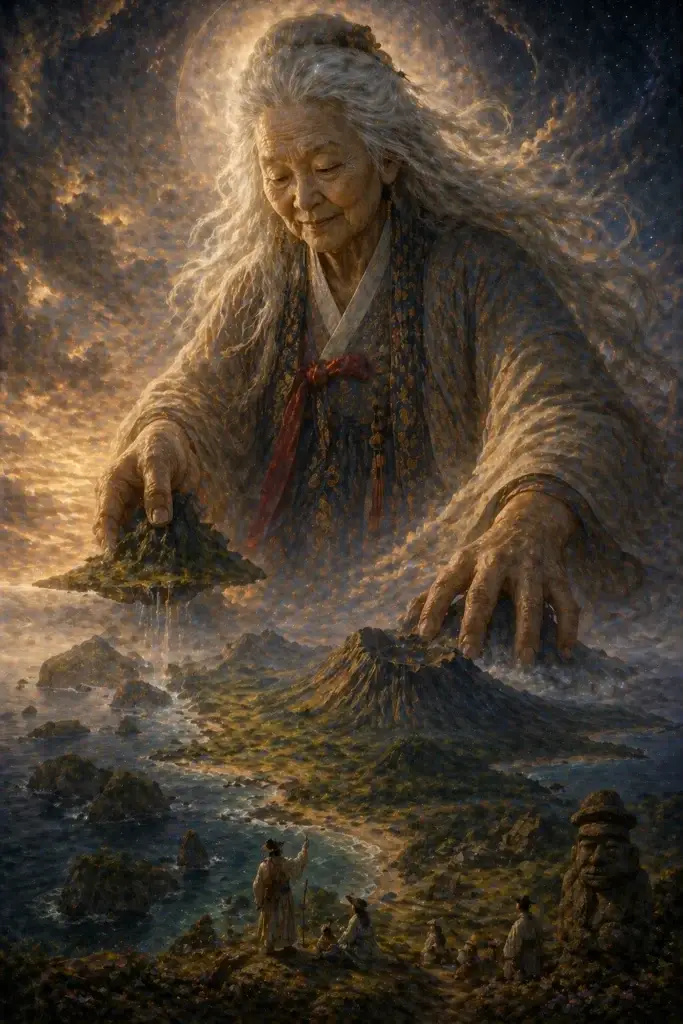
On the island of Jeju an independent mountain-god tradition has survived, at the center of which stands the mountain goddess Seolmundae Halmang («Grandmother Seolmundae»). The Halmang is a giant creator goddess who, according to Jeju mythology, formed the island and its central volcano Hallasan.
She is regarded as the mother of 500 sons and is venerated in numerous local shrines. The mythical tradition is laid down in the «Cheonjiwang-bonpuri» and the «Seolmundae-bonpuri», oral shamanic songs that were recorded in the 20th century by Korean folklorists.
In 2009 UNESCO inscribed the Jeju shamanic festival «Chilmeoridang Yeongdeunggut» on the list of intangible cultural heritage, which has placed the veneration of the Halmang in an institutionalized protective context.
In comparative religious studies, the female mountain-god tradition of Jeju is regarded as important evidence for the thesis of a matriarchal layer in early Korean religiosity, even though this thesis cannot be unequivocally supported archaeologically.
State mountain cult of the Joseon period
The Joseon dynasty (1392 to 1910) institutionalized the mountain cult as part of the official state cult. Five «great mountains» («o-ak») formed the geomantic-ritual framework of the realm: Baekdusan in the north, Jirisan in the south, Geumgangsan in the east, Myohyangsan in the west and Samgaksan (Bukhansan) in the center.
Added to these were the «five guardian mountains» («o-jin») and the «four island mountains». This mountain system is described in detail in the «Joseon Wangjo Sillok» («Annals of the Joseon Dynasty») and in the «Kukcho oryeui» («Five Rites of the State», 1474).
The royal mountain rites differed from folk-religious practice through their Confucian ritualization: in place of the pictorial Sansin there stood memorial tablets bearing a Confucian inscription, the rites followed the scheme of the «jerye», and they were performed by high-ranking officials or by the king himself.
Nevertheless, even the Confucian elites acknowledged the existence of local mountain gods, which documents the religious-political tolerance of the Joseon administration despite its official Confucian orientation.
In «Songs of the Shaman» (1994) and in several essays, Boudewijn Walraven has shown how this dual structure of official Confucianization and the de facto retention of mountain veneration shaped the religious practice of the Joseon period.
Sources and literature
Primary sources: Iryeon, «Samguk Yusa» (1281); «Samguk Sagi» (1145); «Dongguk Yeoji Seungnam» (1481); «Joseon Wangjo Sillok» (Annals of the Joseon Dynasty); «Kukcho oryeui» (1474). Shamanic texts from Jeju: «Cheonjiwang-bonpuri» and «Seolmundae-bonpuri» in the collection by Hyun Yong-jun, «Jeju-do musok charyo sajeon» (Seoul 1980). Secondary literature: David A. Mason, «Spirit of the Mountains: Korea’s San-shin and Traditions of Mountain-Worship» (Seoul 1999); James H. Grayson, «Korea: A Religious History» (Oxford 1989, 2002) and «Myths and Legends from Korea» (Richmond 2001); Don Baker, «Korean Spirituality» (Honolulu 2008); Hong-Key Yoon, «The Culture of Fengshui in Korea» (Lanham 2006); Laurel Kendall, «Shamans, Housewives, and Other Restless Spirits» (Honolulu 1985) and «Shamans, Nostalgias and the IMF» (Honolulu 2009); Boudewijn Walraven, «Songs of the Shaman» (London 1994); Antonetta Bruno, «The Gate of Words» (Leiden 2002); Hyun-key Kim Hogarth, «Korean Shamanism and Cultural Nationalism» (Seoul 1999); Daniel Kister, «Korean Shamanist Ritual: Symbols and Dramas of Transformation» (Budapest 1997).