Apu Ausangate, Most Powerful Mountain Deity of the Southern Peruvian Andes
By Ralf Ittermann · last reviewed on
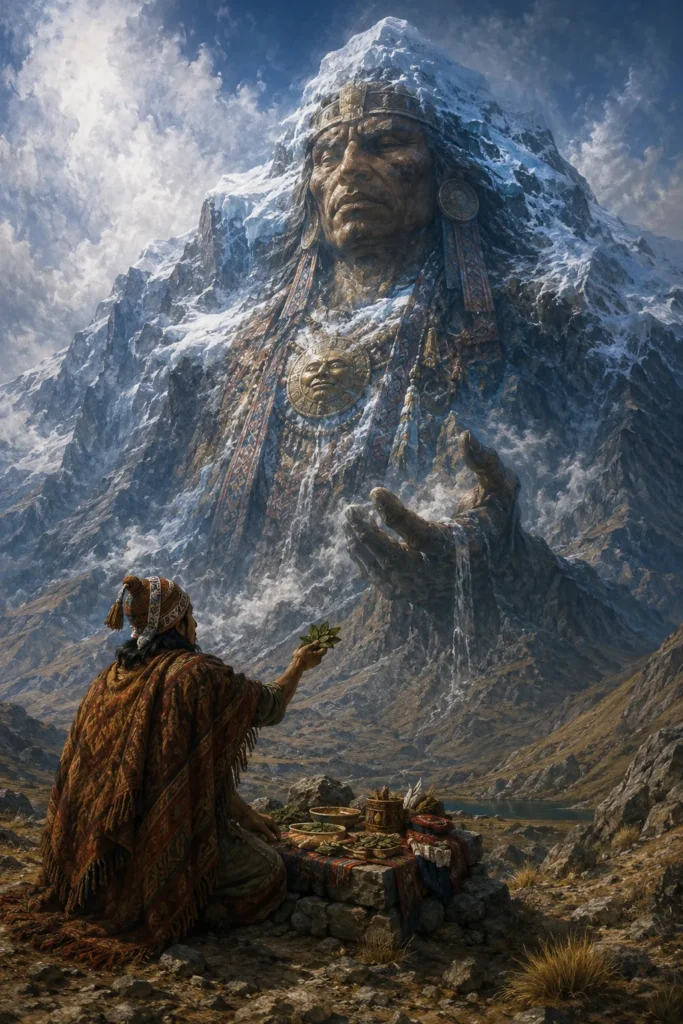
Apu Ausangate (Quechua Apu Awsanqati) is the most powerful mountain deity of the southern Peruvian Andes, a central reference point for highland farmers in the Cusco region and patron of the most important Andean pilgrimage, the Qoyllur Riti. The 6,372-metre main summit southeast of Cusco is regarded as his visible body.
Classification within the Andean Pantheon
Apu (Quechua: lord) is the generic term for the personified mountain deities of the Andes. The Apu class encompasses hundreds of individual mountain peaks, each venerated as an ensouled being by its respective local community.
Within this class, Apu Ausangate is the highest and most powerful representative in the Cusco department and ranks, together with Apu Salcantay, Apu Pitusiray, and Apu Veronica, among the four supreme Apus of the region.
From a religious-studies perspective, Apu beings belong to the category of orographic personifications: geographically prominent mountains are elevated to ensouled numinosities, attributed with their own will, their own temperament, and their own relational bonds.
Structurally comparable phenomena include the alpine mountain spirits of Europe, the Japanese Fuji-Hime cult, the Nepalese Khumbu-Yul-Lha cult, and the mountain traditions of the Pueblo and Navajo peoples of North America.
During the Inca imperial cult, the Apus received veneration organized across the entire empire through the ceque system (see Inti).
Apu Ausangate was one of the most important endpoints of the southeastern ceque sector and stood in a ritual-topographic connection with the Coricancha temple. Brian Bauer reconstructed this Ausangate-Cusco axis in The Sacred Landscape of the Inca (1998).
Structurally important is the fact that the Apu tradition is not centrally hierarchically organized but functions as a distributed religious system. Every village, every community has its own principal Apus, which stand in a complex hierarchy in relation to one another.
As the highest mountain in the region, Ausangate is a kind of Apu of Apus, but he does not replace the local mountain lords. This distributed structure explains the extraordinary resilience of Apu religiosity in the face of the Spanish mission: there were no central institutions that could have been destroyed.
Name and Etymology
The name Ausangate or Awsanqati is not linguistically explained with certainty. Cesar Itier proposed in his Quechua studies (2008) deriving the name from awsa (snow, ice) and qati (rocky tip, summit), making Ausangate the Snow Summit.
An alternative etymology connects aws- with the stem aysa- (to call, to invite), rendering the mountain the Inviting Height, an etymology that would fit the mountain’s pilgrim-destination status.
The designation apu is the highest form of honorific address in Inca-period Quechua, roughly equivalent to the Spanish senor. It was used for members of the highest noble class, for the Inca rulers themselves, and, as a religious extension, for the most powerful mountains.
This linguistic equation of mountains with the highest human class demonstrates the parity status of the Apus in Inca-period theology.
In modern Quechua-speaking villages, apu is the most important term for numinosity in peasant religiosity. Catherine Allen noted in The Hold Life Has (2002) that most highland villages know a local principal Apu who is economically and ritually more important than the higher state deities Inti or Viracocha.
Description and Iconography
Apu Ausangate is described in ethnographic sources predominantly as an anthropomorphic mountain lord: a dignified old man with a long white beard and a mantle of snow who governs his realm from the summit.
This description is not, however, iconographically fixed in any binding way; some practitioners describe Ausangate as a white Inca in golden robes, others as an invisible numinosum without a fixed appearance.
An important visible form of manifestation are the aukis, smaller mountain helpers who visit herds and fields on Ausangate’s behalf. In some accounts, Ausangate also appears as an enormous black bull or as a white condor circling the summit with outstretched wings. Inge Bolin described this iconographic variation for the village of Chillihuani.
In surviving colonial Cusquena paintings, Apu Ausangate occasionally appears in the background of religious scenes, often as a snow-covered mountain backdrop behind depictions of Christian saints.
The well-known image of the Virgen del Cerro (Potosi, ca. 1720) uses not the Ausangate but the Cerro Rico; structurally, however, it is the most important iconographic model for a mountain-as-Mary syncretism.
Mythological Narratives
The mythological narratives surrounding Apu Ausangate are rich and are told in numerous versions in the surrounding villages.
One central myth class describes Ausangate’s familial relationships with other Apus: in some versions Apu Ausangate is the consort of the nearby Apu Pitusiray, in others the father of the younger Apu Salcantay, and in all versions the highest and oldest Apu of the region.
A particularly important narrative describes Ausangate as the keeper of the itu herds: inside the mountain, enormous herds of white llamas, alpacas, and vicunas are said to reside, emerging from the mountain on certain festival days and mingling with the herds of the living.
Whoever steals or injures one of the sacred animals is severely punished by Ausangate. This narrative belongs to a broader Apu topos: the mountain as storage place for the herd reserve that secures the economic survival of highland herders.
A third myth complex connects Ausangate with the Inkari, the mythical last Inca ruler who, following the death of Atahualpa (1533), continues to live inside the mountains and will one day return to reestablish the Inca empire.
This Inkari concept is a central element of post-Inca messianic expectation and was systematically described by Alejandro Ortiz Rescaniere in De Adaneva a Inkarri (1973).
A special narrative class concerns the Inca conflict: according to some villages, Apu Ausangate was one of the beings said to have aided the Inca rulers in critical battles.
In the battle of the Incas against the Chanca (ca. 1438), which politically founded the Inca empire, Ausangate himself is said to have fought as an Apu warrior alongside Pachacuti and enabled the victory.
This connection is mythico-historical and is analyzed in the ethnographic literature as an example of the intertwining of political history with mountain theology.
Cult and Veneration
The veneration of Apu Ausangate takes place primarily in the form of individual or familial offering rituals: the daily or weekly invocation of Ausangate by herders as they go out to the pasture, the occasional offering (despacho or pago a la tierra) at important life transitions, and collective mountain-summit pilgrimages.
The most important collective pilgrimage is the Qoyllur Riti pilgrimage (Quechua quyllur rit’i, snow star), held annually in June in the mountains southeast of Cusco at the foot of the Ausangate massif. It is among the largest Andean pilgrimages and was recognized by UNESCO in 2011 as intangible cultural heritage.
Tens of thousands of pilgrims travel over several days in procession to the sanctuary of Sinakara, pray there before a rock cross, and then ascend to the glacier tongues to keep vigil through the night.
The originally pre-Inca snow pilgrimage was Christianized in 1783, when a rock cross from Sinakara was introduced as a devotional image for pilgrims.
In contemporary practice, the Catholic cross image and indigenous Ausangate veneration are inseparably interwoven. Robert Randall described the dual dimension of this pilgrimage in detail in his study of Qoyllur Riti (1982).
Protective Practice and Apotropaic Traditions
Apu Ausangate is one of the central protective figures in the practice of highland farmers. Ausangate-related protective practice focuses on four areas: protection of the herd, protection from illness, protection of travelers on mountain ridges, and protection from malevolent spirits (Supay).
Concrete protective practices include the invocation of Ausangate before every mountain crossing with the formula Apu Ausangate, runallaykim kani (Apu Ausangate, I am only your person), the stacking of small cairns (apacheta) on mountain heights as a visible sign of invocation, and the burning of wax candles in the morning before driving livestock to pasture.
The ritual specialists paqo or altomisayoq maintain a special relationship with Ausangate; in vocation narratives, Ausangate himself is often named as the mountain teacher.
A specific protective practice involves the ritual purification of Qoyllur Riti pilgrims.
Those who have completed the ascent and arrive at the glacier tongue with the first sun of the upper day earn the privilege of breaking off a small piece of ice to carry back to their home village, where the ice is melted in the fields so that the blessing of the mountain may enter the fields.
This practice has, however, been severely curtailed over the last 20 years due to the retreat of the glaciers as a result of climate change.
The despacho or pago-a-la-tierra practice in relation to Ausangate has its own complexity. A despacho a Ausangate typically comprises a 12-step offering bundle with coca leaves (kintus), llama fat, small sweets, wool in various colors, llama embryos (sullu), gold and silver foil, and a selection of stone figurines.
The entire package is arranged in an artfully folded paper construction with further protective adornments and at the end of the ritual is either burned or buried. This practice is described in detail by Juan Nunez del Prado, Catherine Allen, and Joseph Bastien.
Parallels in Other Cultures
Mountain deities and mountain lords are central reference figures in practically all highland religions of the world.
Structural parallels to Apu Ausangate can be found in the Japanese Fuji-Hime and Asama cult, in the Chinese Taishan mountain cult, in the Hindu veneration of Kailash and Meru, in Greek Olympus theology, and in the alpine mountain-spirit concepts of Tyrol and Switzerland.
Mircea Eliade described the pattern of the sacred mountain as axis mundi systematically in Patterns in Comparative Religion (1958): the mountain connects heaven and earth, is the dwelling place of the gods, and can be ascended by those qualified to do so (priests, hermits, pilgrims) in order to attain an encounter with the numinous.
Apu Ausangate is a paradigmatic example of this pattern.
Within the Americas, Apu Ausangate presents parallels to the Navajo sacred mountain tradition of Changing Woman, and, outside the Americas, to the Tibetan Buddhist Yul-lha tradition.
The latter is particularly noteworthy in that it is organized in a structurally very similar way to the Apu tradition: there too, hundreds of individual mountains are each distinct deities venerated by the local community.
Comparative alpine religious studies has, since the 1990s, increasingly engaged with the question of whether mountain-spirit concepts from various highland cultures are typologically related.
The convergences can be explained by the shared cognitive situation of highland dwellers, for whom the mountain is directly experienced as a geographically dominant, weather-influencing, and dangerous presence that thereby invites personification.
Contemporary Reception and Research
Today, Apu Ausangate is one of the most prominent examples of living indigenous religion in the Andes. The Qoyllur Riti pilgrimage attracts tens of thousands of pilgrims annually and is described in the religious-ethnological literature as a model case of Andean syncretism.
Robert Randall (1982) and Michael Sallnow (1987) have described the pilgrimage at various stages of its modern development.
An increasingly important line of research concerns the effects of the climate crisis.
The Ausangate glacier has lost over 40 percent of its area in the last thirty years; the ice-pilgrim tradition, in which pieces of ice were carried from the glacier tongue into the valley, had to be discontinued in 2003 by the brotherhood of Qoyllur Riti custodians because the ice loss made the tradition ecologically untenable.
Inge Bolin has documented these ritual adaptations in their more recent work on the Andean climate crisis.
From a religious-studies perspective, Apu Ausangate is an important example of how an indigenous religiosity can remain vital even under conditions of modernity, Christianization, and ecological crisis.
Catherine Allen and Joseph Bastien have repeatedly highlighted the resilience of this tradition in their works. The iWell Guard reference to Ausangate veneration describes this tradition from a history-of-religions perspective, without any promises of efficacy.
A growing field of research concerns the relationship between indigenous religiosity and political recognition. In Bolivia and Peru, Apu veneration has been increasingly incorporated into national and international recognition processes over the past 20 years: UNESCO intangible heritage status for Qoyllur Riti since 2011, constitutional recognition of indigenous religiosity in Bolivia and Ecuador.
This political recognition has strengthened the status of the Apu tradition but has also brought with it problematic tendencies toward folklorization and tourist commercialization, which are critically examined in the religious-ethnological discussion.
Literature and Sources
The following selection lists key works in Andean ethnology and the history of religions on Apu veneration and the Qoyllur Riti pilgrimage.
Ausangate in the Annual Festival Cycle of Qoyllur Rit'i
The best-known ritual connection of Apu Ausangate with the living Andean tradition is the pilgrimage of Qoyllur Rit’i, which takes place annually shortly before Corpus Christi at the foot of the Ausangate massif in the Sinakara valley.
Tens of thousands of pilgrims from the Quechua and Aymara communities of the southern highlands make their way to a sanctuary at around 4,600 metres altitude, where a painted image of Christ on a rock face is venerated.
The Catholic interpretation draws on an apparition legend from the 18th century, yet ethnologists such as Robert Randall and later Michael Sallnow have shown that the pilgrimage is simultaneously a mountain cult that addresses Ausangate as the supreme Apu of the region.
The carriers of the ritual are the ukukus or pablitos, masked dancers in shaggy wool costumes who are regarded as intermediaries between humans and the mountain. At night they ascend the glaciers of the Ausangate to obtain ice and carry out rites that serve as both trials of courage and acts of purification.
Formerly, large blocks of ice were carried down into the valley; in view of the glacier retreat, this custom has been severely curtailed in recent years, a development that has itself become a subject of religious interpretation.
The festival cycle thus connects Christian saint veneration, Andean mountain religion, and an agricultural calendar that links the appearance of the Pleiades star cluster with the approaching planting season. Research on the pilgrimage emphasizes that it is not a mere remnant of pre-colonial religion but an autonomous, continuously reinterpreted practice.
Anyone seeking to understand Ausangate’s role must recognize Qoyllur Rit’i as its most important present-day setting. Related mountain deities of the region are addressed in the entry on Apus in general.
Ausangate in the Despacho Ceremony of Andean Healers
In the ritual everyday life of southern Andean Quechua communities, Ausangate appears above all in the despacho, an offering bundle assembled by the paqos or Andean ritual specialists.
On a sheet of paper or cloth, coca leaves are arranged in groups of three, known as k’intu, together with maize kernels, animal fat, colored wool, small lead figurines, and sometimes sweets.
Each element represents a gift to the Pachamama and to the Apus, among whom Ausangate holds the highest rank across large parts of the Cusco region.
The invocation follows a hierarchical order: first the local house mountains are named, then the larger regional Apus, and finally Ausangate as the supra-regional summit. The completed bundle is burned or buried; the rising smoke is regarded as the actual channel of transmission for the gift.
Ethnological works, such as Catherine Allen’s study of the communities near Sonqo, describe the despacho as an act of reciprocity: the mountain receives nourishment and in return gives fertility, protection for the livestock, and healing.
Notably, this practice does not take place in secret but is openly part of religious life and coexists with the Catholic calendar. In recent decades, the despacho has also gained international reach through Andean esoteric tourism, a development that is discussed controversially among researchers.
Some see in it a form of uprootedness, others an act of adaptation of the kind Andean religion has repeatedly carried out since the colonial period. For the understanding of Ausangate, what is decisive is that he appears here not as a distant myth but as a concrete, addressable recipient of ritual gifts.
Literature (Selection)
- Catherine Allen: The Hold Life Has (2002)
- Robert Randall: Qoyllur Riti, an Inca Fiesta of the Pleiades (1982)
- Michael Sallnow: Pilgrims of the Andes (1987)
- Inge Bolin: Rituals of Respect (1998)
- Brian Bauer: The Sacred Landscape of the Inca (1998)
- Alejandro Ortiz Rescaniere: De Adaneva a Inkarri (1973)
- Jean-Jacques Decoster: Incas e indios cristianos (2002)
Related key terms: Apu Ausangate Awsanqati Qoyllur Riti Sinakara Inkari Apacheta Paqo Altomisayoq.
iWell Guard and Protective Traditions
iWell Guard draws on the cultural-historical tradition of portable protective objects, in the tradition of Andes / Inca and many other cultures worldwide. 41 layers, real gold, platinum, silver, made in Germany. 30-day return policy.
Personal experiences may vary. Not a medical product. No healing promises.