Pluto is the god of the underworld and of wealth in the Roman tradition. The name itself means “the rich one” and refers to the mineral treasures of the earth.
From a religious-studies perspective, Pluto is an example of the ambivalence of chthonic deities, at once fearsome and life-giving, both judge of the dead and guardian of the earth.
Pluto rules over the realm of the dead, together with his wife Proserpina. He is not evil, however, but dutiful and devoted to order, a stern lord of the underworld.
His central aspects are dominion over death, purification through death, hidden resources and subterranean fertility. The temple at Tarracina (Volterra) and the cults of the Chthonii (subterranean gods) attest to his widespread veneration.
Sources are numerous: Virgil’s Aeneid (Book 6, journey into the underworld), Ovid’s Metamorphoses, Cicero’s De Natura Deorum, Seneca, Latin grave inscriptions and defixiones (curse tablets). In secondary literature, Karl Latte, Georg Wissowa and Walter Burkert have analyzed the connections between Pluto, Hades and subterranean deities. Distribution extended across Italy, Gaul and Africa.
The continuity of the tradition across these long spans of time is remarkable and shows a deep, stable cultural rootedness. In modern times too, the memory and sometimes active veneration remain alive, sometimes transformed, but in its basic features still recognizable.
Pluto is the Roman god of the underworld, of death and of wealth. Unlike the Greek Hades, he is more strongly tied to Latium. He is not evil, but necessary and respected. His rule over subterranean wealth links him with prosperity. He governs boundaries.
Pluto was not confined to a particular region or location, but was known and venerated, or respectfully feared, universally throughout the Roman world. Whether in large urban centers or in peripheral rural regions, whether among the social elite or the common people, the spiritual or cultural significance of this entity was consistently recognized and universal.
The veneration of the lord of the underworld was a matter of state in Rome, not a private affair: the Secular Games for Dis Pater and Proserpina were held on the Senate’s instructions and concerned the commonwealth as a whole. The Greek Plouton reached Rome by way of southern Italy and its Greek colonies, where he coalesced with the native Dis Pater; in this way a largely uniform image of the god spread throughout Roman territory.
Primary sources: Virgil, Aeneid 6, Ovid, Metamorphoses 5 (the abduction of Proserpina), Horace’s Odes, Martial’s Epigrams, Seneca’s tragedies (Hercules Furens, Octavia), Cicero, Apuleius, Metamorphoses. Period: 4th century BC to 6th century AD. Scholars: Georg Wissowa, Karl Latte (Römische Religionsgeschichte), Walter Burkert, Hendrik Versnel, Filippo Coarelli (archaeology). Evidence: Inscriptiones Latinae Selectae, monuments from Volsinii, Tarracina.
Pluto is depicted across the various sources and artistic traditions with certain recurring iconographic elements that remain relatively constant over decades and across different geographical areas.
These elements are not purely decorative or randomly chosen, but are deeply symbolically encoded and carry great meaning. They centrally convey the functions, sources of power, sphere of responsibility and cosmic role of the being.
The overall system is like a sacred script or an encoded image; it allows the initiated or the culturally educated to grasp and correctly understand the essential, deeper meaning. Colors, sacred objects or weapons, physical attributes, specific accessories, all are significant and handed down by tradition.
Pluto was central to religious practice, everyday rituals and the daily understanding of the Romans. People turned to this entity in critical or particular life situations or at certain ritual times of the year, with structured, often elaborate rituals, prayers or offerings.
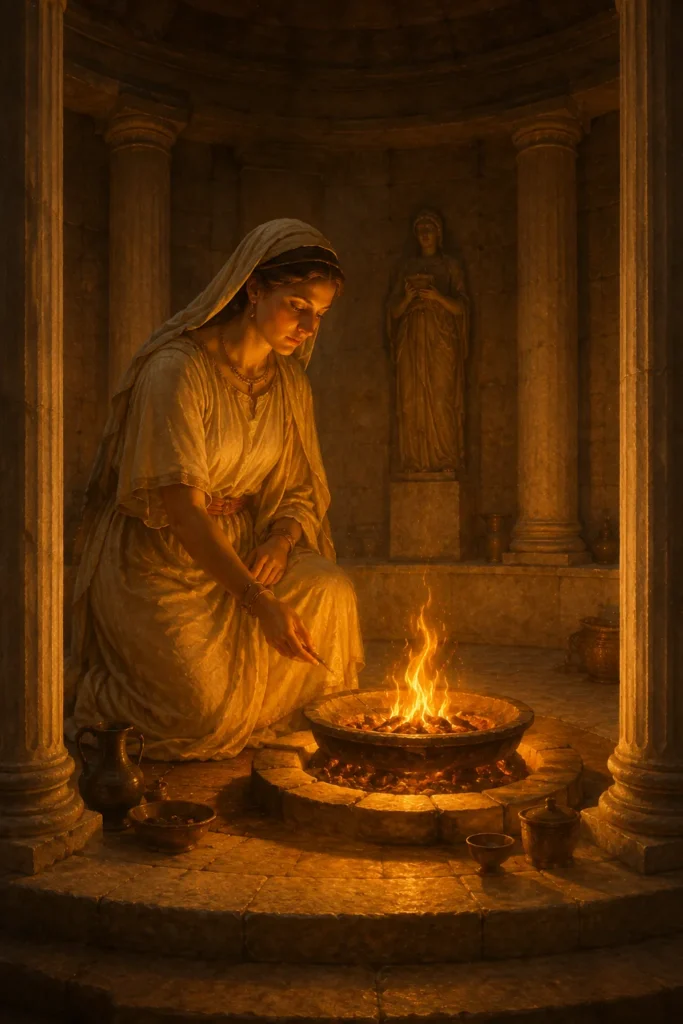
In Rome, Pluto had hardly any independent cult with a fixed temple and priesthood. Rites for the gods of the underworld nevertheless followed firm prescriptions of Roman sacral law: offerings to chthonic deities were made in pits, often at night, and usually carried out under the name of Dis Pater, with whom Pluto largely merged.
The continuity of these practices across many generations clearly shows that the practice was regarded as effective and necessary. The functions were varied: some were preventive (warding off potential misfortune), some restorative (alleviation of illness or suffering), some transformative (accompaniment through transitions between stages of life).
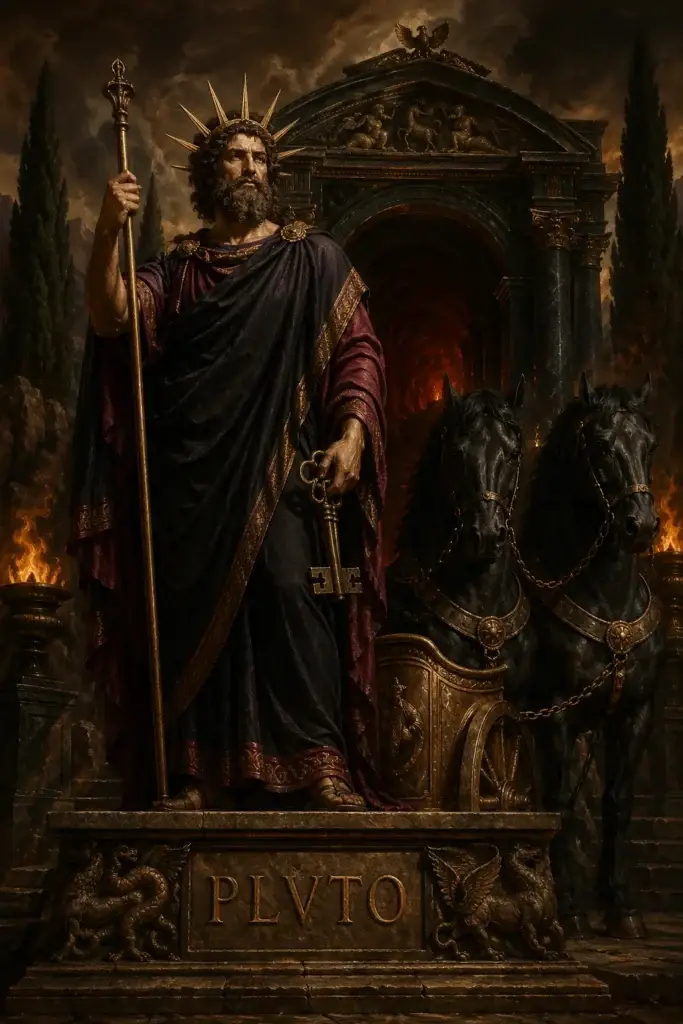
Pluto is depicted as grave and majestic, often in dark robes. A scepter symbolizes his rule. Black and dark gray are his colors. The poppy and the cypress are sacred to him. Sometimes he wears a crown. The ground yawns open beneath his feet.
The Profile outlines Pluto’s dominion across six domains: his mythical-historical origin, the priestly and magical practices of his veneration, his characteristic depiction in art and symbolism, the significance of invocation and respect for the god of death, comparisons with related figures of other cultures, and finally an overall perspective on his cosmic role.
Pluto is the Roman form of the Greek Hades and derives from Indo-European underworld gods. The cult was rooted in Etruria and was adopted by Rome.
At Italic cult sites (especially Tarracina and Volsinii), sanctuaries of Pluto were already established in the 5th century BC. The Roman Plutus (god of prosperity) was a different entity, but was often conflated with Pluto. His cult was less public, expressed rather through private devotion and magical practice.
Pluto was invoked by all mortals, in cases of bereavement, in judicial oaths (to reinforce them through underworld power), by farmers in field curses (defixio), and by magicians in necromancy.
The Etruscan haruspices (diviners of entrails) and Roman priests of the Chthonii (subterranean priests) in particular maintained the cult. In private homes, figures of Pluto were set up to guard graves. The Lemuria festival (9, 11 and 13 May) was a domestic rite to appease subterranean spirits.
Pluto was depicted as a bearded, serious man, often enthroned in rocks or caves, sometimes with a scepter or a serpent.
His attributes are the cornucopia (the horn of plenty, a symbol of subterranean wealth), the poppy head (a symbol of sleep and death), the serpent, coins or treasures. On coins he sits enthroned beside Proserpina. Tombstones show him as judge over the deceased.
Sphere of Influence: Pluto (or Dis Pater) is the ruler of Rome’s underworld, brother of Jupiter and Neptune. He is not evil, but the just administrator of the afterlife.
In Rome he is invoked without eye contact; one turns away and speaks to him. Wealth (*ploutus*, abundance) is associated with him, because all minerals and fruits of the earth come from his realm. He is the silent god who holds everything within himself.
Pluto stood under reverent invocation, not out of fear of punishment, but out of respect for the power of nature. Sacrifices were black-colored animals (rams, bulls), honey and blood offerings.
Defixiones (curse tablets with scratched-in names) were deposited in graves and temples to ask Pluto for justice or revenge. Promises made to Pluto were considered more binding than earthly oaths, an exception in Roman religious practice.
Hades (Greek) is the most direct parallel, with similar roles and attributes. The Etruscan Aitn/Aita is a proto-Pluto. In the Mesopotamian sphere, Nergal corresponds to the underworld god with similar functions. In the Egyptian sphere, Osiris embodies rule over the underworld and rebirth. These deities share the ambivalence between terror and necessary cosmic order.
The Roman Pluto corresponds functionally to the Greek Hades, yet within Roman religious practice he integrates additional chthonic and agricultural associations. His cult overlaps with those of Dis Pater and Orcus, but within the empire it is more strongly oriented toward wealth and the fertility of the soil than its Greek model.
Jewish tradition: The Jewish Sheol is not a realm with a personified god, but simply the realm of the dead. Later (in apocalyptic literature), angels are named as judges, but there is no counterpart to Pluto. A Hades-Pluto syncretism is attested in Hellenistic Judaism, but it is not canonical.
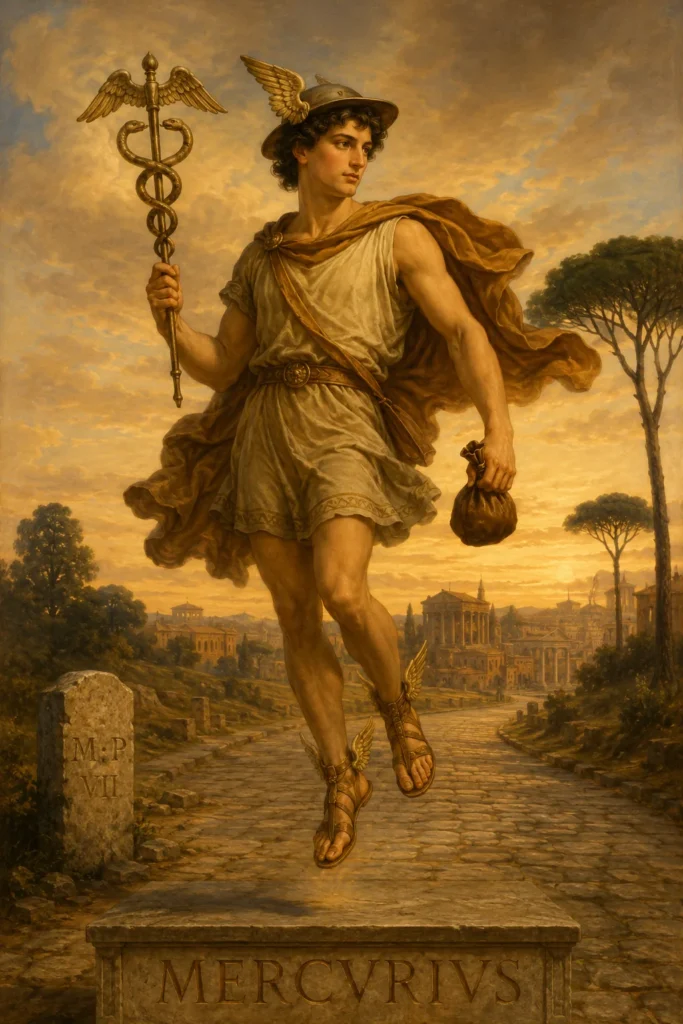
Greco-Roman world: Hades is Pluto’s predecessor and parallel. The Romans built on Greek conceptions, but emphasized jurisdiction and order more strongly. Hermes Psychopompos (guide of the dead) is a complement, not a rival.
Mesopotamia: Nergal and Ereshkigal (goddess of the underworld) rule together over the realm of the dead. Nergal shares with Pluto the power of war and chthonic might. Ereshkigal is a harsher judge than Proserpina.
India/Asia: Yama is the Vedic god of the dead, ordering the order of the dead. No direct parallel, but structurally similar: an arranger of the underworld, strictly just. In Buddhism the underworld is less personalized, without a Pluto equivalent.
The Roman god of the underworld appeared under several names, and their relationship to one another is instructive for the history of religion. Pluto itself is the Latinized form of the Greek epithet Plouton, the rich one, and came to Rome with the adoption of Greek conceptions. Alongside it stood older, native designations.
The most important is Dis Pater, the rich father. The name Dis is regarded as a contraction of dives, rich, and is thus an exact Latin equivalent of the Greek Plouton. Here too, the wealth refers to what lies beneath the earth, to the grain and to the treasures of the soil.
A third name is Orcus, whose origin is disputed; Orcus could denote both the god and the underworld itself, as well as a punishing, intimidating power. From Orcus, by way of various detours, the Italian orco and ultimately the word ogre derive.
This multiplicity of names shows that the Roman conception of the god of the dead was fed by several sources: from a native tradition connected with Dis Pater and Orcus, and from Greek theology, which brought with the name Pluto the elaborated mythology of Hades.
Scholarship assumes that the native Roman conceptions were originally less personlike and rich in myth than the Greek ones. Only through the equation with Hades-Plouton did the Roman underworld god acquire his elaborated form and his narratives, above all the abduction of Proserpina.
A distinct Roman cult of Dis Pater and Proserpina had its center in the Campus Martius at a place called Tarentum or Terentum. There stood a subterranean altar, which was uncovered and used only on particular occasions.
According to the foundation legend, a Sabine named Valesius is said to have dug there and come upon the altar while seeking healing for his children.
At this place the Ludi Tarentini were held, nocturnal games and sacrifices for the subterranean deities.
From this tradition the Ludi Saeculares, the secular games, developed, which were celebrated only once in a saeculum, a span of about a hundred or a hundred and ten years, on the grounds that no human being should experience them twice. The games marked the transition from one age to the next.
Particularly well documented are the secular games that Emperor Augustus had staged in the year 17 BC. For this occasion Horace composed the Carmen Saeculare, which was sung by choirs of boys and girls. An inscription documenting the festival program survives and is regarded as an important source.
From a religious-studies perspective this finding is significant: it shows that Dis Pater appears in the Roman state cult not merely as the recipient of private funerary rites, but as a power connected with the course of the great ages and with the ritual renewal of the community.
The nocturnal, dark sacrifices for the underworld gods thus belonged to the fixed inventory of the Roman festival calendar.
The most striking feature of Pluto is his name itself, the rich one. This connection between the god of the dead and wealth is no coincidence, but the expression of a coherent conception.
The earth into which the dead descend is at the same time the earth from which the grain grows up and in which metals and gems lie stored. Whoever rules over the underworld thereby also rules over these treasures.
In antiquity, Pluto was therefore associated with the wealth of the soil, with agriculture as well as with mining.
The Greek god Plutos, a personification of wealth in the narrower sense, is to be distinguished from Plouton, yet the two names lie so close to each other that they were already conflated in antiquity.
The close bond of the underworld god to Proserpina, who herself appears as a goddess of vegetation, reinforces this aspect: her annual ascent and descent is linked with the growth and decay of the field crop.
From a religious-studies perspective, this finding makes clear that the Romans and Greeks did not think of death and fertility as pure opposites. The same earth that devours also brings forth. The god of the dead is therefore not only a fearsome figure, but also the guarantor of a cycle on which the living depend.
In the visual arts, Pluto was occasionally depicted with a cornucopia, the symbol of abundance, which makes this positive side visible. At sacrifices to him, however, the forms customary for chthonic deities were applied, dark animals, blood directed into the ground, a grave ritual posture turned toward the depths.
In the 20th century the name Pluto enjoyed a second career, far removed from ancient religion. When a new celestial body beyond Neptune was discovered at the Lowell Observatory in Arizona in 1930, a name was sought.
The suggestion came from Venetia Burney, an eleven-year-old schoolgirl from Oxford who was interested in ancient mythology. The name of a god of the dark, distant underworld seemed fitting for the distant, cold celestial body.
The suggestion also prevailed because the first two letters of the name, P and L, were at the same time the initials of Percival Lowell, the founder of the observatory, who had long searched for such a planet.
The astronomical symbol of the celestial body combines these two letters. Pluto was at first regarded as the ninth planet of the solar system. In 2006 it was reclassified by the International Astronomical Union as a dwarf planet, a decision that provoked unusually strong reactions in the public.
From a religious-studies perspective, this episode is an example of the afterlife of ancient names of gods in modern scientific language.
Like the planets Jupiter, Mars, Venus and Neptune, this celestial body too bears the name of a Roman god, and with it a whole field of concepts migrated onward: Pluto’s largest moon is named Charon, after the ferryman of the underworld, while further moons bear names such as Styx and Cerberus.
The ancient geography of the afterlife has thus, stripped of its religious content, become a reservoir for astronomical nomenclature. The god of the dead of the Romans is today known to most people above all as a distant icy body at the edge of the solar system.

As a deity of the Roman tradition, Pluto merges the Greek Hades with old Italic conceptions of the wealth of the earth and rules over the realm of the dead, mineral resources and the subterranean layers of the world.
Against its influence, cross-cultural tradition names these protective means:
Compare in the Protection Compass →Recommended protective means
The simplest protective means in this collection: 41 layers of fine gold 999, platinum, silver and silicon, manufactured in Ruhla, Thuringia. It requires no activation, is bound to no person, and is effective within a radius of around 50 meters, even without being worn.
Related Beings

Ogbanje, the recurring spirit child of the Igbo. Origin, the cycle of birth and early death, the ...

Gods of the Phoenicians and Carthaginians: Baal Hammon, Astarte (Tanit), Melqart, El, Asherah. My...

Brahmarakshasa, the powerful spirit of a Brahmin in India. Origin, the dual nature of horns and t...

In folk belief, parsley protects house and home, yet it was also regarded as a herb of the dead. ...

The witch bottle was a buried vessel against harmful magic. An overview of the origin, finds and ...

Apaosha, the Zoroastrian demon of drought. Origin, the rain battle against Tishtrya, and the clas...