Upyr, Demon of the Slavic Tradition
By Ralf Ittermann · last reviewed on
Upyr is a demon of the Slavic tradition.
The Slavic revenant, progenitor of the modern vampire figure.
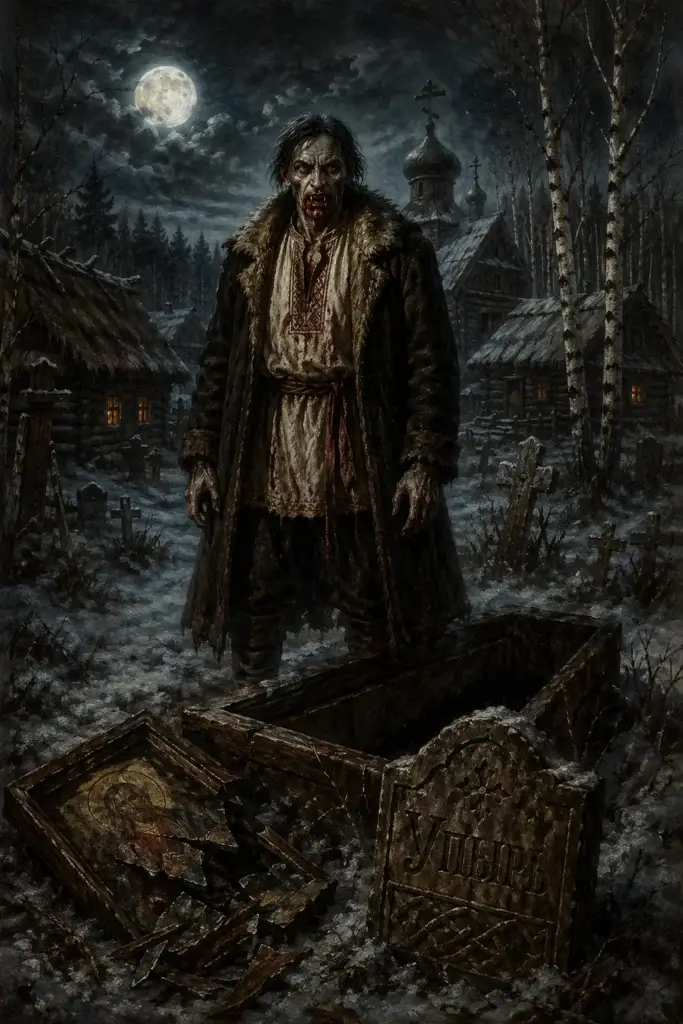
Upyr
The Upyr is the central revenant figure of Slavic folklore, and the direct historical predecessor of the modern vampire figure.
A deceased person who rises from the grave, drains the blood of the living, first decimating the immediate family and then the village, and who can only be permanently laid to rest through specific rites. Unlike the Norse Draugr, the Upyr is more mobile, attacks at night, and can move freely outside the cemetery.
The Slavic Upyr tradition is central to European vampire history. Through travel accounts from the Balkans in the 18th century (Johann Flückinger 1732, the Austrian Arnod Paole case), the phenomenon became known in Western Europe.
From this, modern vampire literature developed through Polidori, Le Fanu, and Bram Stoker. Regional variants: East Slavic Upyr, Polish Upiór, Romanian Strigoi, South Slavic Vukodlak, Vlkodlak.
Quick Overview: Upyr
Type: Slavic revenant, vampire progenitor
Origin: The unbaptized, those who died by suicide, the cursed, the excommunicated
Texts: Slavic church records (from the 11th c.), Balkan accounts 18th c., Karadžić
Period: Medieval to present
Warding off: Aspen-wood stake, decapitation, burning
Context
First written attestations in Slavic church documents of the 11th century. Extensive accounts in the 18th century (Flückinger 1732 on Arnod Paole; further Habsburg investigations). Literary reception: Polidori 1819, Le Fanu 1872, Stoker 1897. Modern scholarship: Paul Barber, Agnes Murgoci.
The Slavic cultural sphere from Russia to the Balkans, with particularly dense tradition in Serbia, Bulgaria, Romania (Strigoi), and Poland. Spread to Western Europe and worldwide through Habsburg colonization and literary reception.
Slavic church records, Habsburg exhumation protocols (18th c.), Vuk Karadžić Srpski rječnik (1818), Agnes Murgoci’s “The Vampire in Roumania” (1926), Paul Barber Vampires, Burial, and Death (1988), modern Balkan and Slavic folklore studies.
Name and Variants
Russian: Upyr (Упырь).
Polish: Upiór, Wąpierz.
Czech/Slovak: Upír.
Romanian: Strigoi (from Latin strix, not Slavic, but in the same semantic field).
South Slavic: Vukodlak, Vlkodlak; Serbian also Vampir, source of the internationally known term.
Ukrainian: Upyr.
The Serbian form Vampir appears in the Habsburg protocols of the 18th century and was disseminated worldwide from there through the Austrian and German press. The entry “Vampyr” in the French Trévoux dictionary (1721) is an early attestation of the internationally established word.
Description
Appearance
After exhumation, strikingly fresh: red face, uncoagulated blood in the heart, grown nails and hair, mouth smeared with blood. Readily explainable through natural decomposition processes; for contemporaries, proof of vampire activity. During nocturnal activity: dark figure, sometimes as an animal (wolf, dog), sometimes as mist.
Behavior
Leaves its grave at night, attacks family members first (hence “the immediate family first”), then the village. Drains blood, brings exhaustion, illness, death. Anyone who dies from an Upyr bite becomes an Upyr themselves. Villages afflicted by an Upyr suffer veritable series of deaths.
Sphere of Influence
The home village and surrounding settlements. Can sometimes move farther when an area becomes depopulated. Border days (Jurjevden, Christmas, Epiphany) particularly active.
Mythological Classification
According to folk-religious tradition, a person becomes an Upyr if they die unbaptized, by suicide, excommunicated, cursed, or as a witch. People born with “two hearts” or “two souls” are also considered at risk. The transformation from the Slavic revenant to the modern vampire took place over centuries.
Profile: Upyr
The most important aspects of the Upyr at a glance.
The unbaptized, those who died by suicide, the cursed, the excommunicated, or those who died as witches. Arises from improper burial or moral failure in life.
First the immediate family, then the village. Anyone who dies from an Upyr bite becomes an Upyr themselves, leading to epidemic-like spread.
After exhumation: red, bloated, with uncoagulated blood and grown nails. At night: dark figure, as an animal (wolf, dog), or as mist.
Drains the blood of the living, brings exhaustion, illness, death. Village-wide series of deaths. Spread through bite transmission.
Exhumation and piercing with an aspen-wood stake, decapitation, burning in open flame, reburial face-down. Garlic, incense, crosses; protective burial practices.
Warding Off and Vampire Combat
Preventive Burial
Anyone considered at risk of becoming an Upyr (suicide, unbaptized state, excommunication) is buried with special care: face down, big toes bound, mouth filled with a stone, grave covered with a sickle (so the revenant would decapitate itself if it tried to rise).
When Suspicion Arises
A series of village deaths prompts a vampire hunt. The village community exhumes suspicious graves. Signs of vampire activity: a fresh corpse, red mouth, uncoagulated blood, grown nails. Then: piercing with an aspen-wood stake, decapitation, burning in open flame, ashes cast into a river. In some regions the heart was burned separately.
Amulets and House Protection
Garlic at windows and doors. Incense throughout the house. Silver cross by the bed. Children protected with red threads around their wrists. During particularly dangerous times (after a series of village deaths): family members sleep together, with protective amulets.
From the Upyr to the Vampire
Habsburg Accounts, 18th Century
In 1732, Johann Flückinger, commissioned by the Austrian army, investigated the case of Arnod Paole in Serbia and wrote the report Visum et Repertum. The document made the vampire phenomenon known in Vienna, Paris, and London. A vampire debate shook the scholarly world of the Enlightenment.
Literary Birth
John Polidori’s The Vampyre (1819) brought the figure into salon literature. Sheridan Le Fanu’s Carmilla (1872) established the female vampire. Bram Stoker’s Dracula (1897) became the central figure of modern vampire literature, explicitly situated on the Romanian-Slavic periphery.
Modern Continuation
The Upyr motif remains active in Romanian, Polish, and Slavic literature (Olga Tokarczuk, The Books of Jacob). Twilight, True Blood, What We Do in the Shadows, and countless further adaptations build directly or indirectly on the Slavic original figure, often without acknowledging this origin.
The Upyr in the Earliest Written Sources
The term upyr is among the earliest attested words in the Slavic vampire tradition.
A frequently cited source is an Old Russian manuscript in which a scribe bears the byname or nickname Upir Lichyj, meaning roughly “the wicked Upir.” The dating of this attestation to the 11th century has been debated in scholarship, yet it is regarded as one of the oldest indications that the word was already current in the East Slavic realm at an early stage.
A further important attestation is an Old Church Slavonic sermon against pagan practices, which censures the offering of sacrifices to upyri and beregini. This text places the Upyr alongside other spirit beings to whom common people brought offerings.
From this it may be inferred that the Upyr was not originally solely the blood-draining revenant of the later tradition, but part of a broader spectrum of spirit beings to whom cultic veneration was accorded.
These early sources are linguistically instructive but sparse in content. They name the word but barely describe the being. The detailed image of the Upyr as a revenant who leaves its grave at night derives from substantially later sources, above all from the early modern period and from the folkloric records of the 19th century.
Scholarship therefore urges caution: the later, fully developed vampire image must not be uncritically projected back onto the medieval attestations. What is certain is only that the word is ancient and that from the outset it designated a feared being associated with the cult of the dead.
The Etymology of a Contested Word
The origin of the word upyr is among the unresolved questions of Slavic linguistics. Several interpretations exist side by side, without any one having definitively prevailed.
A widespread proposal breaks the word into a negating or intensifying prefix and a stem related to flying or to feathers, which would interpret the Upyr as a creature capable of flight or fluttering.
Another proposal connects the stem to a word for bloatedness or puffing up, which would accord with the folklorically well-attested image of the tautly swollen, undecomposed vampire corpse.
The clarification is complicated by the fact that the word occurs in almost all Slavic languages, each in a phonetically modified form.
The South Slavic form vampir is the one that entered Western European languages via German and French in the 18th century and there became the international word for the entire class of beings. Polish upiór, Ukrainian upyr, Russian upyr, and further forms belong to the same word stem.
Linguistic research sees in this broad distribution an argument that the word and the concept it designates were already present in proto-Slavic times. Which of the proposed etymologies is correct remains open, and some scholars even regard the word as a borrowing from a non-Slavic language, which complicates the situation further.
What is important for the religious-studies perspective is the recognition that even the name itself is an ancient, difficult-to-decipher inheritance and not a creation of the modern folklore period.
The Upyr and the European Vampire Debate of the 18th Century
The Slavic vampire belief entered the purview of Western European scholarship in the 18th century, with the Upyr and its South Slavic relatives at the center. The catalyst was several sensational cases from the Habsburg borderlands in the Balkans.
Particularly well known became the case of Arnold Paole and the case of Petar Blagojević in the 1720s and 1730s, in which Austrian authorities and military physicians produced official investigation reports on alleged vampires.
These reports were printed across Europe and sparked a broad scholarly debate. Physicians, theologians, and philosophers discussed whether vampires existed, how the reported phenomena were to be explained, and what stance church and state should adopt.
The Benedictine monk Augustin Calmet published in 1746 a widely read treatise in which he gathered and critically examined the material without arriving at a clear verdict. Enlightenment philosophy responded more sharply and used the vampire belief as an example of superstition and ecclesiastical credulity.
For the religious-studies perspective this episode is significant in two respects. First, it furnished some of the most detailed and oldest systematic descriptions of the Slavic vampire conception, including the practices of grave-opening and staking.
Second, it marks the moment at which a regional folk belief became a subject of pan-European discourse, and thereby began the path into literature and ultimately into modern popular culture.
The literary vampire of the 19th century, from John Polidori’s tale to Bram Stoker’s Dracula, would be inconceivable without this debate of the 18th century.
Further Links
Research Literature
Further standard works in the literature index.
The protective practices described here represent a religious-studies classification of historical traditions. iWell Guard draws on this cultural-historical lineage of wearable protective objects and represents a contemporary form of it. More about the iWell Guard →