Odin, god of the Germanic tradition
By Ralf Ittermann · last reviewed on
Highest god of the Germanic pantheon, All-father, ruler over ecstasy, poetry and wisdom. Odin stands at the centre of North Germanic mythology as supreme guide of gods and humans.
Unlike most Indo-European high gods, Odin is not primarily a weather god or war commander, but a shaman, magician and skald who acquired his knowledge at any price and does not order the world, but pervades it.
At a glance: Odin
Type: High deity, god of ecstasy, wisdom and poetry
Pantheon: Germanic (Asgard)
Function: Keeper of ecstasy and magic, father of martial prowess and skaldic art, psychopompos (death-god aspect)
Main attributes: spear Gungnir, ravens Hugin and Munin, wolves Geri and Freki, horse Sleipnir
Main cult sites: Uppsala (Sweden), Lejre (Denmark)
Roman counterpart: Mercurius (interpretatio romana, Tacitus)
Historical classification
The tradition concerning Odin reaches from the largely lost pre-Christian oral tradition through the Edda collections of the 13th century, Snorri Sturluson‘s Prose Edda and the Poetic Edda (8th to 13th century), down to the observations of Roman and later medieval authors.
The Edda texts are records by manuscript writers based on older, orally transmitted skaldic poems. A continuous written tradition such as exists for Zeus does not exist; instead we have fragmentary sources: Tacitus’ Germania (c. 98 AD), skaldic fragments, Saxo Grammaticus (12th century) and the Edda collections.
Venerated throughout the Germanic-Nordic region: Scandinavia (Norway, Sweden, Denmark), Danish and Norwegian islands, Anglo-Saxon England (where Woden lends his name to Wednesday) and South Germanic territories (Old High German Wodan/Wuodan).
The breadth of the area of distribution is shown in the multitude of tribal names with Woden etymology and in the names of weekdays and months (Wodanstag/Wednesday, Old Norse Óðinsdagr).
The core is formed by the Edda collections: the Poetic Edda (Völuspá, Hávamál, Vafþrúðnismál) and Snorri Sturluson’s Prose Edda (Gylfaginning, Skáldskaparmál).
Added to these are skaldic fragments in later authors, Tacitus’ brief mention of Mercurius with the Woden identification, Saxo Grammaticus’ Gesta Danorum, the Sieversian tradition, and archaeological finds (sacrificial bogs, inscriptions, votive offerings). The chronology is problematic: the Edda records date from the 13th century but describe traditions from the pre-Christian Iron Age.
Name
Old Norse: Óðinn (nominative), genitive Óðins, etymology disputed, possible roots: Proto-Germanic *Wōðanaz (“the raging one”, from *wod- “ecstasy, frenzy, song”) or a connection with Old Norse óðr (spirit, poetry, ecstasy).
Old High German: Wodan, Wuodan, Wuotan, Wuothan. Old Saxon: Wuodan. Old English: Woden, Wodan, namesake of Wednesday (“Woden’s Day”, analogous to Mercredi/Mercoledì in the Romance languages from Roman Mercurius).
Low German/Plattdeutsch: Wodan, Odin. Roman counterpart: Mercurius (interpretatio romana in Tacitus, despite the culturally distant assignment). The English weekday name Wednesday refers to the Roman identification (Wodan = Mercurius), not directly to Mercurius’ functions.
Epithets and titles: All-father, Lord of the Skalds, Spear-Odin, Hanging-God (Hangagoð, on account of the self-sacrifice on Yggdrasil), the One-Eyed, Raven-God (Hrafnaguð), the Wanderer.
Description
Appearance
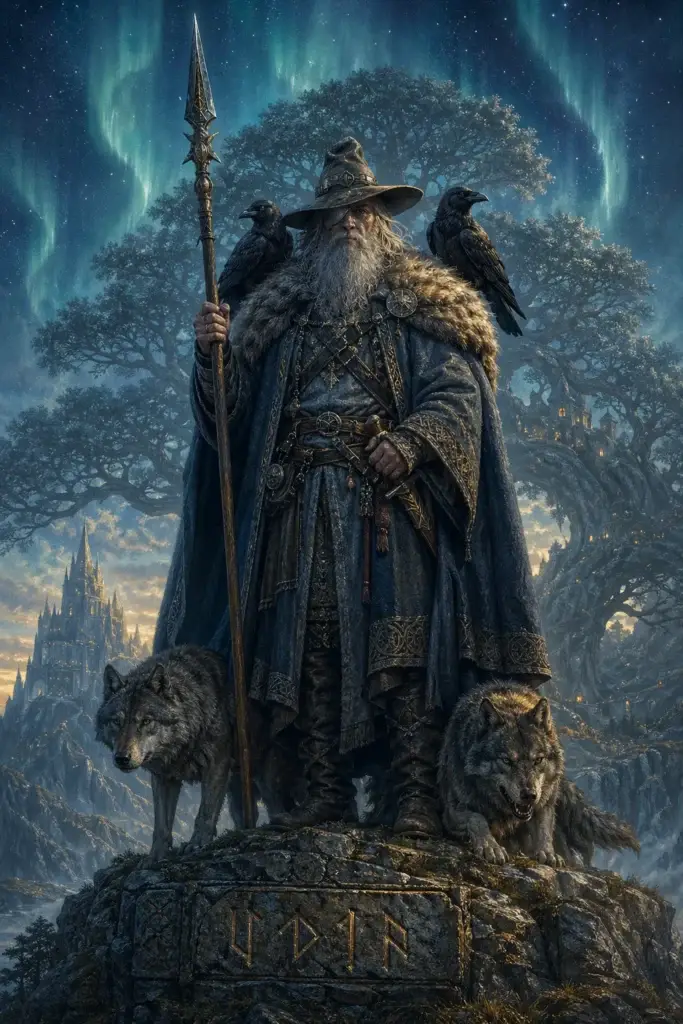
Odin is depicted in literature and pictorial tradition as a one-eyed old man with a long beard. He wears a wide flowing blue or grey cloak and a broad-brimmed hat (Síðhöttr), which partly conceals his missing eye and his face.
He rides the eight-legged horse Sleipnir (Old Norse sleipnir “the gliding one”), which is faster than any other animal and also gallops between the worlds.
At his side he carries the spear Gungnir (Old Norse gungnir “the swaying one”), which never misses its mark. Two ravens, Hugin and Munin (Old Norse huginn “thought” and muninn “memory”), sit on his shoulders and make daily flights across the realm of the Nine Worlds in order to report everything to him.
Two wolves, Geri and Freki (Old Norse geri “the greedy one” and freki “the ravenous one”), accompany him; Odin himself rarely eats, but lives on wine alone (Æsir nature).
Nature and activity
Odin is not the creator of the world, but the one who pervades and transforms it. He is the god of ecstasy, of martial frenzy (berserkergang), of shamanic trance and of skaldic poetry.
His hallmark is self-sacrifice: he hung himself for nine nights on the world tree Yggdrasil, pierced by a spear, in order to win the runes, the ancient writing and magical system.
He sacrificed his right eye to Mimir’s well to drink a draught of its wisdom. His sphere of power encompasses poetry, war (not ordering rule like Zeus, but ecstatic battle frenzy), death and magic.
In contrast to Thor (god of thunder, ordering god of the peasants) or Tyr (god of law and oath), Odin represents transgression: the supernatural, the shaman, magic.
Profile: Odin
The most important aspects of Odin at a glance. The table summarises origin, function, appearance, veneration, symbols and parallels.
Son of Borr and the giantess Bestla. Brother of Vili and Vé. After the creation of the world from the corpse of the primordial giant Ymir, he founded the realm of Asgard together with his brothers, established the order of the Nine Worlds and determined fate and the course of things.
His descent is hybrid: god and giant at once, which underlines his nature as a figure of transgression.
Lord of ecstasy, poetry and magic. God of war in its ecstatic, not ordering, form. Psychopompos and ruler over battle and the fallen, whom he takes to Valhalla. Forefather of the skalds and master of the runes. Unlike other high gods, not primarily an orderer, but a transformer and transgressor.
One-eyed old man with a long beard, wide blue or grey cloak, broad-brimmed hat. Rides Sleipnir (eight-legged horse). Carries Gungnir (magical spear). Hugin and Munin (ravens of thought and memory) on his shoulders. Two wolves, Geri and Freki, as companions.
Odin's veneration
Main cult sites: Uppsala (Sweden, alongside Freyr and Freyja), Lejre (Denmark, seat of the Danish royal houses). Odin was venerated primarily by warriors, skalds and artists, less by peasants and craftsmen (who tended to venerate Thor). Oaths, especially war oaths, were sworn in Odin’s name.
Human sacrifices (hanging) were associated with the Odin cult; captives were sacrificed by hanging in order to gain Odin’s blessing. The so-called sacrificial bogs (for example in Denmark and Northern Germany) contain traces of such practices.
Odin's symbols
Spear Gungnir (which never misses its mark), ravens Hugin and Munin (thought and memory), wolves Geri and Freki, eight-legged horse Sleipnir, runes (especially Wunjo, Ansuz, Dagaz), the gallows (on account of the self-sacrifice), the eye (on account of the offering at Mimir’s well).
Mercurius (Rome, interpretatio romana), Veles (Slavic, magician and psychopompos), Hermes (Greece, psychopompos and sorcerer, functionally), Tyr (Germanic, originally high god, later supplanted by Odin), Loki (Germanic, transgressive, sorcerer, but antagonistic), shamanic high gods in Finno-Ugric and Siberian cultures.
The connection to Roman and Slavic figures underlines that Odin is a broadly universal Nordic manifestation of an Indo-European transgressor figure, not of the orderer model (Zeus, Iuppiter, Dyaus Pita, Perun).
Veneration in everyday life
Odin was not the god of the broad population or of domestic peace; he was the god of warriors, skalds and magicians.
In everyday life his veneration was expressed less in family offerings than in oath formulas at war oaths and oaths of honour, in skaldic invocations before composing poetry, and in practices of ecstatic induction (whether martial or ritual).
For warriors, especially leaders and elite warriors (berserkers), Odin was the patron. He bestowed the berserkergang, an ecstatic martial frenzy in which the warrior overcomes all pain and fear of death.
His veneration was therefore practical and dangerous: not consoling like the household cult of Hestia/Vesta, but transgressive and empowering. At important decisions, particularly before wars, before sea voyages or before magical undertakings, offerings to Odin were customary, often in combination with Thor (protection) or Tyr (oath-keeping).
Artists and skalds, that is, high-ranking poets and musicians, also venerated Odin as their patron.
Odin, parallels in other cultures
Roman tradition
Mercurius, not because of functional similarity (Hermes/Mercurius are primarily messenger gods), but because of the Roman habit of the interpretatio romana; Tacitus equates Wodan with Mercurius, probably because of the shared role as a god of travel and of speech (Mercurius = god of trade and rhetoric, Odin = god of skalds and runes).
This identification is culturally superficial and shows less genuine functional kinship than the chess game of Roman syncretism.
Vedic and Hindu tradition: no direct parallel in the Vedic pantheon. The idea of a high deity acquiring wisdom through self-sacrifice does, however, recall shamanic motifs in Indo-European religions. Possible functional parallels to Rudra/Shiva (transgressive god, sorcerer, ecstatic) are speculative.
Slavic tradition
Veles (Volos), god of magic, the underworld, herds and prosperity, shares with Odin the transgressive nature and the psychopompos function. Both are magician gods, not orderers. Veles, however, is connected primarily with the underworld and the dead, Odin with ecstasy and poetry.
Germanic parallels: Tyr (Tiu, Ziu), originally an Indo-European high god (related to Zeus, Iuppiter, Dyaus Pita through the root *dyeus). In the course of early Germanic history Tyr was “supplanted” or “replaced” by Odin as high god, but retained the functions of the god of oaths and guardian of law.
This succession is culturally and historically significant and shows how a society’s shift in values is expressed in its deity.
The motif of self-sacrifice
A characteristic feature of Odin is his willingness to sacrifice himself in order to gain wisdom and power. According to the Edda he hung for nine nights on the world tree Yggdrasil, pierced by his own spear, without food and drink, until the runes were revealed to him.
He also sacrificed his right eye to the well of the giant Mimir in order to drink a draught of the well water that grants wisdom. This motif distinguishes Odin fundamentally from other Indo-European high gods: while Zeus, Iuppiter or Perun acquire power through victory or order, Odin acquires it through renunciation and transgression.
The acquisition of the runes: Odin's self-sacrifice on the world tree
One of the best-known episodes of the Odin myth is his self-sacrifice for the acquisition of the runes, transmitted in stanzas 138 to 145 of the Eddic poem Hávamál (Sayings of the High One).
Odin himself reports there that he hung for nine nights on the windy tree, wounded by the spear, consecrated to himself, given to himself.
The tree is in all probability the world ash Yggdrasil, whose name can be interpreted as Odin’s steed, with the gallows poetically counted as the horse of the hanged.
Without bread or mead, Odin looked down, seized the runes with a cry and fell back. In the same context he reports how he received nine mighty magical songs from his maternal kinsman Bölthorn and a draught of the precious mead.
The comparative study of religion has discussed this passage intensively. Some researchers see in it an old initiation rite, comparable with shamanic practices in which the seeker undergoes a symbolic death in order to attain hidden knowledge.
Others emphasise the literary character of the text and warn against premature shamanic interpretations. Undisputed is that the episode portrays Odin as the god of knowledge won through suffering, who is willing to sacrifice himself in order to gain power over language, magic and hidden connections.
The mead of poetry: Odin as thief of inspiration
The most detailed narrative on the origin of poetry is preserved by Snorri Sturluson in the Skáldskaparmál, the second part of his Edda. It begins with the being Kvasir, who arose from the spittle of the reconciled Æsir and Vanir and could answer all questions.
Two dwarves slew Kvasir and mixed his blood with honey into a mead which conferred on anyone who drank of it the gift of poetry and wisdom.
Through several stations this mead came into the possession of the giant Suttung, who had it guarded inside the mountain Hnitbjörg by his daughter Gunnlöd. Odin set out under the alias Bölverk in order to obtain the mead.
With the help of the drill Rati he bored through the rock, transformed himself into a snake, crawled through and spent three nights with Gunnlöd, who in return granted him three draughts.
In three gulps Odin emptied all three vessels, transformed himself into an eagle and fled to Asgard, where he spat the mead into vessels.
This narrative also explains why poetry can be paraphrased in Old Norse as Odin’s booty or Kvasir’s blood. Researchers have pointed to structural similarities with the Indian Soma myth, in which a divine intoxicating drink is likewise stolen and an eagle becomes the bearer.
Whether a common Indo-European heritage underlies this remains controversial, yet the parallel is striking enough to be treated repeatedly in comparative mythology.
Wodan in the continental sources and the long beard
Odin is known not only from the Icelandic sources of the high Middle Ages, but also under the continental Germanic name Wodan or Woden from considerably older witnesses.
The Roman historian Tacitus mentions in the Germania around 98 AD a god whom the Germanic peoples venerated most highly and whom he identifies with Mercurius, which research predominantly takes to refer to Wodan.
From the 8th century comes the Second Merseburg Charm, one of the few surviving pagan texts in Old High German, in which Wodan heals a sprained horse’s foot through incantation.
The Lombard historian Paulus Diaconus transmits the story of how Wodan helped the Lombards to their name: his wife Frea placed the women of the tribe with their hair combed over their faces in the spot where Wodan would look upon waking, so that he addressed them as long-bearded ones.
The name itself, Proto-Germanic roughly Wōdanaz, belongs to a semantic field denoting rage, frenzy and ecstasy; Gothic wods means “possessed”. Adam of Bremen formulated in the 11th century the famous gloss Wodan, id est furor, “Wodan, that is, frenzy”.
This linguistic anchoring shows that the ecstatic, raging trait of Odin is not a late literary construct but was deeply embedded in the conception of the god. The English weekday Wednesday and the German Wuotanstag preserve the name to this day.
Odin and the Wild Hunt: afterlife in folk tradition
After Christianisation Odin did not vanish entirely, but lived on in folk conceptions, especially in the motif of the Wild Hunt. Across wide parts of the Germanic-speaking region, folk tradition knew of a nocturnal spectral procession that raced through the skies especially in the dark season, led by a demonic figure.
In Scandinavia and parts of Northern Germany this leader was in some places identified with Odin or a name derived from it. In the 19th century Jacob Grimm collected numerous such records in his Deutsche Mythologie and saw in them a survival of the pagan storm god.
More recent research is more cautious: the Wild Hunt is a complex bundle of folkloristic conceptions into which various figures entered, and not every regional manifestation can be traced directly to Odin.
Nevertheless the motif fits Odin’s nature well. He is the god of fallen warriors, the leader of a host of the dead, who rides through the air on his eight-legged steed Sleipnir. The ecstatic, storm-like character already inherent in the name finds a post-Christian form in the raging spectral host.
In the Romantic period and later in Richard Wagner’s Ring of the Nibelung, Odin became, as Wotan, a central cultural figure, which shaped his reception into modern fantasy literature and popular culture while at the same time often detaching him from the historical tradition.
The many names of Odin and their meaning
Few deities in the history of world religions bear as many epithets as Odin. The Eddic poem Grímnismál and Snorri’s Gylfaginning transmit more than 150 different designations, and skaldic poetry knows still more.
This abundance of names is not mere poetic ornament, but the expression of a theological conception: Odin takes on different forms and roles, and each name designates one aspect of his being.
Many epithets refer to his outward appearance and his disguises. Hárbarðr (Grey-beard), Síðhöttr (Broad-hat), Grímnir (the Masked One) designate him as a wandering, veiled god who appears one-eyed because he gave his eye for a draught from Mímir’s well.
Other names concern his functions: Valföðr (Father of the Fallen), Sigföðr (Father of Victory), Galdrsföðr (Father of the Magical Songs).
Yet other names tie in with specific myths. Bölverkr (Evil-doer) is the alias used in the theft of the mead of poetry, Báleygr (Flame-eye) refers to his gaze. Research interprets this multitude of names as a mirror of Odin’s character as god of transformation, cunning and hidden knowledge.
Unlike a god with a clearly delimited sphere of responsibility, Odin is hard to pin down, and the names are the linguistic means by which the Old Norse tradition expressed this multi-layered quality. For skaldic poetry they at the same time provided an inexhaustible reservoir of paraphrases.
Odin in cult: human sacrifices and the question of archaeological traces
The literary sources repeatedly connect Odin with human sacrifices, especially with killing by hanging and spear thrust. This form mirrors his own self-sacrifice on the tree; the sacrificed one dies, as it were, the death of the god.
In the 11th century Adam of Bremen describes the great sacrificial feast at the temple of Uppsala, at which humans and animals are said to have been hanged in a sacred grove.
The literary tradition knows several narratives in which kings are consecrated to Odin and sacrificed by hanging or spear, for example in the Ynglinga saga and in the sagas. How reliably these reports reflect actual cult is controversial, since they stem from Christian times and pursue, in part, polemical aims.
Archaeology provides a differentiated picture. Bog bodies from the Iron Age, for example from Northern Germany and Denmark, show traces of hanging or strangulation and are sometimes interpreted as offerings, but an unambiguous assignment to a particular god is not methodologically possible.
Finds of weapons and spears in bogs and at offering sites fit Odin’s connection with the spear Gungnir and with the custom of consecrating the enemy host to the god by means of a spear cast.
On the whole the archaeological findings confirm that human and weapon sacrifices existed in the Germanic region, without it being possible to quantify Odin’s share precisely. Research here works with probabilities, not certainties.