The Wild Man between forest, coat of arms and carnival
By Ralf Ittermann · last reviewed on
The Wild Man is a spirit of European tradition.
The hairy figure of the wilderness in legend, coat of arms and custom.
The Wild Man, called Woodwose or Wodewose in England, is the hairy human figure of medieval Europe: half forest being, half counter-image of civilised man. As the Wild Man he appears in church art and heraldry as well as in legends and living carnival customs.
Unlike demons, he is not a deliberately harmful power but the embodiment of untamed wilderness; the danger lies in his unpredictability and physical strength, not in harmful magic.
Type: Hairy forest being and counter-image of civilised man
Origin: Central Europe, the British Isles, the Alpine region
Texts: Visual art and literature from the 12th to the 16th century, legends and customs continuing to the present
Period: High Middle Ages to today
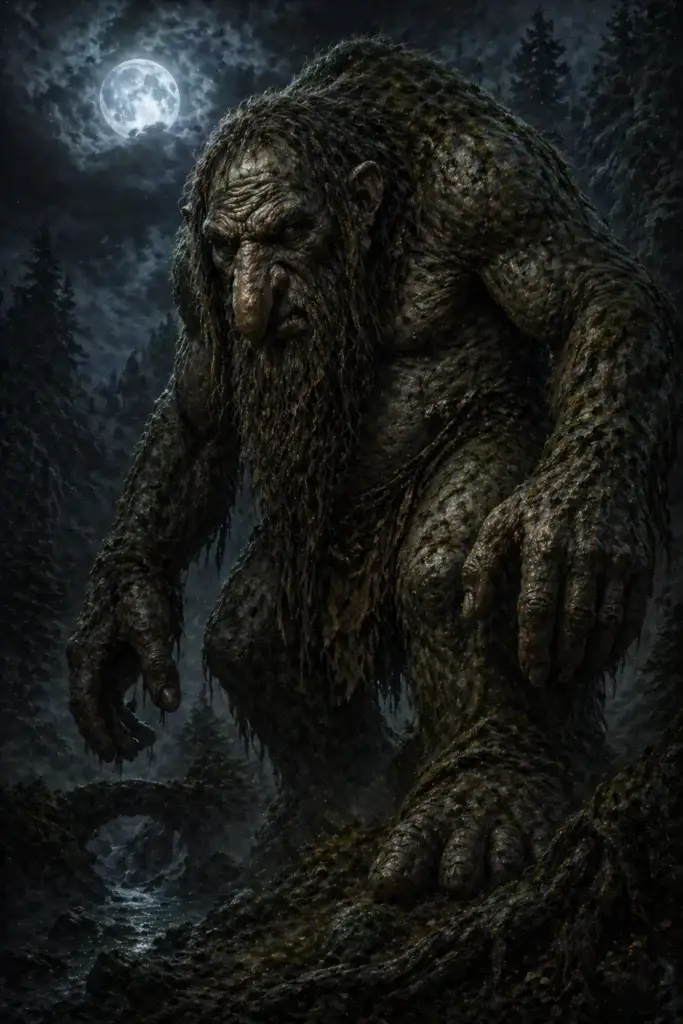
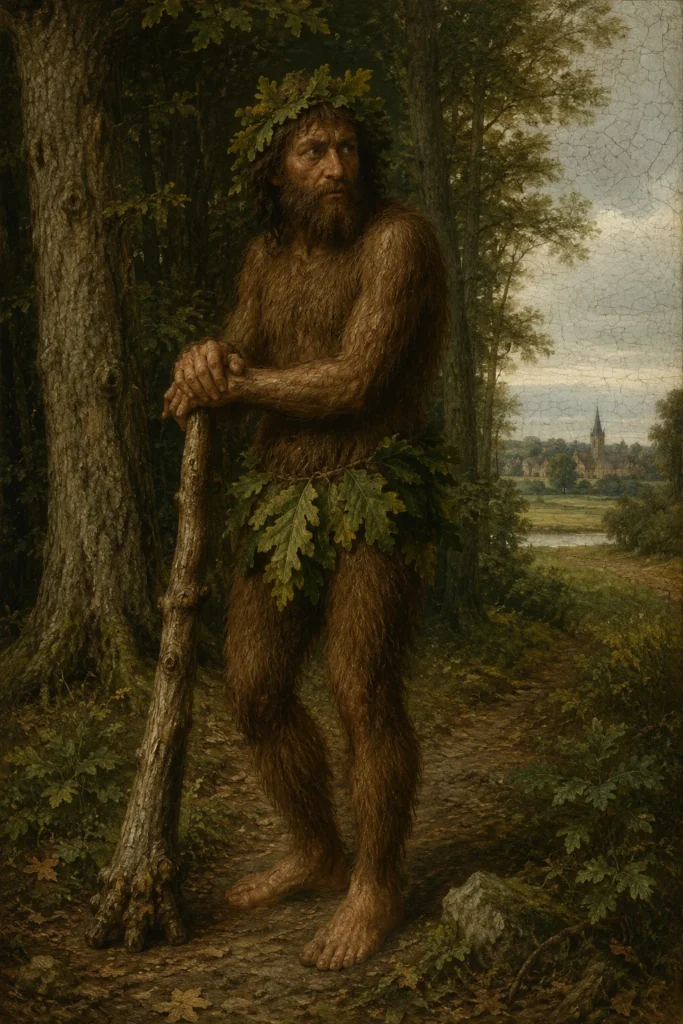
Appearance: human-sized figure covered in hair from head to foot, with a leaf loincloth and club
Historical Classification
Period of the Texts
Since the 12th century the Wild Man has appeared continuously in European visual art; legends and customs carry the figure into the present.
Area of Diffusion
Central Europe, the British Isles and the Alpine region; in the late Middle Ages the figure is omnipresent on capitals, on tapestries, in printmaking and in heraldry.
Sources
Visual sources, heraldry, custom and folk legends; the standard study was presented by Richard Bernheimer in 1952, and the body of images was catalogued by Timothy Husband in 1980.
Name and variants
German and English: Wilder Mann, in English Woodwose or Wodewose. Since the late Middle Ages, wild women and entire wild families appear alongside him; as the inn name Zum Wilden Mann, the figure became a familiar house sign.
Description
Appearance
The distinguishing feature is complete bodily hair, with the face, hands and feet left bare; added to this are a leaf wreath and leaf loincloth, along with a club or an uprooted young tree as a weapon. In the customary form, moss or straw costumes predominate, completely covering the wearer.
Effect
The legends portray the Wild Man ambivalently. He can frighten, scatter livestock and, in older tales, abduct people; more common, however, is the motif of the knowing wild man: if given hospitality or captured, he reveals weather rules and other advice and is then released again. In custom he serves as the embodiment of winter or of the wilderness, which is bound and driven out or symbolically killed. The sources say nothing of deliberate malice.
Profile: Wild Man
The key aspects of the hairy forest being at a glance.
A figure of image and custom in medieval Europe, drawn from ancient forest beings, the biblical image of Nebuchadnezzar and the tales of forest madness.
Hunters, shepherds and forest travellers in the legends; during customary periods such as carnival, the wilderness is symbolically brought into the village and then driven out again.
A figure covered in hair from head to foot, with a leaf wreath, leaf loincloth and club; in heraldry a shield-bearer, among others in the Danish royal coat of arms and the Prussian coat of arms.
Counter-image of civilisation and guardian figure: read theologically as distance from God, and in folk tradition as a figure of strength, closeness to nature and weather knowledge.
Courtesy and hospitality in the legends, binding and driving out in the yearly cycle of customs; tradition knows no special protective means against him.
From capital to Bal des Ardents: the career of an image figure
Since the 12th century, the Wild Man has appeared consistently in European visual art as a fully hair-covered figure carrying a club. His roots are manifold: ancient forest beings such as Silvanus and the satyr circle had an influence, as did the biblical image of Nebuchadnezzar turned beast and the narratives of forest madness, such as Merlin as a wild man of the woods in Geoffrey of Monmouth’s Vita Merlini or the feral Iwein of Arthurian epic.
In the late Middle Ages the figure becomes ubiquitous: on capitals and choir stalls, on tapestries and in printmaking, as a shield-bearer in heraldry, and in carnival plays in which a Wild Man is captured and driven out. The practice of costuming is historically documented in 1393 at the Parisian Bal des Ardents, when King Charles VI and noblemen appeared in wild-man costumes and several dancers were burned. The folk legends of the Alpine region tell of wild men and wild people with knowledge of weather and herbs into the 19th century.
Afterlife and interpretation
Schongauer and Dürer made wild people a popular subject of printmaking; heraldry still features them today. The custom figures remain alive: the Wilde-Mändle dance in Oberstdorf, performed only every five years, and the Wild Maa of the Basel Vogel Gryff. The photographer Charles Fréger documented European wild-people customs from Portugal to the Balkans in the volume Wilder Mann (2012). In popular culture, wild-man motifs echo in figures such as Bigfoot and the Yeti, which nonetheless form their own narrative traditions.
From a religious-studies perspective, Bernheimer read the Wild Man as a figure of projection: an image of repressed drives and a counter-model to the courtly-Christian order. He is a threshold figure between nature and culture, whose significance lies more in the realm of image and custom than in belief in a real being. The Mannhardt school interpreted the custom plays as vegetation rites; more recent research is cautious about such continuity theses and understands the carnival figures as historically evolved stagings of wildness that make social order visible through its opposite.
Binding, driving out, hosting: how to deal with him
Well documented are above all customs of banishment and reconciliation: in carnival and calendar customs the Wild Man is caught, bound and led out of the village, symbolically taming the wilderness. The legends recommend courtesy and hospitality towards wild people; whoever mocks them or abuses their trust loses their advice and help. Alongside this stand the general Christian protective signs of legend, prayer and the sign of the cross, when an encounter in the forest turns uncanny. Tradition knows no particular means of defence against the Wild Man, because he was not regarded as a harmful being.
Wild people from Enkidu to the Basajaun
The earliest literary wild-man figure is Enkidu in the Epic of Gilgamesh, who lives hairy among animals before becoming human; the background is explained on the culture page Mesopotamia. In visual terms, the Wild Man owes much to the ancient circle around Satyr, Faun and Silvanus. As a territorial lord of the forest he corresponds to the Slavic Leshy, and as a mountain-forest being to the Japanese Tengu; the Basque Basajaun shares his hairiness and culture-bringer traits.
Frequently asked questions about the Wild Man
Was the Wild Man a demon?
No. Although medieval theology used him as an image of distance from God, in legend and custom he is not a harmful spirit but the embodiment of untamed nature. He does not cause harm deliberately, but frightens through his strangeness and physical strength.
Where can one encounter the Wild Man today?
In coats of arms and inn names, as well as in living customs such as the Oberstdorf Wilde-Mändle dance or the Wild Maa of the Basel Vogel Gryff. In museums, he is widely represented in the printmaking and tapestry art of the late Middle Ages.
Does the Wild Man have anything to do with Bigfoot?
Both belong to the worldwide narrative type of the hairy wild man, but are independent traditions. The European Wild Man is a figure of image and custom from the Middle Ages, while Bigfoot is a modern North American narrative with cryptozoological claims.
Further links
Further reading:
- Germanic – all beings of Germanic tradition
- Schrat, Moss People, Wood Maiden – the wild people of the German forest
- Basajaun – the hairy forest lord of the Basques
- Iron, Bells, Salt, Protective Circle – traditional protective means
- Protection Compass – protective means at a glance
Literature (selection)
Further standard works in the bibliography.
In English heraldry the Woodwose gained significance as a shield-bearer, and so the type of the Wild Man links legend, visual art and living custom: a figure against whose wild counter-image Europe has measured its own order since the Middle Ages.