Sennentuntschi, the revenge of the lonely alpine hut
By Ralf Ittermann · last reviewed on
The Sennentuntschi is a demon of alpine tradition.
The animated herdsman’s doll that punishes its creators.
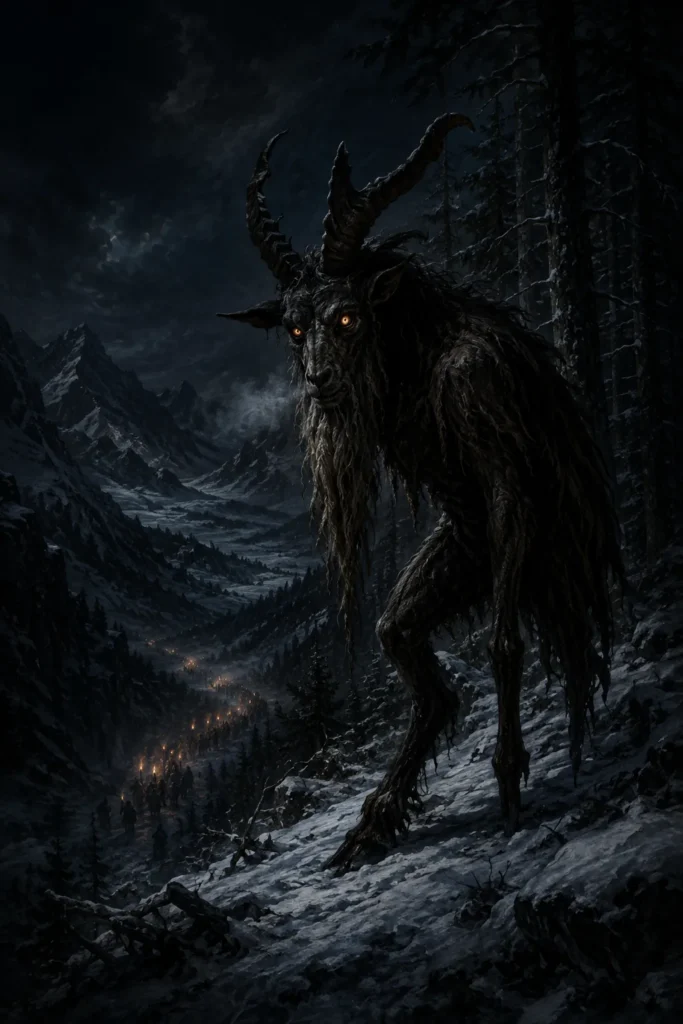
The Sennentuntschi is a legendary figure of the Swiss Alps: a female doll made by lonely herdsmen from straw, wood and cloth, which comes to life shortly before the end of the alpine summer season. What begins as a pastime during the lonely alpine season ends, in most versions, in bloody retribution against those who made and mistreated it.
The legendary motif spans the entire German-speaking Alpine region: from the Bernese Alps through Uri and Graubünden to the St Gallen highlands, to Vorarlberg, Tyrol and Carinthia. A single surviving object, a wooden doll acquired in 1978 in the Calanca valley in Graubünden, has been kept at the Rhaetian Museum in Chur since 1986.
Type: Animated herdsman’s doll, vengeful figure of alpine legend
Origin: orally transmitted, documented in folklore studies since the 19th century
Texts: regional legend collections of the 19th century
Period: over the course of the alpine summer season, culminating on the day of the descent from the alp
Appearance: a female doll made of wood, straw and clothing that comes to life

Context of tradition
Period of the Texts
The legendary motif is orally transmitted and has been documented in folklore studies since the 19th century, among others in the legend collections of Lütolf and Rochholz.
Area of Diffusion
The legend is widespread in the Bernese Alps, in Uri, Graubünden and the St Gallen highlands as well as in Vorarlberg, Tyrol and Carinthia, with further variants in Upper Valais, Styria and Upper Bavaria.
Sources
The source material rests on regional legend collections of the 19th century as well as on a single surviving object at the Rhaetian Museum in Chur, whose original purpose, according to the museum’s management, is not established with certainty.
Name and variants
Designation: The name is made up of Senn, the term for the alpine herdsman, and Tuntschi, the term used in the legend text for the doll itself. Locations include Weissenboden (Schächental valley) and Urseren valley.
Appearance and behaviour
Appearance
The Tuntschi is made from the simplest materials of the alpine hut: wood, straw, scraps of fabric and old clothing give it a roughly human, female shape. This origin in mere work material makes its transformation into an acting being especially striking.
Effect
After being brought to life in a kind of baptism ceremony at the end of the alpine season, the Tuntschi behaves increasingly independently: it demands food and attention and no longer submits to the herdsmen. According to the legend, when the herd is driven down from the alp, it demands that one of the men stay behind with it; this master herdsman is killed, in many versions in a particularly cruel manner.
Profile: Sennentuntschi
The key aspects of this vengeful figure at a glance.
A legend motif found throughout the German-speaking Alpine region, from Switzerland to Tyrol and Carinthia, documented in folklore studies since the 19th century.
Solitary herdsmen on remote alpine pastures during the months-long grazing season, without human company.
A female doll made of wood, straw and clothing: a wooden head mounted on a manure fork, yellow ribbons as hair, straw bales as breasts.
Revenge on the herdsmen who created and mistreated the doll; killing of the master herdsman left behind when the herd is driven down from the alp.
No dedicated protective means has been passed down; the central rule is to refrain from making the doll in the first place, in some places supplemented by a clerical blessing.
The Golem of Jewish tradition as an artificially animated figure that escapes control.
From pastime to legend of revenge
The legend motif is widespread throughout the German-speaking Alpine region, from the Bernese Alps through Uri, Graubünden and the St. Gallen Oberland to Liechtenstein, Vorarlberg, Tyrol and Carinthia, with further variants in Upper Valais, Styria and Upper Bavaria. Fixed locations of the tale include the Weissenboden below the Kinzig Pass in the Schächental and the Urserental.
In the core plot, solitary herdsmen, out of boredom during the lonely alpine summer, fashion a doll: the head from a piece of wood mounted on a manure fork, painted with eyes, nose and a red mouth, yellow ribbons as hair, straw bales as breasts. The doll is treated like a person, led to dance, seated at the table and left to spend the night in the hut. During a kind of baptism ceremony at the end of the alpine season, in which the doll is drenched with liquid manure, it opens its eyes, according to the legend, and begins to act.
Legacy and classification
The motif has been taken up artistically several times in the 20th and 21st centuries: Hansjörg Schneider’s dialect play from 1972 triggered a complaint for blasphemy after its television broadcast in 1981, Jost Meier set the material as an opera, and Michael Steiner’s 2010 feature film Sennentuntschi brought the legend to a wide audience. Marie Luise Kaschnitz also took up the motif literarily in 1966 in the story Der Tunsch.
From a religious-studies perspective, the Sennentuntschi can be read as an atonement legend: the punishment inflicted on the tormented herdsman is interpreted in research as a religious addition meant to retroactively atone for the transgression of creation and the treatment of the doll. At the same time, the tale reflects the real isolation of alpine herdsmen during the summer months. A small wooden doll in the Rätisches Museum Chur is considered the only surviving object of this kind; according to the museum’s management, what it was actually used for is not confirmed. The proximity to the ancient Pygmalion motif of the animated statue is discussed in research, though no direct derivation can be proven.
Abstention as the only recorded form of protection
Unlike many other legendary figures, the tradition surrounding the Sennentuntschi records hardly any dedicated protective means of its own, since the danger arises from the herdsmen’s own actions rather than from an outside source. The most important recorded rule is therefore abstention itself: not to shape a doll in human form and not to treat it like a living person. In some versions it is reported that a priest summoned in time, or a church blessing, could still have averted the disaster, which brings the legend close to general notions of penance.
The Golem and related alpine beings
A structural parallel is offered by the Golem of Jewish tradition, a figure shaped from clay and artificially animated, which escapes the control of its creator. Both tales address the fear of a self-created being that turns against its maker, though the Golem is usually conceived as a servant, while the Tuntschi, from the outset, is conceived as a mistreated creature. In the alpine world of legend, the Salige Frau and the Fänggen stand alongside it as further female nature beings, while the Kasermandl and the Venedigermandl, as male alpine spirits, complete the legendary landscape of the alp.
Frequently asked questions about the Sennentuntschi
Does the Sennentuntschi really exist?
The Rätisches Museum Chur holds a small wooden doll, acquired in 1978 in the Calanca Valley in Graubünden, considered the only known real object of this kind. According to the museum’s management, its original use is not confirmed.
Why is the doll shaped into a woman?
The legend reflects the months-long isolation of herdsmen on the alp and the absence of female company during the summer season. The animation of the doll and its subsequent revenge can be read as a narrative processing of this isolation.
Is the legend the same in all regions?
No, the basic structure of doll, animation and revenge is preserved, but details such as location, names and outcome differ between the valleys. What most versions have in common is the end of the alpine season as the turning point.
Further links
Further reading:
- Alpine region – all beings of the alpine world of legend
- Golem, Salige Frau – related animated and female legendary beings
- Kasermandl, Venedigermandl – further alpine spirits of the region
- Holy water, Protective pouch, House protection – traditional protective means
- Protection Compass – protective means at a glance
Literature (selection)
Further standard works in the bibliography.
As a Sennentuntschi alpine legend, this story tells of an animated herdsman’s doll from Switzerland that became one of the most striking cautionary tales of the Alpine region: no outside demon haunts the alpine hut, but a creature that the solitary herdsmen created themselves.