Jabmiidaibmu - Land of the Dead and Subterranean Realm of the Deceased in the Sámi Tradition
By Ralf Ittermann · last reviewed on
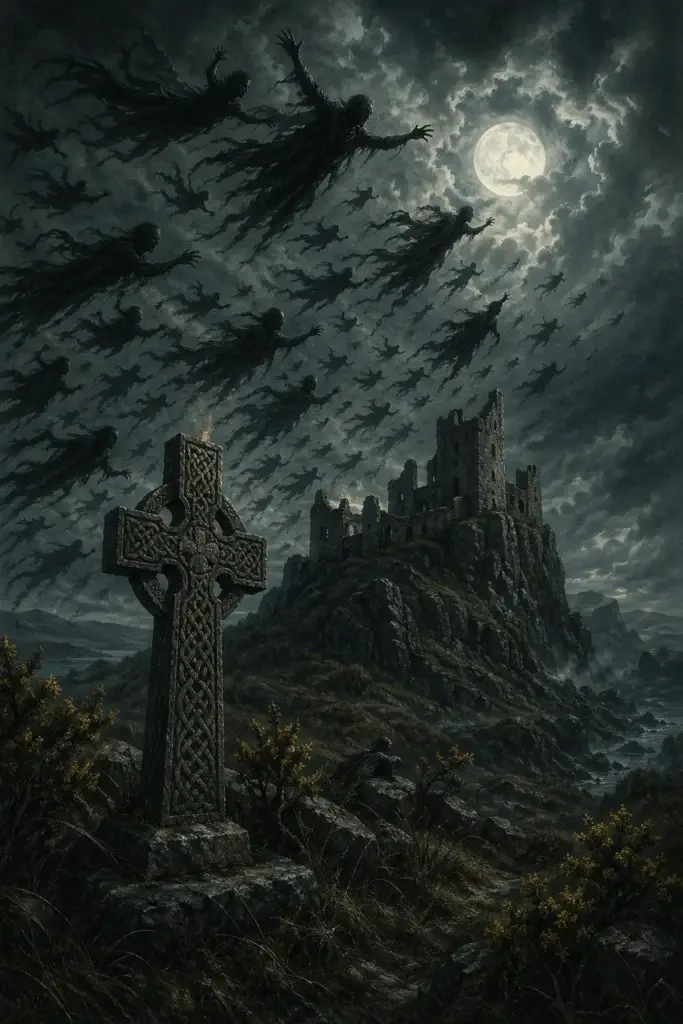
Jabmiidaibmu, also written Jamiaibmu, Jábme-aibmu or Jamijmo, is the land of the dead of the pre-Christian Sámi religion. It lies beneath the earth and is the dwelling place of the deceased. In terms of religious studies, it belongs to the broad class of subterranean underworlds found in circumpolar and Northern European mythologies.

Profile: Jabmiidaibmu
Jabmiidaibmu: the most important aspects at a glance. The following fields summarise origin, effect, appearance, function, protection and parallels.
Jabmiidaibmu, also written Jamiaibmu, Jábme-aibmu or Jamijmo, is the land of the dead of the pre-Christian Sami religion. The name is composed of jábmi for dead person and áibmu for world or realm. The realm lies under the earth.
Jabmiidaibmu receives all the deceased, regardless of how they lived. The dead go on living there in a muted form and have their tools, their families and their reindeer herds.
Jabmiidaibmu is described as a cold, dark, shadowy place. The deceased live there as a mirror image of their earthly existence with muted vitality. Their identity is preserved, only the intensity is reduced.
A noaidi could travel into the world of the dead in trance to question the dead in crises, illness or family matters. Illness was partly interpreted as the dead calling a living person to them. The noaidi then offered a substitute gift, often an animal.
At the transition into the world of the dead stand guardians or keepers who examine the soul, in some sources an Akka, in others a male spirit. The deceased were buried with tools, jewellery and sometimes slaughtered reindeer that they would need in the world of the dead.
Structurally comparable are the Inuit Adlivun, kept by Anguta, the Greek underworld Hades, the Old Norse Helheim, kept by Hel, the Mesopotamian Kurnugia, the Nenets Ngo’-jelba and the Finnish Tuonela, kept by Tuoni. The Tuonela of the Finns is regarded as the closest parallel.
Classification and Brief Profile
Jabmiidaibmu is the subterranean land of the dead of the Sámi tradition. The sources describe it as a cold, shadowy place where the deceased continue to exist, though not in the same form as they did on earth.
The term is composed of jábmi, meaning “dead person,” and áibmu, meaning “world” or “realm.” Jabmiidaibmu thus literally means “world of the dead” or “realm of the dead.” The etymology is linguistically clear and well documented in religious studies.
In terms of religious studies, Jabmiidaibmu belongs to the broad class of subterranean underworlds represented in numerous religions. Structurally comparable examples include the Inuit Adlivun (see Anguta), the Greek underworld Hades, the Old Norse Helheim, and the Mesopotamian Kurnugia.
The realm of the dead known as Jabmiidaibmu has also been examined in recent scholarship using expanded methods that combine ethnographic precision, linguistic source criticism, and comparative perspective.
The Sámi knowledge community is itself now part of this research and critically reassesses older Western interpretations of the realm of the dead where they were shaped by colonial patterns of thought.
As a subterranean realm of the deceased, Jabmiidaibmu fits into the pattern of a circumpolar religious topography that recurs across vast distances. The fact that this structure preserves its basic features across thousands of kilometres is one of the most remarkable findings of comparative religious studies and continues to be discussed to this day.
Name and Etymology
The name Jabmiidaibmu is a linguistically transparent compound. Jábmi or jámet means “dead,” “deceased,” or “departed” in Sámi. Áibmu or aibmu means “world,” “realm,” or “sphere.” The compound is productive in Sámi and belongs to standard terminology.
Etymologically, the root jábmi is related to the Finnish jämä, meaning “remainder” or “last portion,” and belongs to the Finno-Ugric core vocabulary. The depth of this root in the history of religion is considerable and points to an ancient stratum of conceptions of the dead.
Dialectal variants include Jamijmo in Southern Sámi, Jamiaibmu in Ume Sámi, and Jábme-aibmu in Northern Sámi usage. This variety reflects the general dialectal differentiation.
From a sociology-of-religion perspective, one may additionally ask what function the concept of Jabmiidaibmu served within the social order of the traditional Sámi community, for instance in dealing with death, grief, and the relationship to the deceased.
Religious conception and social practice were not separate here but closely interwoven. This interweaving constitutes a distinct field of religious anthropology that has been studied systematically above all by Håkan Rydving.
A further dimension concerns the significance of the land of the dead for Sámi identity politics today. With Sámi self-governance and the international recognition of indigenous rights, the transmitted religious conceptions are once again gaining greater visibility.
How religious scholarship and political recognition intersect in this process constitutes a distinct field to which scholarship has devoted increasing attention in recent years.
Topography and Description
Jabmiidaibmu lies beneath the earth and is not directly accessible. The deceased are guided there after death, and only shamans can travel there in trance in order to see or consult the dead.
In the sources, above all in Schefferus, Leem, and Læstadius, Jabmiidaibmu is described as a cold, dark, shadowy place. The deceased continue to exist there in a weaker form, often as a mirror image of their earthly existence, but with diminished vitality.
From a phenomenology-of-religion perspective, this conception is not a moral tribunal of punishment in the Christian sense. Jabmiidaibmu is not hell but a realm of the dead that receives all the deceased regardless of how they lived. This conception, remote from ethics, is a distinct phenomenon in the phenomenology of religion.
The Path to the Realm of the Dead
The path to the realm of the dead is described in detail in the Sámi sources. The soul of the deceased crosses an icy tundra, crosses a river or a mountain, and finally enters Jabmiidaibmu through a fissure beneath the earth.
At this threshold stand various guardians or wardens who test the soul. In some sources the guardian is an Akka figure, in others a male spirit. This notion of guardians is typical in the phenomenology of religion for transitions into the realm of the dead.
Shamans who traveled to Jabmiidaibmu in trance also had to traverse this path. Concrete descriptions of the shamanic journey to Jabmiidaibmu are detailed in the sources, for example in Schefferus, who records a lengthy account by a noaidi of his trance journey to Jabmiidaibmu.
The Dead in Jabmiidaibmu
The dead live in Jabmiidaibmu in a form that mirrors their earthly existence but is diminished. They retain their tools, their families, their reindeer herds, but everything in a weaker form than on earth.
This conception is a distinct phenomenon in the phenomenology of religion and sets Sámi theology of the dead apart from traditions in which the dead pass into an entirely different form of existence. Among the Sámi, the identity of the deceased is preserved; only the intensity is reduced.
In religious studies, this corresponds to a mirror-image theology of the realm of the dead, attested in many indigenous religions. The structural correspondence with other traditions is itself a distinct finding in the phenomenology of religion.
Burial Rituals and Contact with the Dead
Sámi burial rituals were closely linked to Jabmiidaibmu. The deceased were buried with tools, jewellery, and sometimes slaughtered reindeer that they would need in the land of the dead. This practice of grave goods is documented in detail in the ethnology of religion.
Contact with the dead was possible through the shamans. In cases of crisis, illness, or family matters, a noaidi could journey to Jabmiidaibmu and consult the dead. This practice was a central element of Sámi religion in the ethnology of religion.
The dead could also appear of their own accord, above all as dreams or as spirits that became visible at particular moments. This conception is a distinct phenomenon in the phenomenology of religion and is widespread in many indigenous religions.
Jabmiidaibmu in Circumpolar Comparison
Jabmiidaibmu belongs to the broad class of subterranean realms of the dead that are widespread in circumpolar and Northern European religions. Structurally comparable examples include the Inuit Adlivun (guarded by Anguta), the Old Norse Helheim (guarded by Hel), the Finnish Tuonela (guarded by Tuonen), and the Nenets Ngo’-jelba.
The distinctive feature of Jabmiidaibmu lies in its detailed topographical description and in the elaborate shamanic practice of journeying there. This depth of tradition is independently significant in the phenomenology of religion and makes Sámi theology of the dead a well-accessible case study.
Within the Finno-Ugric tradition, the Finnish Tuonela concept is the closest parallel. The structural kinship is considerable and well documented in the history of religion. This kinship points to an ancient shared stratum.
Mission and Displacement
Christian mission partially reinterpreted Jabmiidaibmu as hell, partially as purgatory, and partially as limbo. This reinterpretation led to considerable theological confusion because the Sámi conception, which stands apart from ethics, could not readily be fitted into the Christian moral schema.
The ritual practice of burial was profoundly altered by the mission. Grave goods were prohibited, and shamanic journeys to the realm of the dead were criminalized. Remnants of the tradition have survived in family practice and in orally transmitted narratives.
In religious studies, this history of mission is a distinct field of research. The postcolonial reappraisal of Sámi theology of the dead has made considerable progress in recent decades and corrects the older missionary-influenced portrayal.
Research and Current State
Research on Jabmiidaibmu is extensive. Håkan Rydving, Juha Pentikäinen, and Anna Lia Berthelsen have studied the theology of the dead systematically and identified the specifically Sámi configuration.
In contemporary Sámi culture, Jabmiidaibmu is present in joik texts, in Sámi literature, and in the visual arts. Writers such as Nils-Aslak Valkeapää have drawn productively on the concept of the realm of the dead.
The scholarly reappraisal of Jabmiidaibmu is ongoing. Concrete research gaps exist in the precise relationship between Jabmiidaibmu and Saivo as a second subterranean world in the Sámi tradition. This doubling of the underworld is independently significant in the phenomenology of religion.
Lexicon Cross-References
Source Situation: Missionary and Folkloric Records
Of Jabmiidaibmu, the ruler of the Sámi realm of the dead Jábmiidáibmu, not a single pre-Christian text written by the Sámi themselves has survived. All knowledge comes second-hand: from the records of Lutheran missionaries of the 17th and early 18th centuries and from later folkloric collections.
The most important early witnesses are the Danish-Norwegian missionary reports, in particular the manuscripts associated with Thomas von Westen’s Missionscollegium, as well as the works of Isaac Olsen and Jens Kildal.
These sources are doubly filtered. First, they come from people who fought the Sámi religion and described it as superstition or devil-worship. Second, many names and terms were written down phonetically, without uniform orthography, which is why the form of the name varies considerably.
Scholars of religion such as Håkan Rydving have pointed out that the seemingly systematic lists of deities found in missionary texts are partly constructions that pressed Sámi conceptions into a familiar schema.
Regional diversity adds further complexity. Sámi culture extends across Norway, Sweden, Finland, and the Kola Peninsula, with several distinct languages. A figure appearing in Southern Sámi sources need not have played the same role in Northern Sámi or Skolt Sámi traditions.
Statements about Jabmiidaibmu should therefore always be accompanied by the question of which region and which recording layer they derive from.
Jábmiidáibmu as a Place: the Realm of the Dead beneath the Earth
In the transmitted conceptions, Jábmiidáibmu is first and foremost a place, a realm of the dead imagined as lying beneath the earth, and only secondarily a personified ruler of that realm.
The Sámi word contains the stem for “the dead” (jábmek) and an element meaning “world” or “realm.” According to the records, the dead led an existence there that resembled earthly life, with reversed or mirrored features.
The relationship between the living and the realm of the dead was not definitively severed. Several sources report that the noaidi, the Sámi ritual specialist, could descend to the dead in trance in order to conduct negotiations, for example in cases of illness.
Illness was partly interpreted as the dead calling a living person to them. The noaidi would then attempt to offer a substitute gift, frequently an animal.
In this context the personified ruler appears. She is the authority with whom negotiations are conducted, the one who accepts or rejects offerings.
Unlike the Christian figure of Death, she is not drawn as unambiguously threatening or punitive; she administers a realm to which every human being is assigned, and she remains indistinct in the sparse sources.
This indistinctness is not a deficiency of the figure but a consequence of the tradition: the missionaries were interested in what they could condemn as idolatry, not in the subtle features of a ruler of the hereafter.
Bibliography (Selection)
- Johannes Schefferus: Lapponia (Frankfurt 1673)
- Knud Leem: Beskrivelse over Finmarkens Lapper (Copenhagen 1767)
- Lars Levi Læstadius: Fragmenter i lappska mythologien (Manuscript ca. 1840)
- Håkan Rydving: The End of Drum-Time (Uppsala 1993)
- Juha Pentikäinen: Saamelaiset (Helsinki 1995)
Related key terms: Jabmiidaibmu Jamiaibmu Jábme-aibmu Sámi land of the dead underworld Noaidi burial rituals.
iWell Guard and Protective Traditions
iWell Guard draws on the cultural-historical tradition of wearable protective objects, in the tradition of the Sámi and many other cultures worldwide. 41 layers, real gold, platinum, silver, made in Germany. 30-day return policy.
Individual experiences may vary. Not a medical product. No healing promises.