Amaterasu, goddess of the Japanese tradition
By Ralf Ittermann · last reviewed on
Solar sovereign, ancestress of the imperial house, soul of Japan. Amaterasu Ōmikami is the central goddess of Japanese Shinto, the incarnation of the sun itself, the supreme Kami of all cults.
She is not merely a celestial body but the legal ancestor of the emperor, which is why her principal sanctuaries are kept under the strictest access.
The Ise shrine, Japan’s holiest site, is dedicated chiefly to her veneration. In the Kojiki myth, Amaterasu hides in a cave, plunging the world into darkness, a striking image of the cosmic dependence on divine light.
Amaterasu is the sun queen of Japan and ancestral mother of the imperial house.
Amaterasu is the goddess of the Japanese tradition and sun queen of the Shinto pantheon.
Overview: Amaterasu
Type: Japanese principal deity, sun goddess and ruler of the heavens (Shinto)
Pantheon: Shinto (highest deity of the Japanese pantheon), identified with Mahavairocana in syncretistic traditions
Function: sun, light, cosmic order, mythical ancestral mother of the Japanese imperial house
Principal attributes: solar disc, sword (Kusanagi), mirror (Yata-no-Kagami), curved jewel (Yasakani-no-Magatama)
Principal cult site: Ise shrine (Mie prefecture, the largest and holiest shrine in Japan)
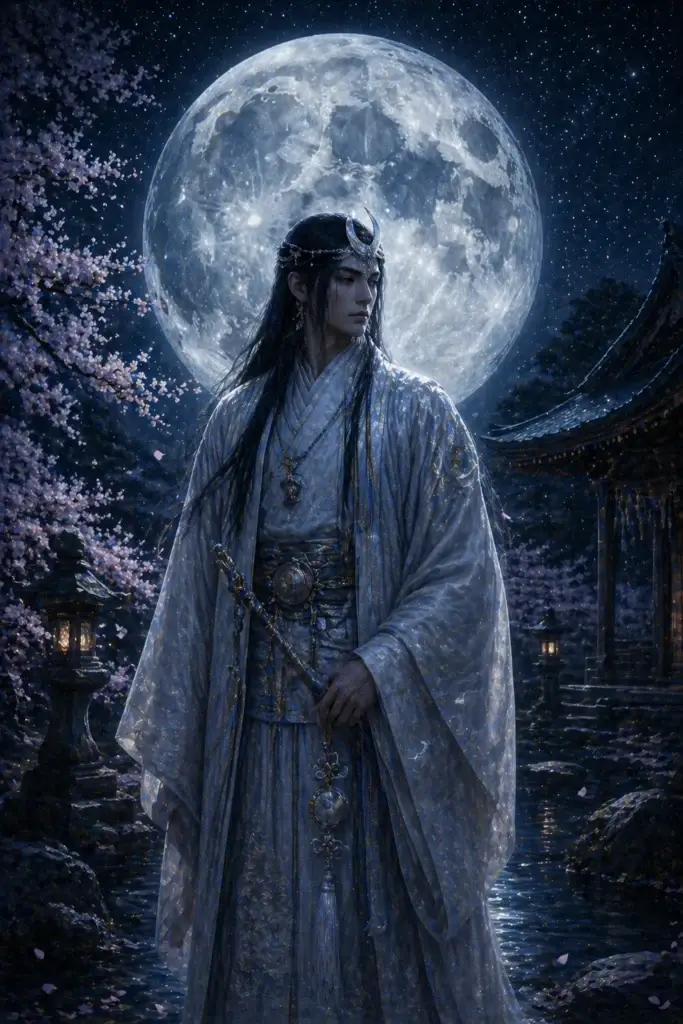
Siblings: Tsukuyomi (moon), Susanoo (storm)
Historical Context
Period of the Texts
Amaterasu is attested in literature from the 8th century CE in the Kojiki (712) and Nihon shoki (720), the two principal sources of Shinto mythology.
Since the early Heian period (9th century), she has been canonized as the highest deity of the Japanese imperial house: the imperial genealogy traces back to her through Amaterasu’s grandson Ninigi-no-Mikoto.
The Ise shrine, probably at its present location since the 7th century CE, is rebuilt completely every twenty years according to ancient tradition (Shikinen Sengu); the most recent such renewal was in 2013, the next in 2033. In Vajrayana Buddhism (Shingon), she has been identified since the 9th century with the cosmic Buddha Mahavairocana (Dainichi Nyorai).
Area of Distribution
Principal cult site: Ise Jingū in Mie prefecture, consisting of the outer shrine Geku (dedicated to the food deity Toyouke) and the inner shrine Naiku (dedicated to Amaterasu). The inner shrine houses the sacred mirror Yata-no-Kagami (one of the three imperial regalia of Japan).
The sanctuary may be entered only by members of the imperial house and selected priests. Beyond this, there are roughly 80,000 shrines in Japan in which Amaterasu is co-venerated (bun-rei of the principal Ise deity). Abroad: shrines in Hawaii and São Paulo.
Source Situation
Central sources: Kojiki (712) and Nihon shoki (720), the two principal source collections of Shinto mythology; Engi-shiki (10th century, cult–ritual regulations for Ise); the Norito (ceremonial invocation texts).
Secondary literature: Aston, Shinto. The Way of the Gods; Breen/Teeuwen (eds.), Shinto in History. Ways of the Kami; Bocking, A Popular Dictionary of Shinto; Breen/Teeuwen, A New History of Shinto; Reader, Religion in Contemporary Japan.
Name and Variants
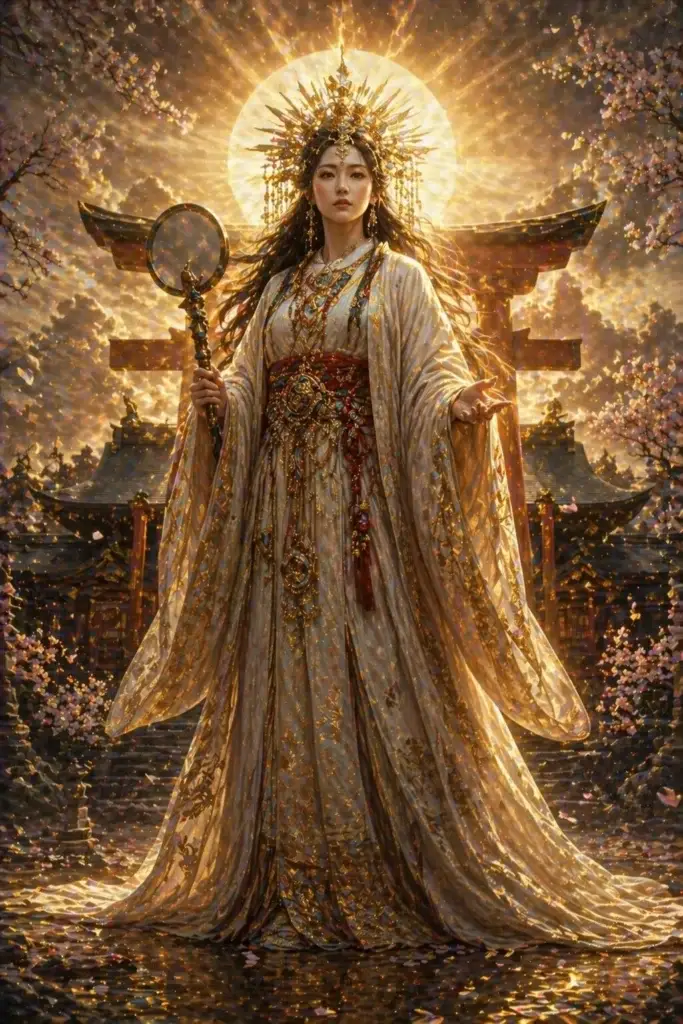
Amaterasu is depicted as a radiant female goddess surrounded by light. She wears celestial robes and is often shown holding a gleaming mirror (Yata-no-Kagami), one of the three imperial treasures, regarded as her body or her symbol of the self.
Abbreviated iconography shows her enthroned, flanked by her brothers Tsukuyomi (moon) and Susanoo (storm). The Ise shrine is pure architecture, not visible from outside, veiled, mysterious. Every 20 years the shrine is rebuilt completely and Amaterasu’s soul is solemnly relocated.
Description
Amaterasu is the supreme Kami, not a member of a pantheon of equal gods but central. Her veneration at the Ise shrine is ritually unique: only certain priestly families may enter the inner sanctuary. The emperor himself functions as a high-priest figure.
The Shinto New Year rests on her gift of light. When, according to the myth, she hid in a cave, the world fell into complete darkness; only through a stratagem did the other Kami draw her out. This is cosmic dependence: without Amaterasu there is no life, no light, no Japan.
Appearance and symbolism
Amaterasu is depicted as a beautiful woman with a radiant presence, often in imperial robes. She is associated with the solar disc (the red circular disc of the Japanese flag). Her sacred symbols are the mirror (Yata-no-Kagami), the sword, and the jewel. She is surrounded by light.
Profile: Amaterasu
The most important aspects of Amaterasu at a glance. The following fields summarize origin, function, appearance, veneration, symbols, and cultural parallels.
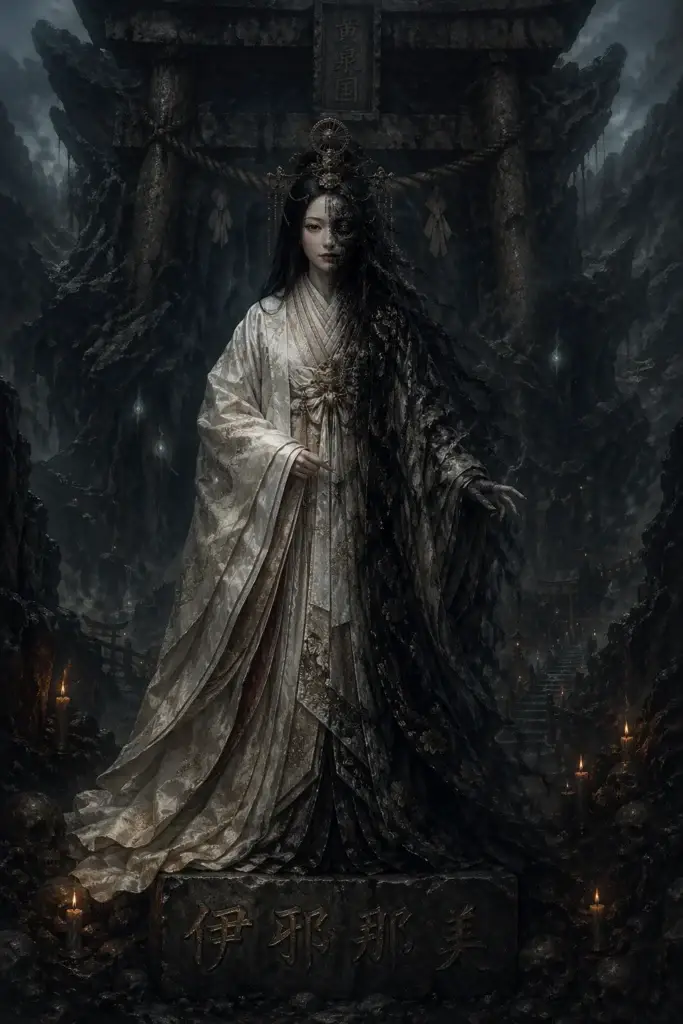
Amaterasu Ōmikami (‘the great deity who illuminates the heavens’) is, according to the main version of the Nihon shoki, the daughter of the creation couple Izanagi and Izanami, but according to the Kojiki she arose from Izanagi’s left eye alone as he purified himself after returning from Yomi (the underworld).
Sister of the moon god Tsukuyomi (from the right eye) and the storm god Susanoo (from the nose). Principal myth: after a brutal quarrel with Susanoo, Amaterasu withdraws into a cave (Ame-no-Iwato), and the world sinks into darkness.
The gods lure her out through an ecstatic dance performance by the goddess Ame-no-Uzume and a mirror in which she sees her own shining face. Mother of the divine line that leads to the Japanese imperial house: her grandson Ninigi-no-Mikoto descends from heaven and brings with him the three imperial regalia (mirror, sword, jewel).
Sun and light goddess, and thus source of life and of the power of sight, a comparatively rare female solar deity in world mythology (unlike the male Mediterranean sun gods). Mythical ancestral mother of the Japanese imperial house: every Tenno (emperor) is regarded as a descendant of Amaterasu.
In modern Japan, despite the separation of religion and state (1947), still a point of identity reference. Patroness of agricultural fertility (through her sunlight). In the Shingon tradition, as Mahavairocana-Dainichi, the cosmic Buddha himself. Not central in modern Shinto sects (e.g., Tenrikyo, Konkokyo); in Tenrikyo, Tenri-Ō-no-Mikoto (Oyagami) is at the center, in Konkokyo Tenchi Kane no Kami.
Amaterasu has no fixed iconographic form; in the orthodox Shinto tradition the making of statues of gods is avoided. Her presence is represented through sacred objects (shintai): in the Naiku, the mirror Yata-no-Kagami.
In religious imagery from the medieval period onward, she is sometimes shown as a solemn young woman in a multilayered court robe with a solar diadem; she is also frequently depicted as the solar disc itself.
Accompanying animals: white horses (kept at the Ise shrine), the rooster (announcing the sunrise). In the Buddhist Shingon identification as Mahavairocana, with crown, crown gesture, and lotus throne.
Sphere of influence: Amaterasu is venerated at every Shinto household altar (kamidana), which is universal in traditional Japanese homes. Principal festivals at the Ise shrine: Kanname-sai (October, harvest offering to Amaterasu), Niiname-sai (November, imperial harvest festival), Tsukinami-sai (June and December, semiannual principal rites).
At the imperial enthronement (Daijōsai), a symbolic union of the Tenno with Amaterasu takes place. Personal invocation at the household altar daily before breakfast. Pilgrims to Ise take home an O-fuda (printed protective amulet).
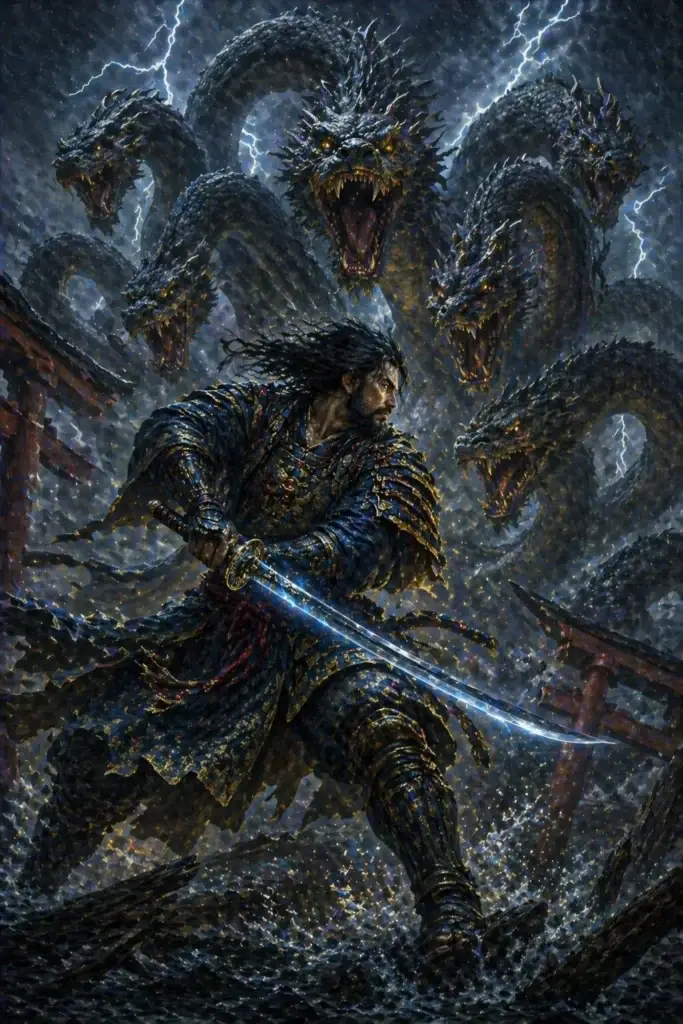
Solar disc, mirror (Yata-no-Kagami, one of the three imperial regalia), sword (Kusanagi-no-Tsurugi, which her brother Susanoo cut from the tail of the Yamata-no-Orochi dragon), curved jewel (Yasakani-no-Magatama).
Sacred animals: white horse, rooster, crow (yatagarasu, the three-legged sun crow that guided her descendant Jimmu). Sacred plants: rice, the sakaki tree (central in Shinto rites). Sacred color: white.
Mahavairocana / Dainichi Nyorai (Buddhism, Shingon identification), Ohirume-no-muchi (alternative Japanese designation), Sol Invictus (Roman, late Roman sun god), Helios (Greece), Sūrya (Hinduism), Re (Egypt).
Female sun goddess parallels: Sol (Germanic, female, unlike the Roman male solar form), Sáramaṇa (Hittite), Sun-Goddess of Arinna (Hittite), Saulė (Baltic). The Norse goddess Sol and Amaterasu are the two most striking female solar high deities in world mythology.
Protective Practice
Veneration rituals
Amaterasu Ōmikami (Japanese 天照大御神, ‘heaven-illuminating majesty’) is the sun goddess and ancestral mother of the Japanese Tennō house. The principal cult site is Ise Jingū (inner shrine, Naikū), founded in 4 BCE according to tradition.
Every 20 years the shrine is torn down and rebuilt according to ancient tradition (Shikinen Sengū, most recently in 2013). Principal festivals: Hatsuhinode (first sunrise prayer at the New Year), Tsukinami-sai (June and December, Ise festival). The Tennō enthronement includes the secret Daijōsai ritual with the symbolic transfer of solar energy (cf. Bock).
Invocations
Norito prayers to Amaterasu follow the oldest surviving formulas of Japanese Shinto (Engi-Shiki, 927 CE). The cave myth (Amaterasu withdrew into the Ame-no-Iwato cave after Susanoo’s transgression) is performed in Kagura dances; the dance of Ame-no-Uzume before the cave is the origin of Japanese theater.
Amulets and protective symbols
Ise Omamori (protective amulets from the Ise shrine) are the most widely distributed protective amulets in Japan. The Yata-no-Kagami (sacred mirror), one of the three imperial regalia, kept in the Naikū, is regarded as her manifestation. Solar-disc pendants of bronze or gold. The Hi-no-Maru has its symbolic root in Amaterasu’s solar manifestation.
Amaterasu, Parallels in Other Cultures
Amaterasu resembles the Egyptian Ra (sun), the Greek Helios or Apollo, and the Vedic Surya. Unlike many sun gods, Amaterasu is female, a rarity that the patriarchal Shinto establishment long emphasized.
She shares features with the Inca Inti (sun) and the Aztec Tonatiuh. Her constitutional role is distinctive: in Japan, Amaterasu is not only religious but political; her divine authority legitimizes imperial rule itself.
The Rock Cave Myth in Detail
The best-known narrative about Amaterasu is her withdrawal into the heavenly rock cave, Ama no Iwato. It is transmitted in the two oldest historical works of Japan, the Kojiki of 712 and the Nihon Shoki of 720, with differences in detail.
The trigger is the violent behavior of her brother Susanoo. He lays waste to the rice fields, defiles sacred halls, and finally hurls a flayed horse through the roof of the weaving hall in which Amaterasu or her attendants weave sacred garments.
Frightened and offended, Amaterasu withdraws into the rock cave and seals the entrance. With this, light vanishes from the world; heaven and earth sink into darkness, and all manner of misfortune breaks forth.
The other gods confer at the ‘quiet riverbed of heaven.’ They devise a ruse. They plant a sakaki tree, adorn it with jewels, strips of cloth, and a mirror, have birds call out, and induce the goddess Ame no Uzume to perform an exuberant, comical dance.
The assembled gods laugh so loudly that the noise shakes the entire heaven. Amaterasu, grown curious as to why the gods are joyful despite the darkness, opens the cave a crack.
Uzume explains that a more exalted deity has appeared and holds the mirror before her. Surprised by her own radiance, Amaterasu steps further out; a strong god draws her fully forth, and a rope is stretched behind her so that she cannot return.
Light returns to the world. Scholarship interprets the myth, among other things, as a reflection of ritual practice and as a narrative about the recovery of cosmic order.
Amaterasu and the Tennō: the Dynastic Justification
Amaterasu’s central political significance lies in her role as ancestress of the Japanese ruling house. According to the Kojiki and the Nihon Shoki, Amaterasu sends her grandson Ninigi to earth to rule over the land.
She gives him three objects that are regarded as the three regalia of Japan: the mirror, the curved jewel, and the sword.
From Ninigi, according to the mythical genealogy, the line of the Tennō derives, the first of whom, Jimmu, is regarded as Ninigi’s great-grandson. The rule of the Japanese imperial house is thus traced directly back to the sun goddess.
This construction was no mere myth but a political program. The two historical works of the early 8th century arose at a time when the Yamato court sought to consolidate and legitimize its supremacy over other lineages.
Scholarship emphasizes that the special position of Amaterasu within the very large pantheon of the kami is connected with the rise of precisely this ruling lineage. Other powerful clans venerated other ancestral deities; that Amaterasu moved to the top is an expression of a political development.
The dynastic connection remained effective over the centuries and was newly emphasized in the 19th and early 20th centuries within the framework of State Shinto. After 1945, the Tennō renounced the claim of divine descent in the religious-political sense, but the mythical genealogy remains part of the transmitted tradition and of ceremonial practice.
The Ise Shrine and the Sacred Mirror
Amaterasu’s most important cult site is the inner shrine of Ise, Naikū, in Mie prefecture. There the sacred mirror Yata no Kagami is kept, one of the three regalia, regarded as a symbol of Amaterasu’s presence.
Tradition connects the founding of the shrine with the princess Yamatohime, who on behalf of the court sought a suitable place for the veneration of the goddess and finally found it at the Isuzu river.
The Ise shrine is of great architectural simplicity. The buildings are made of untreated cypress wood and follow an old style largely free of later Chinese influences. Particularly well known is the practice of the Shikinen Sengū, the ceremonial reconstruction of the principal buildings every twenty years on an adjacent plot.
The shrine is rebuilt entirely from fresh wood, and the sacred objects are transferred into the new building in a solemn procession. This renewal combines permanence and transience and at the same time secures the transmission of craft knowledge.
The inner area of the shrine is not accessible to the public; the mirror itself is seen by no one. Until the modern period, Ise was closely connected with the imperial house, and for a long time an imperial princess served as priestess, the saiō, of the shrine.
In terms of religious studies, Ise is a central point of reference for understanding Shinto, because here dynastic claim, nature veneration, and a pronounced concept of purity are combined.
Solar Deity and Gender: an Open Debate
Amaterasu is a female solar deity, which is notable in the comparison of religions, since solar deities are conceived as male in many cultures. This particularity has led to ongoing discussions in scholarship.
Some older as well as more recent works have argued that the solar deity may originally have been male or of indeterminate gender and only became female in the course of transmission, or, conversely, that an ancient female solar veneration was present.
Indications of this debate arise from inconsistent details in the sources and from comparison with local cults. The source situation, however, permits no certain decision, and the discussion remains open.
A related strand of scholarship examines whether the figure of Amaterasu reflects an older conception of a priestess or shaman who served the solar deity, so that the human mediator and the deity merged in transmission. Here too these are hypotheses, not established results.
For the religious-studies classification, it is above all to be noted that Amaterasu’s gender is unambiguously female in the transmitted texts and that the later connection with the likewise predominantly male-understood imperial office did not problematize the sources further.
The modern debate about the origin and possible transformations of gender is therefore more a question of historical reconstruction than of transmitted theology. Those interested in the sibling tension will find further references in the entry on Susanoo and in the entry on the moon god Tsukuyomi.
Further Links
Sources and Literature
Further standard works in the literature index.
Frequently Asked Questions about Amaterasu
Who is Amaterasu in Japanese mythology?
Amaterasu Ōmikami (Japanese 天照大御神, Great Exalted Goddess who illuminates the heavens) is the highest deity of Japanese Shinto, the sun goddess and mythical ancestress of the imperial family of Japan.
She is the daughter of Izanagi-no-Mikoto and sister of Tsukuyomi (moon god) and Susanoo (storm god). Her principal sanctuary is the Ise shrine in Mie prefecture, the most important shrine of Shinto, rebuilt ritually every twenty years according to ancient tradition (the Shikinen Sengū ritual).
What is the story of Amaterasu in the cave?
The central Amaterasu myth: out of a quarrel with her stormy brother Susanoo, Amaterasu withdraws into the heavenly cave (Amano-Iwato) and seals it with a boulder. The world sinks into darkness.
The other gods gather before the cave, hang a mirror on a tree, adorn another tree with jewels, and the goddess Ame-no-Uzume dances a wild, half-naked dance that makes the other gods laugh. Curious, Amaterasu opens a crack, sees her own light in the mirror, and is drawn out by Tajikarao. The light returns.