Yaksha and Yakshi, guardians of trees and treasures
By Ralf Ittermann · last reviewed on
Yakshas are spirits of Indian tradition.
Ambivalent guardians of trees, springs and hidden treasures.
Yaksha, female Yakshi, are the ambivalent nature spirits of India, often guardians of trees, springs and hidden treasures. In the retinue of Kubera, lord of wealth, they grant fertility and prosperity, but can also be moody and dangerous.
Their religious layer is older than the epics and the organised Brahmanical cult; via Buddhism the Yakshas travelled from South Asia to East and Southeast Asia and continue to shape Buddhist art to this day.
Type: Ambivalent nature spirits, male Yakshas and female Yakshis
Origin: South Asia, older than the epics
Texts: Ramayana and classical Sanskrit sources, plus Buddhist art
Period: from Vedic echoes to medieval sculpture
Appearance: nature spirits, often bound to trees and springs
Source context
Period of the Texts
The religious layer of the Yakshas is older than the epics and the organised Brahmanical cult; the evidence ranges from Vedic echoes to medieval sculpture.
Area of Diffusion
All of South Asia; via Buddhism the concept spread as far as East and Southeast Asia.
Sources
The source material is good: classical Sanskrit sources such as the Ramayana, the iconography of Buddhist art and the foundational study by Coomaraswamy.
Name and variants
Sanskrit: yaksha, female yakshi or yakshini. The Yakshas are nature spirits associated with water, trees, wilderness, treasures and fertility, and are rooted in the veneration of local spirits at particular trees, springs and crossroads.
Appearance
Appearance
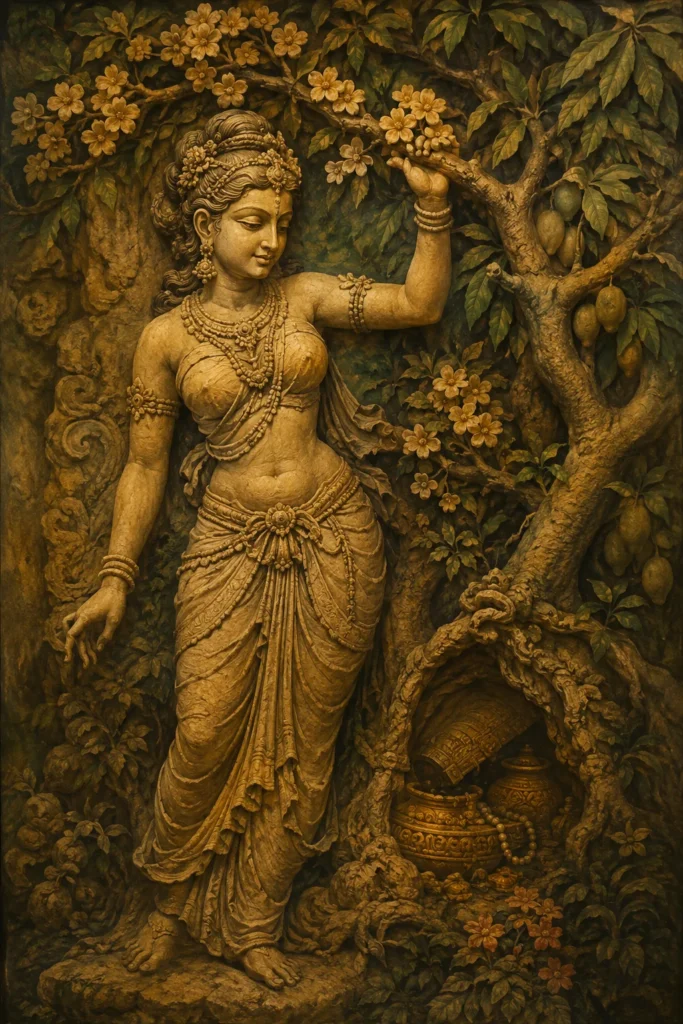
A central motif is the Shalabhanjika, the Yakshi shown as a woman grasping a tree branch and bringing it into blossom and fruit, an image of fertility and prosperity. At the eastern gate of the Great Stupa of Sanchi, six Shalabhanjika Yakshi figures originally served as brackets supporting the gate; the tree spirits literally hold up one of the most sacred Buddhist sites.
Effect
The Yakshas are guardians of treasures hidden in earth and tree roots and grant fertility, but can also be wilful, capricious or dangerous. This ambivalence is their defining trait.
Profile: Yaksha
The most important aspects of these nature spirits at a glance.
Nature spirits of a religious layer older than the Brahmanic cult; their king is Kubera, the lord of wealth.
Travellers, treasure seekers, forest dwellers and worshippers: anyone who approaches trees, springs and hidden treasures enters their domain.
Male Yakshas and female Yakshis, often bound to trees and springs; the best known is the Shalabhanjika, who brings the branch into blossom.
Guarding treasures hidden in earth and tree roots, granting fertility and prosperity, but also capable of wilfulness and danger.
Yaksha shrines at trees and crossroads, tree worship and offerings to appease the ambivalent spirits.
The Vanadevatas are benevolent deities of the groves; the Yakshas, by contrast, are ambivalent nature spirits. In the West they correspond to the Dryad, in the East to the Kodama.
Kubera's retinue: a layer preceding the Brahmanic cult
The Yakshas are rooted in the veneration of local spirits at particular trees, springs and crossroads, a religious layer older than the epics and the organised Brahmanic cult. Their sphere is water, trees, wilderness, treasure and fertility.
Their king is Kubera, the lord of wealth and one of the four guardians of the world, who resides in the city of Alaka in the Himalayas; the Yakshas form his retinue. Through Buddhism, the idea travelled far beyond South Asia: the Shalabhanjika Yakshis at the eastern gate of the Great Stupa of Sanchi show how naturally the old tree spirits entered Buddhist art.
Coomaraswamy and the ambivalence of nature spirits
The Yakshas have shaped Buddhist art worldwide and are considered a classic case of nature-spirit ambivalence. The foundational study is by Ananda K. Coomaraswamy, who compiled iconography and textual evidence.
In terms of the study of religion, the Yakshas belong to a religious layer older than the Brahmanic cult and embody the vegetation and fertility spirits of an early water cosmology, as reconstructed by Coomaraswamy. Their ambivalence, benevolent and dangerous, is a classic case of belief in nature spirits: generally friendly, but capricious to potentially dangerous.
Shrines, offerings and appeasement
Well attested are Yaksha shrines at trees and crossroads, along with tree worship and offerings for appeasement. The Yakshas are closely bound to specific trees and springs to which the veneration applies: it is not the spirit in general that is invoked, but the inhabitant of this one tree, this one spring.
Tree spirits in cultural comparison
The Yakshas correspond to the Greek Dryad, the tree nymph, and the Japanese Kodama, the tree spirit, with whom they share the bond to particular trees. Within India, they are related to the Vanadevata, the benevolent tree deities of the sacred groves; what distinguishes the Yakshas from these is their ambivalence and their rank as spirits, not deities.
Frequently asked questions about Yaksha and Yakshi
Are Yakshas good or evil?
Ambivalent: generally benevolent, but capricious to dangerous. This dual nature is their defining trait.
What is a Shalabhanjika?
A Yakshi who touches a branch and triggers blossom or fruit, a symbol of fertility, as seen in the Sanchi gate figures.
Who leads the Yakshas?
Kubera, the god of wealth, one of the four guardians of the world, who resides in the city of Alaka in the Himalayas.
Further links
Further reading:
- Vanadevata, Aranyani – related forest deities of India
- Dryad – the Greek tree nymph
- Kodama – the Japanese tree spirit
- Smoke cleansing, Amulet, Mugwort – traditional protective means
- Protection Compass – protective means at a glance
Literature (selection)
Further standard works in the bibliography.
Yaksha and Yakshi remain the great nature spirits of India: guardians of tree, spring and treasure, who as vegetation spirits sustain Buddhist art while also reminding us that India’s nature spirits were never thought of as purely friendly.