Mari, Mistress of the Earth and Lady of Anboto
By Ralf Ittermann · last reviewed on
Mari is a goddess of the Basque tradition.
Mistress of the earth and mountains, weather-maker of Anboto. Mari is the mountain goddess of the Basques.
Mari, also called Anbotoko Mari, the Lady of Anboto, is the central female deity of Basque mythology, mistress of the earth and the mountains. She dwells in caves in several mountains, above all Mount Anboto, is a weather-maker, and rewards honesty while punishing lies and arrogance.
Mari is documented above all through the fieldwork of José Miguel de Barandiarán in the 20th century; she personifies the earth and the forces of nature. Her whereabouts and her journeys between the mountain caves determine drought, rain or hail.
Type: Central female deity, mistress of the earth and mountains, weather-maker
Origin: Basque mythology, pre-Christian
Texts: oral tradition, ethnographically recorded by Barandiarán
Period: pre-Christian roots to the present
Appearance: elegant lady, also a ball of fire between the peaks
Source context
Period of the Texts
Oral tradition with pre-Christian roots; documented scientifically above all through the fieldwork of José Miguel de Barandiarán in the 20th century.
Area of Diffusion
The Basque Country, especially Mount Anboto; besides this, Mari moves in turn between the caves of several mountains.
Sources
Well documented through 20th-century fieldwork, above all Barandiarán, together with Caro Baroja’s standard work on the Basques.
Name and variants
Basque: Mari, also Mari Urraca; Anbotoko Mari means Mari of Mount Anboto. The name resembles the Christian Maria, yet the figure is pre-Christian; the similarity of names is considered a later association rather than a common origin.
Form and appearances
Appearance
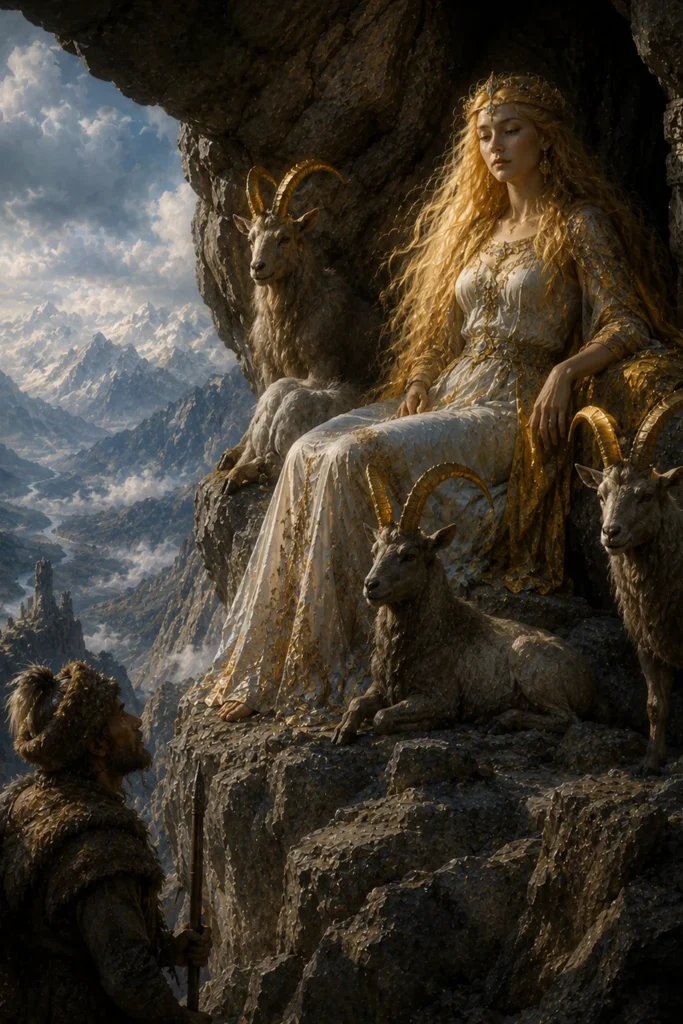
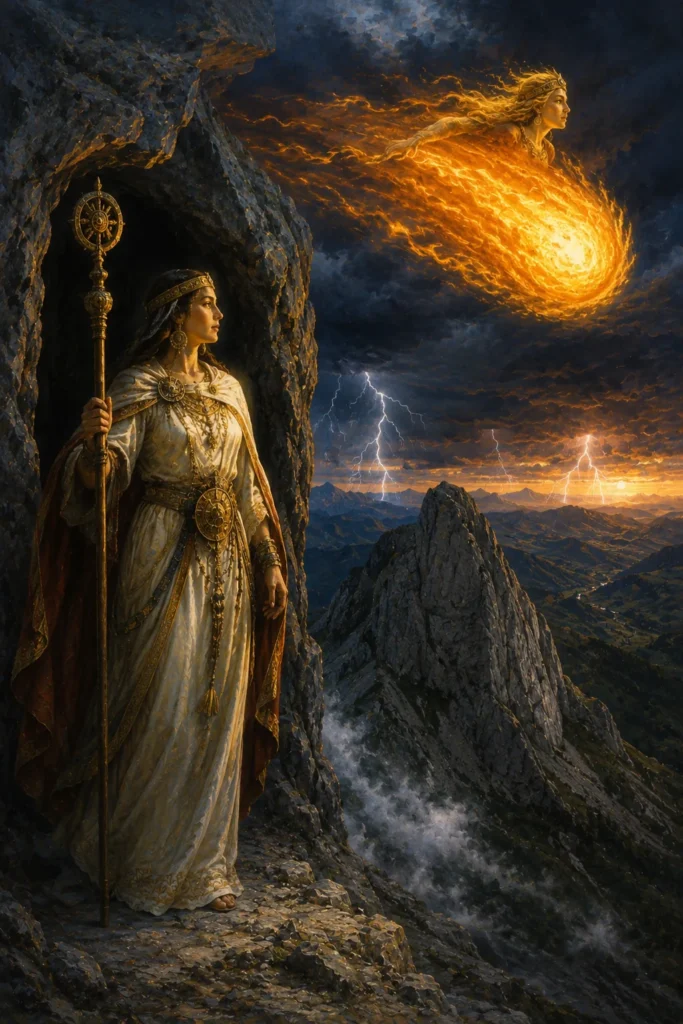
Mari is shape-shifting: an elegant lady, but also a ball of fire or a crescent of fire flying through the air between the mountain peaks, sometimes with animal features such as claws or bird feet. Her dwelling is the cave Mariren Koba near the summit of Anboto, though she moves in turn between several mountain caves.
Effect
Mari is mistress of the earth and mountains and a weather-maker: her whereabouts and journeys determine drought, rain or hail; when she travels with her partner, hail falls. She rewards honesty and punishes lying, theft, arrogance and breaking one’s word.
Profile: Mari
The key aspects of the mountain goddess at a glance.
Central deity of Basque mythology with pre-Christian roots, documented through 20th-century fieldwork.
Earth, mountains and weather, as well as human order: honesty is rewarded, while lying, theft, arrogance and breaking one’s word are punished.
Elegant lady, and at the same time a ball of fire or a crescent of fire between the peaks, sometimes with animal features such as claws or bird feet.
The weather: her whereabouts and journeys determine drought, rain or hail; when she travels with her partner, hail falls.
Rules of conduct when entering her cave: do not address her informally, do not leave with your back turned to her, and bring offerings.
Her partner, the serpent being Sugaar, also called Maju; her motifs relate to earth and mother goddesses and to the white serpent.
The Lady of Anboto in Basque mythology
The name Mari, also Mari Urraca, resembles the Christian Maria, yet the figure is pre-Christian; the similarity of names is considered a later association rather than a common origin. Anbotoko means of Mount Anboto. Mari is central to Basque mythology and personifies the earth and the forces of nature.
She is documented above all through the fieldwork of José Miguel de Barandiarán in the 20th century. Her family includes her partner Sugaar, also called Maju, and her sons Atarrabi and Mikelats, who embody good and evil.
Reception and classification
Mari is an icon of Basque identity and culture and the subject of modern neopagan and regional reception.
From a religious-studies perspective, Mari fundamentally upholds order but is dangerous towards rule-breakers, with real control over destructive weather. Important clarifications: she is not to be equated with the Christian Virgin Mary, the similarity of names is probably secondary; and Sugaar and Maju are the same partner under different names, not two separate beings.
Rules of conduct in the goddess's cave
There is no ancient temple cult for Mari; what has been passed down are folk rules of conduct for entering her cave: do not address her informally, do not leave with your back turned to her, and bring offerings. These rules are documented by Barandiarán, not as an organised cult in the ancient sense. Anyone who breaks the rules must fear the goddess, for lying, arrogance and breaking one’s word are among the offences that Mari punishes.
Sugaar, sons and mother goddesses
Mari is the partner of the serpent being Sugaar, also called Maju; her sons Atarrabi and Mikelats embody good and evil. Motivically she is related to earth and mother goddesses and to the white serpent; among the earth mothers of other cultures, the Andean Pachamama may be compared, and among mountain women, the Albanian Zana.
Frequently asked questions about Mari
Who is Mari?
The central female deity of Basque mythology, mistress of the earth and mountains and a weather-maker.
Where does she live?
In caves in several mountains, above all in the cave Mariren Koba on Anboto, between which she moves.
Is Mari the same as the Virgin Mary?
No. The figure is pre-Christian; the similarity of names is probably secondary.
Further links
Literature (selection)
Further standard works in the bibliography.
As the Basque mountain goddess and Lady of Anboto, Mari embodies the order of the old Basque world: whoever remains honest and respects her rules stands on the right side of the mistress of the weather.