Eate, the rumbling voice before the catastrophe
By Ralf Ittermann · last reviewed on
Eate is a god of Basque tradition.
The genius whose rumbling announces fire and flood. The account frames Eate’s rumble as a warning sounded just before disaster strikes.
Eate is a Basque genius of fire, storms and flooding. When a blaze, a flash flood or a hurricane approaches, his powerful, rumbling voice is heard as a warning.
His tradition is confined to a narrow region and is reconstructed mainly from the field notes of José Miguel de Barandiarán; no nationwide myth exists. During fires, the flickering flames are regarded as strands of his beard.
Type: genius of fire, storm and flash flood, herald of catastrophe
Origin: Basque folk belief, collected in the 20th century
Texts: field notes by Barandiarán, Basque mythology lexicons
Period: documented in the 20th century
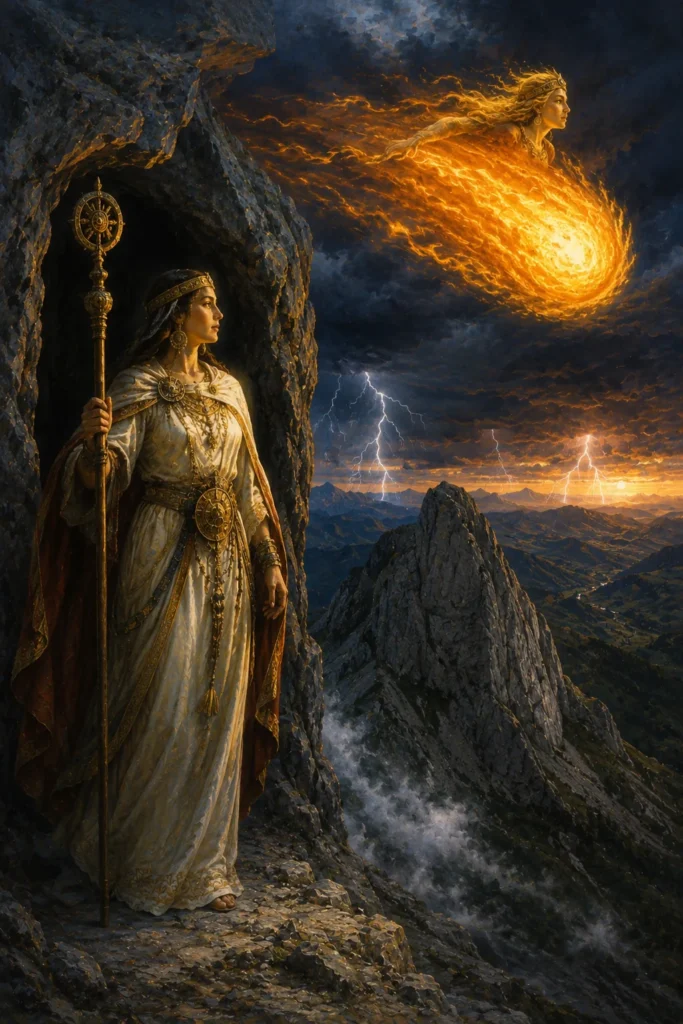
Appearance: celestial genius whose beard forms the flames

Region of origin and sources
Period of the Texts
Basque folk belief, collected in the 20th century; almost all information goes back to the fieldwork of José Miguel de Barandiarán.
Area of Diffusion
Confined to a narrow region: Goierri and Azpeitia in Gipuzkoa as well as Arakil in Navarre. No nationwide myth exists.
Sources
Sparse and local: essentially Barandiarán’s Diccionario de mitología vasca, supplemented by Caro Baroja.
Name and variants
Basque: The main form is Eate, secondary forms are Egate, Ereeta and Orots. Unconfirmed but common is the derivation from Basque errete (to burn); an original fire genius is suspected.
Form and Activity
Appearance
Eate dwells in the stormy sky. During fires, the flickering flames rising into the sky are regarded as strands of his beard. He embodies the combined force of fire, wind and water.
Effect
Eate announces catastrophes: when a storm, a great fire or a flash flood approaches, his muffled, rumbling voice can be heard. The sources do not clearly distinguish whether he causes the catastrophe or merely announces it.
Profile: Eate
The key aspects of the catastrophe genius at a glance.
Local genius of Basque folk tradition, combining fire, storm and flood in a single figure.
People in the vicinity of impending natural disasters: his rumbling was seen as an omen of fire, hurricane and flash flood.
Celestial genius without a fixed image; during fires the rising flames are interpreted as strands of his beard.
Blaze, flash flood and hurricane; his muffled, rumbling voice precedes the catastrophe.
No cult documented: rumbling and rising wind were interpreted as omens, prompting people to secure house and livestock.
To be distinguished from the thunder and cloud genius Odei; within the Basque environment stand Mari and the storm being Sugaar.
Barandiarán and the voice in the sky
The main form of the name is Eate, alongside Egate, Ereeta and Orots. A common but unconfirmed interpretation derives the name from Basque errete, to burn, suggesting an original fire genius. Eate is attested in a narrowly confined region: in Goierri and Azpeitia in Gipuzkoa as well as in Arakil in Navarre.
The accounts were collected in the 20th century by José Miguel de Barandiarán, whose field notes form the basis for almost all information. No nationwide myth ever emerged from this; Eate remained a local figure whose rumbling was read by the people of the affected valleys as a warning of fire, flood and hurricane.
Interpretation and classification
Eate is not a prominent myth; his renown stems almost entirely from Barandiarán’s legacy and popular collections. He plays hardly any role in art or ritual.
From a religious-studies perspective, Eate shows how a local folk belief combines fire, storm and flood into a single foreboding genius. Three clarifications: he is not a nationwide fire god, but a regional herald figure of natural catastrophe. Reducing him to a pure fire god falls short. And he should not be confused with the thunder and cloud genius Odei.
Omen rather than ritual
No cult is documented for Eate. What survives is pure folk belief: the rumbling and the rising wind were interpreted as omens, to which people responded with caution and by securing house and livestock. Rituals, amulets or invocations specifically for Eate are not attested; protection lay in hearing the warning in time, not in warding off the genius himself.
Odei, Mari and Sugaar: the Basque environment
Eate is to be distinguished from the Basque thunder and cloud genius Odei, with whom he is often confused. Within Basque tradition he stands alongside the central numen figure Mari and the serpent and storm being Sugaar. Outside the Basque context there are only typological similarities to storm and fire gods such as Thor, Zeus or Taranis.
Frequently asked questions about Eate
Is Eate only a fire god?
No. He is a genius of fire, storm and flash flood alike, and above all a herald of catastrophes.
How does he manifest?
Through his powerful, rumbling voice, which precedes a catastrophe, and through flaring fires whose flames are regarded as his beard.
Is Eate the same as Odei?
No. Odei is the Basque thunder and cloud genius; the two are often confused.
Further links
Literature (selection)
Further standard works in the bibliography.
As a Basque genius of fire, Eate is only half described: he is above all a herald of catastrophe, a rumbling voice in the sky that grasps fire, storm and flood as a single, unified force.