Umai, Turkic-Siberian protective goddess of mothers and newborns
By Ralf Ittermann · last reviewed on
Umai is the mother and child goddess of the Turkic-Siberian religious sphere. Her name also denotes the placenta; she protects pregnant women, newborns, and young children, and serves shamans and midwives as a personal helper goddess.
Umai is regarded as the Turkic-Siberian protective goddess of children and patron of childbirth. Her cult is attested in Mongolo-Turkic sources from the 8th century onward. Her cult is attested in Mongolo-Turkic sources from the 8th century onward.
Profile: Umai
Umai: the most important aspects at a glance. The following fields summarise origin, function, appearance, veneration, symbols and parallels.
Umai belongs to the Tengrism of the Turks and Siberia and is one of the few female high deities that are clearly documented already in pre-Islamic times. The inscription of Tonyukuk names her around AD 720 together with Tengri and Yer-Sub. Yakut, Altaic and Khakas ethnographies of the 19th and 20th centuries also attest her.
Umai is the goddess of mothers and children. She watches over birth, infant sleep and the first year of life and protects pregnant women, newborns and small children; she assists female shamans and midwives as a helper goddess. In an Altaic tale she carries the soul of a newborn down from heaven in a golden cradle.
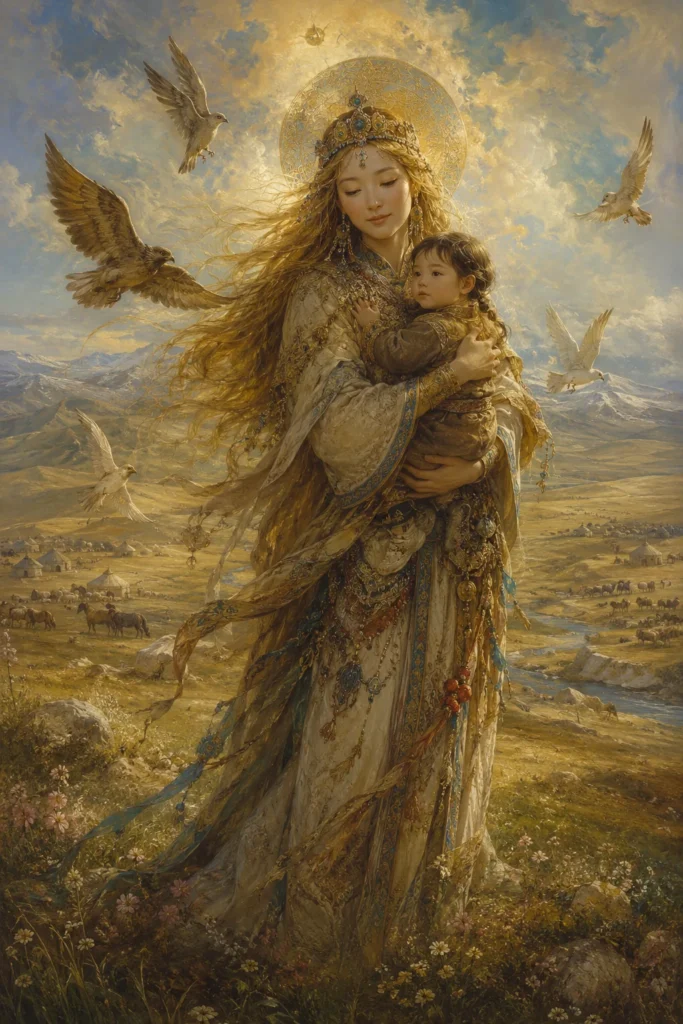
Umai is described as a young woman with a long braid and silver ornaments. She rides on a white bird, often a swan, wears a cloak embroidered with sun and moon and carries a small golden bow with which she drives harmful spirits away from children’s cradles.
The cult was closely tied to the household. Main rituals were the purification feast nayan-ot three days after birth with smoke of juniper and larch resin, the hanging of the bow over the cradle and an annual food offering of curd, mare’s milk and butter pastry at the spring festival. Shamans invoked her in healing sessions for children.
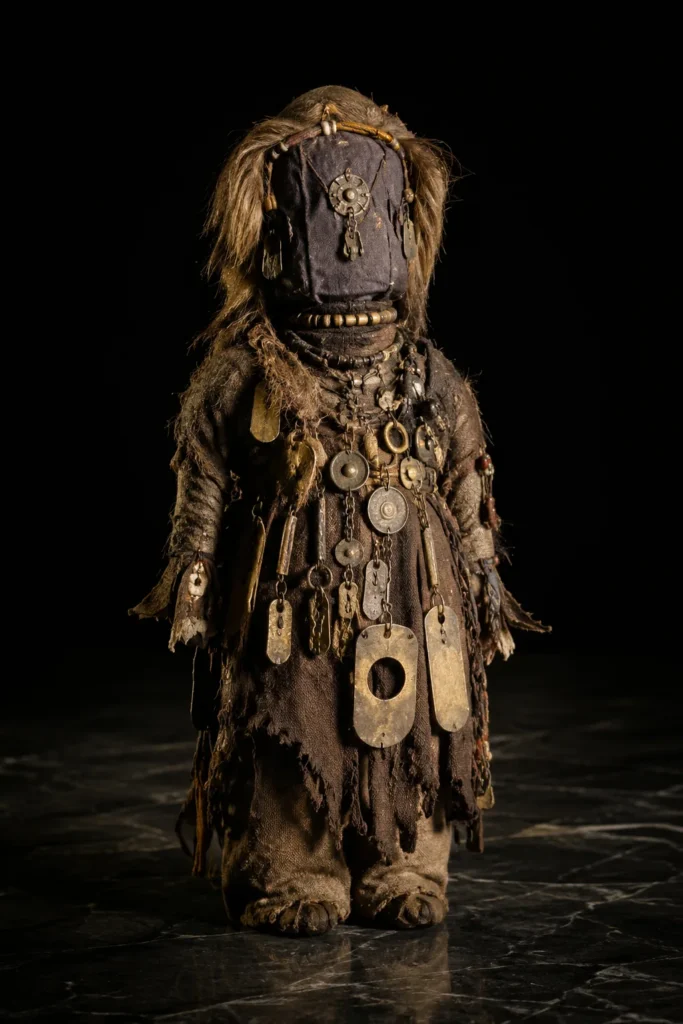
Her sign is the cradle wood, small carved pendants in the shape of a bird or bow, which are hung on the cradle. The first little shirt of the newborn, made from the cloth of a healthy sibling, is regarded as Umai’s garment. The term umai means placenta, which was laid down in a sacred place, for example in a tree, under a threshold or at the hearth.
Functionally comparable are the Greek Eileithyia and Hera Argeia, the Roman Juno Lucina, the Slavic Mokosh, the Norse Frigg, in Siberia the Yakut Ajisit, in China Bixia Yuanjun and in India Shashthi. The Mongolian sources know her as Etügen Eke, “Mother Earth”, and thus show a partial merging with the earth goddess.
Classification and Short Profile
Umai (also Omai, Omoj, Umaj, May-Ene) is one of the few female high deities of historical Tengrism who are clearly documented from pre-Islamic times.
While Tengri as a remote sky god guarantees the background order, Umai is a concretely engaged protective power within the family sphere: she watches over birth, infant sleep, and the first year of life.
Evidence ranges from the Old Turkic Orkhon inscriptions of the 8th century (the Tonyukuk inscription) through Yakut, Altaic, and Khakas ethnographies of the 19th and 20th centuries to modern revivals in Tuva and Kazakhstan.
Within the cultural sphere of the Siberian-Tengrist tradition, she is the central mother figure and stands in functional tension with Ajisit, the Yakut birth goddess.
Umai is of particular interest to religious studies because she establishes a rare link between an abstract cosmic maternal function and a concrete anatomical substrate: the term umai literally means “placenta.” In this way, a piece of the body itself becomes the dwelling of the deity, recalling the religious significance attributed to anatomical realia in many other cultures.
Name and Etymology
The word umai in Old Turkic denotes both “placenta” and “protective deity of children.” This double meaning is decisive in the history of religions: the afterbirth was regarded as the material counterpart of divine protection and, after delivery, was not discarded but deposited at a sacred site (in a tree, beneath a threshold, by the hearth).
Etymologically, the word is classified as Old Turkic by Gerard Clauson and other Turkologists, without a clear Iranian or Palaeo-Siberian borrowing. Among the Yakuts and Buryats she is known as Ymaj and Manzan Gormo respectively, in a functionally similar role.
Mongolian sources know her as Etügen Eke, “Mother Earth,” indicating a partial fusion with the earth goddess; in this fusion Umai approaches Yer-Sub.
The Köktürk inscription of Tonyukuk (around 720 CE) names her alongside Tengri and Yer-Sub, attesting her state-bearing role in early Turkic religion. Scholarship has read this tripartite invocation formula as a cosmological triad: sky, mother, earth-water.
Description and Iconography
Umai is traditionally described as a young woman with a long braid and silver ornaments. She rides a white bird (often a swan), wears a cloak embroidered with sun and moon, and carries a small golden bow with which she drives harmful spirits away from children’s cradles.
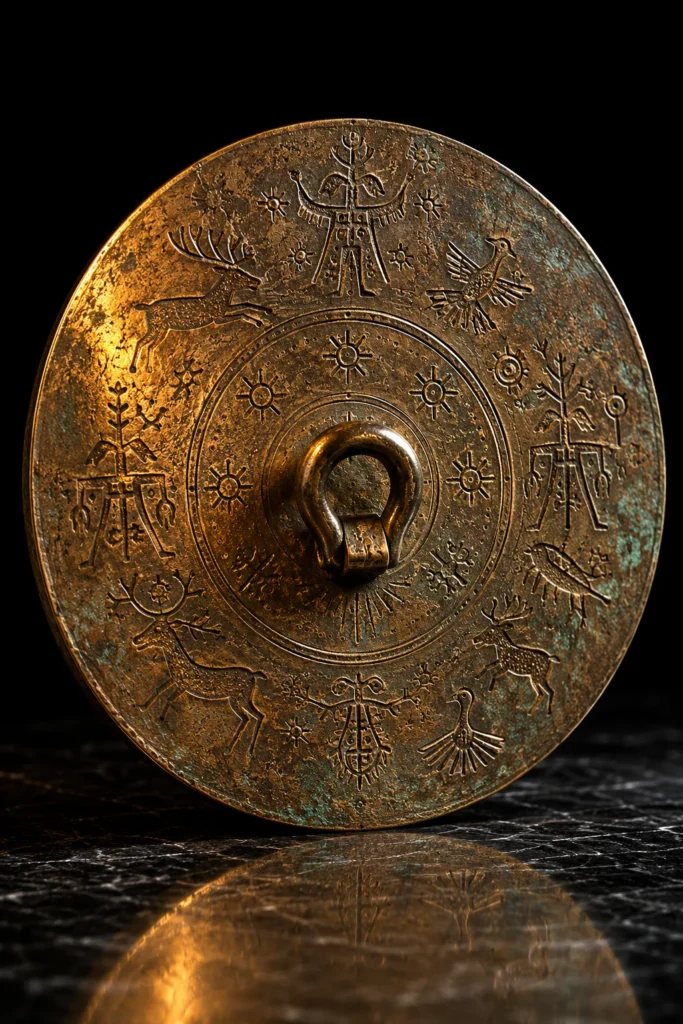
In the South Siberian shaman drums she usually appears in the upper half, close to but below Ülgen.
In the household symbolic system her sign is the cradle wood: small carved pendants in the form of a bird or bow, hung on the cradle.
The newborn’s first shirt, often made from the fabric of a healthy sibling, is also called the “Umai garment.” The ethnographic collections of the Russian Museum (St. Petersburg) and the Ethnographic Museum in Ulan-Ude contain numerous such objects.
In the modern Tuvan and Kazakh re-Tengrism movement, Umai has become a cultural icon; in Astana her figure adorns a fountain. This modern iconography draws on traditional descriptions but, as is common in religious renaissances, creates a consolidated visual form that did not exist in such a unified shape in the historical material.
Mythological Narratives
The Tonyukuk inscription (ca. 720 CE) names Umai for the first time alongside Tengri: “Tengri, Umai, and the sacred earth-and-water have given us victory.” Umai appears here in a trinity with the sky god and the place-bound earth-water power (cf. Yer-Sub). Talat Tekin analysed this passage in grammatical and semantic detail in 1968.
An Altaic narrative recorded by Wilhelm Radloff describes how Umai carries the soul of a newborn child down from heaven in a golden cradle and places it breathing in the mother’s arms. When a child dies, “Umai takes back her shirt,” a phrase that expresses the reversibility of the divine gift without assigning blame.
In the Yakut Olonkho epics she partially merges with Ajisit and appears as the bearer of the life-soul. This fusion is instructive for the history of religions: it shows how a pan-Siberian function is differently personalised in regional pantheons.
Cult and Veneration
The Umai cult was closely tied to the household.
The main rituals were: the purification ceremony nayan-ot three days after birth, during which the midwife and mother pass through smoke of juniper and larch resin; the “hanging of the bow” above the cradle; and the annual food offering (curd, mare’s milk, butter pastries) at the spring festival.
Shamans invoked Umai above all in healing sessions for children. She was regarded not as a mysterious but as an accessible power, a “nearby goddess” to whom one might also speak aloud in daily life.
Today she plays a role in Tuvan and Khakas folklore as a reference figure for midwifery and the mourning of infants who died.
The socio-religious observation of Vladimir Basilov is central here: Umai fills an emotional and practical gap that the distant Tengri cannot fill. This complementarity is one of the structural features of multi-member pantheons with a deus otiosus at the apex.
Protective Practices and the Apotropaic
Described from a religious-studies perspective (without any claims of efficacy), the apotropaic complex surrounding Umai comprised: hanging small wooden bows or bird figures above the cradle; concealing the placenta in a pure place; avoiding loud noises and sharp tools during the first 40 days; placing an “Umai shirt” made from the cloth of a healthy sibling on the newborn.
From an insider perspective, these practices addressed the concern that an infant might be “pulled back down” by harmful spirits such as Khargi harmful spirits or by the envoys of Erlik Khan. From the outside perspective of ethnography, they are everyday-structuring rituals that give cultural form to elevated infant mortality.
The 40-day convalescence period after birth recurs in many Eurasian religions (Orthodox Christianity, Judaism, Islam), suggesting that Umai-centred practices form part of a broader Eurasian birth-ritual complex, without a direct historical derivation being possible.
Parallels in Other Cultures
Functionally comparable figures include: the Greek Eileithyia and Hera Argeia; the Roman Juno Lucina; the Slavic Mokosh; the Norse Frigg in her role as patron of childbirth; and within Siberia itself Ajisit (Yakuts). In China her typological equivalent is Bixia Yuanjun, the birth goddess of Tai Shan; in India, Shashthi.
The religious-historical point: in virtually every pantheon that possesses a distant sky god, there is a compensating female protective figure for the drama of the first year of life.
Umai fulfils this role in Tengrism in a particularly compact way. In terms of religious phenomenology, she is a textbook example of the correlation between a deus otiosus above and a concretely engaged female protective figure “below.”
Unlike with Umai, whose name means placenta, the name of the Latin goddess of dawn Mater Matuta has no connection to a bodily function but belongs to Latin matutinus, “early”.
Modern Reception and Research
In modern republican versions of Tengrism (Tuva, Khakassia, Kazakhstan), Umai has become a cultural identification figure; in Astana she adorns a city fountain as a statue. Academically she is the subject of work by Vladimir Basilov and Irina V. Stebleva.
An important research strand examines the linguistic and functional bridge between umai = placenta and umai = protective deity as an example of how religiosity crystallises around material bodily experiences. This research is in dialogue with the comparative birth-and-death scholarship of Robert Hertz and Arnold van Gennep.
Research Debates and Open Questions
Two methodological debates shape Umai research. First: to what extent is the close coupling of placenta and deity an originally Turkic-Altaic phenomenon, or does it reflect a universal anatomical sacralisation also found among the Aymara, in South India, and in the West African Yoruba complex?
Second: can the Old Turkic Umai of the Orkhon inscriptions be identified with the Altaic Umai of the 19th century, or does the word in different periods denote different functional figures? Sergei Neklyudov argued for a continuous identification in Mify narodov mira (Moscow, 1992); more recent research urges greater scepticism.
The open research landscape makes Umai a rewarding object of study for a comparative religious studies that takes seriously not only gods but also their bodily and material anchoring.
The Study of Umai in Modern Scholarship
Umai research has become methodologically highly differentiated over the past two decades. Gender-oriented religious studies increasingly reads Umai no longer merely as a “birth goddess” but as a central female high figure whose status was often obscured behind the dominant Tengri research.
This re-reading is part of a broader trend toward reassessing female deities in Altaic and Uralic religions.
A second line of research connects Umai with the study of material religion: placenta practices (laying down, burying, hanging) are read as the intersection between anatomy and symbol. Here research draws on Mary Douglas’s Purity and Danger (1966) and on Robert Hertz’s studies of the “right” and “left” hand.
Third, diaspora research in Kazakhstan and Turkey has shown that Umai practices are also passed on in urban middle-class contexts, often as “cultural tradition” without explicit religious framing. This secularisation-with-persistence is a classic pattern in the sociology of religion.
Sources and the Cultural Hub
Those wishing to study the full scope of the Umai complex will find on the overview page Siberian-Tengrist Tradition the most important cross-references to related protective figures such as Ajisit, Ülgen, and the earth-bound power Yer-Sub.
Reading the Tonyukuk inscription in Talat Tekin’s standard edition (1968) remains the natural entry point for the Old Turkic layer.
For the ethnographic layer of the 19th and 20th centuries, Wilhelm Radloff’s Proben der Volkslitteratur der türkischen Stämme (from 1866) and Vladimir Basilov’s Izbranniki duchov (1984) are the standard works.
More recent sources include the ethnographic records of the Academy of Sciences of the Republic of Tuva.
From a religious-phenomenological perspective, Mircea Eliade‘s book on shamanism (1951) remains a productive starting point, even if his reading is no longer accepted uncritically today. Roberte Hamayon’s later critique (1990) supplements the picture and should be read alongside it.
Religious-Phenomenological Depth
In terms of religious phenomenology, Umai is a model example of what Mircea Eliade calls the “hierophany of the beginning”: the birth of a human being is charged with cosmic significance, in which the boundaries between above and below, visible and invisible, become permeable. In this phase Umai is constitutively present.
The connection with the cradle ritual (the nightly singing, the rocking, the attaching of protective threads) also belongs to a broad religio-anthropological class of “incorporation rituals,” systematically described by the French folklorist Arnold van Gennep in Les rites de passage (1909).
Compared with other Siberian mother goddesses, Umai is distinguished by a special connection with the political sphere: she stands in the Tonyukuk inscription between Tengri and Yer-Sub, that is, at the level of state-bearing power. This political elevation is not self-evident in the history of religions for a mother-protective goddess.
Methodological Reflection
Working with Umai sources raises several methodological problems. First: the oldest sources are brief invocation formulas in the Köktürk inscriptions; detailed ethnographic descriptions date only from the 19th and 20th centuries. A direct identification of both layers is not conclusively established.
Second: Russian and Soviet ethnography often identified Umai with the “mother goddess” of comparative religious studies, suggesting a universalist reading that is not always supported by the material itself. Religious-phenomenological caution is warranted here.
Third: the contemporary Umai movement in Tuva and Kazakhstan represents a form of self-representation that draws on traditional sources yet is itself a modern construct. A reflexive religious ethnology is needed here, as Andrei Znamenski demanded in Shamanism and Western Imagination (2007).
Umai and the Circumpolar Comparative Perspective
A comparative circumpolar perspective shows that Umai belongs to a broad family of female birth-protective deities stretching from Scandinavia to Siberia. The Finnish Akka, the Sami-transmitted Maderakka, the Old Turkic Umai and the Yakut Ajisit are functionally closely related.
Juha Pentikäinen systematically described this circumpolar branching in Shamanism and Culture (1998). Whether the relationship is one of genetic descent or typological convergence remains contested; both hypotheses have strong arguments.
This comparative embeddedness makes Umai relevant to religious studies beyond the Old Turkic-Siberian material. She stands at the centre of a research tradition concerned with the question of how similar religious functions arise under similar ecological and economic conditions.
Umai in the Old Turkic Inscription Tradition
The name Umai is known not only from modern ethnography but already from the oldest datable texts in a Turkic language: the Orkhon Turkic runic inscriptions of the 8th century from Mongolia.
In the Tonyukuk inscription and in the context of the monuments of the Second Turkic Khaganate, Umai appears in a fixed construction in which the success and protection of a person, often a high-ranking woman or a child, is attributed to the agency of heaven (Tengri) and of Umai.
This early attestation carries significant weight in the history of religions. It shows that the notion of a protective female power associated with birth, offspring, and the thriving of children is not a modern folkloristic construct but reaches back at least to the early Middle Ages.
It also shows that Umai was already conceived in close pairing with the sky god, in a kind of superordination and subordination in which Tengri embodies the wide above and Umai the near, sheltering.
The runic Turkic inscriptions were deciphered from the late 19th century onward, above all by Vilhelm Thomsen, who deciphered the script in 1893, and by Wilhelm Radloff.
The scarcity of evidence means, however, that almost nothing is known about the details of a Umai cult in the Khaganate. The inscription gives a name and a function, but no myth and no ritual.
Word History: Umai between Placenta and Protective Power
A linguistic peculiarity of Umai is that the same or a closely related phonetic body designates both a concrete word and a deity name in several Turkic languages. In a number of Turkic languages, umai or a phonetically close form means the placenta, the afterbirth, and occasionally also the uterus or the amniotic sac.
This doubling is no coincidence but is key to understanding. The protective power that watches over newborns and the organ that envelops and nourishes the unborn bear the same name because they were conceived as two sides of the same thing.
In some ethnographically documented customs, the placenta was therefore not carelessly disposed of but treated with care, stored or buried in a protected place, because its fate was considered linked to that of the child.
There is also an old proposal to connect the name with the Old Indian Uma, a byname of the goddess Parvati. This proposal is contested in the specialist literature and is rejected by many Turkologists as insufficiently supported on phonological and historical grounds; it should be mentioned only as an old, uncertain hypothesis. The more solid line remains the inner-Turkic one: Umai as the personification of a protective force whose name derives from the sphere of birth and afterbirth. For the related sky concept, see Tengri.
Selected Bibliography
- Vladimir Basilov: Izbranniki duchov (1984)
- Wilhelm Radloff: Proben der Volkslitteratur der türkischen Stämme Süd-Sibiriens (1866ff.)
- Jean-Paul Roux: La religion des Turcs et des Mongols (1984)
- Roberte Hamayon: La chasse a l’ame (1990)
- Talat Tekin: A Grammar of Orkhon Turkic (1968)
- Andrei Znamenski: Shamanism and Western Imagination (2007)
In Turkic-Siberian religious history, Umai is regarded as the protective goddess of mothers and newborns.
Among the Altai Turks, Khakas, and Tuvans she was invoked especially during the period of childbirth and the postpartum period; her name in older Turkic also denotes the placenta, pointing to a close association with the threshold between prenatal and new life.
Ethnographic records of the 19th and early 20th centuries describe offerings, cradle rituals, and protective formulas by which mothers placed their children under Umai’s care.
Related key terms: Umai placenta Tonyukuk cradle infant protection Etügen Eke.
iWell Guard and Protective Traditions
iWell Guard draws on the cultural-historical tradition of wearable protective objects, in the tradition of Siberia / Tengrism and many other cultures worldwide. 41 layers, genuine gold, platinum, silver, made in Germany. 30-day return policy.
Personal experiences may vary. Not a medical device. No claims of healing efficacy.