Caishen, Chinese god of wealth
By Ralf Ittermann · last reviewed on
Caishen (Chinese Cai Shen, “god of wealth”) is one of the most popular deities in Chinese folk religion. He is the patron of economic prosperity, of business, of successful investments and generally of material fortune.
In terms of religious history, he is not a single figure but a complex of various personifications that are grouped together under a common functional name. His veneration intensifies particularly around the Chinese New Year festival.

Profile: Caishen
Caishen: the most important aspects at a glance. The following fields summarise origin, function, appearance, veneration, symbols and parallels.
In Chinese folk religion, Caishen (“God of Wealth”) is a complex of various personifications under a common functional name. Among the oldest figures are Zhao Gongming, Bi Gan, Fan Li and Guan Yu. Zhao Gongming appears in the novel “Investiture of the Gods” (Fengshen Yanyi, 16th century) as a warrior of the Shang dynasty.
Caishen is patron of economic prosperity, of business, of successful investments and of material good fortune. The tradition distinguishes the civil god of wealth (Wenshen Caishen) from the military one (Wushen Caishen), who protects business from theft, fraud and partners who break contracts.
The standard form shows an official in a red robe with a black official’s hat or a golden cap and a yuanbao, a cast gold ingot, in his hand, often accompanied by four little Caishen. In his military form he wears armor and carries a weapon. Zhao Gongming appears as a bearded warrior with a black face, riding a black tiger.
Veneration intensifies around the Chinese New Year. On the fifth day of the first lunar month the “Welcoming of Caishen” (jie Caishen) is celebrated, businesses open for the first time, fireworks are set off and incense is offered. Shrines to Caishen today stand in restaurants, hair salons, small shops and even corporate headquarters.
Red dominates in his images; it is the Chinese color of good fortune and stands for joyful expectation and success. The red couplets on front doors at New Year often contain images of Caishen. Further attributes are the gold ingot yuanbao and, for Zhao Gongming, the steel whip and the black tiger.
In Chinese folk religion, areas of function are mostly occupied by a flexible cluster of comparable figures, rarely by a single deity. The monotheistic religions tend to know one deity for all areas of life, while the Chinese tradition orders religious reality by functions. The Kitchen God (Zaojun) reports to the Jade Emperor.
Several Caishen figures
Unlike many other Chinese gods, there is not one single Caishen but a plurality of wealth deities that are distinguished regionally and by area of function.
The oldest and most frequently named figures are Zhao Gongming, Bi Gan, Fan Li and Guan Yu. Each of these men has his own life story and his own approach to the subject of wealth.
In terms of the phenomenology of religion, this diversity is typical of Chinese folk religion, in which areas of function are usually occupied not by a single deity but by a flexible cluster of comparable figures.
Anne Birrell (“Chinese Mythology. An Introduction”, Baltimore 1993) pointed out that this plurality increased the adaptability of folk religion to local needs.
Zhao Gongming
Zhao Gongming is the most prominent Caishen figure in the written sources. He appears in the novel “Investiture of the Gods” (Fengshen Yanyi, 16th century) as a warrior of the Shang dynasty who fights against the rising Zhou dynasty and is finally killed.
Posthumously he is appointed head of wealth by the Jade Emperor. His iconographic form shows him as a bearded warrior with a black face, a steel whip and riding a black tiger.
The fact that he is depicted as a general and not as a merchant is instructive in terms of religious history: in this tradition wealth is associated with strength, protection and conquest, not primarily with trade and calculation.
Four subordinate deities accompany him, each responsible for one aspect of wealth, such as acquisition, preservation or business fortune.
Bi Gan
Bi Gan is a semi-historical figure of the late Shang period (around the 11th century before our era). He was a loyal minister of the cruel King Zhou and tried to restrain him from his excesses.
The king thereupon had him killed by having his heart cut out. Posthumously Bi Gan was venerated as a martyr of loyalty and was classified in later tradition as a god of wealth.
The logic of this attribution rests on the idea that a man without a heart can also act without self-interest and bias; he is thus the ideal arbiter in money matters. This narrative is transmitted in Sima Qian’s “Shiji” and became the canonical story of loyalty in the Han period.
Mark Lewis (“Sanctioned Violence in Early China”, Albany 1990) analysed the complex of loyalty martyrs of the late Shang period as a founding myth of the political ethics of the Zhou period.
Fan Li
Fan Li is likewise a historical person, an adviser to King Goujian of Yue in the 5th century before our era.
He helped Goujian to defeat the neighbouring kingdom of Wu, then withdrew from state service and, under the name Tao Zhugong, became an extraordinarily successful merchant. He is said to have built up his fortune three times and distributed it to the poor and to relatives twice.
He is thus the only Caishen figure who is historically actually connected with trade. His posthumous ascent into the heaven of the gods is attested not by literary appropriation but by folk-religious tradition; his cult is especially widespread in the provinces of Jiangsu and Zhejiang.
The “Shiji” describes his career in the chapter “Huo Zhi Liezhuan” (“Biographies of the Wealthy”), which is a source instructive for economic history regarding pre-imperial China.
Guan Yu as Wushen Caishen
A special position is held by Guan Yu, the historical general of the late Han period (2nd to 3rd century of our era) and comrade-in-arms of Liu Bei in the triad of the Three Kingdoms.
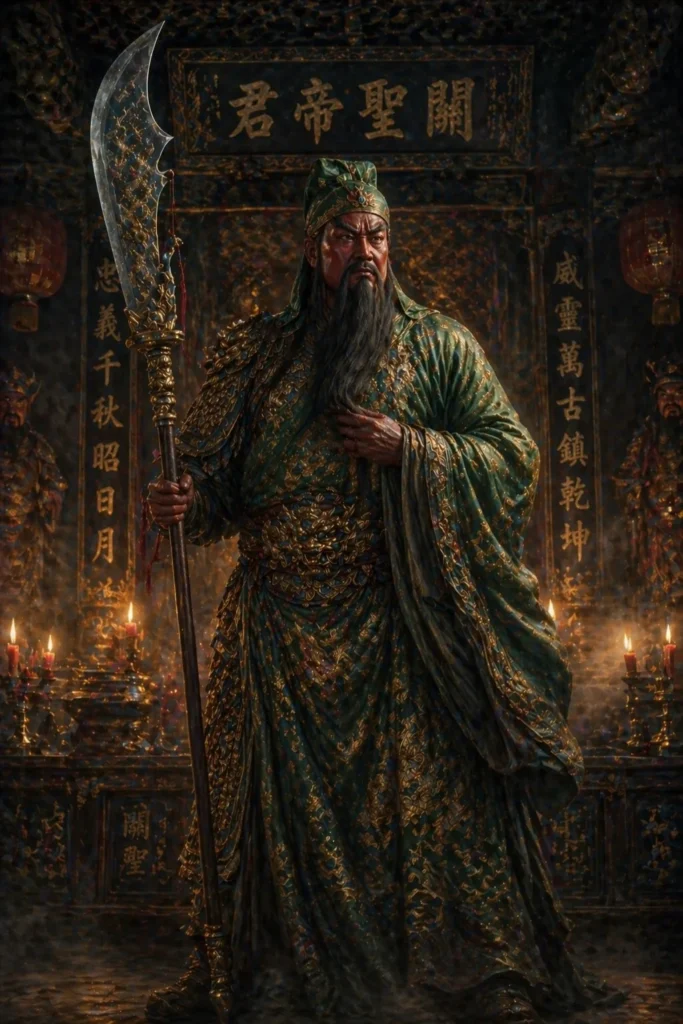
He was made a protective deity of warriors in the Song period and the “Wushen Caishen”, the “military god of wealth”, in the Ming and Qing periods. His area of responsibility lies less in promoting commercial success than in protecting business from theft, fraud and contract-breaking partners.
Business people often swear contracts before his image, because his well-known loyalty is regarded as a guarantee of business ethics. This is a remarkable constellation in the sociology of religion: a warrior becomes the guardian of trade.
Functional differentiation
The Caishen tradition distinguishes between “Wenshen Caishen” (civil god of wealth) and “Wushen Caishen” (military god of wealth), with Bi Gan and Fan Li assigned to the first category and Zhao Gongming and Guan Yu to the second.
Alongside this there exists a system of “Five Ways Caishen” (Wulu Caishen), in which Caishen is venerated from the five cardinal directions.
This conception goes back to the novel “Fengshen Yanyi” and the folk religion of the Ming and Qing periods and integrates the veneration of wealth into the cosmological scheme of the Five Phases of Transformation (wuxing). Caishen is therefore not a single figure but a systemic node at which several religious logics converge.
New Year customs
The central festival practice of the Caishen cult concentrates on the days around the Chinese New Year. On the fifth day of the first lunar month the “Reception of Caishen” (jie Caishen) is celebrated. On this day businesses traditionally open for the first time after the New Year break, fireworks are set off, incense is offered. The red couplets that are hung on the front doors at New Year frequently contain images of Caishen or references to him. A special practice is the “distribution of Caishen images”, in which wandering monks or beggars bring images of Caishen from door to door and receive in return a small gift, which is regarded as a bringer of fortune for the coming year.
Iconography
The standard iconographic form of Caishen shows an official in an official red robe, with a black official’s hat, a golden cap with bands pointing upward, and a Yuanbao (cast gold ingot) in his hand. He is frequently accompanied by four “little Caishen” (xiao Caishen), who are responsible for different segments of wealth.
In military form, above all as Zhao Gongming or Guan Yu, he wears armour and a weapon. The colour red dominates in both forms; it is the Chinese colour of fortune and stands in the Caishen cult for joyful expectation and success.
Caishen in the modern economy
In the Chinese diaspora and in the modern China of the reform era since 1978, the Caishen cult has experienced an astonishing renaissance. Even in strongly secular business milieus, for example in Shanghai or Hong Kong, Caishen shrines are widespread in restaurants, hairdressers, small shops and even corporate headquarters.
In terms of the sociology of religion, this is an interesting example of how traditional religion can be compatible with modern capitalist business ethics without the theological implications being worked out.
Classification in religious studies
Caishen is a textbook example of the “functional specialisation” of Chinese folk religion.
While the monotheistic religions tend to know one deity for all areas of life, the Chinese tradition organises religious reality by functions, each of which possesses its own deity or ensemble of gods. Wealth as a central area of function receives a pronouncedly multifaceted divine representation.
This multiplicity displays its own logic in the phenomenology of religion, in which function, ethical requirement and iconographic form are set in relation to one another. Edward Schafer, in “The Divine Woman” (Berkeley 1973) and in subsequent studies, characterised this functional specialisation as a typical feature of Chinese religiosity.
Sources and further reading
Primary sources: Fengshen Yanyi (“Investiture of the Gods”), 16th century; Shiji, Sima Qian, chapter “Huo Zhi Liezhuan” (“Biographies of the Wealthy”); Ming and Qing period temple inventories from Zhejiang and Jiangsu; folk-religious Wushen Caishen liturgies of the Qing period.
Secondary literature: Anne Birrell, “Chinese Mythology. An Introduction”, Baltimore 1993; Edward Schafer, “The Divine Woman”, Berkeley 1973; Mark Lewis, “Sanctioned Violence in Early China”, Albany 1990.
Caishen and the Kitchen God
An important aspect of the Caishen complex is his relationship to the Kitchen God (Zaojun, Zao Wangye), one of the most popular household deities of China. According to folk belief, the Kitchen God lives in the kitchen stove all year long and observes the behaviour of the family.
On the 23rd day of the 12th lunar month he ascends to heaven and reports to the Jade Emperor. Caishen, in turn, is according to some traditions responsible for the disbursement of the earthly “reward” that follows on the basis of this report.
This idea connects an ethical component (reward of the virtuous) with an economic one (increase of wealth). It is interesting in terms of the sociology of religion, because it shows how Chinese folk religion embeds economic success in a moral frame of reference.
Unlike in a purely liberal economic ethic, wealth here is not the result of individual rationality but a consequence of correct behaviour that is allocated by the heavenly bureaucracy.
Caishen in the secret societies
A peculiar line of the veneration of Caishen leads to the Chinese secret societies of the Qing period (17th to early 20th century).
These societies, among them the Triad (Sandian Hui), incorporated Guan Yu as god of wealth (Wushen Caishen) into their rituals. Entry into the society was accompanied by a blood oath before his image.
Business people who were members of a society swore their business relationships under the protection of Guan Yu, which made possible an extra-state binding of contracts.
This religious-legal construction was especially pronounced in the emigrant communities of southern China and extended, with migration into the diaspora, to Southeast Asia, North America and Australia.
Caishen temples worldwide
The spread of the veneration of Caishen has reached almost all parts of the world with the Chinese diaspora.
In the Geylang district of Singapore there is a well-known Caishen temple that was endowed by Chinese merchants in the 1930s. In the Chinatown of San Francisco, in Sydney and in Manila similar temples can be found.
In modern mainland China the economic reforms since 1978 have led to a revival of the veneration of Caishen.
In the strata of Shanghai, Shenzhen and Guangzhou, Caishen shrines can be found in practically every smaller shop, every restaurant and every hair salon.
This “return” of a religious practice believed to have been overcome has attracted considerable attention in research in the sociology of religion. It shows that the folk religions suppressed in the Mao era were not extinguished but only pushed into the hidden realm.
Confucian-Daoist embedding
The veneration of Caishen cannot be strictly assigned to one of the three main Chinese religions. It is predominantly folk-religious, but has both Daoist and (in the case of Guan Yu) Confucian components. The Daoist liturgy can integrate Caishen into its hierarchy of gods by treating him as a subordinate deity of the Jade Emperor.
Confucian ethics can take up Guan Yu as a model of loyal virtue in its own catalogue of virtues. This multiple affiliation is a typical feature of Chinese religiosity, in which the sharp boundary-drawings between “religions”, as they are customary in Western religious history, do not constitute an adequate instrument of description.
Florian Reiter and Stephen Bokenkamp independently pointed to the methodological difficulty of describing Chinese folk religion with Western concepts of religion.
Zhao Gongming in the Fengshen Yanyi
The novel “Fengshen Yanyi” (Novel of the Banishment of the Gods, probably end of the 16th century, attributed to Xu Zhonglin) is the principal literary source for the Caishen figure Zhao Gongming.
In the novel Zhao Gongming is a Daoist magician who fights on the side of the Shang dynasty against the rising Zhou dynasty. He rides a black tiger, carries a magical staff and controls the “Twenty-four Gold Pearls”, which he uses as throwing weapons.
After his death in battle he is posthumously assigned by the Jade Emperor to the “Court of the Dark Troops”, from where he, as Caishen, oversees earthly business affairs.
The veneration of Caishen in connection with Zhao Gongming has two aspects: on the one hand the literary-novelistic one, which depicts him as a lost hero, and on the other the folk-religious one, which invokes him as guarantor of wealth.
Liu Ts’un-yan (“Buddhist and Taoist Influences on Chinese Novels”, Wiesbaden 1962) analysed comprehensively the significance for religious history of the Fengshen Yanyi as a vehicle of the popular-religious spread of Daoist deities.
The Wushen tradition with Guan Yu
Guan Yu (died 220 of our era), the historical general of the late Han period, was venerated as a protective deity from the Song period onward and was integrated into the Caishen pantheon in the Ming period as “Wushen Caishen” (warrior god of wealth).
The connection of Guan Yu with the cult of wealth is a paradox that requires explanation in terms of the phenomenology of religion.
The folk-religious tradition derives it from several roots: from Guan Yu’s loyalty as a model of business ethics, from his protective function against robbers and dishonest competitors, and from the fact that the accountant’s trade in the Ming period had structural contacts with the military estate.
Prasenjit Duara (“Superscribing Symbols: The Myth of Guandi, Chinese God of War”, Journal of Asian Studies 47, 1988) described the rise of Guan Yu to a state-promoted cult as a key case for the sociology of religion of the late imperial period. Today Guan Yu is present as a protective figure in many East Asian business premises, from bank branches to restaurants.
Five-Ways Caishen and the provincial division
An important variant of the Caishen cult is the veneration of the “Five-Ways Caishen” (Wulu Caishen). This constellation knows one central Caishen and four further Caishen, each assigned to a cardinal direction.
The central Caishen is usually Zhao Gongming; the four gods of the cardinal directions are Xiao Sheng (East), Cao Bao (West), Chen Jiugong (South) and Yao Shaosi (North).
This fivefold structure is constructed in analogy to the Confucian administrative division of the empire and the Daoist Five-Mountains theology. It reflects the Chinese need for spatial symmetry in the religious sphere.
In southern Chinese folk belief and in the Southeast Asian diaspora communities the Wulu Caishen variant is especially widespread. The temples of the Hokkien communities in Penang, Malacca and Singapore maintain it as the main form.
The New Year liturgy and the reception of Caishen
The “reception of Caishen” (jie Caishen) is a central element of the Chinese New Year liturgy. It traditionally takes place on the morning of the fifth day after New Year, when businesses reopen after the festival week.
Families and companies light incense, burn red candles and recite Caishen petitionary formulas. In some places Caishen performers walk through the streets and hand out red envelopes or talismans.
This public form of the reception of Caishen has experienced an astonishing renaissance in modern China after the market reform of the late 1970s.
The renaissance stands in relation to the economic-political turn and shows that the religious structures under Maoism were not extinguished but had continued to exist beneath the surface.
Caishen in southern Chinese business ethics
In the southern Chinese business world, especially among the Hokkien, Teochew and Hakka, Caishen has a specific role as a cosmic co-partner.
In some branches of trade contracts are concluded ritually before an image of Caishen, and the annual accounting-closing ceremony (on New Year’s Eve or on the 24th of the 12th moon) is connected with an offering to Caishen.
This ritual embedding of business ethics in the Caishen cult has been interpreted by Hill Gates (“China’s Motor: A Thousand Years of Petty Capitalism”, Ithaca 1996) as a key to Chinese economic history.
It provides a cultural justification for the ethical binding of business partners and reduces transaction costs in an economy that historically could rely little on state-legal contract enforcement.
The Caishen temples as a touristic and religious phenomenon
Caishen temples are represented in almost every Chinese city, often as secondary cults in larger temple complexes, but occasionally also as independent sanctuaries.
Well-known Caishen temples are the Caishen Miao in Datong (Shanxi), the Caishen Dian in the Lama temple (Yonghegong) in Beijing and several temples in Taipei. In the diaspora the Caishen temples in Hong Kong, Singapore and Bangkok are especially prominent.
During the birthday celebration of Caishen on the fifth day of the first lunar month, these temples record visitor numbers of ten thousand to a hundred thousand pilgrims per day.
The touristic dimension has in the last two decades partly overlaid the religious one, which has led to a debate about the authenticity and commercialisation of the Caishen cult. This debate is documented by Mayfair Yang (“Chinese Religiosities”, Berkeley 2008) and David Palmer.
Frequently asked questions
Who is Caishen? The Chinese god of wealth, of economic prosperity and of successful business. He is not a single figure but a complex of several personifications, among them Zhao Gongming, Bi Gan, Fan Li and Guan Yu.
What is the difference between Wenshen and Wushen Caishen? The civil Caishen (Wenshen) is responsible for promoting economic success, the military Caishen (Wushen) for protection against theft, fraud and breach of contract. Bi Gan and Fan Li belong to the civil category, Zhao Gongming and Guan Yu to the military one.
When is Caishen particularly venerated? At the Chinese New Year. On the fifth day of the first lunar month the “Reception of Caishen” is celebrated, on which businesses traditionally open for the first time after the New Year break.
What does Caishen look like? In civil form as an official in a red robe with a black official’s hat and a golden Yuanbao in his hand. In military form (Zhao Gongming, Guan Yu) as a warrior in armour with a weapon.