Tara, Bodhisattva of Compassion
By Ralf Ittermann · last reviewed on
In Mahāyāna and especially in Tibetan Vajrayāna Buddhism, Tārā is a female bodhisattva figure of outstanding importance. Her name (Sanskrit tārā, “she who carries across”) points to her function as a saviour who brings beings across the “stream” of the cycle of existence (saṃsāra) to the far shore of liberation (nirvāṇa).
She appears in numerous manifestations, the best known being Green and White Tārā; in addition, twenty-one forms of Tārā are traditionally venerated.

Profile: Tara
Tara: the most important aspects at a glance. The following fields summarise origin, function, appearance, veneration, symbols and parallels.
Female bodhisattva of the Mahayana and especially of Tibetan Vajrayana. The oldest evidence comes from India and goes back to the 6th to 7th century CE. One narrative tradition has her arise from the tears of Avalokiteshvara; her own older Indian root was only later connected with him.
Tara, “She Who Ferries Across,” is a savior who brings beings across the “river” of the cycle of existence (samsara) to the far shore of liberation (nirvana). Green Tara responds quickly to invocation, while White Tara is associated with long life, health and protection from early death.
Green Tara is green in color, her right leg descends from the lotus seat, her right hand shows the gesture of wish-granting (varada-mudra), and her left holds a blue lotus flower (utpala). White Tara sits in the full lotus position and has seven eyes, one on the forehead and one each on the palms and soles.
The practice comprises recitation, visualization and offerings, in everyday life as well as in intensive retreat practice (drubchen). The “Praise to the Twenty-One Taras” is part of the daily liturgy in almost every Tibetan school. She is venerated in Tibet, Nepal, Mongolia, Buryatia and Kalmykia.
The root mantra “om tare tuttare ture svaha” is among the most frequently recited texts of Tibetan Buddhism. The blue lotus flower accompanies the wish-granting gesture of Green Tara, and the seven eyes of White Tara symbolize watchful compassion in all directions.
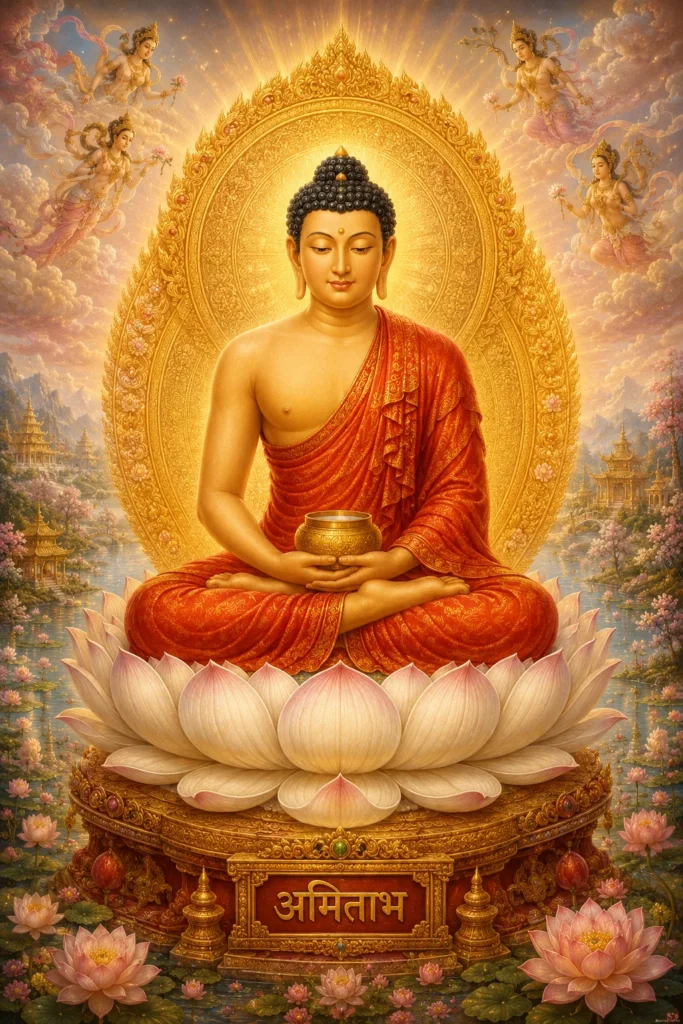
With Prajnaparamita, the personification of perfected wisdom, she shares the dignity of a “mother of all buddhas.” In parallel to Avalokiteshvara, who becomes the female-connoted Guan Yin in China, she is regarded as a manifestation of the activity of the Buddha Amitabha.
Origin and History
The oldest evidence for Tārā reaches back to the 6th and 7th centuries of our era in India.
Sculptures from Nālandā and from the Pāla empire (8th to 12th century) show her early on in the typical seated posture lalitāsana, with one leg hanging down as a sign of her readiness to rush to the aid of those who petition her.
The canonical texts are the Āryatārā-nāmāṣṭottaraśataka (One Hundred and Eight Names of the Noble Tārā) and the Tārā-Tantra. In Tibet the veneration is anchored through translation activity from the 8th century onward.
An important Tibetan tradition, transmitted above all in the Gelug school, links Tārā with the two Buddhist consorts of King Songtsen Gampo: Bhṛkuṭī from Nepal is said to embody Green Tārā, Wencheng from China White Tārā. This legend is historically unattested; it is a retrospective construction of the 11th and 12th centuries that gives iconic form to the introduction of Buddhism into Tibet.
David Snellgrove (“Indo-Tibetan Buddhism”, London 1987) assigns this episode to the late Indian fusion of bodhisattva veneration and tantric yidam practice.
Green and White Tara
Green Tārā (Sanskrit Śyāmatārā, Tibetan Drölma Jangu) is regarded as the active form that responds quickly to invocation. She is depicted green in colour, the right leg stepping down from the lotus seat; in her right hand she holds the gesture of granting wishes (varada-mudrā), in her left a blue lotus blossom (utpala).
Her mantra “om tāre tuttāre ture svāhā” is among the most frequently recited texts of Tibetan Buddhism. White Tārā (Sitatārā, Drölma Karpo), by contrast, is the meditative form associated with longevity, health and protection from premature death.
She sits in the full lotus posture; her body bears seven eyes, one on the forehead and one each on the palms and soles, which symbolise wakeful compassion in all directions.
In the iconographic tradition both forms are read as two aspects of the same female bodhisattva: active and contemplative, swift action and long life. The twenty-one Tārās of the Sarvatathāgatamātṛtārā-Viśvakarmabhava-Tantra differentiate this polarity further, from wrathful protective forms to peaceful healing forms.
Myth and Narrative Tradition
A Tārā story widespread in the Tibetan sphere tells of the princess Yeshe Dawa, who in a distant world-age resolved to attain enlightenment.
When her teachers advised her to assume a male body in a future birth, because such a body was better suited to becoming a Buddha, she vowed always to be born in female form until all beings are liberated.
This episode has been intensively discussed in modern feminist religious scholarship. Anne Klein (“Meeting the Great Bliss Queen”, Boston 1995) reads the narrative as a deliberate marking of a gender-specific promise of salvation that sets a counter-position within the patriarchally shaped Indian Mahāyāna.
In the Tārā-Tantra she is called “Mother of all Buddhas”, a dignity she shares with Prajñāpāramitā, the personification of perfected wisdom. The identification is not accidental; both figures embody the female dimension of enlightenment, in which insight and compassion are undivided.
Practice, Mantra and Ritual
Tārā practice encompasses recitation, visualisation and offerings. The root mantra “om tāre tuttāre ture svāhā” is used both in everyday life and in intensive retreat practice (drubchen).
The “Praise to the Twenty-One Tārās” (Namastāre ekaviṃśati-stotra) is part of the daily liturgy in nearly every Tibetan school. Visualisations follow the instructions of the respective sādhana, which precisely prescribe the form, colour, attributes and mandala of the deity.
In Tibetan Vajrayāna, Tārā is employed as a yidam (meditation deity). The practice aims to realise the qualitative attributes of the bodhisattva, not her outer form, within one’s own perception.
Stephan Beyer comprehensively documented the ritual corpus of a Tibetan monastic school in “The Cult of Tara” (Berkeley 1973), thereby presenting a reference work that remains central to this day.
Spread within Mahayana
Tārā is venerated not only in Tibet but also in Nepal, Mongolia, the Buddhist regions of Buryatia and Kalmykia, and historically in Java and in Chinese Vajrayāna. In East Asia she is less prominent; here the bodhisattva Avalokiteśvara, depicted as male or gender-indeterminate, dominates, becoming in China the female-connoted Guan Yin.
In the Theravāda Buddhism of Sri Lanka and Southeast Asia she is absent, since the tantric bodhisattva programme was not received there.
Significance within Vajrayana
In Vajrayāna, Tārā is assigned to the five Buddha families (kula), and in the later Tantras above all to the Padma (lotus) family of the Buddha Amitābha. She is regarded as a manifestation of his activity, parallel to Avalokiteśvara.
This systematic placement within the five Buddha families shows that Tārā stands within a theoretically articulated cosmic scheme and is not an isolated popular deity. Donald Lopez describes in “The Story of Buddhism” (2001) how this classification structures the Tibetan pantheon.
Tara and Avalokiteshvara
An important narrative tradition has Tārā arise from the tears that Avalokiteśvara weeps when he recognises the extent of the suffering of beings.
From one of the two lotus-tears Green Tārā emerges, from the other White Tārā. This genealogy links the two bodhisattvas as two aspects of compassion and makes Tārā the direct helper of Avalokiteśvara.
From the perspective of religious studies, this narrative is to be read as a later joining of two originally separate cult traditions. Tārā has her own, older Indian root, which was only linked with the Avalokiteśvara complex in the Pāla age.
Modern Reception
In Western Buddhism since the 1970s, Tārā has become one of the most prominent female figures, especially in communities shaped by Tibetan tradition.
The teacher Tsultrim Allione presented Tārā as an accessible practice figure for modern Western practitioners in “Women of Wisdom” (London 1984). In feminist Buddhist theology she stands for a female figure of enlightenment who is not mediated through a male being but acts independently.
Sources and Further Reading
Primary sources: Āryatārā-nāmāṣṭottaraśataka; Tārā-Tantra; Sarvatathāgatamātṛtārā-Viśvakarmabhava-Tantra; “Praise to the Twenty-One Tārās” (Namastāre ekaviṃśati-stotra).
Secondary literature: Stephan Beyer, “The Cult of Tara”, Berkeley 1973; David Snellgrove, “Indo-Tibetan Buddhism”, London 1987; Anne Klein, “Meeting the Great Bliss Queen”, Boston 1995; Tsultrim Allione, “Women of Wisdom”, London 1984; Donald Lopez, “The Story of Buddhism”, 2001; Robert Buswell and Donald Lopez, “Princeton Dictionary of Buddhism”, Princeton 2014.
The Twenty-One Forms of Tara
The twenty-one Tārās are a systematised canon of female bodhisattva manifestations, first described in detail in the Sarvatathāgatamātṛtārā-Tantra. Each form has its own colour, its own mudrā gesture and its own functional effect.
The first form, Pravīra Tārā, is the “swiftly rescuing” one and stands for rapid response to emergencies. The seventh form, Vajra Tārā, has a wrathful character and is invoked against hostile forces.
The eleventh form, Vaiśravaṇa Tārā, is associated with prosperity and wealth. The twenty-first, Paripūraṇī Tārā, is the “all-completing” one and stands for final realisation.
This list is not identical in all schools; the Nyingma and Gelug traditions have differing orders and emphases. Stephan Beyer documented in full the list widespread in the Karma Kagyü tradition in “The Cult of Tara”.
Tara in the Buddhist Tantra Classes
The Tibetan classification of Tantra distinguishes four or six classes, whose arrangement follows the degree of practice attainment and the complexity of visualisation. Tārā is treated in several of these classes.
In the Kriyā-Tantra, the lowest class, she is present as a venerable deity with a relatively simple ritual form. In the Yoga-Tantra she is employed as a yidam with her own mandala structure.
In the Anuttarayoga-Tantra, the highest class, she appears as the central figure of the Tārā-Tantra, which in the late Indian and Tibetan tradition is treated as an independent body of teachings.
This multiple placement within the Tantra classes is illuminating for the history of religion; it shows that Tārā is not a figure of one particular teaching tradition but occurs in several layers of tantric systematisation.
The Tibetan Iconography of Tara
The iconographic depiction of Tārā follows strict conventions that are laid down in detail in the sādhana texts (practice instructions). Green Tārā is depicted in the seated posture lalitāsana, the right leg lowered from the lotus seat.
Her right hand shows the varada-mudrā (granting of wishes), the left holds the stem of a blue utpala blossom that blooms over her left shoulder.
She is depicted youthful, sixteen years of age, with the adornment of a royal princess, thirteen ornaments and the characteristic tantric crown bearing five Buddha images.
White Tārā sits in the full lotus posture (vajraparyaṅka), likewise holding the right hand in varada-mudrā and the left before the chest in the gesture of the threefold refuge. Her body is endowed with seven eyes.
Tara and the Karmapas
The Karmapa lineage, the oldest tulku lineage of Tibet, has a special relationship to the veneration of Tārā. The first Karmapa, Düsum Khyenpa (1110 to 1193), according to tradition received direct Tārā visions that supported him on his path to enlightenment.
The second Karmapa vision is said to have been experienced by Karma Pakshi (1204 to 1283), who under the Yuan dynasty also taught Tārā practice at the Mongol court.
The Karma Kagyü tradition has since cultivated its own Tārā sādhana, which is still practised daily today in the monasteries of Rumtek (Sikkim) and Tsurphu (Tibet). This connection shows how the veneration of a bodhisattva does not remain abstractly theological but is embedded in concrete institutional lineages.
Tara in the Sadhanamala
The Sādhanamālā, a collection of 312 tantric visualisation texts from the 11th and 12th centuries, is the most important Indian source on Tārā practice.
No fewer than 21 texts of this collection are dedicated to Tārā, in several colour forms and with differing mantra structures. Benoytosh Bhattacharyya critically edited the texts in 1925 and 1928 in Baroda and systematised them in “Indian Buddhist Iconography” (Calcutta 1958).
The Sādhanamālā texts presumably originate from the monasteries of Vikramaśīla and Nālandā, whose teachers were among the initiators of late Indian Tārā theology. Most of these sādhanas were translated into Tibetan soon after their composition and are today canonical in the Kangyur and Tengyur collections.
The Transmission through Atisha
The Bengali scholar Atiśa Dīpaṃkara Śrījñāna (982 to 1054) had a particularly close relationship to Tārā. His “Bodhipathapradīpa” (Lamp for the Path to Enlightenment) is regarded as the founding text of the Kadam school. Atiśa introduced Tārā practice into Tibet, where it passed via Drom Tönpa and the subsequent Kadam masters into the Gelug school.
Tradition reports that Atiśa venerated Tārā as a personal protective deity (yidam) and always carried her image with him. Several Tārā hymns attributed to him are preserved in the Tibetan Tengyur.
Robert Beer (“The Encyclopedia of Tibetan Symbols and Motifs”, Boston 1999) shows that Atiśa’s Tārā practice definitively canonised the Central Asian Tārā iconography in Tibet.
Cittamani Tara and the Secret Lineage
A particular esoteric lineage of Tārā practice is the Cittamaṇi Tārā (Tārā as the “wish-fulfilling jewel of the mind“). According to tradition she was received in a vision by the Indian mahāsiddha Takphu Garwang and belongs to the Anuttarayoga-Tantra class. This form became prominent in the Gelug context through Pabongka Rinpoche (1878 to 1941).
The first Dalai Lama, Gendün Drub, composed an extensive sādhana that is today among the principal practices of the Gelug school. Cittamaṇi Tārā is green, sits in the posture of royal ease and holds lotus and vajra.
The practice combines devotion to Tārā with the completion-stage yogas of the Anuttara-Tantra, which structurally makes it the highest level of Tārā realisation.
Tara in the Indo-Tibetan Monasteries
In the great Tibetan monasteries of Ganden, Drepung and Sera, the Tārā liturgy is cultivated in a fixed annual cycle.
The “Tārā Pūjā” (sgrol ma’i mchod pa) is among the most frequently recited liturgies and is performed both in the spring assembly of the Mönlam Chenmo and on special occasions such as illness or political crisis.
The liturgy follows a fixed structure with praise, mandala offering, mantra recitation and repetition of the vidyā. The number of repetitions varies from 100 to 100,000, depending on occasion and intention.
Robert Thurman (“Essential Tibetan Buddhism”, San Francisco 1995) described this liturgy as “the Tibetan counterpart to the Christian rosary”, which is tenable in the sense of a formally comparative phenomenology of religion.
The Khadiravani Tara
A form especially prominent in the Sādhanamālā corpus is the Khadiravāṇī Tārā, “Tārā from the Khadira forest”. She is connected with the acacia tree (Khadira), beneath which she is said by tradition to have appeared on Mount Potala. The images show her green in colour, flanked by Mārīcī (sun) and Ekajaṭī (moon).
This triad is an older iconographic constellation that frequently occurs in the Pāla-period sculptures of eastern India, for instance in finds from Bihar and Bengal.
The later Tibetan tradition adopted this constellation and transferred it to wall paintings, for example in Tabo and Alchi (Western Himalaya, 11th century). Roger Goepper, in his studies on Alchi (“Alchi. Buddhas, Göttinnen, Mandalas”, Cologne 1982), documented the iconographic continuity between Indian models and Tibetan execution.
Tara and the Space for Women in Buddhism
The Tārā tradition is remarkable in the history of religion in that here a female figure of enlightenment stands fully and equally alongside the male bodhisattvas.
Tārā is not a “consort” (prajñā) of a male principal, but an independent Buddha form. In the 12th century the Tibetan yoginī Machig Labdrön composed hymns to Tārā that are still recited today.
Sarah Harding (“Machig’s Complete Explanation”, Ithaca 2003) has documented this lineage as one of the few authentically female voices of Tibetan religious literature. The modern Buddhist women’s movement frequently invokes Tārā’s avowal, “Until the world is empty, I shall be a Buddha in female body”.
Frequently Asked Questions
Is Tārā a Buddha or a bodhisattva? She is a bodhisattva, that is, a being on the path to enlightenment who has vowed to bring the other beings along to liberation.
In some later tantric texts she is also treated as an already fully enlightened female Buddha, but this distinction has little bearing on practical veneration.
What is the difference between Green and White Tārā? Green Tārā is the active form; she is invoked in acute difficulties. White Tārā is the meditative form; she is associated with longevity, health and deepened understanding. Both are regarded as two aspects of the same bodhisattva.
Which mantra is assigned to Tārā? The root mantra is “om tāre tuttāre ture svāhā”. It is one of the most frequently recited mantras in Tibetan Buddhism and may be recited in any situation of life.
Does Tārā have a connection to the Indian goddess Durgā? In the history of religion the connections are contested. Both are female protective figures with martial aspects.
Structural parallels cannot be ruled out, but a direct borrowing cannot be demonstrated. Anne Klein and David Snellgrove see Tārā as an independent Indian bodhisattva development with only peripheral contacts to the Śākta tradition.