Hebat, Hurrian Supreme Goddess and Consort of Teshub
By Ralf Ittermann · last reviewed on
Hebat is the highest female deity of the Hurrian pantheon and consort of the weather god Teshub. In the Hittite imperial pantheon she was identified with the Sun Goddess of Arinna and was regarded as a royal protective goddess. Queen Puduḫepa, herself a priestess of Hebat, made her the goddess of the realm.
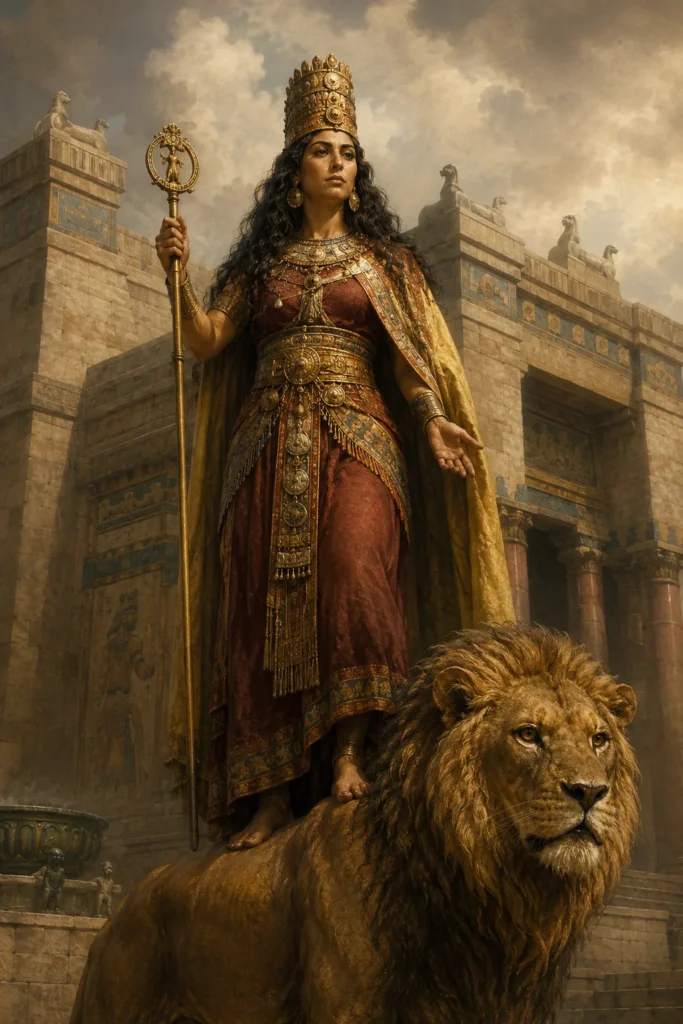
Profile: Hebat
Hebat: the most important aspects at a glance. The following fields summarise origin, function, appearance, veneration, symbols and parallels.
Hebat is the highest female deity of the Hurrian pantheon and was originally the city goddess of Aleppo. In the 2nd millennium BC she rose to become imperial goddess of the Hurrians and of Syria. In Hittite imperial religion she has been the female pole since the 14th century BC and was identified with the sun goddess of Arinna.
Hebat’s function covers protection of the king, protection in pregnancy, healing and family order. She protects queen, family and dynasty and forms the centre of the family triad with Teshub and Sarruma. She was asked for help in difficult births, infant illnesses and sterility.
Hebat appears as an enthroned or striding goddess in a long pleated garment with a high crown (polos) and a sun disc as attribute. In Yazılıkaya chamber A she stands at the centre of the female procession of gods opposite Teshub, on a leopard or a mountain. In Karkamiš she appears as an enthroned queen.
Her main cult was in Kizzuwatna, her most important sanctuary in the city of Kummanni; she was also worshipped in Aleppo and Šamuḫa. Queen Puduḫepa established an official cult with Hurrian priests in Ḫattuša. Among the most important festivals were the purification ritual itkalzi and the great spring festival.
Her sacred animal is the leopard or panther, in some depictions also the lion. These animals link her with ancient Syrian mother goddesses. Statuettes of her were set up in houses as apotropaic objects, and on royal seals she appears with her animals as protectress of the queen.
Hebat is closely related to the Akkadian Ištar and the Northwest Semitic Aštarte. In the Ugaritic pantheon Athirat (Asherah), the wife of El, corresponds to her. As a royal protective goddess she resembles the sun goddess of Arinna. With the Greek Hera there are parallels without demonstrable dependence.
Classification and Brief Profile
Hebat (sometimes also written Ḫebat, Hepat or Ḫepatu) is the highest female deity of the Hurrian pantheon. In Geschichte der hethitischen Religion (1994), Volkert Haas showed that she was originally the city goddess of Aleppo and rose over the course of the 2nd millennium BC to become the Hurrian-Syrian goddess of the realm.
In Hittite imperial religion from the 14th century BC onward she is the female pole of the imperial divine order.
In terms of religious history she is a protective goddess of kingship, a guarantor of the dynasty and of the treaty order. Queen Puduḫepa, the consort of Ḫattušili III, was originally a priestess of Hebat in Kizzuwatna; she made the Hebat cult the official protective cult of kingship.
In Life and Society in the Hittite World (2002), Trevor Bryce described this political-religious configuration in detail. This ‘Hurrianization’ of the Hittite pantheon in the 13th century BC is among the best-documented processes in the religious history of the Old Near Eastern Late Bronze Age.
Hebat’s function encompasses the protection of kingship, the protection of pregnancy, healing and family order. She is the theological center of a Hurrian family triad with Teshub and Sarruma.
Within the Hittite tradition she thus occupies a position comparable to Arinna, with whom she was officially identified; the theological merging of two female supreme goddesses is a remarkable process.
Name and Etymology
The name Hebat belongs to the Hurrian stratum of the texts. An etymology is not definitively established; one plausible interpretation connects it with the Semitic ḫbb ‘to love’ or with the Hurrian ḫib- ‘fresh, young’. In the cuneiform texts she appears as Ḫe-pa-at, Ḫe-bat, occasionally logographically as DGAŠAN (‘Lady’).
In Akkadian she is identified with Ištar, in Hittite with the Sun Goddess of Arinna.
This multiple identification is explicitly addressed in the famous Puduḫepa prayer: ‘In Ḫatti you have given yourself the name Sun Goddess of Arinna; in the land that you created as the Land of the Cedar, you have given yourself the name Hebat.’ Itamar Singer commented on this passage at length in Hittite Prayers (2002).
In West Semitic the name appears as Ḫebat in Ugarit and as Ḫipat in Amorite personal names; the goddess was thus venerated widely and across vast areas. In Religions of Second Millennium Anatolia (2009), Piotr Taracha documented her diffusion in detail.
In Mari she appears as Ḫebat in god lists of the 18th century BC; in Alalaḫ and Nuzi (15th century) she is attested as an important goddess of the pantheon.
Description and Iconography
Hebat appears as an enthroned or striding goddess in a long pleated robe, with a tall polos crown and a sun disk as her attribute.
In Yazılıkaya Chamber A she stands at the center of the female divine procession, facing Teshub, standing on a leopard or a mountain. Beside her stands her son Sarruma, likewise on a leopard.
Her sacred animal is the leopard or panther, in some depictions also the lion. This animal iconography links her with Old Syrian mother goddesses and distinguishes her from the Mesopotamian Ištar, whose animal is the lion. In Materia Magica et Medica Hethitica (2003), Volkert Haas edited magical and medical rituals.
In Karkamiš and other Late Hittite sites Hebat appears on reliefs as an enthroned queen; her iconography became, in the Iron Age, a supra-regional Syrian-Anatolian pictorial tradition.
On royal seals from Ḫattuša she frequently appears with her animals as the protectress of the queen. Bronze figurines of an enthroned goddess with a polos crown from Ḫattuša and Šamuḫa are mostly identified as Hebat.
Mythological Narratives
Hebat recedes somewhat in the great myths of the Kumarbi cycle; in the ‘Song of Ullikummi’ (CTH 345) she is the anxious mother who wants to bring her son Sarruma to safety when the stone giant threatens to conquer the heavens. Her emotional intervention contrasts with the heroic activity of Teshub.
In the ritual myth of the ‘Vanishing Sun God’ (CTH 323) she appears as a healing and calming goddess, parallel to Kamrušepa and the Sun Goddess.
Her mythical role is on the whole less heroic than advisory, protective, ordering. In a fragmentary Hurrian myth, the ‘Song of Release’ (CTH 789), she appears as a mediator between Teshub and the inhabitants of Ebla.
In the Puduḫepa prayer (CTH 384) she appears as the personal protective goddess of the queen, whose voice addresses the goddess directly and, with theological argumentation, asks for the king’s healing.
Itamar Singer translated and commented on the prayer in Hittite Prayers (2002); it is among the literarily and theologically outstanding texts of Hittite religion. The queen speaks to the goddess as to a familiar patroness and appeals to their shared priestly past in Kizzuwatna.
In the Hurrian festival texts Hebat additionally appears accompanied by her daughters Allanzu and Kunzišalli, who are regarded as protective goddesses of the queen. They perform ritual dances and present Hebat with offerings from the hands of the queen.
These festival songs, composed in the Hurrian language, are among the most important linguistic testimonies of Hurrian in general and were published in the edition by Volkert Haas and Ilse Wegner.
In the ‘Songs of Release’ (CTH 789) too, a bilingual Hurrian-Hittite narrative collection, Hebat appears as the consort of Teshub and as the mother of Sarruma in an advisory role.
Cult and Veneration
Hebat’s main cult lay in Kizzuwatna, a region of Hurrian character in southeastern Anatolia (today the Çukurova plain). Her most important sanctuary was in the city of Kummanni (presumably today Comana Cappadociae near Şar). In addition she was venerated in Aleppo, in Šamuḫa and at numerous smaller sites.
In the Hittite imperial cult she received a central position through Puduḫepa. Queen Puduḫepa imported Hurrian rituals, Hurrian priests and Hurrian cult objects into Ḫattuša and established an official Hebat cult at the highest imperial level.
Itamar Singer and Volkert Haas have studied this process of Hurrianization of the Hittite pantheon in the 13th century BC in detail.
The most important Hebat festival was the itkalzi purification ritual and the great spring festival. The priestly organization comprised Hurrian priests (kaluti), female singers and female dancers.
Hebat was also a protective goddess of pregnant women; her invocation in birth rituals is well attested. In the Hurrian itkahi oath rituals her name was invoked together with that of her consort Teshub and her son Sarruma in the divine triad.
A special cultic role was held by Hebat in the Late Hittite city-states of Karkamiš, Maraş and Aleppo of the Iron Age. Hieroglyphic Luwian royal inscriptions of the 10th and 9th centuries BC name Hebat as a royal protective goddess and guarantor of oaths.
The continuity of Hurrian religion in these ‘Neo-Hittite’ city-states is a key witness to the religious-historical persistence of Old Anatolian traditions beyond the end of the Bronze Age.
Protective Practice and the Apotropaic
Hebat was the protective goddess of the queen, of the pregnant woman, of the family and of the dynasty. In pregnancy rituals she was invoked together with the ‘fate goddesses’ (Gulšeš) and with the Hattic mother goddess Ḫannaḫanna.
In Materia Magica et Medica Hethitica (2003), Volkert Haas edited numerous birth rituals in which Hebat appears as protectress. In difficult births, in infant illnesses and in cases of sterility she was asked for help.
Apotropaically, Hebat statuettes were set up in houses; in the Hurrian oath rituals her name was invoked together with that of her consort Teshub.
The itkahi oath ceremony linked her name with those of Teshub and Sarruma in a divine triad. On the royal seals of Tudḫaliya IV and of Puduḫepa the Hurrian triad appears as a protective figure above the royal name.
From a religious-studies perspective, Hebat’s protective function is strongly oriented toward family and dynasty; she is not primarily an individual protective goddess, but in contexts of birth and healing she was also invoked privately. The iWell Guard regards Hebat as a historical, religious-historical figure and refrains from references to modern healing promises.
In Hittite incantation texts of the ‘Old Woman’ Hebat is frequently invoked as ‘the Queen’, often in connection with the Šaušga of Šamuḫa and the Sun Goddess of the Earth. This triad of female deities forms the backbone of Hurrian-Hittite women’s protective ritual practice.
Parallels in Other Cultures
Hebat is closely related to the Akkadian Ištar and the Northwest Semitic Aštarte; in her function as a royal protective goddess she resembles the Sun Goddess of Arinna. In the Ugaritic pantheon she corresponds to Athirat (Ašerah), the wife of El, with whom she shares the function of mother of the gods.
In terms of religious history, Hebat is an example of the Mediterranean tradition of the supreme goddess of the Bronze Age, which in the Iron Age was differentiated into numerous local goddesses.
In the Phoenician pantheon too there are, with Tanit and Astarte, goddesses of similar function, though in a markedly different mythological configuration.
The Greek Hera, the consort of Zeus, has parallels to Hebat in her function as a goddess of kingship; a direct religious-historical dependence is, however, not demonstrable.
In From Hittite to Homer (2016), Mary Bachvarova pointed to structural correspondences without postulating a genealogical line. In the later Carthaginian religion with Tanit, the type of the female goddess of the realm continues in the western Mediterranean.
The interweaving of Hebat with local Anatolian mother goddesses such as Ḫannaḫanna and with the Hattic city goddesses is the subject of more recent research by Petra Goedegebuure and Magdalena Kapełuś, who have studied the priestly organizations in Sapinuwa and Kuššara in detail.
Present-Day Reception and Research
Hebat research is today well developed; important contributions have been made by Volkert Haas, Itamar Singer, Piotr Taracha and Gary Beckman. Singer’s edition of the Puduḫepa prayer is the standard reference.
In From Hittite to Homer (2016), Bachvarova took up the Greek parallels. Current archaeological research at Late Hittite sites in Karkamiš, Maraş and Aleppo expands the picture of Iron Age Hebat veneration.
In modern Turkey Hebat is scarcely received in popular culture; in scholarly discussion she is an important example of Hurrian religion and of the royal protective-goddess tradition of the Late Bronze Age. A spiritual revival in the neo-pagan sense is absent; Hurrian religion is too foreign and too mythologically complex for modern forms of piety.
In religious studies she is today regarded as a central object of study for Hurrian-Hittite religious dynamics. The iWell Guard records her as a historical figure and not as a present-day addressee of protection.
Current research focuses on the precise identification of her city Kummanni, on the relationship to the ‘fate goddesses’ tradition and on the comparative study of female supreme goddesses in the Ancient Near East.
A particular research question is the identification of Hebat with the later Carthaginian Tanit or with the Greek Hera. The religious-historical discussion in Corinne Bonnet and others shows that such equations are tenable only functionally, not genealogically.
Literature and Sources
The following selection brings together the most important standard works on Hebat research. It encompasses editions, translations and religious-historical syntheses that open up the material for deeper engagement.
Itamar Singer’s Hittite Prayers is the first entry point as a collection of primary sources; Volkert Haas’ Geschichte offers the contextual embedding; Bachvarova’s work the comparative perspective. Anyone who wishes to take up the Hurrian festival texts will find in Volkert Haas and Ilse Wegner the most important editions.
Hebat in the Hittite State Cult and the Relief Procession of Yazılıkaya
The most impressive evidence for the standing of the goddess Hebat in the Hittite realm is the rock sanctuary of Yazılıkaya near the capital Hattuša in present-day central Anatolia.
In an open rock chamber two divine processions move toward each other in a long relief. At the central point the weather god Teššub and, facing him, Hebat come together, she standing on a panther or lion, behind her her son Šarruma.
The reliefs are usually dated to the second half of the 13th century BC, to the time of the kings Tudhalija IV and his circle.
They show that Hebat was not a marginal figure in the imperial pantheon of the late Hittite period, but stood at a central place as the consort of the supreme weather god.
This is all the more remarkable because Hebat is originally not a Hittite but a Hurrian goddess, whose cult derives above all from the North Syrian region, in particular from Aleppo.
She owes her rise in part to Queen Puduhepa, the consort of Hattušili III. Puduhepa came from a priestly family of the South Anatolian city of Lawazantija and promoted Hurrian cults.
In her prayers she equates the Hittite Sun Goddess of Arinna with Hebat, a classic case of theological merging that shows how political marriage alliances changed the world of the gods. Yazılıkaya has been researched since the 19th century; important interpretive work was provided, among others, by Kurt Bittel and later Volkert Haas.
Hebat in the Ritual Texts and the Language of the Hurrian Prayers
Beyond the pictorial work, Hebat is attested in numerous cuneiform texts from the archives of Hattuša. The clay tablets have been recovered since the German excavations from 1906 under Hugo Winckler and are published in edition series such as the Keilschrifturkunden aus Boghazköi.
Hebat appears in festival rituals, in offering lists and in prayers, often in fixed sequence with Teššub and Šarruma as a kind of divine family.
It is linguistically interesting that many of these texts contain Hurrian passages, in part entire Hurrian hymns that were written down in Hittite cuneiform.
Hurrian belongs, together with Urartian, to the Hurro-Urartian language family; its grammar was only gradually opened up over the course of the 20th century, decisively through the works of Emmanuel Laroche and later Ilse Wegner and Gernot Wilhelm.
Hebat’s name itself, in Hittite spelling mostly Ḫepat, belongs to this Hurrian stratum; attempts to interpret it, for instance as a connection to a place name, remain uncertain.
The ritual texts further show that Hebat was not only venerated theologically but was practically integrated into the festival calendar. At great imperial festivals she received her own offerings, her statue was moved, food and drink were presented to her.
This sober ritual bureaucracy is more valuable to research than any narrative myth, because it shows how an originally foreign goddess was anchored organizationally and financially within the Hittite state.
Literature (Selection)
- Volkert Haas: Geschichte der hethitischen Religion (Leiden 1994)
- Itamar Singer: Hittite Prayers (SBL 2002)
- Piotr Taracha: Religions of Second Millennium Anatolia (Wiesbaden 2009)
- Harry A. Hoffner Jr. (hg. v. Gary M. Beckman): Hittite Myths (SBL 1998)
- Volkert Haas: Materia Magica et Medica Hethitica (Berlin 2003)
- Trevor Bryce: Life and Society in the Hittite World (Oxford 2002)
The written sources on Hebat range from Hurrian ritual tablets to Hittite state treaties, in which she is invoked as a supreme goddess alongside Teshub as guarantor of the royal oaths.
Related key terms: Hebat Hurrians supreme goddess Puduḫepa Kizzuwatna Kummanni Sun Goddess.
iWell Guard and Protective Traditions
iWell Guard ties in with the cultural-historical tradition of portable protective objects, in the tradition of Hittite and many other cultures worldwide. 41 layers, solid gold, platinum, silver, manufactured in Germany. 30-day right of return.
Personal experiences may vary. Not a medical device. No healing promise.