Arinna, sun goddess and highest imperial goddess of the Hittites
By Ralf Ittermann · last reviewed on
The sun goddess of Arinna, Hittite D UTU URU Arinna, is the highest female deity of the Hittite state pantheon. In the prayers of Queen Puduḫepa she is invoked as ‘Queen of Ḫatti, Lady of the Lands’ and is regarded as the protective goddess of the great kings and the guarantor of kingship.
Profile: Arinna
Arinna: the most important aspects at a glance. The following fields summarise origin, function, appearance, veneration, symbols and parallels.
The sun goddess of Arinna is of Hattic, that is pre-Indo-European, origin and belongs to the oldest layer of the Anatolian pantheon. The Hittite Great Kings officially elevated the city goddess to the highest female deity of the empire. Her Hattic personal name is Wurušemu.
Arinna is protective goddess of the Great Kings and forms with Tarhunna the supreme divine pair. She is regarded as sovereign of the day and guarantor of royal dignity. The Great King calls himself “my Sun”, that is, son or deputy of the goddess.
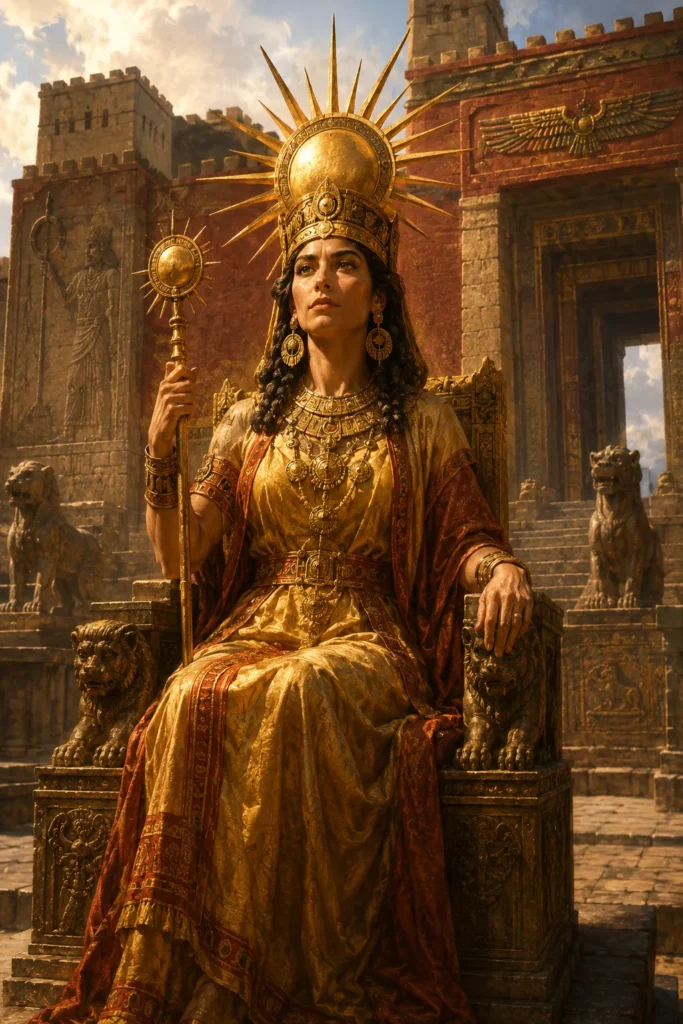
Arinna appears as an enthroned goddess in a long garment with a high crown (polos) and a sun disc as attribute. In Yazılıkaya she stands at the head of the female procession of gods and faces Tarhunna. Free-standing cult images have hardly survived.
Among others, the spring festival AN.TAḪ.ŠUM was dedicated to her, a festival cycle of 38 days in which the Great King visited her cult sites in Ḫattuša, Arinna and Nerik. At the burial of a king, after a ritual of 14 days he joined her in heaven under her protection.
Her symbol is the sun disc, which on royal seals appears as a winged disc above the king’s name and at the same time as a protective formula. An eagle on her hand and a lioness as mount are attested in isolated cases. Sun discs were worked into door lintels and window lintels as protection.
In Hurrian, Hebat corresponds to her, whom Queen Puduḫepa explicitly equates with her in her prayer. As a royal protective goddess she is also comparable to Ištar. As a female sun she stands closer to the Germanic Sól, the Lithuanian Saulė and the Japanese Amaterasu than to the male Šamaš.
Classification and short profile
The sun goddess of Arinna, in short Arinna or Wurušemu, belongs to the oldest layer of the Anatolian pantheon and is of Hattic origin, that is, pre-Indo-European. In Geschichte der hethitischen Religion (1994), Volkert Haas showed that the Hittite great kings officially elevated the Hattic city goddess of Arinna to the highest female imperial deity.
Together with Tarhunna she forms the supreme divine couple of the empire and holds a prominent position in the festival calendar, in the state treaties, and in royal theology.
In her function she is not the sun as a celestial body, but the sovereign of the day and the guarantor of royal dignity. In many inscriptions the Hittite great king calls himself ‘My Sun’, that is, the son or representative of the sun goddess.
In Life and Society in the Hittite World (2002), Trevor Bryce described this theological construction in detail and showed how it grounds the legitimation of kingship.
Arinna differs from the Mesopotamian sun god Šamaš in that she is female; in Anatolia the sun was female, an archaic gender attribution that coincides with the Hattic to Indo-European language boundary and is remarkable in the history of religion.
The Hittite tradition thereby preserves a pre-Indo-European Anatolian heritage within an Indo-European-shaped state religion, a syncretism that Piotr Taracha presented systematically in Religions of Second Millennium Anatolia (2009).
Name and etymology
The name Arinna is a place name; the goddess is named after the city in which her main sanctuary was located.
The exact location of Arinna has to this day not been clearly identified archaeologically; proposals focus on sites in northern Anatolia, in particular Alaca Höyük and Sapinuwa. The city name Arinna itself is of Hattic origin and probably means ‘spring’ or ‘well’.
Her Hattic proper name is Wurušemu, literally perhaps ‘Mother of the Earth’ or ‘Mother of the Land’. The Hittite translation is D UTU URU Arinna, ‘Sun deity of the city of Arinna’. In Hurrian she is identified as the equivalent of Hebat, an equation that Queen Puduḫepa explicitly formulates in her famous prayer: ‘Sun goddess of Arinna, my lady, you are queen of all lands; in Ḫatti you gave yourself the name sun goddess of Arinna, in the land that you created as the land of the cedar you gave yourself the name Hebat.’
The etymology and the theology of the name were discussed in detail by Piotr Taracha in Religions of Second Millennium Anatolia (2009).
A particular difficulty is that D UTU can denote not only the sun goddess of Arinna, but also other solar beings such as the ‘Sun goddess of the Earth’ (chthonic) or the male Luwian sun deity Tiwaz. The exact identification must in each case be inferred from the context.
Description and iconography
In images Arinna appears as an enthroned goddess with a long, pleated robe, a high polos crown, and a sun disk as an attribute.
In Yazılıkaya, the great rock sanctuary near Ḫattuša, she stands at the head of the female procession of gods and faces her male counterpart Tarhunna in the center of the main chamber A. The winged sun disk above her head is an old Mesopotamian and Egyptian symbol that the Hittite pictorial tradition adapted.
On numerous royal seals, for instance the bullae from the Nişantaş archive, the sun disk appears as a royal insignium; there it stands for the protection of the sun goddess over the ruler.
The animal form of the goddess is more rarely attested; individual texts speak of an eagle sitting on her hand, as well as of a lioness as her mount. In the Hattic to Hittite standard cult, those ring-shaped bronze standards with animal finials from Alaca Höyük, the sun disk is used as a central element.
Striking is the small number of free-standing cult images of Arinna. Hittite theology concentrated its iconography on the state-controlled rock reliefs and on seals; statue images in the Mesopotamian sense are barely preserved.
Temple inventories, however, name ‘the sun disk of gold’ and ‘the image of the sun goddess in silver’ as important cult objects, of which nothing has physically survived. In Materia Magica et Medica Hethitica (2003), Volkert Haas described the iconographic tradition in detail.
Mythological narratives
Unlike Tarhunna or Telipinu, Arinna is barely attested as an acting figure in myths. She appears above all in prayers, hymns, and treaty texts.
The most important source is the prayer of Queen Puduḫepa (CTH 384), in which the great queen asks the goddess for the healing of her ailing husband Ḫattušili III. The prayer contains a detailed theology of the goddess as guarantor of kingship and is one of the most literarily elaborate texts of Hittite religion.
In the myths Arinna usually appears as ‘mother’ of other gods, above all as the mother of the weather god of the sky and of the moon and grain goddess Mezzulla, who is perhaps a hypostasis of herself.
In an Old Hittite festival ritual she is portrayed as an arbiter in the council of the gods. In a fragmentarily preserved text she laments the disappearance of Telipinu and commissions an eagle to search for him; this eagle roams the world but does not find him.
In the history of religion this paucity of myths is typical of the Hittite pantheon configuration: the supreme imperial gods are less narrative figures than legal and political guarantors.
Mythic activity is shifted onto second generations such as Telipinu, Sarruma, or Ullikummi. In Hittite Myths (1998), Harry A. Hoffner Jr. highlighted this as a typical feature of the Hittite state religion.
Cult and veneration
The cult of the sun goddess of Arinna was closely intertwined with kingship. In the Hittite festival calendar the great spring festival AN.TAḪ.ŠUM was dedicated to her, among others, a 38-day festival cycle whose texts are readily accessible in the edition by Volkert Haas and Liane Jakob-Rost.
During the festival the great king visited the most important cult sites of the goddess in Ḫattuša, Arinna, and Nerik in a ritualized sequence of travel.
Her temple in Ḫattuša is referred to in the texts as the ‘temple of the sun goddess’ and is identified with the Great temple in the Lower City district.
In the inventory there are silver and gold sun disks, cult robes, bull figures, and clay balls whose ritual function has to this day not been fully clarified.
In The Organization of the Anatolian Local Cults (2003), Joost Hazenbos analyzed the priestly hierarchy: at its head was a SANGA priest, to whom several female priestesses and cult personnel were subordinate.
A special feature is the burial of the kings under her patronage: the šalliš waštaiš, ‘the great sin’, as the Hittite euphemism for the death of the king goes, was carried out with a 14-day burial ritual that describes the transformation of the king into a divine being under the protection of the sun goddess.
The edition by Heinrich Otten, Hethitische Totenrituale (1958), remains authoritative to this day. In the course of the ritual ‘the king becomes a god’, as the Hittite formula says; he leaves the world of mortals and joins the sun goddess in the sky.
Protective practice and the apotropaic
Arinna was the protector of the king and of kingship; her apotropaic function concerned the imperial dynasty less than the individual person. On royal seals the winged sun disk stands above the royal name; it was at once an identity sign and a protective formula.
In vassal treaties she is invoked as a high-ranking deity together with Tarhunna, with the same penalty formula: a breach of loyalty draws down her destructive wrath.
In the private sphere the veneration of the sun goddess is less well documented. Occasionally there appear women who, with the help of the ‘Old Woman’ (ḪAR.ḪAR), direct a ritual to the sun goddess, for instance in cases of infertility or serious illness.
The Sun goddess of the Earth, an independent hypostasis with a chthonic, underworldly function, is also frequently invoked in these rituals; she is not identical with the sun goddess of Arinna, but is theologically closely related.
The transition from the daytime sky to the underworld takes place through the double function of the sun: morning and evening it crosses the horizon and thereby passes between the worlds.
From a religious-studies perspective the double function of the sun goddess as heavenly queen and chthonic ruler of the underworld is remarkable; it shows the close interweaving of day, night, and death in the Hittite worldview. iWell Guard regards Arinna as a historical figure of religious history without any present-day connection to healing claims.
Apotropaic sun disks were worked into door and window lintels, a practice attested archaeologically at several Hittite sites.
Parallels in other cultures
The female gender assignment of the sun is unusual in the Ancient Near East; in Akkadian Šamaš is male; in Ugaritic, by contrast, Šapaš is grammatically feminine and a goddess, as likewise in Phoenician Šapšu. The Hattic tradition stands here closer to the Germanic Sól, the Lithuanian Saulė, and the Japanese Amaterasu.
In the history of religion the female gender of the sun is interpreted as an archaic feature that was pushed back by the influence of patriarchal storm-god theologies.
Even in Anatolia itself Arinna is not the only female solar figure. The Luwians knew Tiwaz as a male sun god, but alongside him also the earth sun goddess. The differentiation between various solar hypostases was presented systematically by Volkert Haas in Materia Magica et Medica Hethitica (2003).
The Hattic female sun, the Hittite female sun, the Luwian male sun, and the chthonic Sun goddess of the Earth form a complex solar pantheon that can be disentangled only through careful analysis of the sources.
In her function as royal protective goddess Arinna is comparable with Hebat from the Hurrian pantheon and with the Mesopotamian Ištar as imperial protector; here too the imperial-pantheon type of the Late Bronze Age becomes apparent, in which the highest female deity takes on dynastic functions.
Present-day reception and research
Arinna is well documented in current research. Important studies are available from Volkert Haas, Daniel Schwemer, Piotr Taracha, Gary Beckman, and Itamar Singer. In Hittite Prayers (SBL 2002), Singer translated and commented on the most important prayers to Arinna.
The Puduḫepa prayer ranks among the literarily outstanding sources of ancient Near Eastern religious history and is frequently cited in comparative religious studies as well.
In modern Turkey Arinna has hardly been received in popular culture; local tourism initiatives in Çorum and Yozgat, however, have begun to use the sun disk of Alaca Höyük as a cultural symbol.
The winged sun disk appears in the logo of the Turkish Hittitology congress. A spiritual reception in the neo-pagan sense, as is common with Nordic goddesses, is largely absent for Arinna.
In religious studies, Arinna is today discussed above all in comparative studies of the Late Bronze Age, of the theology of female kingship, and of Hattic to Hittite religious dynamics.
Current research priorities lie in the precise identification of her city, in the relationship to the ‘Sun goddess of the Earth’, and in the comparative investigation of female solar theologies in the Ancient Near East.
Literature and sources
The following standard works cover the most important aspects of research on Arinna and are entry points into the Hittite source material. They combine cuneiform text editions, archaeological findings, and religious-historical syntheses. The list follows the iWell Guard convention of naming established standard works before more recent specialized studies.
Anyone who wants to delve deeper into the material will find in the works named further bibliographies on the Hittite festival calendars, on the AN.TAḪ.ŠUM festival cycle, and on the theology of female kingship of the Late Bronze Age.
In particular, Itamar Singer’s Hittite Prayers, with the full translation of the Puduḫepa prayer, is indispensable as an entry into the primary sources.
The prayer of Puduhepa to the sun goddess
One of the most impressive sources on Arinna is a long prayer by the Hittite queen Puduhepa, the wife of Hattusili III from the 13th century before our era.
In this text the queen turns to the sun goddess of Arinna and asks for life and health for her husband. The prayer is transmitted on clay tablets from the archive of Hattusa and is one of the most personal religious texts of the Hittite world.
It is remarkable that in this prayer Puduhepa explicitly equates the sun goddess of Arinna with the Hurrian goddess Hebat. She addresses the deity as the one who in the land of Hatti bears the name sun goddess of Arinna, but in the land of the cedar is called Hebat.
The text thus itself provides a rare, explicitly formulated piece of evidence for religious translation: the queen, herself of Hurrian origin, thinks of the native Hittite chief goddess and the Hurrian chief goddess as one and the same.
The prayer shows Arinna in her highest position. She is not one goddess among many, but the lady of the lands, the queen of heaven and earth, who watches over Hittite kingship.
Research, for instance Itamar Singer in his collection of Hittite prayers, has highlighted this text as an example of how closely the state cult was interwoven with the personal devotional life of the royal house.
The prayer of Puduhepa is thus at the same time a theological document and a human testimony of a queen’s concern for her husband.
Arinna as imperial goddess and protector of kingship
The sun goddess of Arinna was the most important female deity of the Hittite state pantheon and in many respects the actual imperial goddess.
In the state treaties and in the annals of the Hittite kings she regularly appears at the forefront of the lists of gods, often together with the weather god. The kings describe themselves as her favorites and attribute their victories to her assistance.
Her role becomes especially clear in the so-called annals of Mursili II, in which the king again and again stresses that the sun goddess of Arinna, the weather god, and the other gods ran before him and delivered the enemy into his hands.
This formula shows that military success was understood religiously as a gift of the gods and that Arinna played a leading role in this.
Arinna was also central in the area of royal legitimation. The king was regarded as installed by her, and after his death he became, as the Hittite texts say, a god.
The connection of sun and kingship was widespread in the Ancient Orient, and in the Hittite empire even the king himself bore the title My Sun.
The sun goddess of Arinna and the solar title of the king thus belong closely together. In his account of Hittite religion, Volkert Haas worked out that Arinna was less a goddess of the natural sun than a goddess of order, of justice, and of rule.
Her position in the state cult makes her one of the politically most significant deities of the Hittite empire.
The solar deities of the Hittite world
One difficulty in dealing with Arinna is that Hittite religion knew several solar deities that are not always clearly separated in the texts. Besides the sun goddess of Arinna there was a sun deity of the sky and a sun deity of the earth, that is, of the underworld.
The sun goddess of Arinna is the principal figure, a female deity connected with kingship. The sun deity of the sky, by contrast, appears rather male and stands close to the Mesopotamian conception of the sun god as judge.
This multiplicity is explained by the stratification of Hittite religion. Arinna herself goes back to the Hattic population layer that lived in Anatolia before the Indo-European-speaking Hittites. In Hattic the goddess was called Wurunsemu.
The Hittites adopted her and placed her at the head of their pantheon. Alongside this the Mesopotamian influence was at work, contributing the male sun god as guardian of law, and the Hurrian influence, which connected Arinna with Hebat.
The sun deity of the earth in turn had a special function in the rituals of purification and of magic, because she was regarded as the lady of the underworld and was invoked in incantations to take up what was impure.
In each textual attestation, research must carefully examine which solar deity is meant, since the writing with the sun sign can be ambiguous. This differentiation is among the most demanding tasks of Hittitology and shows how multilayered the sphere of sun veneration alone was in the Hittite empire.
Literature (selection)
- Volkert Haas: Geschichte der hethitischen Religion (Leiden 1994)
- Piotr Taracha: Religions of Second Millennium Anatolia (Wiesbaden 2009)
- Itamar Singer: Hittite Prayers (SBL 2002)
- Trevor Bryce: Life and Society in the Hittite World (Oxford 2002)
- Heinrich Otten: Hethitische Totenrituale (Berlin 1958)
- Volkert Haas: Materia Magica et Medica Hethitica (Berlin 2003)
Related key terms: Arinna sun goddess Wurušemu Puduḫepa AN.TAḪ.ŠUM Hittites queen.
iWell Guard and protective traditions
iWell Guard ties in with the cultural-historical tradition of portable protective objects, in the tradition of Hittite and many other cultures worldwide. 41 layers, solid gold, platinum, silver, made in Germany. 30-day right of return.
Personal experiences may vary. Not a medical device. No healing claim.