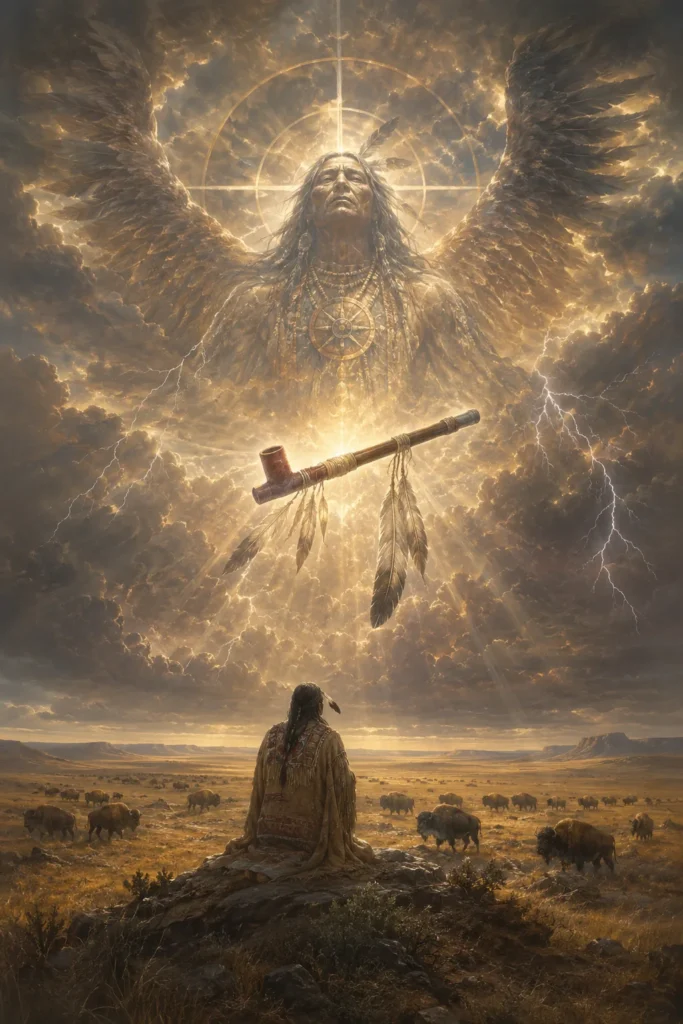
White Buffalo Calf Woman, sacred founder of the seven Lakota rites
By Ralf Ittermann · last reviewed on
White Buffalo Calf Woman (Lakota Ptesan Win) is, in the Lakota tradition, the sacred woman who, on behalf of Wakan Tanka, brought the sacred pipe chanunpa and the seven sacred rites into the Lakota world.
She is counted among the most central figures in the religious history of indigenous North America.
White Buffalo Calf Woman is regarded as a Lakota saint who brought the sacred pipe and the seven rites to the Lakota nation.
Classification within Lakota Religion
White Buffalo Calf Woman is the central founding figure of Lakota religion.
She is not herself a supreme deity like Wakan Tanka, but rather a numinous intermediary who appeared in mythological time (approximately 500 years ago, by traditional Lakota reckoning) to teach the Lakota the religious practices that have since defined the identity of the people.
From a religious-studies perspective, she belongs to the class of culture heroes or religious founders. Structurally comparable figures include the Mesoamerican Quetzalcoatl, the Mongolian Aerguene-Boegele tradition, the Australian Rainbow Serpent founding figure, and, in subtle structural parallels, the Christian-Near Eastern Mary.
These comparisons must, however, be read with care: White Buffalo Calf Woman is genuinely Lakota and should not be forced into foreign religious categories.
Her founding story is the central sacred narrative of the Lakota and is retold in nearly every Inipi sweat lodge session. Joseph Epes Brown documented it systematically in The Sacred Pipe (1953), drawing on the accounts of Black Elk.
The narrative stands in close relationship to the founding of the sacred chanunpa pipe, whose living guardianship (currently in the 19th generation, held by Arvol Looking Horse) establishes an unbroken line reaching back to the first encounter.
An important theological distinction concerns the relationship of White Buffalo Calf Woman to the buffalo theology of the Plains Indians more broadly. Among the Cheyenne, Crow, Pawnee, and other Plains peoples, there are comparable buffalo-woman founding narratives, though with distinct details.
The historian Pekka Hämäläinen has shown in Lakota America (2019) how closely Lakota economy, Lakota identity, and Lakota religion were intertwined with the buffalo, and how the destruction of the buffalo herds by the US government in the 19th century was not only an economic but also a religious and spiritual catastrophe to which Lakota religion is still responding today.
Name and Meaning
The Lakota name Ptesáŋ Wíŋ is composed of pte (buffalo), sáŋ (white), and wíŋ (woman). The direct translation is therefore White Buffalo Woman.
The popular English designation White Buffalo Calf Woman is a conventional simplification that foregrounds her manifestation as a white buffalo calf at the beginning of the founding narrative.
The more precise ethnological translation Buffalo Calf Pipe Woman or White Buffalo Calf Woman has been common in the sources since the 19th century.
In the wider Sioux tradition, regional equivalents exist: among the Dakota in Minnesota there is a comparable founding-woman figure under a similar name; among the Yankton Sioux and Assiniboine the narrative details differ, but the structural founding function is the same. This pan-Sioux tradition has been systematically described by Raymond DeMallie.
Description and Iconography
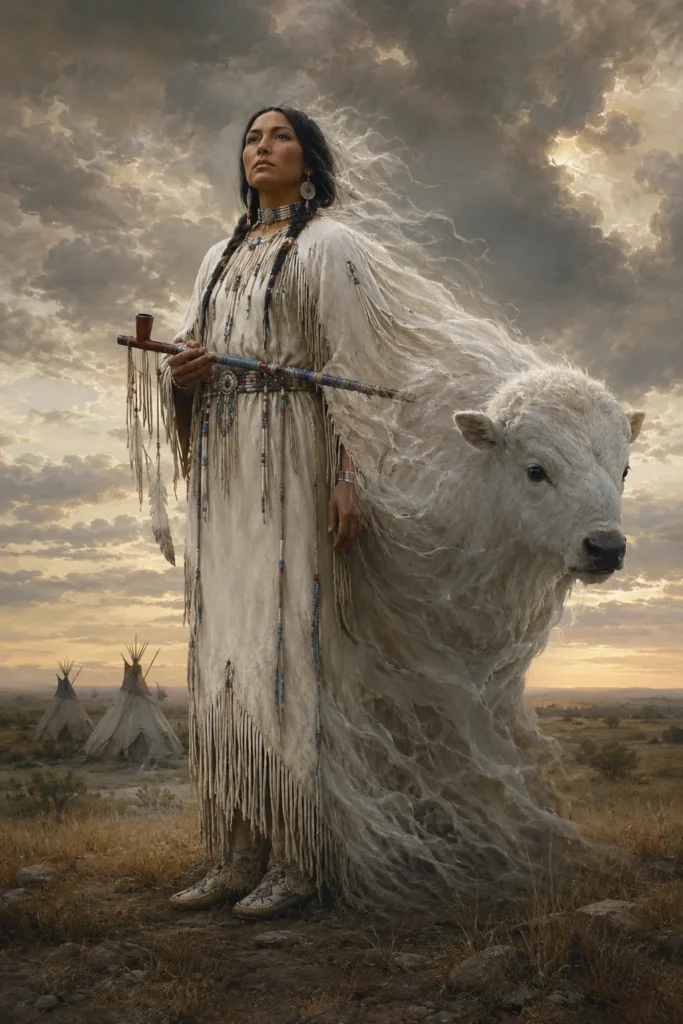
White Buffalo Calf Woman is described in the founding narrative in several forms. She first appears to two Lakota warriors as a beautiful woman in a white buffalo-hide dress, floating across the prairie.
One of the warriors approaches her with dishonorable intentions and is immediately transformed into a heap of bones; the other remains respectful and is instructed to return to the camp and announce the arrival of the sacred woman.
In the camp she then appears as a perfect woman with long black hair, a white buffalo-hide dress decorated with intricately painted patterns, a small sacred pipe on her back, and a mystery bundle in her hands.
After completing the founding instructions, she transforms as she leaves the camp into a white buffalo calf that changes through several colors in succession: black, brown, red, white. These four colors correspond to the four directional colors of Lakota cosmology and symbolize the four generations in which the Lakota people will live.
In modern Lakota visual art, such as the works of Oscar Howe (1915 to 1983), White Buffalo Calf Woman is a recurring motif.
She is usually depicted as a dignified woman in white robes, often with the sacred pipe in her hands, sometimes with a white buffalo calf spirit beside her. Contemporary Lakota artists Donald Montileaux and Arthur Amiotte have depicted her repeatedly in their paintings.
The Founding Narrative
The central founding narrative, transmitted through Black Elk and Joseph Epes Brown, begins with a period of great hardship among the Lakota people.
The buffalo herds have disappeared, the people are starving, and the warriors are quarreling among themselves. In this crisis, Wakan Tanka sends White Buffalo Calf Woman to give the Lakota the religious knowledge that will restore their collective vitality.
After the encounter with the two warriors (the negative encounter with the first, the respectful one with the second) and her arrival in the camp, White Buffalo Calf Woman performs the central founding acts before the assembled Lakota people. She opens the mystery bundle and reveals the sacred pipe chanunpa.
She shows the assembly how the pipe is assembled (the wooden stem represents the masculine, the red catlinite stone bowl the feminine), how the tobacco is packed in (with the invocation of the Four Winds), and how the pipe is smoked (with the invocation of Wakan Tanka).
She then teaches the first rites, and according to some sources all seven sacred rites in summary form, while according to other sources primarily the Inipi (sweat lodge) and the Hanblechiyapi (vision quest), with the remaining rites revealed in later visions to individual Lakota healers.
Finally she leaves the camp and transforms into the four-colored buffalo calf. With her departure the buffalo herds return and the Lakota people are saved.
An important component of the founding narrative is White Buffalo Calf Woman’s teaching about the cosmic order.
She teaches the Lakota the form of the rite and, with it, its symbolic meaning: the pipe connects heaven and earth, the tobacco smoke is the visible form of the prayer rising to Wakan Tanka, the Four Winds represent the cosmological structuring of the world.
This symbolic and philosophical depth of the founding teaching has been described in detail by Joseph Epes Brown in The Spiritual Legacy of the American Indian (1982), and distinguishes Lakota religion from a purely rite-centered tradition.
The Sacred Pipe (chanunpa)
The White Buffalo Calf Woman pipe, the chanunpa wakan, has been preserved since the mythological founding time by an unbroken line of guardians. The current 19th-generation guardian is Arvol Looking Horse, who keeps the pipe at the Cheyenne River reservation in South Dakota.
The traceable guardian line thus reaches back to the 15th or early 16th century and is one of the best-known examples of unbroken religious tradition among the indigenous peoples of North America.
The pipe itself consists of two main parts: a wooden stem of red wood and a bowl of red catlinite stone (also called pipestone), quarried exclusively at the pipestone quarry in southwestern Minnesota.
There lies the sacred stone quarry, said since mythological times to have been colored by buffalo blood, where all Sioux tribal groups quarried their ritual pipe bowls.
Pipe smoking is a strictly prescribed ritual act. The healer packs the tobacco (a mixture of tobacco, dried willow-bark powder, and rabbit tobacco, kinnikinnick) into the pipe bowl with the invocation of the Four Winds, the sky and the earth, and the ancestral spirits.
While smoking, the pipe is held toward all four cardinal directions, toward the sun, and toward the earth. Joseph Epes Brown documented the rite in meticulous detail in The Sacred Pipe.
The pipestone quarry in Minnesota has been federally protected as the Pipestone National Monument since 1937. Only members of recognized indigenous tribes may quarry the sacred stone; this is done by traditional hand-work without mechanical tools.
The stone, a medium-soft red argillite, has been quarried by various Plains and Woodland Indian peoples for at least 3,000 years and is found in archaeological assemblages across a wide area of North America.
The present quarry and its ritual significance have been systematically described by the Native American anthropologist Sigrid Khera and pipestone guardian Hank Crowe.
Protective Practice and Apotropaic Function
Protective practice related to White Buffalo Calf Woman is closely connected to the chanunpa ritual. Her numinous presence is made present in every Lakota pipe ceremony; the smoking of the pipe is therefore a prayer to Wakan Tanka and at the same time an encounter with the sacred woman who founded the pipe.
Concrete protective practices include the wearing of small pipe replicas (or, among modern practitioners, small pipe pendants) as protective amulets, the invocation of the Buffalo Woman at births and illnesses of women, and the ritual use of white buffalo hide pieces or white buffalo hair tufts as protective objects.
The latter is especially significant because white buffalo are extremely rare in nature (approximately 1 in 10 million) and their appearance since the 1990s has been interpreted as a sign of the prophesied return of the sacred woman.
The birth of a white buffalo calf in 1994 in Wisconsin (Miracle, the first in living memory) was received with considerable prophetic weight in Lakota and Plains Indian communities.
Several further white buffalo births in the following decades, in 2006, 2011, and 2012, were likewise interpreted as prophetic signs and are received in modern Lakota religiosity as confirmation of the founding tradition.
A notable component of modern practice is the connection between White Buffalo Calf Woman and female initiation. The Ishna Ta Awi Cha Lowan ritual for a young woman’s first menstruation is a direct founding act of the sacred woman and is observed in every Lakota reservation community with its own solemn ceremony.
The young woman being initiated is ritually wrapped in a buffalo cloth symbolizing the connection to the Buffalo Woman. This practice underwent an important revival in the 20th century and has been described in detail by Lakota theologian Doris Leader Charge.
Parallels in Other Cultures
White Buffalo Calf Woman is an unusual religious figure who was recognized relatively late in comparative religious studies, because she corresponds clearly neither to European concepts of a deity nor to a human founder (Buddha, Jesus, Mohammed). She is rather an intermediary figure who acts on behalf of a higher power.
Structurally comparable in the classical Mediterranean world is the Greek Eleusinian Demeter-Persephone tradition, in which a numinous female figure likewise brings the founding of the most important religious mystery rites (the Eleusinian Mysteries).
Within the Americas, White Buffalo Calf Woman shows strong structural similarity to the Navajo Changing Woman and to the Mesoamerican Tonantzin-Mary syncretism in the Guadalupe Marian cult.
The founding-woman figure is represented in many indigenous traditions of North America: among the Cherokee it is the Selu woman, among the Iroquois the Sky Woman, among the Anishinabe the Nokomis grandmother.
This pan-American founding-woman constellation has been systematically described by religious ethnologist Joan Halifax in Shaman: The Wounded Healer (1982).
Contemporary Reception and Research
White Buffalo Calf Woman is today the most prominent Lakota religious figure in popular perception. The growing visibility of Lakota religion since the American Indian Religious Freedom Act (1978), the births of white buffalo calves in the 1990s and 2000s, and the diplomatic advocacy of Arvol Looking Horse have brought her to broad public attention.
Problematic is the growing tendency toward spiritual appropriation by Western New Age groups. The Lakota Elders Council officially protested in 1993 in the Declaration of War Against Exploiters of Lakota Spirituality against the commercial dissemination of Lakota rites by non-indigenous practitioners.
This position has been further represented by Vine Deloria Jr., George Tinker, and Lyla June Johnston.
From a religious-studies perspective, White Buffalo Calf Woman is an important example of a living indigenous founding tradition that is not frozen in a distant mythological past horizon, but continues to act in the present through the unbroken chanunpa guardian line.
The guardian line extends through 19 generations back to the mythological founding time and is one of the most remarkable examples of continuous religious tradition in the Americas. iWell Guard’s engagement with the Lakota tradition is explicitly observational in the religious-studies sense, without any claims of efficacy.
Literature and Sources
The following selection lists key works on Lakota religion and North American indigenous research concerning the White Buffalo Calf Woman complex.
The tradition of the handing over of the sacred pipe
The central narrative surrounding the figure known as White Buffalo Calf Woman, in Lakota Pte San Win, recounts the handing over of the sacred pipe to the Lakota. According to the widely known version, a woman appears to two hunters.
One of them approaches her with dishonorable intentions and is killed, while the other behaves respectfully and is instructed to prepare the camp for her visit.
The woman brings the pipe to the community and instructs them in its use and in ceremonies. Upon departing she transforms and disappears, in many versions as a white buffalo calf.
The narrative is connected with the received origin of the seven rites of the Lakota, which the religious specialist Black Elk set out in the collection The Sacred Pipe, edited by Joseph Epes Brown in 1953. This publication is one of the most influential sources, yet must also be read critically, because it is the result of a collaboration between an elderly Lakota specialist and a non-indigenous editor, produced during a particular phase of Lakota religious history.
For the Lakota, the narrative is not a mere myth, but the foundation of a religious order still practiced today. A material object exists that is regarded as the original pipe or one closely connected to it, and is preserved by a traditional guardian whose office is passed down across generations.
Research notes that the narrative is told with variations among different Lakota groups and that its public recounting is considered sensitive by many Lakota. A responsible account therefore limits itself to the essential core and avoids elaborating the details of the rites.
The birth of white buffalo calves and their present-day significance
One reference point that keeps the figure of White Buffalo Calf Woman active into the present is the rare birth of white buffalo calves.
Because the woman of the tradition, according to the account, appeared and disappeared in the form of a white buffalo calf, the birth of such an animal is regarded by many Lakota and other groups of the northern Plains as a significant sign.
A widely noted case was the birth of a white bison calf on a farm in Wisconsin in 1994. The event drew visitors from various indigenous communities over several years, who brought offerings and conducted ceremonies.
Further white calves have been recorded since, including in Yellowstone National Park. Researchers have described such events as examples of how an ancient tradition is made present by a biological occurrence and generates religious resonance in the contemporary world.
The interpretations are not uniform. Some understand the birth as a reminder of the obligations that came with the pipe, others as the announcement of a time of renewal or as a warning. Some traditional voices also caution against the commercialization of such events and against their appropriation by non-indigenous esoteric circles.
For the religious-studies observer, the finding is instructive because it shows that the figure of White Buffalo Calf Woman does not rest in a closed mythological time, but can be connected to concrete, datable events in the present and thereby becomes a reference point for current indigenous self-understanding.
Literature (Selection)
- Joseph Epes Brown: The Sacred Pipe (1953)
- John Neihardt: Black Elk Speaks (1932)
- Severt Young Bear: Standing in the Light (1994)
- Arvol Looking Horse: White Buffalo Teachings (2000)
- Raymond DeMallie: The Sixth Grandfather (1984)
- Vine Deloria Jr.: The World We Used to Live In (2006)
Related key terms: White Buffalo Calf Woman Ptesan Win Chanunpa Pipestone Catlinit Looking Horse.
iWell Guard and Protective Traditions
iWell Guard draws on the cultural-historical tradition of wearable protective objects, in the tradition of Native American and many other cultures worldwide. 41 layers, real gold, platinum, silver, crafted in Germany. 30-day return policy.
Personal experiences may vary. Not a medical device. No healing claims.