Pachamama, earth mother and fertility goddess of the Andean world
By Ralf Ittermann · last reviewed on
Pachamama, the earth mother of the Andes, remains to this day the most important religious point of reference in the everyday life of the Quechua- and Aymara-speaking highland population.
Unlike the state-imperial Inti cult, the veneration of Pachamama is deeply rooted in the agricultural rhythms of the year and of life, and has survived colonisation in syncretic form.
Profile: Pachamama
Pachamama: the most important aspects at a glance. The following fields summarise origin, function, appearance, veneration, symbols and parallels.
Pachamama (Quechua pacha: world, time, space; mama: mother) is the earth mother of the Quechua- and Aymara-speaking highland population. Since Inca-era theology she has counted among the central high beings. The official imperial cult emphasised Inti, but the rural population mostly made offerings to Pachamama.
Pachamama is the female numinosity of the fertile earth, of the fields and of the reproduction of living beings. In the Aymara highlands, according to Joseph Bastien, she is experienced rather as the animate substance of the earth than as a personalised goddess. In southern Peru she is held responsible for landslides and earthquakes when offerings are insufficient.
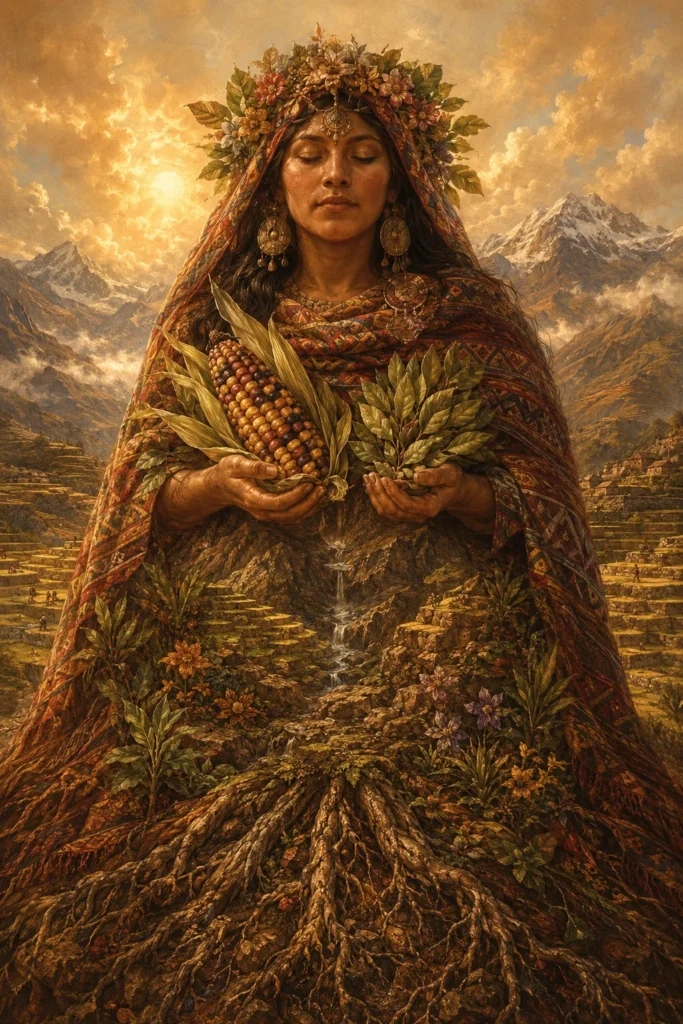
In Inca-era iconography Pachamama is hardly depicted in human form; she manifests in the cultivated clod of earth, in heaps of stones (apacheta) and in offering places and offering pits. Later she appears as an Indigenous woman in traditional dress with a wide skirt, mantle and bowler hat, sometimes with a child or a carrying cloth (aguayo). Marian iconography has influenced these images.
The centre of the cult is the despacho or pago a la tierra, in which coca leaves, llama fat, wine or chicha are arranged in an offering bundle and buried or burned. The most important feast day is 1 August. Offerings are also made at sowing, the first ploughing, harvest, house building, marriage and births. Ritual specialists are yatiri, paqo or altomisayoq.
Belonging to Pachamama are coca leaves, especially the kintu of three perfect leaves, along with chicha, wine, llama fat, llama foetuses (sullu) and small clay figurines. Places of her presence are the clod of earth, the apacheta at the mountain pass and the offering pits. The rising of the Pleiades in June is also associated with her.
Compared are the ancient Indian Prithivi, the Greek Gaia, the Roman Tellus Mater, the Germanic Nerthus and the Changing Woman of the Navajo. Unlike Demeter and Gaia, Pachamama is less fully personalised. Specifically Andean is the connection with the Apus, the mountain spirits, as a complementary pair (yanantin).
Classification within the Andean Pantheon
Pachamama (Quechua: pacha, world, time, space; mama, mother) designates, in the traditional religions of the Andean highlands, that female numinosity which is active in the fertile earth, in the cultivated fields, and in the reproduction of living beings.
Since Inca-period theology, she has been counted among the central higher beings alongside Inti, the thunder god Illapa, the moon goddess Mama Killa, and the creator Viracocha.
The religious ethnologist Joseph Bastien (Mountain of the Condor, 1978) has shown for the Aymara highlands of Bolivia that Pachamama is experienced in local perception less as a personalised goddess than as the animate substance of the earth itself.
This substantiality distinguishes her structurally from many classical earth mother figures of the Mediterranean world (Demeter, Gaia), which are mythologically more strongly personalised.
In relation to the state Inca theology, Pachamama occupied a peculiarly subaltern position: the official imperial cult emphasised the male Inti, while the rural population in its majority made offerings to Pachamama.
Catherine Allen (The Hold Life Has, 2002) describes this relationship as a gender-specific stratification of the Andean religious system, in which the male solar theology lies above an older, female earth theology.
Name and Etymology
The Quechua term pacha is semantically extraordinarily multifaceted. It designates simultaneously time (a concrete era), space (the world as a whole), and a state of the world.
Diego Gonzalez Holguin translates it in his Vocabulario de la lengua general (1608), depending on context, as mundo, tiempo, or suelo. Pachamama is therefore the Mother of all World-Reality, not merely of the soil.
In the Aymara of the Bolivian Andes the equivalent Pachamama is found as well, sometimes rendered as Pachatata (Father-Earth) for the male complement. In the Quechua of Cajamarca and in the Ayacucho region there exists the regional form Mama Pacha with the components reversed, which nonetheless refers to the same deity.
An alternative etymology links pacha with the concept of cosmological order.
The historian of religion Frank Salomon points out in Native Lords of Quito (1986) that pacha in the Inca-period language also denotes the world-era as a stage in history (Pre-Inca, Inca, Post-Conquest), whereby Pachamama can be understood as Mother of All World-Eras, a concept that plays a particular role in the Pachakuti myths (world overturnings).
Description and Iconography
In contrast to Inti, who was associated with a concrete cultic image (the Punchao), Pachamama was scarcely depicted in anthropomorphic form in Inca-period iconography.
She appears above all in the form of ritual sites and objects: in the cultivated clod of earth, in the apacheta stone cairns at mountain passes, in the mesa offering places, and in the buried offering pits.
In colonial-period and modern folk art she is increasingly depicted in anthropomorphic form as an indigenous woman in traditional dress, with a wide pollera skirt, shawl, and bowler hat (in the Bolivian Aymara context).
Sometimes she carries a child or an aguayo carrying cloth filled with Andean grain. These depictions are predominantly influenced by Christian-syncretic Marian iconography, especially through the Madonna of Copacabana and the Madonna del Cerro (Potosi), in which the earth mother and Marian veneration merge.
On surviving pre-Hispanic ceramics of the Moche and Wari cultures, female figures with pronounced primary and secondary sexual characteristics are found, which are archaeologically often interpreted as Pachamama precursors. This attribution is, however, speculative, since we lack the emic designation. Christopher Donnan cautioned against such identifications in Moche Art (1978).
Mythological Narratives
The mythological tradition concerning Pachamama is remarkably sparse in the early chronicles, which Pierre Duviols has explained as a consequence of the predominantly male-imperial perspective of the Spanish chroniclers.
What is tangible are rather fragments of cosmogonic constellations: Pachamama as spouse or sister of Pachakamak in the coastal region, as daughter of Viracocha in the highlands, as consort of Pachatata in the Aymara sphere.
A central myth links Pachamama with the cycle of drought and rain. She is believed to be fat and satiated in March/April after the harvest, and perceived as hungry and thirsty in the dry months of May through September, which is why a particularly large number of offerings are brought during this period.
In the pampa mountain regions of Argentina (Salta, Jujuy) the most important Pachamama festival takes place in August; on 1 August farmers symbolically open the earth by digging a small hole and placing the first gift (chicha, coca leaves, bread, fat) inside it.
An important narrative links Pachamama with the rising of the Pleiades in June. The seven-week presence of the Pleiades in the morning sky is understood as her attention toward human crops; when the Pleiades rise brightly, a rich harvest year is expected.
Gary Urton described this Andean archaeoastronomical correlation systematically in At the Crossroads of the Earth and the Sky (1981).
In southern Peru, Pachamama is also connected with the mythological figure of Mama Pacha, who according to tradition causes landslides and earthquakes in Pakaqtanpu when insufficiently propitiated.
This punitive dimension of the earth mother is also found in the Argentine Andes, where August is considered the mes peligroso (dangerous month) because the hungry earth mother requires special attention and incautious travellers are said to be able to fall ill.
From a religious-ethnological perspective it is noteworthy that this punitive dimension is regularly omitted in the Western New Age reception of Pachamama.
Cult and Sacrificial Practice
The Pachamama cult remains to this day the most living religious practice in the villages of the highlands.
Its centre is the ritual of the despacho or pago a la tierra (earth payment), in which coca leaves, sweets, llama fat, llama embryos (sullu), small clay figurines, and wine or chicha libations are arranged artfully in an offering bundle and buried in the earth or burned.
Catherine Allen describes for the village of Sonqo (province of Paucartambo) the recurring element of the kintu, three perfectly overlapping coca leaves that are blown in all cardinal directions and then offered to the earth, the mountains, and the venerated ancestors.
Joseph Bastien has described the parallel Aymara practice in the highlands of La Paz.
The ritual specialists are called, depending on the region, yatiri (Aymara), paqo (Quechua), or altomisayoq. They are not institutionalised priests like the Inca-period Coricancha functionaries, but village-bound diviners and healers who often receive their vocation through a lightning-strike experience (Illapa calling).
The Peruvian anthropologist Juan Nunez del Prado systematised the initiation stages of these paqo specialists in his work of the 1970s.
The most important calendar date is 1 August, which is considered the Day of Pachamama; in addition she is propitiated at all important points of the agricultural year: at sowing, at the first ploughing, and at the first harvest. At house construction, marriage, and birth a Pachamama offering is also obligatory.
In the mining regions of the Andes (Potosi, Oruro, Cerro de Pasco) a separate Pachamama cult of underground workers has moreover developed, in which Pachamama is venerated in connection with the tunnel spirit Tio.
June Nash documented the dual cult Pachamama/Tio in the Bolivian silver mines ethnographically in We Eat the Mines and the Mines Eat Us (1979), showing how the relationship between capitalist exploitation and ritual reciprocity is negotiated in this double deity.
Protective Practice and the Apotropaic
The Pachamama cult is at its core not a protective practice in the strict sense, but a reciprocal maintenance of relationship (ayni).
Where apotropaic functions are attributed, this occurs mostly in connection with other beings: against harmful spirits such as Supay or against the condenados (condemned souls), Pachamama is effective only insofar as ritual reciprocity has been observed.
Concrete protective practices in the Pachamama context include the placing of coca leaves under the threshold during a new build, the burying of a bottle filled with wine and chicha under the house entrance, or the laying of an apacheta (stone cairn) at the mountain pass, at which every passing traveller adds a stone and thus contributes their share to the shared securing of the route.
The religious ethnologist Olivia Harris showed in To Make the Earth Bear Fruit (2000) that this cairn practice remains alive today on the Bolivian highland roads.
From a religious-studies perspective, these practices are not understood as operative magic, but as ritual affirmation of a cosmic order in which every gift anticipates an equivalent in return. The iWell Guard reference to the Pachamama tradition is here explicitly one of religious observation, not of promised efficacy.
Parallels in Other Cultures
Structurally, Pachamama can be compared with other earth mother deities of the world’s religions without it being necessary to postulate a genetic connection.
Particularly informative from a religious-studies perspective is the comparison with the ancient Indian Prithivi, the Greek Gaia, the Roman Tellus Mater, the Germanic Nerthus (Tacitus), and the North American Changing Woman of the Navajo.
Mircea Eliade identified in The Sacred and the Profane an earth mother pattern that appears in almost all agrarian high cultures: a female numinosity associated with fertility, cyclicity, seed, and death. Pachamama fits into this pattern, but through her Pacha-dimensionality (time, world-era) exhibits a far-reaching semantic horizon.
Specific to the Andes is the connection of Pachamama with the local mountain spirits Apu (see Apu Ausangate). These male lords of the mountains and the female earth mother form a complementary gender system, expressed in Andean cosmology as yanantin, the productive tension of opposing pairs.
A further important parallel is shown in the Afro-American veneration of the Orisha Yemaya or the Vodou Loa Erzulie, in which female numinosity is associated with water, fertility, and protection. Here too these are convergent structures of agrarian religiosity, not historical kinship.
The religious-studies category of the Magna Mater, the Great Mother, has been repeatedly discussed since Johann Jakob Bachofen in the 19th century; however, the simple reduction of all earth mother deities to one archetypal primordial form is today regarded with methodological caution.
Christianisation and Syncretism
The Spanish mission was never able to completely displace the Pachamama cult. Instead, one of the most remarkable syncretisations in the religious history of the Americas came about: the connection of Pachamama with Catholic Marian veneration, in particular with the Madonna of Copacabana (Bolivia) and the Madonna del Cerro (Potosi).
In the famous painting Virgen del Cerro (anonymous, ca. 1720, Potosi), the Madonna herself appears as the silver mountain of Potosi; her garment forms the mountain silhouette, the crown sits at the peak, and within the mountain the miners are visible.
Teresa Gisbert has interpreted this image as an iconographic manifesto of the Pachamama-Marian syncretism. The Madonna is not placed above the mountain; she is the mountain, and is thereby simultaneously the earth mother.
The central pilgrimage site of Copacabana on Lake Titicaca was also built on an older Inca sanctuary. The Virgen Morena (dark-skinned Madonna) venerated there is today regarded simultaneously as the Christian patron saint of Bolivia and as a manifestation of Pachamama.
Sabine MacCormack (Religion in the Andes, 1991) has described the process of this dual identity in detail.
Contemporary Reception and Research
Pachamama today is, far beyond the narrower religious context, an identification figure for indigenous political movements in South America. In Bolivia, President Evo Morales (2006, 2019) declared 1 August as Dia de la Pachamama a national holiday, and the 2009 constitution makes explicit reference to Pachamama belief.
In Ecuador too, Pachamama was endowed with its own rights in the 2008 constitution, a step that attracted international attention in legal history.
In the ecological movement and in Western New Age circles, Pachamama has found broad resonance in recent decades. This reception is, however, to be viewed critically: it frequently extracts the term from its concrete Andean context and turns it into a global earth-mother cipher.
Religious ethnologists such as Marisol de la Cadena (Earth Beings, 2015) have pointed out that the Andean Pachamama is not identical with the Western Gaia hypothesis and cannot be subsumed within its conceptual framework.
In the Vatican, Pachamama moved to the centre of a controversial debate in 2019 during the Amazon Synod, after wooden figures were placed in the church of Santa Maria in Traspontina.
The incident demonstrates the undiminished power of earth-mother symbolism into the 21st century. In academic research, the works of Catherine Allen, Joseph Bastien, Frank Salomon, and Marisol de la Cadena in particular have shaped the field.
Literature and Sources
The following selection lists key works of Andean ethnology and the history of religion that are authoritative for Pachamama research.
The Pago a la Tierra and the Custom of the Earth Gift
A well-documented and to this day living custom associated with Pachamama is the earth gift, referred to in the Andean countries mostly as pago a la tierra or despacho.
A bundle of various offerings is assembled, which depending on the region may contain coca leaves, maize kernels, fat, sweets, small figurines, and further components. The bundle is buried or burned, frequently at fixed locations and at specific times.
In many areas of the southern Peruvian and Bolivian Andes, August is the month in which such gifts are brought particularly frequently, because the earth is considered open and receptive during this period. The custom is often led by ritual specialists who are called by different names depending on the region.
Ethnographic research, such as Catherine Allen’s work on a Quechua community near Cusco, has shown that the gift to Pachamama is embedded in the everyday relationship with the environment. Pouring a little liquid onto the ground before drinking belongs to the same body of ideas.
Research emphasises that this complex is neither a pure continuation of pre-colonial practice nor mere folklore. Over centuries it has absorbed Christian elements without losing its core. Pachamama is venerated in many places alongside Catholic saints, and the same persons participate in Mass and in the earth gift.
The gift is not a petition for a miracle, but the expression of a relationship of reciprocity: whoever takes from the earth gives back to it. This logic of reciprocity, often linked in the Andes with the Quechua term ayni, is in the view of many researchers the actual key to understanding the custom.
Pachamama in Contemporary Political and Ecclesiastical Controversy
In the 21st century, Pachamama has become, beyond the religious sphere, a political and ideological point of reference.
In Bolivia and Ecuador the term was taken up in the constitutional and legislative process of the 2000s and 2010s. Ecuador incorporated rights of nature into its constitution in 2008, and Bolivia passed a law in 2010 known as the Ley de Derechos de la Madre Tierra.
Pachamama appears here as a symbol for an environmental order that ascribes intrinsic value to nature.
Research discusses critically how far this political use corresponds to local religious conceptions.
Some authors see in it a meaningful connection to Andean thought; others a form of appropriation that generalises a diverse local custom into a national symbol and in doing so simplifies it. The actual ritual practice in the villages remains largely unaffected by state symbolism.
A separate controversy arose in the ecclesiastical sphere in 2019. During the so-called Amazon Synod in Rome, wooden figures were used that were described in the public debate as Pachamama representations.
Several conservative circles within the Catholic Church regarded this as idolatry, and the figures were removed by unknown persons from a Roman church and thrown into the Tiber.
The incident triggered a broad debate about how the Church should deal with indigenous religious forms of expression. For a religious-studies perspective it shows that Pachamama has today become, far beyond the Andean region, an object of contention in which questions of inculturation, syncretism, and religious identity are negotiated.
Literature (Selection)
- Catherine Allen: The Hold Life Has (2002)
- Joseph Bastien: Mountain of the Condor (1978)
- Sabine MacCormack: Religion in the Andes (1991)
- Marisol de la Cadena: Earth Beings (2015)
- Olivia Harris: To Make the Earth Bear Fruit (2000)
- Diego Gonzalez Holguin: Vocabulario de la lengua general (1608)
- Frank Salomon: The Cord Keepers (2004)
As the fertility goddess of the Andean world, Pachamama connects agriculture, animal husbandry, and mountain veneration; offerings of coca, maize, and chicha accompany sowing, harvest, and house construction to this day in Bolivia, Peru, and northern Argentina.
Related key terms: Pachamama Quechua Aymara Ayni Despacho Paqo Yatiri Apacheta Sullu.
iWell Guard and Protective Traditions
iWell Guard draws on the cultural-historical tradition of wearable protective objects, in the tradition of Andes / Inca and many other cultures worldwide. 41 layers, real gold, platinum, silver, manufactured in Germany. 30-day return policy.
Personal experiences may vary. Not a medical device. No healing promises.