Empusa, Demoness of the Greek Tradition
By Ralf Ittermann · last reviewed on
Shape-shifting night demon in the retinue of Hecate. Greek tradition describes Empusa as a shape-shifting demon in the retinue of Hecate.
Empusa is one of the most distinctive night figures of the Greek tradition: a shape-shifting being that appears to travellers, takes the form of a beautiful woman, and seduces, drains and kills its victims. She belongs to the retinue of Hecate and appears especially at crossroads and remote places during the night.
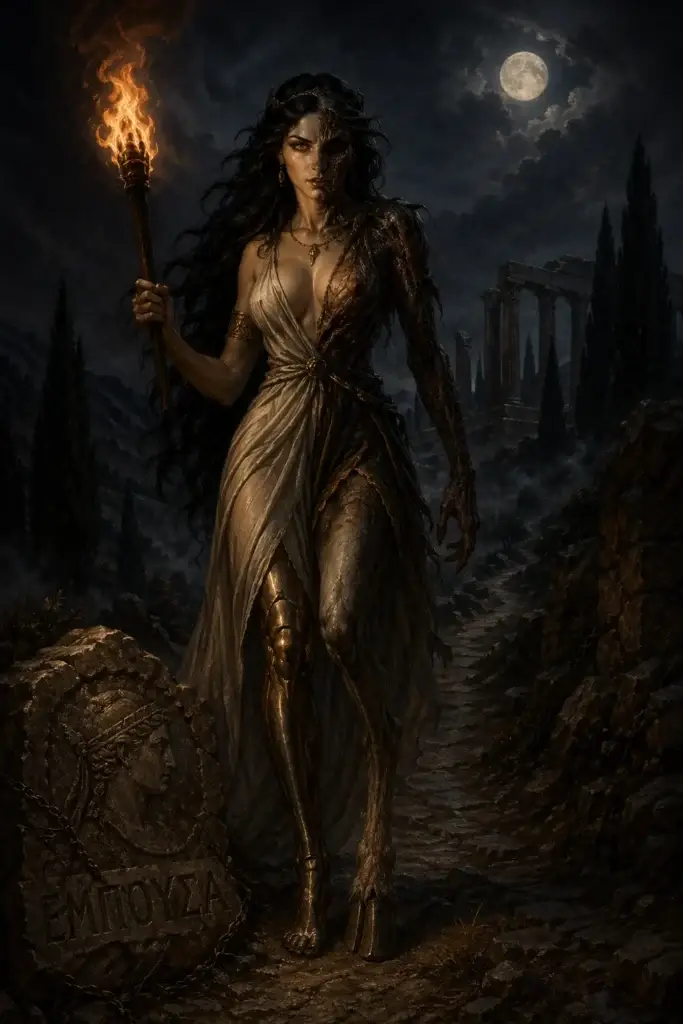
In ancient literature she first appears in Aristophanes, later prominently in Philostratus’ Vita Apollonii, where she passes herself off as a charming woman and is unmasked only through the wisdom of Apollonius. Her best-known peculiarity: one leg of bronze, the other like that of a donkey.
Quick Overview: Empusa
Type: Shape-shifting and night demoness
Origin: Retinue of Hecate
Texts: Aristophanes, Philostratus, magical papyri, Byzantine popular belief
Period: Classical era to late antiquity and the Byzantine era
Distribution: Greco-Roman cultural sphere
Defence: Insult (drives her away according to Aristophanes), conjurations, crossroads offerings
Classification
Earliest evidence in Aristophanes (5th century BCE, The Frogs). The full narrative figure appears in Philostratus (2nd/3rd century CE). The magical papyri name her in the context of nocturnal conjurations. In Byzantine popular belief she remains present into the Middle Ages.
Mythological classification
In Greek mythology Empusa is a demonic being, a servant of Hecate, who seduces and devours wanderers at night. She is a shape-shifter, often with abnormal legs. Empusae are related to the Lamiae and, like these, interested in blood and flesh. They embody the danger of the night.
The core region is the Greek world: the mainland, the islands, the coast of Asia Minor. Mentions of Empusa are found especially in Attic comedies (Aristophanes, The Frogs 285, 293) and in late-antique writings on the cults of Hecate.
In the Roman late antiquity the profile of Empusa partly merges into Lamia and into the Strix complex.
Individual literary references, magical papyri, Byzantine popular literature. No pictorial tradition of its own; the description lives on literary detail, especially on Philostratus’ narrative.
Name
Greek: Ἔμπουσα (Empousa), etymology uncertain. A possible derivation from en-pous (“one-footed”) on account of her characteristic single donkey leg. Other scholars see a pre-Greek background. Plural: Empusae, Empousai. Related to the Mormolykeiai (figures of terror), the Lamiai and to Hecate as nocturnal leader.
Characteristics
Appearance
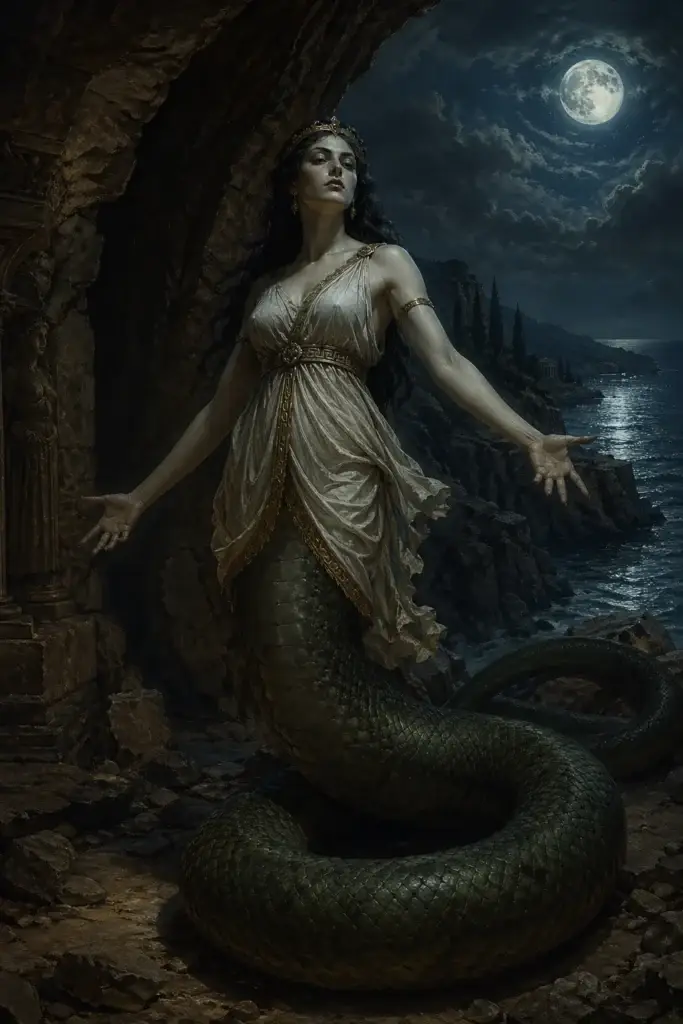
Basic form: a female figure, often beautiful and seductive. Distinctive feature: one leg of bronze, the other like that of a donkey. Transformations between woman, hound, cow and other animals are described.
Behaviour
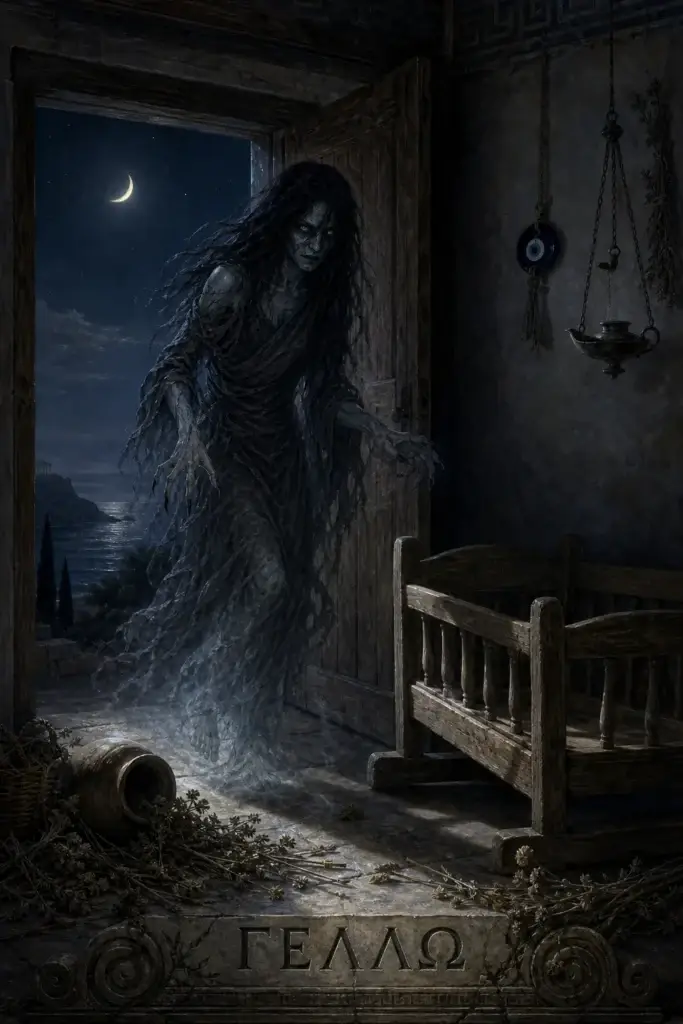
Empusa confronts travellers, especially those wandering alone, at night at crossroads or in remote places. She presents herself as a travelling companion or lover, then reveals herself as an animal. Her aim is to drain and kill the victim.
Sphere of effect
Night, crossroads, remote paths, meals with strangers. She acts where the protective space of society is absent.
Mythological origin
Retinue of Hecate, without a family history of her own. Empusa is not a former queen like Lamia, but a demonic servant of a night deity from the very beginning.
Appearance and symbolism
Empusa is depicted with a human upper body and abnormal legs, one foot of bronze, the other a donkey’s hoof. She sometimes wears an animal head or a mask. Fire radiates from her. A sense of anomaly and danger emanates from her. The symbolism of Hecate is associated with her.
Profile: Empusa
The most important aspects of Empusa at a glance. The detailed treatment of name, description, defence and parallels can be found in the following sections.
Retinue of Hecate. No divine genealogy, no origin story of her own; Empusa is a pure creature of the night.
Solitary travellers, especially young men. People in foreign places, at crossroads, during nocturnal meals with strangers.
A woman, often beautiful; one leg of bronze, one like that of a donkey. She transforms into a hound, a cow, and finally into her “true” terrible form.
Seduction, draining, death. Her effect is slow, not a sudden attack but a staged deception.
According to Aristophanes: insult drives her away. Philostratus: she yields before a spoken truth. The magical papyri name protective formulas with the invocation of Hecate.
Lilītu, Lamia, Strix (Roman), Vrykolakas (Byzantine), incubus/succubus (medieval Christian), nightmare.
Protective Practice
Rituals of defence
At crossroads, offerings were made to Hecate: flat cakes, eggs, black animals. These offerings were intended both to appease the servants of Hecate, among them Empusa, and to keep them at a distance.
Conjurations
The Greek magical papyri contain formulas against nocturnal attackers that invoke Hecate and send her servants back. The structure: invocation of the mistress, identification of the threat, command of defence.
Amulets and protective symbols
Hekataia, small statues of Hecate at house entrances, also protect against Empusa. The Gorgoneion as an apotropaic image. Name amulets in late antiquity.
Cult and veneration
Empusa is not venerated, but feared with respect as a servant of Hecate. Nocturnal travellers carried protective amulets. The magic of Hecate could invoke or banish her. In mystery traditions the Empusae are understood as aspects of Hecate’s power. Calm when passing through her domains.
Empusa, Parallels in Other Cultures
Mesopotamia: The Akkadian ardat-lilî shares the profile of the nocturnal-sexual female demoness and forms a typological predecessor; a direct cultural contact cannot be demonstrated.
Rome
Strix and Striga take over the function of nocturnal shape-shifting; the Lamiae form the collectivised form of the Lamia-Empusa complex. Lucian of Samosata attests in the High Imperial period to the popular equation of the two terms.
Middle Ages and the early modern period: In scholastic-theological writings Empusa merges with the concept of the succubus. In the witch persecutions the one-legged element (the donkey’s or goat’s foot) becomes the standard marker of a pact with the devil.
Modern reception
Charles Kingsley uses Empusa as a character in Hypatia (1853). In modern fantasy and myth reception (for example in Rick Riordan’s Percy Jackson series) she appears as a companion of Hecate and a shape-shifting seductress. In mythographic literature (Robert Graves) she is read as an archetype of nocturnal, threatening femininity.
The Appearance in the Comedies of Aristophanes
The earliest detailed literary trace of Empusa is found in the Attic comedy of the 5th century before the common era.
In Aristophanes’ play The Frogs (performed in 405 BCE), the god Dionysus, on his way to the underworld, encounters an Empusa who transforms rapidly: first a cow, then a mule, then a beautiful woman, then a dog.
The slave Xanthias additionally describes her with one leg of bronze and a second of donkey dung. The scene is conceived as a moment of terror that is at the same time broken comically, for Dionysus falls into a panic while Xanthias comments on the apparition half mockingly.
This passage is important for religious studies for several reasons. It shows, first, that Empusa must already have been familiar to the Athenian audience as a figure of terror, otherwise the allusion would not have worked.
Second, it documents the core of the image of Empusa: the rapid shape-shifting and the combination of seduction and threat. Third, the location at the entrance to the underworld points to her belonging to the circle of Hecate, the goddess of crossroads and thresholds.
A scholion, that is an ancient explanatory note on this passage of Aristophanes, adds that Empusa frightened travellers in lonely places and that she could be driven away by insults, whereupon she fled shrieking.
This detail is telling: Empusa here appears not as an all-powerful force, but as a being that depends on fear and loses its effect through mockery. The comedy thus uses a genuinely widespread popular notion and at the same time makes it the object of laughter.
Empusa, Lamia and the Narrative in Philostratus
In later antiquity the boundaries between Empusa, Lamia and the figures of terror known as mormolykeia become blurred. Several authors treat them as related or interchangeable beings, all assigned to the sphere of Hecate and dangerous above all to young men.
The most detailed narrative elaboration is offered by Philostratus in his Life of Apollonius of Tyana (Book 4), composed around 220 CE. There the young student Menippus falls in love with a beautiful, wealthy woman whom he wishes to marry.
Apollonius of Tyana sees through the apparition and unmasks her at the wedding feast as an empousa, elsewhere in the text also called a lamia.
The being confesses that it had wanted to fatten the youth in order to feed on his blood and flesh, because it nourishes itself on beautiful, young bodies. Before the words of Apollonius the seemingly magnificent buildings and servants dissolve into nothing.
This episode later became extraordinarily influential. John Keats took it up in 1820 in his poem Lamia, and by this route it helped to shape the romantic and modern notion of the beautiful, dangerous seductress, who is sometimes read as an early vampire figure.
From the standpoint of religious studies it must be stressed that Philostratus here provides no popular testimony of belief, but a literarily crafted didactic tale: it serves to demonstrate the superhuman perceptiveness of the wise Apollonius. In this text Empusa is a means, not an end.
Etymology and the Dispute over the Meaning of the Name
The origin of the name Empousa has been disputed since antiquity and remains to this day not conclusively settled. Even ancient grammarians offered interpretations, but these followed the sound of the word rather than its actual linguistic history.
A widespread ancient explanation linked the name with limping on one foot, that is with the conspicuous feature of the one bronze or one animal leg. This interpretation remains uncertain.
Modern linguistic proposals partly assume a connection to words for foot or movement, partly see a formation that expresses pushing in or intruding. None of these explanations has gained general acceptance.
A further difficulty is that the name may not originally be Greek at all, but could derive from a pre-Greek or foreign substrate, as is suspected for numerous names of lesser figures of terror.
More illuminating than the uncertain root is the use of the word. Empousa could in Greek be both a proper name and a generic designation; ancient texts speak of Empusa as of a single figure, yet also know a plural. The same dual nature appears in the related words lamia and mormo.
From this it may be concluded that we are dealing less with a clearly defined mythological individual than with a category of frightening beings that lived in household upbringing and in the popular imagination.
Scholarship therefore assigns Empusa to the so-called bogey-figures, figures of terror used to intimidate children and to make lonely paths unsettling.
Empusa as a Bogey for Children and Popular Notion
Unlike the great gods of the Greek pantheon, Empusa was not the object of an organised cult with temples, priests or festivals. She belonged to the sphere of household and everyday belief, which has left its mark only in incidental mentions in literary sources.
This state of the sources explains why our knowledge remains fragmentary: what mothers and nurses told their children about Empusa was not systematically recorded.
Nonetheless, a picture can be gained from scattered indications. Empusa belonged to a group of figures grouped together as mormolykeia, used to frighten naughty or restless children.
She was counted among the retinue of Hecate and was held to be active at crossroads, thresholds and lonely places, that is precisely at those locations regarded in the Greek imagination as dangerous and permeable to the sphere of the dead. Her appearance favours the midday hour or the night.
Remarkable is the weakness ascribed to her. Several sources stress that Empusa flees when one insults or mocks her. This notion points to an important function of such figures: they made fear manageable by supplying at the same time a remedy.
The child or the traveller was not helplessly delivered up to Empusa, but could break her power through a particular form of conduct.
From the standpoint of religious studies, Empusa thus belongs to the lesser figures of the Greek imaginative world, which served the need to give diffuse fears of darkness, solitude and sexual threat a tangible, combatable form. Comparable functions were fulfilled in other cultures by figures such as the Lamia.
Further reading:
- Greece (parent culture page)
- Hecate (mistress of Empusa)
- Lamia (structurally related)
- Lilû and Lilītu (Mesopotamian parallel)
- Night beings and sleep paralysis
Sources and Literature
Further standard works in the literature index.
The protective practice described here is a religious-studies classification of historical traditions. iWell Guard ties in with this cultural-historical line of portable protective objects and represents a contemporary form of it. More about the iWell Guard →
In the ancient sources Empusa appears as a shifting demon of Hecate, who besets solitary wanderers and especially young men and is described in the comedies of Aristophanes as well as in Philostratus as a formless figure of terror.